Introduction: HR Consulting Lead Generation Needs More Than Referrals
HR consulting is a trust-heavy sale. Buyers worry about compliance, employee impact, leadership decisions and organizational risk before they ever ask for a proposal. A big list of contacts doesn't equal demand.
The pool is crowded. Census data counted 8,526 employer establishments in the HR consulting category in 2023, so "HR consulting" alone doesn't set a firm apart.
This playbook is for US HR consultants, outsourced HR providers and fractional HR teams. It covers five steps: a focused ideal customer profile (ICP), trigger-based authority building, combined inbound and outbound channels, strict qualification, and revenue-based measurement.
Key Takeaways
- Build messaging around a specific organizational trigger, not the phrase "HR consulting."
- Pair thought leadership and search with targeted outreach to accountable buyers.
- Qualify for fit, problem, urgency, authority, service model and capacity first.
- Measure held meetings, proposals and revenue, not clicks or form fills.
Build a High-Intent ICP and Offer Around Buying Triggers
Define the ideal account and buying committee
Start with your own client history. Look at which clients stayed longest and paid best, then segment by:
- Company stage and headcount
- Industry and workforce complexity
- HR maturity
- US operating footprint
- The specific problem you solve well
TopLead's own ICP example uses 10 to 500 employees and $2M to $50M in annual revenue as fit criteria. Treat that as a starting template and adjust it to your delivery model.
Then map the buying committee. Founders, CEOs, COOs, CFOs, HR directors and operations leaders all weigh in differently. Identify who holds the budget and who is the internal HR champion, because they're often different people.
Filter out the noise too. Job seekers, employees looking for personal advice, and companies that really need legal, recruiting, payroll or software services aren't your buyers.
Small businesses are a natural fit. SHRM's 2024 reporting says owners are often the HR decision-makers and that more than 80% of those decision-makers lack HR training or confidence. That's directional rather than a national benchmark, but it shows why founder-led companies need outside help.

Turn broad services into trigger-specific offers
Buyers don't wake up wanting "HR consulting." They wake up with a problem. Map each offer to a recognizable trigger:
- A rapid hiring push or a first HR hire
- Multi-state expansion
- A leadership change or restructuring
- Rising turnover or inconsistent manager practices
- Policy gaps or a new compliance obligation
Be clear about the engagement model:
- Project consulting
- Retained advisory
- Fractional HR
- Outsourced HR
- PEO
A PEO is also a tax-defined category. The IRS certifies a Certified PEO, so don't use the term loosely.
Create one low-friction offer per priority segment. Examples include an HR systems review, a policy gap checklist, a leadership audit, or an executive consultation. If an offer cites regulations, link to current official US sources.
Build Trust Through Content, Search, and Professional Networks
Create a content system around buyer questions
Write for the questions buyers research before hiring a consultant:
- Compliance preparation and multi-state operations
- Workforce planning, retention, and compensation
- Leadership development and HR technology
Pair educational articles with commercial assets: service pages, case studies, checklists, webinars, and comparison guides. Be explicit about when you're a good fit and when you aren't.
Thought leadership earns trust. In the Edelman-LinkedIn study, 73% of executives said it was a more trustworthy basis for judging an organization than marketing materials. The survey is global and not HR-specific, so use it as support, not a promise.
Skip unsupported statistics and legal conclusions. Cite government and recognized HR sources.
Improve search visibility for high-intent demand
Map keywords by stage: awareness, consideration and decision. Terms like "fractional HR," "outsourced HR" and "HR compliance consultant" sit alongside problem-specific searches.
Pages should answer follow-up questions, not just hold keywords:
- Scope and industries served
- Engagement models and process
- Timing and proof
- Next steps
Link educational posts to service pages and conversion assets. Use regional targeting only where you can substantiate your service area.
Use authority and partner channels
- Publish LinkedIn insights on recurring executive problems, with a real point of view.
- Build relationships with SHRM chapters, accountants, benefits brokers, employment attorneys and executive communities, with clear referral boundaries.
- Run webinars, briefings and workshops so buyers see your expertise before a sales call.
Referrals matter, but they're not the whole picture. Hinge's consulting research describes high-growth firms relying less on referrals and more on direct outreach and inbound channels. Treat that finding as directional; Hinge has not published a full methodology.
Run Targeted Outbound to Book Qualified Conversations
Build a signal-based account list
Combine firmographics with observable signals:
- Hiring surges
- A new HR leader
- Expansion into another state
- Leadership changes or restructuring
Score accounts on fit, trigger strength, likely buyer, service relevance, timing and your capacity. Record when you saw each signal.
A signal is a reason to ask a good question. It isn't proof of a company's headcount, legal status or readiness to buy.
Write messages around the business problem
Drop the capability list. Use this structure instead:
- A specific observation
- The likely business implication
- A useful resource or point of view
- A low-pressure question

Tailor by role:
- Executives: risk and workforce stability
- HR leaders: process ownership and employee experience
- Finance and operations: cost, control and operational impact
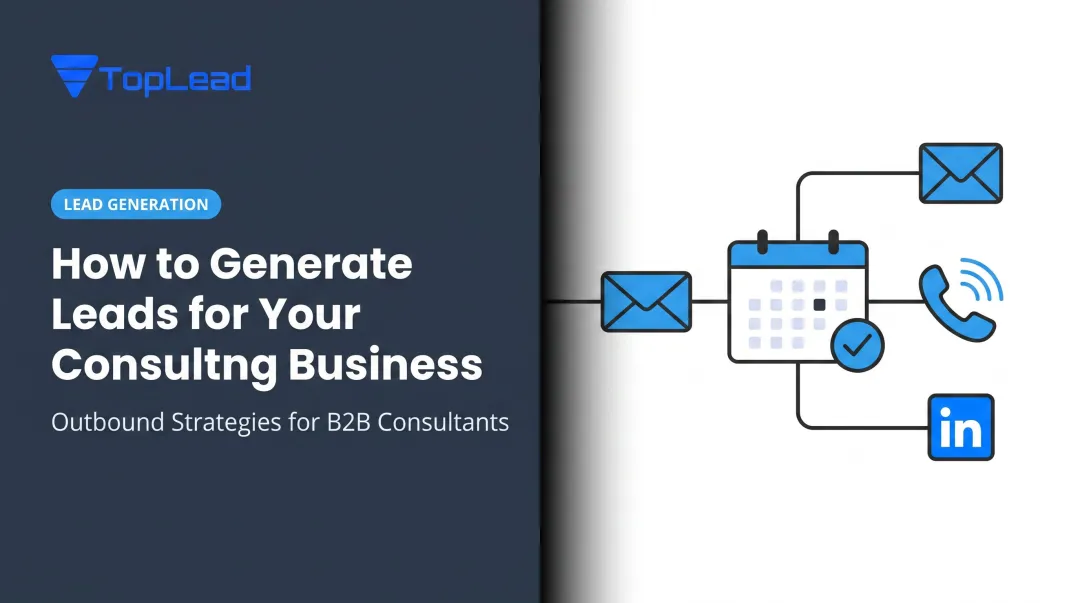
Build a short sequence across email, LinkedIn and phone, with different messages for project, retained, fractional, outsourced and PEO-related offers.
Protect compliance and buyer trust
Cold outreach carries rules. The FTC says CAN-SPAM has no B2B exception. It requires accurate sender information, a valid physical postal address, a clear opt-out and honoring opt-outs within 10 business days.
- Phone and text rules vary by channel; check Do Not Call, Telemarketing Sales Rule and TCPA guidance before launch.
- Verify state privacy requirements for your data.
- Never present a cold message as legal advice. Link to current government guidance and tell readers to confirm how a rule applies to them.
- Set suppression, do-not-contact, retention and consent procedures in your CRM.
Consider specialized appointment-setting support
If your ICP and offer are clear but prospecting capacity is thin, an appointment-setting partner can act as a virtual SDR team rather than a list vendor.
TopLead is one such provider. It has more than 15 years in B2B marketing, more than 25,000 appointments arranged, and U.S.-based multi-channel outreach across email, LinkedIn and phone.
It verifies decision-makers, integrates with CRMs, reports transparently, and works pay-per-appointment with reschedule or replacement terms and no long-term contract. You get qualified meetings, not guaranteed sales.
Evaluate any provider on:
- What counts as an accepted meeting
- Qualification standards
- Reporting and CRM access
- Rescheduling and replacement policy
- Contract flexibility
- Understanding of HR buyer roles
Convert Interest Into Pipeline With Offers, Nurture, and Sales Alignment
Build conversion-focused landing pages
Give each campaign one audience and one next step. Include:
- A headline tied to the buyer's trigger
- A clear scope statement
- Relevant proof and process details
- Short FAQs and a concise form
Ask only questions that improve routing: company size, locations, challenge, desired service, timing, decision role, and current HR setup.
Match the call to action to readiness:
- Checklist or workshop for early research
- Assessment for active problem-solving
- Consultation for high-intent prospects
For context, Unbounce's 2024 benchmark report puts median landing-page conversion at 6.6% across all industries. Don't treat that as your target.
Nurture and route leads based on intent
Segment follow-up by trigger, service model, industry, and stage. Send education, proof, and next-step guidance—not the same automated email to every lead.
Write down the marketing-to-sales handoff:
- Who responds, and how fast
- Meeting acceptance and no-show follow-up
- Discovery preparation
- Disqualification reasons
Then track each lead through held meeting, accepted opportunity, proposal, and engagement so you can see where the journey leaks. Plan for a long cycle; nurture programs commonly run three to six months.
Measure and Scale What Produces Revenue
Define the complete funnel
Track every stage that ties outreach to revenue:
- Accounts reached and responses
- Content conversions
- Booked and held meetings
- Accepted opportunities and proposals
- Wins, retained and project revenue
- Expansion and retention
Write a clear definition of a qualified opportunity. Include:
- Target-account fit
- Relevant trigger
- Accountable buyer
- Service alignment
- Timing and realistic capacity
Common frameworks such as BANT (budget, authority, need, timing) and MEDDIC can serve as a base.
Take benchmarks from your own CRM and reliable industry sources. No credible HR-specific benchmark exists for reply rates, meeting rates or outsourced appointment pricing, so don't borrow invented ones.
Review performance by segment and trigger
Compare channels, industries, buyer roles, service models, triggers and messages. You're looking for combinations that create commercial conversations, not cheap, low-fit inquiries.
- Hold regular marketing and sales reviews on opportunity quality, stage movement, objections, losses, revenue and retention.
- Use CRM data to find where leads drop: slow response or weak qualification.
- Fund the campaigns that earn it.
Scale carefully
Expand a winning audience-message-offer combination only after confirming consultant availability and a consistent qualification process.
Pause campaigns that attract job seekers, employee complaints or out-of-scope requests. Turn recurring objections into new content or offer tweaks.
Conclusion: Turn HR Consulting Demand Into a Repeatable Growth System
The sequence is simple:
- Pick the right account
- Find the timely trigger
- Show expertise
- Reach the accountable buyer
- Qualify the fit
- Tie activity to revenue
Your first step is small. Review recent clients by trigger, buyer, service model, source, revenue, and retention. Build the next campaign around the strongest repeatable pattern, rather than launching every channel at once.
Frequently Asked Questions
What does an HR consulting firm do?
The U.S. Census Bureau describes these firms as advising organizations on HR policies and practices, benefits, compensation, and wage administration. Many also offer workforce planning, employee relations, leadership support, and fractional or outsourced HR. Scope varies by provider.
What is the best marketing strategy for consulting firms?
No single channel wins. Combine a focused niche and trigger-based offer with authority content, professional networks, targeted outbound, strong proof, and measurement tied to qualified opportunities.
How do HR consulting firms generate qualified leads?
The strongest approaches are referrals and partnerships, search-driven content, LinkedIn thought leadership, webinars, trigger-based outreach and lead magnets. A qualification process then separates real business buyers from noise.
What makes a lead qualified for an HR consulting firm?
The company fits your ICP, has a relevant HR problem, and has an accountable decision-maker. Timing, service-model alignment, budget potential and your capacity to deliver must also line up.
Should an HR consulting firm outsource lead generation?
It can help when prospecting capacity is limited and the offer is repeatable. Require verified decision-makers, clear qualification criteria, compliant outreach, transparent reporting, CRM access and defined meeting or replacement terms.