Outsourcing lead generation gets framed as a cost-cutting move. That's a narrow way to look at it. The real impact shows up in pipeline quality, how your sales team spends its time, and whether your revenue forecast is something you can actually trust.
This article breaks down the practical, measurable benefits of outsourcing B2B lead generation — and explains when it produces meaningfully better outcomes than managing everything in-house.
Key Takeaways
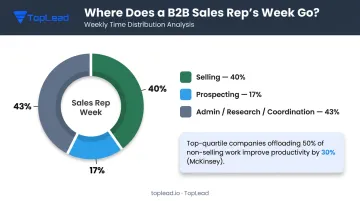
- Sales reps currently spend just 40% of their week actually selling, according to Salesforce — outsourcing lead gen reclaims the rest
- Outsourced teams handle prospecting, qualification, and outreach so your sales team focuses on converting deals
- You get immediate access to proven SDR expertise, multi-channel outreach systems, and qualification frameworks with no ramp time
- A pay-per-appointment model converts fixed overhead into predictable, performance-linked pipeline spend
- Results compound over a 3–6 month engagement — treat it as a partnership, not a one-time campaign
What Is Outsourced B2B Lead Generation?
Outsourced B2B lead generation means hiring an external team to handle prospecting, outreach, lead qualification, and appointment setting on behalf of your sales organization.
It covers the top and middle of the funnel — working through each stage before handing off sales-ready opportunities:
- Identifying and targeting the right accounts
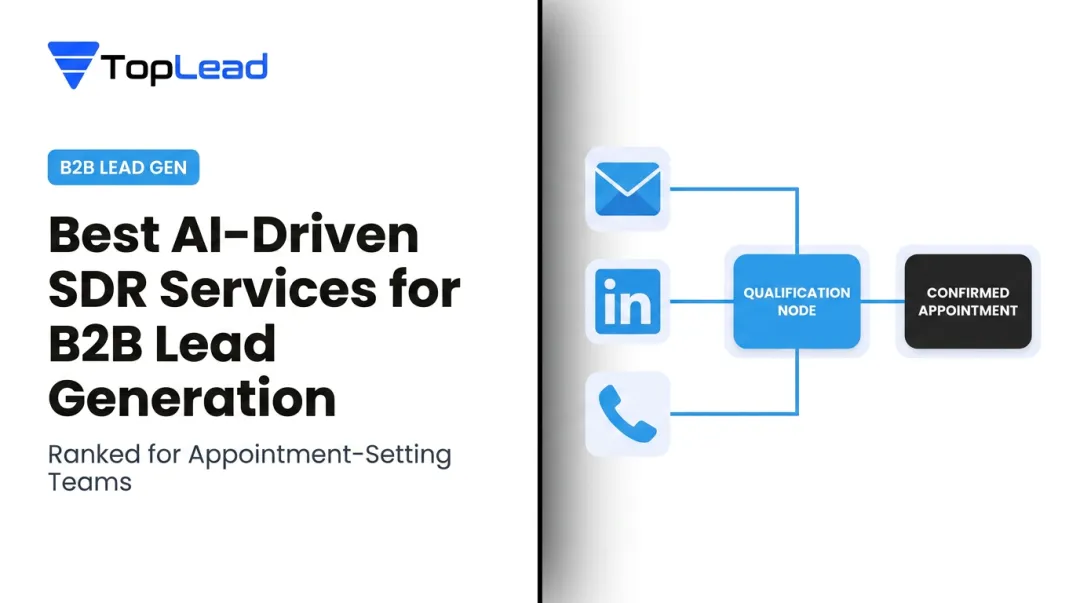
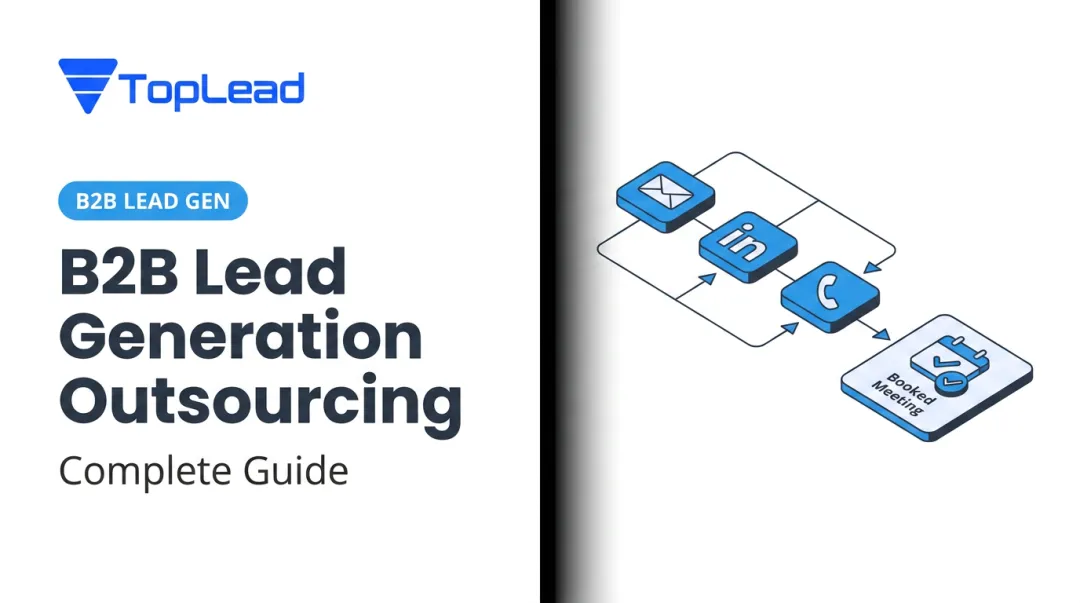
- Running multi-channel outreach across email, LinkedIn, and phone
- Qualifying prospects against your specific criteria
- Booking calendar-confirmed meetings with verified decision-makers
Your internal team receives those meetings ready to go.
The real value is a predictable, qualified pipeline your closers can act on immediately, built entirely without pulling them away from selling.
Key Benefits of Outsourcing B2B Lead Generation
The benefits below are organized around measurable operational impact: efficiency, pipeline quality, cost, and scalability. Each one maps directly to KPIs your leadership team tracks every quarter.
Your Sales Team Stays Focused on Revenue-Generating Activity
One of the most immediate effects of outsourcing lead generation is what it removes from your sales team's plate.
According to Salesforce's 2026 State of Sales report, reps spend just 40% of their week selling and only 17% prospecting — with the remaining time consumed by admin, research, and internal coordination. Nearly half of sales professionals say their teams lack the bandwidth for consistent cold outreach.
When prospecting is outsourced, a dedicated external team handles:
- Cold outreach across email, LinkedIn, and phone
- Follow-up sequences and objection handling
- Prospect qualification against your ICP
- Appointment scheduling with verified decision-makers
Your reps receive booked meetings — not raw leads they still need to chase down and pre-qualify.
Why this matters for pipeline: Sales reps who split their time between prospecting and closing tend to do both less effectively. McKinsey's 2023 research on sales productivity found that non-selling activities consume roughly two-thirds of the average sales team's time — and that top-quartile B2B companies who offload up to 50% of that non-selling work improve overall productivity by as much as 30%.
KPIs directly affected:
- Close rate
- Average sales cycle length
- Revenue per rep
- Quota attainment
When this benefit matters most: Companies where reps currently own their own prospecting, organizations scaling without adding headcount, and industries with complex multi-stakeholder sales cycles feel this the fastest.
Immediate Access to Proven Expertise and Multi-Channel Outreach Systems
Building an in-house SDR function from scratch takes longer and costs more than most growth-stage companies expect.
Consider what's involved: recruiting, onboarding, tool setup, messaging development, targeting refinement, and ongoing coaching. SDR ramp time typically runs 3–6 months before a new hire reaches consistent output.
Attrition compounds the problem. The Bridge Group reported 40–50% annual SDR attrition as a standard planning assumption — and the fully loaded cost of an in-house SDR grows quickly. Base salaries alone average $60,000, with OTE closer to $85,000 per rep, per RepVue's 2026 benchmarks, before accounting for benefits, tools, management, and data.
Outsourcing bypasses that ramp entirely.
A specialized agency with U.S.-based SDR teams brings:
- Pre-built outreach sequences refined across dozens of campaigns in your industry
- Verified decision-maker lists and targeting frameworks
- SDRs trained on qualification methodology (BANT, MEDDICC, or CHAMP, depending on your sales process)
- Multi-channel cadences across email, LinkedIn, and phone — already tested and optimized
TopLead, for example, deploys multi-touch outreach sequences across email, LinkedIn, and phone. Channel sequencing draws on 15+ years of campaign data and more than 25,000 appointments arranged across North America. When a cybersecurity MSP client assumed LinkedIn would underperform, three weeks of A/B testing showed LinkedIn InMail outperforming cold email 3:1 for their vertical — the kind of insight that takes months to surface when building from scratch.
KPIs directly affected:
- Cost per qualified lead
- Lead-to-meeting conversion rate
- Time to first appointment
- SDR ramp time (effectively zero)
When this benefit matters most: Companies entering new markets, launching new products, or recovering from inconsistent in-house lead gen results — and businesses that lack the management bandwidth to recruit and coach an SDR team.
Scalable, Predictable Pipeline Without the Fixed Overhead
In-house lead generation is a fixed cost structure: salaries, benefits, tools, and management whether the pipeline is full or empty. Outsourcing converts that into a more flexible, performance-linked model.
With a pay-per-appointment structure built for American mid-market sales teams, you're paying for confirmed meetings with qualified prospects, not activity logs or contact lists. TopLead's standard packages guarantee a minimum of 4–6 qualified appointments per month at $300–$350 per lead, with a reschedule or replacement guarantee if an appointment doesn't meet quality standards.
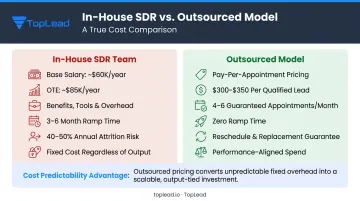
That cost predictability changes how you plan.
When you know your cost per qualified appointment and the minimum monthly volume, you can model pipeline growth and revenue projections with real numbers. Only 7% of sales organizations achieve forecast accuracy above 90%, according to Gartner data cited by Demand Gen Report — and unreliable pipeline input is a leading cause.
Outsourcing also absorbs fluctuations that would disrupt an in-house team:
- Campaign demand shifts based on market conditions
- Hiring freezes that would otherwise stall prospecting
- Seasonal or cyclical swings in lead volume needs
KPIs directly affected:
- Cost per lead
- Pipeline velocity
- Lead volume consistency
- Marketing-to-sales handoff rate
When this benefit matters most: Growing businesses that need to scale pipeline without committing to headcount, and companies in seasonal or cyclical markets where lead gen demand fluctuates quarter to quarter.
What Happens When Lead Generation Is Left to an Overstretched In-House Team
When prospecting gets added to a sales or marketing team's existing workload without dedicated resources or a structured process, the results tend to follow a predictable pattern.
- Outreach turns sporadic: Prospecting competes with active deals, customer calls, and admin work. Volume drops, sequences break, and follow-up falls through the cracks.
- Lead quality deteriorates: Without a structured qualification process, meetings get booked with contacts who lack budget or authority. Reps spend call time re-qualifying prospects who should have been screened before the meeting was ever scheduled.
- Pipeline becomes reactive: Strong months get followed by dry spells as the team oscillates between closing active deals and scrambling to rebuild the top of the funnel. Revenue forecasting suffers — not because the product is weak, but because the input is inconsistent.
For growing companies, the real bottleneck is rarely product quality or sales team skill. It's the inability to keep a steady stream of qualified opportunities entering the funnel — and that's precisely where outsourcing changes the equation.
How to Get the Most Value from Your Outsourced Lead Generation Partnership
Outsourcing works best when the agency functions as an extension of your team — not a vendor operating in isolation.
Set them up with the right inputs from day one:
- A specific, defined ICP (firmographics, decision-maker titles, company size, buying triggers)
- Your core value proposition and the business problems you solve
- Competitive positioning and common objections your reps encounter
- Feedback from recent sales conversations that reveal what's resonating
Track the right metrics from the start. Lead volume is a lagging indicator. The KPIs that actually predict revenue are show rate, qualified appointment rate, and pipeline conversion — not the number of emails sent.
Plan for a 3–6 month optimization cycle. The first month establishes baseline data. Months two and three refine targeting and messaging based on what's converting. By months four through six, the campaign runs on validated sequences with tighter qualification filters. Results compound as targeting and messaging sharpen.
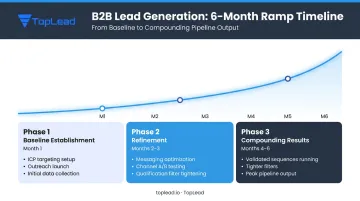
TopLead's campaign model is built around this lifecycle: CRM-integrated reporting (Salesforce, HubSpot, Pipedrive, and others), weekly performance reviews covering booked meetings, show rates, and attribution data, and continuous refinement of messaging based on what the pipeline is telling you.
The strongest outsourced lead gen partnerships function as a specialized SDR team embedded in your sales operation, accountable to the same revenue outcomes your closers are chasing.
Conclusion
Outsourcing B2B lead generation produces three compounding outcomes as the program runs:
- Your sales team closes more deals because they spend less time prospecting
- Your pipeline grows more consistently because specialists are running structured, multi-touch outreach
- Your cost per qualified opportunity drops over a 3–6 month campaign as targeting sharpens
Outsourcing doesn't displace your team. It removes the friction of building outreach capability from scratch while you're simultaneously trying to hit quarterly targets — so your closers spend their time closing. If you're evaluating whether a structured appointment-setting program fits your pipeline goals, TopLead delivers 4–6 qualified, decision-maker-verified appointments per month with no long-term contracts required.
Frequently Asked Questions
Why is B2B lead generation important?
Lead generation is the foundation of B2B revenue growth. Without a consistent flow of qualified prospects in the pipeline, even the strongest sales teams have nothing to close. It's the single most critical input to hitting growth targets.
What is the rule of 7 in B2B?
The rule of 7 refers to the idea that prospects need repeated exposure to your brand before taking action. Current research from RAIN Group puts the average at 8 touchpoints to secure an initial meeting. Specialized agencies use multi-touch, multi-channel sequences specifically because single outreach attempts rarely convert.
What are the 4 C's of B2B marketing?
The 4 C's — Customer, Cost, Convenience, and Communication — reframe traditional marketing around buyer needs. Outsourced lead generation aligns directly with this: it focuses on reaching the right customer with relevant messaging at the right time, targeting verified decision-makers instead of generic contact lists.
What is the difference between in-house and outsourced B2B lead generation?
In-house requires building and managing your own SDR team — with full hiring overhead, ramp time, tool costs, and ongoing management. Outsourcing provides immediate access to trained specialists, proven outreach processes, and performance accountability without the fixed internal cost structure.
How do I choose the right B2B lead generation agency?
Focus on five criteria: industry experience, lead qualification process, transparency in reporting, pricing model (especially whether performance-based options are available), and whether they integrate with your existing CRM and sales workflow.
What results can I realistically expect from outsourcing B2B lead generation?
A well-run outsourced program delivers a predictable volume of qualified appointments with verified decision-makers each month. Results improve over a 3–6 month period as targeting and messaging are refined. Most programs hit their stride around month three as the campaign data matures.