Introduction
Selling PEO services is genuinely hard. The value proposition is strong—payroll, compliance, benefits, and HR all bundled under one roof—but your prospects are skeptical, stretched thin, and most already have something in place. NAPEO's 2024 tracking survey found that 33% of business decision-makers already use a PEO, while 54% outsource payroll and 60% outsource health insurance benefits. You're not selling into an untapped market. You're displacing whoever they're already using.
That makes the competitive math brutal: roughly 510 PEOs are competing for the same 230,000+ client businesses nationwide. A great pitch isn't enough. What separates growing PEOs from stagnant ones is a deliberate acquisition system built for displacement selling.
If you're a PEO sales leader, marketing director, or growth executive, this guide gives you a practical framework—covering ICP definition, pipeline development, referral activation, and performance measurement.
Key Takeaways
- Know your ICP precisely before prospecting—targeting the wrong size, industry, or decision-maker wastes pipeline budget
- Outbound is non-negotiable—SMB owners rarely search for a PEO, so you must reach them proactively
- Referral and broker partnerships deliver the highest ROI and lowest cost per close of any acquisition channel
- Track CAC, pipeline velocity, and close rate to pinpoint funnel leaks and prioritize where to invest
Why PEO Client Acquisition Is More Complex Than Standard B2B Sales
Most B2B sales involve selling a product or service. PEO sales involve convincing a business owner to co-employ their workforce with you. That's a different conversation entirely.
Co-employment agreements, multi-service bundles, and long-term contractual commitments mean prospects do more due diligence and take longer to decide. For context, 6sense reports the average B2B buying cycle runs 10.1 months—and PEO deals, with their compliance complexity and benefit plan transitions, can push well past that for mid-market prospects.
You're Usually Displacing Someone
The bigger challenge is competitive density. Most prospects already have:
- A payroll provider (ADP, Paychex, Gusto)
- A benefits broker handling health insurance
- An incumbent PEO they're lukewarm about
PEO sales is rarely about creating awareness from scratch. You're proving the switching cost is worth it — which means qualifying for pain and fit early, before you've invested in three demos and a proposal.
That shifts the entire acquisition approach. Wide-net prospecting burns resources. Tighter ICP targeting, trigger-based outreach, and displacement-focused messaging deliver better returns at every stage of the funnel.
Define Your Ideal PEO Client Profile First
Skipping ICP definition is the number one reason PEO pipelines stall. Reps spend time on companies that are too small, too large, in high-risk industries, or simply not ready to change. Every hour spent on a bad-fit prospect is an hour not spent on one that would close.
The Core ICP Variables
Company size: NAPEO's 2025 client analysis shows 50% of PEO clients have 10–49 employees, with penetration highest among 50–99 employee firms at 15%. The practical sweet spot for most PEOs is 20–150 employees—large enough to value bundled HR, small enough to lack a full internal team.
Industry vertical: Nearly half of all PEO clients fall into four sectors: professional/scientific/technical services, construction, healthcare, and manufacturing. Professional services alone accounts for 19% of all PEO clients. Among 20–499 employee businesses, information companies show 38% PEO penetration. Start campaigns where adoption already clusters.
Geography: Florida, California, New York, and Texas hold slightly more than half of all PEO clients. Hawaii leads in penetration at 50% among 20–499 employee businesses, followed by Florida at 45% and Utah at 38%.
Growth trajectory: A company actively hiring is a far better prospect than one with flat headcount. Hiring creates the exact pain PEOs solve.
The Trigger Event Framework
Static demographic lists—filtered by size and industry alone—produce mediocre results. The higher-value approach layers in trigger events:
- Rapid hiring — new job postings and LinkedIn headcount growth signal immediate need
- Recent funding round (capital injected, team scaling imminent)
- Benefits renewal season, typically 60–90 days before a policy renews
- New office or location opening
- Compliance incidents: an OSHA issue, misclassification concern, or pending audit
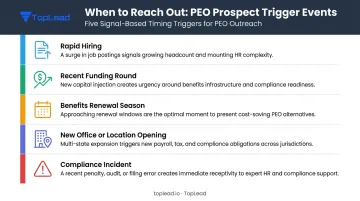
Trigger-based outreach reaches prospects when their pain is acute—and acute pain is what gets a meeting booked.
Decision-Maker Mapping
Knowing when to reach out only matters if you're reaching the right person. In companies with under 50 employees, the buyer is typically the CEO or founder. Above 50–100 employees, the decision shifts toward a VP of HR, COO, or CFO. Reaching the wrong person doesn't just slow a deal—it can kill it entirely if that person lacks authority or incentive to champion the change.
Your ICP document should specify decision-maker title by company size band, and your outreach sequences should be tailored accordingly.
Outbound Prospecting Strategies That Drive PEO Pipeline Growth
The SMB owner you want to reach isn't browsing comparison sites or downloading PEO guides. They're dealing with payroll issues on Friday afternoon. Inbound alone can't build a predictable pipeline—outbound is non-negotiable.
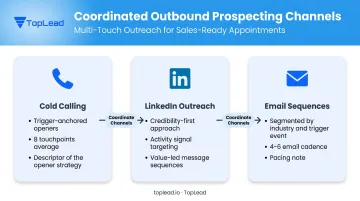
The key is coordinating channels rather than running them in isolation.
Cold Calling for PEO
Calls should be short, specific, and trigger-anchored. A useful opener: "We work with companies your size that just crossed 15 employees and found their payroll setup wasn't keeping pace with compliance—does that sound familiar?"
That framing does three things: establishes relevance, names a pain, and invites a yes/no response rather than a pitch-defense reflex.
On cadence: RAIN Group research shows it takes an average of 8 touchpoints to generate a conversion, while top performers average 5. Don't mark a prospect unresponsive after one or two attempts.
LinkedIn Outreach
LinkedIn works best for PEO when used to build credibility before asking for time. Use company size and job title filters to identify decision-makers, then look for activity signals—recent job posts, company announcements, or role changes.
Message sequences should lead with value. Effective openers include:
- A recent compliance update relevant to their state or headcount
- A benchmarking insight tied to their industry
- A direct question about their current HR or payroll setup
Save the meeting ask for after you've established relevance. Once that's done, email sequences let you scale the same logic across entire prospect segments.
Email Sequences
Generic mass sends rarely move the needle. Segmented sequences—organized by industry vertical and trigger event—do. A 4–6 email sequence tailored to, say, a construction firm approaching benefits renewal will outperform a generic "we help businesses like yours" template every time.
Subject lines that reference a specific trigger ("Your Q4 benefits renewal—two options worth comparing") outperform generic subject lines. Case study snippets—especially from the same industry—can meaningfully lift reply rates.
Appointment Setting as a Scalable Alternative
Building an in-house SDR team means hiring at $45,000–$60,000+ per rep annually, absorbing a 90-day ramp period, and managing consistent performance thereafter. When a rep leaves, you start over.
For PEO firms that want to accelerate pipeline without that overhead, a specialized appointment-setting partner can deliver pre-qualified, decision-maker-verified meetings directly into the calendar—no ramp period, no attrition risk.
TopLead, a U.S.-based appointment-setting agency, has arranged 25,000+ appointments for companies across the country, including Insperity and other firms in the PEO and HR outsourcing space. Their multi-channel model combines email, LinkedIn, and phone under a pay-per-appointment structure: 4–6 qualified leads per month at an average cost of $300–$350 per lead, with no long-term contracts required.
Building a Referral and Broker Partner Channel
Outbound builds pipeline fast. Referral channels build it sustainably. A referred prospect arrives with built-in trust, requires less education, and closes faster. HBR and Wharton research found referred customers carry 16% higher lifetime value and are 18% less likely to churn—directionally strong evidence even if not PEO-specific.
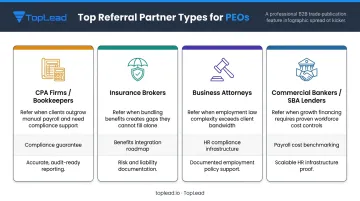
The Best Referral Sources for PEOs
| Partner Type | Why They Refer | What They Need from You |
|---|---|---|
| CPA firms / bookkeepers | Serve the same SMB base, trusted on financial decisions | Easy referral process, prompt follow-up, no poaching |
| Insurance brokers | Natural complement to PEO benefits bundling | Clear commission structure, co-branded materials |
| Business attorneys | Involved at formation and growth inflection points | Compliance credibility, fast response for clients |
| Commercial bankers / SBA lenders | Growth-stage clients need HR infrastructure | Simple introductions, no complexity on their end |
These partners refer when it's easy and safe to do so. Complicated submission processes, unclear economics, or fear of client conflict kills referral programs before they start.
Operationalizing the Partner Program
Informal referral relationships produce sporadic results. A formal program produces consistent volume. That means:
- Defined referral fees or revenue-share (documented, not verbal)
- Simple one-page submission process
- Co-branded materials the partner can share without customizing
- Regular touchpoints: quarterly business reviews, partner newsletters, joint webinars
Those operational basics matter most to insurance brokers. PEO Insider's May 2024 broker perspective notes that insurance brokers and consultants want clarity on census data, plan summaries, invoices, and sales force conflict before they'll refer clients. Address those concerns explicitly in your partner onboarding.
Current Clients as a Referral Engine
Your best advocates are clients who've experienced a specific win—their first clean benefits enrollment, a compliance issue resolved, a successful new-hire onboarding. That's the moment to ask—not passively at the end of a routine check-in.
A structured ask outperforms "let us know if you know anyone." Reach out directly, describe the type of company you're looking for, and make it easy to send an introduction. Reward referrals with something meaningful:
- Gift cards or account credits
- A charitable donation in their name
- A handwritten note alongside a tangible thank-you
Measuring and Optimizing Your PEO Client Acquisition Funnel
Most PEO sales teams track activity metrics — calls made, emails sent — without connecting them to the funnel stages that show where deals are actually won or lost. That disconnect is where growth stalls.
The Core Metrics to Track
- Qualified leads generated per month — the top-of-funnel health indicator
- Lead-to-meeting conversion rate — reveals outreach effectiveness
- Meeting-to-proposal rate — reveals discovery and qualification quality
- Proposal-to-close rate — reveals competitive positioning and pricing alignment
- Average sales cycle length — longer cycles signal complex ICPs or poor timing
- Customer acquisition cost (CAC) — fully loaded sales and marketing cost divided by new clients signed
- Average WSE count per new client — tracks revenue quality, not just client count
Together, these metrics show where the funnel leaks. A low meeting-to-proposal rate means your discovery process needs work. A low proposal-to-close rate usually means a positioning or pricing problem.
The CAC-to-LTV Framework
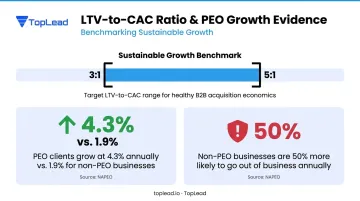
PEO contracts are long-term by nature. A client who stays three to five years generates far more revenue than the cost to acquire them — but only if you hold the relationship. HubSpot notes that SaaS companies commonly target a 3:1 to 5:1 LTV-to-CAC ratio as a baseline for sustainable growth.
That benchmark applies directly to PEO. Your actual LTV depends on WSE count, gross margin per WSE, and retention rate — which means improving any one of those levers compounds over time.
NAPEO data provides useful supporting evidence: PEO clients grow at 4.3% annually versus 1.9% for non-PEO businesses, and non-PEO businesses are 50% more likely to go out of business annually. Longer-lived, faster-growing clients mean higher realized LTV—which justifies meaningful CAC investment per new client.
Closed-Won and Closed-Lost Analysis
Run this review monthly. The questions that matter:
- What triggered this prospect to start the evaluation?
- Who was the actual decision-maker, and who influenced them?
- What objections came up, and were they addressed effectively?
- What attributes do closed-won deals share that lost deals don't?
Once patterns emerge across 10–15 deals, update your ICP criteria and outreach messaging to reflect what actually closes — then stop investing time in the prospect segments that consistently drop off without converting.
Frequently Asked Questions
What does PEO stand for in acquisition?
In sales and growth contexts, "PEO client acquisition" refers to how Professional Employer Organizations attract and sign new business clients—not mergers or corporate acquisitions. Here, it means winning new PEO service clients through outbound outreach, referrals, and structured sales processes.
What is the client acquisition process for a PEO?
The typical stages run: ICP-based prospecting → multi-touch outreach → discovery call → needs assessment → proposal and pricing → close and onboarding. The process is longer than most B2B services due to the co-employment structure, compliance review requirements, and benefits plan transition logistics.
How long is a typical PEO sales cycle?
Small businesses (under 25 employees) can move in 4–8 weeks when there's a clear trigger. Mid-market deals (50–500 employees) often run 3–6 months or longer, especially when an incumbent provider is involved or benefits renewal timing doesn't align. Decision-maker accessibility is the single biggest variable.
What industries are the best targets for PEO client acquisition?
Professional services, technology and SaaS startups, healthcare-adjacent businesses, construction, and manufacturing are the highest-value verticals. NAPEO data shows professional/scientific/technical services accounts for 19% of all PEO clients, while information companies show 38% penetration among 20–499 employee firms. Prioritize companies actively hiring—growth-stage headcount is the clearest signal that HR pain is acute enough to drive a decision.
Should PEO sales teams build an in-house SDR function or outsource prospecting?
In-house SDR teams offer control and brand alignment but carry real costs: roughly 90 days to baseline productivity, plus ongoing management and retention overhead. Outsourced specialists with PEO-specific experience can accelerate pipeline, particularly for firms testing new markets or managing fixed headcount budgets.
What is a realistic cost per qualified lead for PEO client acquisition?
Referral-sourced leads carry the lowest cost per close. Cold outbound through a specialized partner typically runs $300–$350 per qualified appointment, based on TopLead's benchmarks across PEO and HR outsourcing campaigns. Always evaluate cost per lead against client lifetime value—channel economics look very different once you factor in average contract size.