The Manual Outreach Problem Is Costing B2B Teams More Than They Realize
Sales reps spend 60% of their time on non-selling tasks — admin work, list research, CRM updates, follow-up coordination. That leaves less than half their week for actual conversations with buyers.
The problem compounds when you factor in what buyers now expect. 76% of B2B decision-makers get frustrated when outreach feels generic or irrelevant, yet most outbound processes are still built on static lists, manual prioritization, and templated sequences that treat every prospect the same.
The result: reps work long hours, pipeline stays unpredictable, and senior buyers disengage before a real conversation ever happens.
AI is changing that — not by automating what already exists, but by rethinking how outreach gets built and prioritized in the first place. This article covers how AI is reshaping the core mechanics of B2B appointment setting, where human expertise remains non-negotiable, and how to measure whether it's moving your pipeline.
Key Takeaways
- AI handles lead scoring, outreach sequencing, and scheduling so reps spend more time in real conversations
- The biggest gains come from detecting real-time buyer intent, not just sending more messages faster
- Qualification conversations, objection handling, and decision-maker verification still require skilled human SDRs
- The strongest results combine AI-driven targeting with human-led follow-through when a prospect signals genuine interest
- Track held meeting rate, meeting-to-opportunity conversion, and cost per qualified meeting — not just volume metrics like emails sent
What AI in B2B Appointment Setting Actually Means
AI appointment setting uses artificial intelligence to handle lead scoring, outreach sequencing, scheduling, and follow-up — without requiring manual input at each step. That distinction matters. Traditional automation runs fixed drip sequences on a timer. AI adapts based on prospect behavior and real-time data.
A prospect who visits your pricing page twice in a week gets treated differently than one who opened a single email three months ago. That behavioral logic is what separates AI-powered outreach from a static cadence tool, driven by what the prospect actually did rather than when a timer happens to fire.
What Problem This Actually Solves
Most B2B outbound programs run on three things that don't scale well:
- Static contact lists that decay quickly (roles change, companies grow, priorities shift)
- Gut-feel prioritization — reps decide who to call based on incomplete information
- Manual tracking of every touchpoint across email, phone, and LinkedIn
AI replaces the guesswork with behavioral scoring and trigger-based logic. It routes the right message to the right prospect at the moment they're most likely to respond — not based on when a timer fires, but based on what the prospect actually did.
The AI Stack: Tools by Function
AI in appointment setting spans several distinct categories:
- Lead intelligence: ZoomInfo, Apollo, and Seamless.AI pull verified contact data and enrich records before outreach begins
- Intent data: Demandbase and Bombora surface prospects actively researching solutions in your category
- Sequencing platforms: Outreach, Salesloft, and Lemlist adjust cadence timing and messaging based on how prospects engage
- Scheduling tools: Calendly and Chili Piper eliminate back-and-forth by letting qualified prospects book directly
- CRM analytics: HubSpot and Salesforce tie it together with pipeline visibility and performance reporting
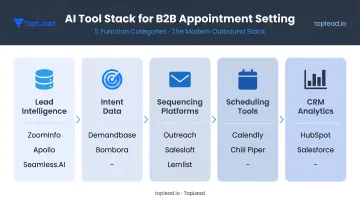
Most teams use a combination of these. The smarter move is to identify which function is actually broken — targeting, sequencing, scheduling, or measurement — before evaluating tools. That focus prevents overbuilding a stack that creates complexity without results.
How AI Is Reshaping the Core Functions of B2B Appointment Setting
Smarter Lead Identification: From Static Lists to Behavioral Signals
Traditional targeting starts with a list. AI-powered targeting starts with behavior.
Platforms like Demandbase operationalize this through behavioral scoring: a demo request might carry 50 points, a pricing page view 40, a whitepaper download 30. Prospects above an 80-point threshold are treated as hot leads; careers page visits trigger negative scoring.
The result is a dynamic priority queue that reflects actual buying intent, not job titles pulled from a database six months ago.
The signals AI monitors go well beyond website visits:
- Email open and click patterns
- Content download history
- LinkedIn activity and connection requests
- Company hiring patterns (a sudden surge in HR headcount often signals a PEO evaluation)
- Repeat engagement with specific pages or topics
By the time a rep reaches out, the prospect has already shown intent. That changes the entire dynamic of the first conversation — the rep isn't starting from zero, they're following up on demonstrated interest.
Personalized Outreach at Scale Without Sacrificing Quality
Name-insertion is not personalization. AI-powered sequencing tools adjust the message angle, subject line, call-to-action, and tone based on persona, industry, funnel stage, and behavioral history simultaneously.
B2B sellers using AI to craft outreach see an average 28% increase in buyer response rates, according to LinkedIn. The gap between expectation and execution is wide — Salesloft's benchmark data found that personalization averaged only 10–14% across 20 industries, meaning most outreach still misses the mark.
The real B2B advantage is maintaining persona distinctions at scale. AI tools hold those distinctions across hundreds of active sequences simultaneously — a CFO message looks nothing like an HR Director message:
- CFO at a financial services firm: cost predictability, compliance exposure, financial visibility
- HR Director at a mid-market SaaS company: employee experience, administrative overload, retention
Multi-channel coordination compounds the effect. AI orchestrates email, LinkedIn, and phone in a sequenced funnel — warming prospects through content touchpoints before a rep picks up the phone. McKinsey reports B2B buyers now use an average of 10 interaction channels, up from five in 2016. Covering those channels is no longer a differentiator — it's a baseline expectation.
Automated Scheduling and Show-Rate Protection
Back-and-forth calendar negotiation kills momentum. AI scheduling assistants eliminate it by syncing directly with rep calendars, surfacing live availability the moment a prospect responds positively. The prospect picks a time, the meeting confirms, both parties get reminders — no manual coordination required.
Show-rate protection matters just as much as booking.
Industry data from Chili Piper puts the standard sales no-show rate at 20%, but with automated, personalized reminders sent via email or SMS in the days and hours before a meeting, that figure drops below 5%.
The best reminder systems also give prospects a frictionless path to reschedule rather than simply ghost. That one design choice recovers meetings that would otherwise be lost entirely.
Where Human Expertise Still Drives Results
AI can identify who to reach and when. It cannot conduct a real qualification conversation.
For complex B2B sales — financial services, PEO, insurance, SaaS — the prospect needs to feel understood, not just prospected. That requires a skilled human on the other end of the line. Gartner predicts that by 2030, 75% of B2B buyers will prefer sales experiences that prioritize human interaction over AI — a signal worth taking seriously when building outreach programs today.
The Critical Handoff Moment
The instant a prospect sends a substantive reply, asks a specific question, or signals genuine interest, a human rep must step in immediately. Continuing with automated responses at that moment is one of the most common and costly mistakes in AI-powered outreach. The prospect has moved from passive to active — the process needs to match that shift.
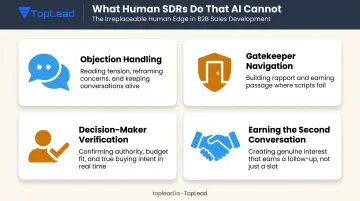
What Human SDRs Do That AI Cannot
Skilled SDRs handle specific tasks that don't reduce to pattern recognition:
- Objection handling — reading tone and hesitation in real time, adjusting the conversation accordingly
- Gatekeeper navigation — building credibility with assistants and coordinators who control access
- Decision-maker verification — confirming budget authority, genuine need, and timeline through dialogue, not just matching job titles
- Earning the second conversation — building enough credibility in the first call to make a follow-up welcome, not an intrusion
TopLead combines data-driven targeting and multi-channel outreach with U.S.-based trained SDRs who apply BANT, MEDDICC, and CHAMP frameworks to verify decision-maker status before any appointment is confirmed. Over 25,000 appointments arranged across financial services, insurance, and SaaS show what AI-assisted targeting paired with rigorous human qualification actually produces.
One mid-market SaaS firm doubled reply rates, increased meetings booked by 80%, and shortened the sales cycle by nearly two weeks — the result of shifting from volume-driven prospecting to fit-first engagement.
The Risks of Going All-In on AI Without Human Oversight
The Volume Trap
AI makes it easy to send more outreach faster. More volume without better targeting usually means more spam complaints, more unsubscribes, and damaged sender reputation. Google requires bulk senders to keep spam complaint rates below 0.10% — 0.30% is the threshold where deliverability breaks down significantly. Validity's 2025 benchmark data found that inbox placement for business services already sits at 76.7%, meaning roughly one in four legitimate emails never reaches the inbox even before complaint rates become a problem.
Brand Risk in Senior B2B Buying
Automated messages that miss the tone or context expected by senior buyers can permanently damage credibility with a prospect. Decision-makers at enterprise and mid-market companies remember a tone-deaf email — and they talk to peers. One bad sequence can close a door that takes years to reopen.
That reputational damage compounds fast. TopLead has worked with US clients who came in after previous vendors ran 1,000+ unsegmented emails per week with no human review, resulting in domain reputation damage and zero booked calls. Rebuilding from that position takes time and direct cost.
Quality Erosion in Complex Sales
In financial services, healthcare, or enterprise technology, relationships and trust are prerequisites for a sale. AI that optimizes for booking velocity rather than meeting quality fills calendars with low-intent conversations that waste AE time and distort pipeline forecasts.
High meeting volume means nothing without downstream conversion. Watch for these warning signs that quantity is overtaking quality:
- No-show rates above 30-40% across booked meetings
- Meetings with contacts outside the actual buying committee
- Pipeline contributions that don't materialize past the first call
- AEs reporting meetings as unqualified after attending
A calendar full of low-intent conversations isn't a growth signal — it's a measurement gap.
How to Measure Whether AI-Powered Appointment Setting Is Delivering ROI
Tracking emails sent, sequences launched, and meetings booked tells you how active your program is. It doesn't tell you whether it's generating revenue. The metrics that matter sit further down the funnel.
The Three Metrics That Matter
| Metric | What It Measures | Why It Matters |
|---|---|---|
| Held meeting rate | Percentage of booked meetings that actually take place | Reveals show-rate health and whether prospects are genuinely engaged |
| Meeting-to-opportunity conversion | Held meetings that advance to qualified pipeline | Indicates whether targeting and qualification are aligned with your ICP |
| Cost per qualified meeting | Total program cost divided by meetings generating a real opportunity | Confirms whether program economics make sense at your average deal size |
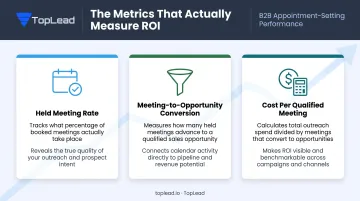
Gartner found that 47% of sales leaders say analytics have less influence on performance than executive leadership desires — largely because teams report on activity rather than outcomes. Shifting to outcome-based reporting is what closes that gap.
A Practical Review Cadence
Structure reviews at three intervals:
- Weekly — Review activity and held meeting rates to catch quality issues before they compound
- Monthly — Review meeting-to-opportunity conversion to assess whether targeting and messaging match your actual ICP
- Quarterly — Compare cost per opportunity against average deal size to confirm the program makes financial sense
Good reporting at each interval should tie directly to pipeline outcomes. That means CRM-synced data covering contacted versus replied rates, booked meetings, call show rates, and channel attribution (LinkedIn versus email) — not just top-of-funnel activity counts. TopLead builds this reporting layer into every program, giving clients visibility into what's working at each stage before problems compound.
Frequently Asked Questions
Can AI fully replace human SDRs in B2B appointment setting?
No. AI handles targeting, sequencing, and scheduling well, but it can't manage nuanced objection handling or the trust-building complex B2B deals require. Human SDRs remain essential the moment a prospect signals genuine interest and needs to feel understood, not just prospected.
What types of AI tools are used in B2B appointment setting?
The main categories are lead intelligence platforms (ZoomInfo, Apollo), intent data providers (Demandbase, Bombora), AI-powered sequencing tools (Outreach, Salesloft), automated scheduling assistants (Calendly, Chili Piper), and CRM-integrated analytics. Most teams use a combination rather than a single unified platform.
How does AI improve lead qualification in B2B sales?
AI scores leads based on behavioral signals (pricing page views, content downloads, email engagement) and firmographic fit, helping SDRs focus on prospects actively researching solutions. Human reps still need to confirm budget, authority, and timeline through direct conversation before locking in a meeting.
How long does it take to see results from AI-powered appointment setting?
Initial meetings typically appear within the first 30 days as data accumulates and sequences launch. Meaningful optimization — better lead scoring accuracy, improved reply rates, consistent meeting quality — usually takes 60–90 days as the system learns from real audience response and messaging gets refined.
What is the biggest risk of relying too heavily on AI for appointment setting?
Prioritizing booking volume over meeting quality. This fills calendars with low-fit prospects, wastes AE time, and in complex B2B verticals, can permanently damage relationships with senior buyers who remember tone-deaf outreach.