Introduction
Picture this: an SDR spends three days qualifying a prospect — multiple calls, tailored emails, a LinkedIn exchange. The prospect is engaged, the pain is real, and they've agreed to a demo. The SDR books the meeting, sends a quick Slack to the AE, and considers it a win.
Then silence. The AE follows up two days later with a generic opener, and the prospect — now cold — doesn't remember why they agreed to talk. The deal dies.
This scenario plays out across B2B sales teams every week. Forrester research found that companies with a formal lead handoff stage generate 9.3 closed/won deals per 1,000 inquiries — compared to just 4.6 without one. That's a 2x performance gap tied directly to handoff quality.
This article breaks down exactly what a high-conversion SDR to AE handoff requires — from the information that needs to transfer, to the process steps that keep deals moving, to the metrics that tell you whether your handoff is working or leaking revenue.
Key Takeaways
- A broken handoff kills momentum, context, and trust — exactly what prospects need to keep moving forward
- Every handoff needs a structured brief covering who the prospect is, what they care about, and what was already promised to them
- AEs should follow up within minutes of receiving a handoff — speed matters as much here as it does on a cold call
- High-converting handoffs run on standardized briefs, clean CRM records, and consistent SDR-AE feedback loops
What Is the SDR to AE Handoff and Why Does It Break Down?
The SDR to AE handoff is the moment a qualified prospect transfers from a Sales Development Representative to an Account Executive. SDRs focus on prospecting and qualification. AEs own discovery, negotiation, and closing. The roles are intentionally separate — one builds pipeline volume, the other converts it.
A clean transition keeps deals moving. A broken one stalls them, and the damage adds up fast.
Why Handoffs Fail
The breakdown almost always comes down to one of four problems:
- Missing context: The AE receives a calendar invite but no background on why the prospect agreed to meet
- Delayed follow-up: Hours pass between handoff and first AE contact, and the prospect loses interest
- Incomplete CRM records: Notes aren't logged, so the AE walks into the call blind
- Repeated questions: The prospect is asked to re-explain their situation — a fast trust-killer
That last point matters more than most teams realize. Salesforce research found 47% of business buyers said they'd work with an AI agent instead of a person specifically to avoid repeating themselves.
The Business Cost
A broken handoff isn't just frustrating — it's expensive. Every stalled handoff represents:
- Wasted SDR effort and outreach spend
- An inflated cost-per-acquisition with nothing to show for it
- Pipeline that looks full but isn't moving
Those costs compound at the pipeline level. Forrester found that sales acceptance of marketing-sourced leads sits at just 42% in organizations with an established handoff stage, compared to 85%+ among aligned teams. That 43-point gap is recoverable — but only with a structured process.
The SDR Handoff Brief: What to Include Before the Transfer
The handoff brief is the single most important element of any SDR to AE transition. It's a documented summary the AE reviews before their first interaction, so they walk in ready to advance the deal rather than re-qualify from scratch.
Core Components of a Strong Handoff Brief
| Component | What to Include |
|---|---|
| Prospect identity | Full name, title, company, industry, company size |
| Pain points & trigger | What problem they're solving and why now |
| Engagement history | Calls made, emails exchanged, content viewed, prior touchpoints |
| Decision-making context | Other stakeholders, timeline, budget status |
| Objections & concerns | Any hesitations, competing solutions, red flags |
| Confirmed next steps | Meeting date/time, what was promised, what the AE should prepare |
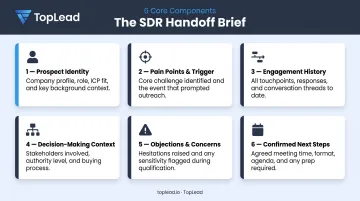
Log every field in the CRM before marking the handoff complete. AEs should never walk into a call needing to ask questions the prospect already answered.
The Handoff Introduction Email
A strong SDR intro email follows this structure:
Subject: Intro: [AE Name] + [Prospect Name] — [Company]
Hi [Prospect Name],
Wanted to formally introduce you to [AE Name], who will be leading our conversation on [date/time]. I've shared everything we discussed — your current [pain point], [timeline], and what you're hoping to get out of the call.
[AE Name], [Prospect Name] mentioned [key insight from qualification]. Looking forward to seeing this move forward.
[SDR Name]
CC the AE, recap the key context in one line, and set the prospect's expectation that the AE already knows their situation.
How TopLead Approaches Handoff Briefs
When American businesses work with an appointment-setting agency like TopLead, handoff briefs arrive pre-populated with verified decision-maker data, documented pain points, engagement history, and confirmed meeting details. AEs receive the full picture — not just a calendar invite — along with post-meeting reporting that keeps the feedback loop intact from first call through close.
Best Practices for a High-Conversion SDR to AE Handoff
Define Lead Qualification Standards First
The handoff process starts before any transfer happens. SDRs and AEs need to jointly define what "sales-ready" actually means — otherwise, one team's "qualified" is another team's waste of time.
Frameworks like BANT (Budget, Authority, Need, Timeline) or ANUM give both sides a shared language for qualification. TopLead's U.S.-based SDR teams use BANT, MEDDICC, and CHAMP depending on client preference, with criteria customized per vertical. The principle is consistent: if the qualification standard isn't written down and agreed upon, the handoff will always be inconsistent.
Warm the Prospect Before the Transfer
Cold handoffs kill momentum. Three approaches that preserve it:
- Book directly on the AE's calendar during the SDR call — the prospect leaves with a confirmed time, not a "we'll follow up"
- Send a formal intro email with both SDR and AE CC'd — creates continuity and signals the AE is already looped in
- SDR joins the first 5 minutes of the AE's discovery call — makes a live introduction, recaps context, then steps back
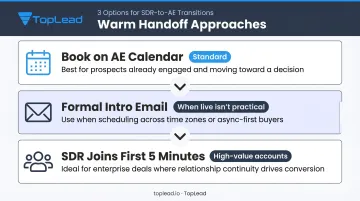
Use option 1 for standard handoffs, option 2 when a live warm transfer isn't practical, and option 3 for high-value, complex accounts where momentum is critical.
Set Clear Follow-Up SLAs for AEs
Once a handoff occurs, AEs need a defined window to follow up — not a general expectation. The MIT Lead Response Management Study found that the odds of contacting a lead drop 100 times when calling at 30 minutes versus 5 minutes, and qualification odds drop 21 times in that same window.
That data is about cold leads. For warm handoffs — where the prospect has already agreed to talk — the decay is even more damaging because expectation has been set.
A practical SLA structure:
- Within 1 hour: AE acknowledges receipt and reviews the brief
- Same day: AE sends a confirmation email to the prospect
- Before the meeting: AE reviews all CRM notes and prepares discovery questions
Automate Lead Routing Where Possible
Manual routing introduces delays. When a handoff requires someone to look up which AE covers which territory, assign the lead, and notify them — time passes and context gets lost.
Automated routing in your CRM assigns leads instantly based on territory, deal size, industry, or account ownership — so the right AE receives the handoff the moment it's marked complete, with no delay and no guesswork about ownership.
Foster SDR-AE Feedback Loops
The handoff process doesn't improve without feedback. SDRs need to know if the leads they're passing are converting. AEs need to know if the context they're receiving is complete enough.
Research from InsideSales.com/Tenbound found that daily SDR-AE communication was associated with a 7.2% increase in quota attainment and an appointment hold rate 17.7% higher than teams that coordinated only weekly.
A simple weekly sync covering three questions is enough to start:
- Are handed-off leads converting, and if not, where are they stalling?
- Are AEs receiving enough context in the brief?
- Do qualification criteria need to be adjusted?
Common Sales Rules Every SDR and AE Should Know
The 5-Minute Rule
Speed-to-response is one of the most studied variables in sales. The MIT/InsideSales research cited above shows contact odds fall off dramatically within the first 30 minutes of a lead's engagement window.
That urgency doesn't stop at the first contact. A prospect who agreed to a meeting last Tuesday and hasn't heard from the AE by Thursday is already reconsidering. Following up within the hour — not the day — keeps the deal alive.
The 3-3-3 Rule
There's no authoritative research validating the 3-3-3 rule as an industry standard, but as an operating cadence it works: contact the lead 3 times, over 3 days, using 3 different channels (phone, email, LinkedIn).
It gives AEs a structured approach for re-engaging a quiet prospect or chasing a missing confirmation.
Use it as a framework, not a formula. The channel mix should reflect what the prospect actually responds to, based on what the SDR documented in the brief.
The Talk-to-Listen Ratio
The "70-30 rule" — listening 70%, talking 30% — is widely repeated but not quite right. Gong's conversation research puts the ideal ratio at roughly 43% talking, 57% listening, with top performers closer to 46% talk time. Talking more than 65% of the call consistently hurts performance.
The principle holds: AEs should be listening more than they're talking, especially on the first post-handoff discovery call. A thorough SDR brief makes this easier — the AE arrives knowing the situation, so discovery goes deeper instead of starting over.
How to Measure and Continuously Improve Your Handoff Process
Key Metrics to Track
| Metric | Why It Matters | Healthy Benchmark |
|---|---|---|
| Time-to-AE-follow-up | Measures response urgency after handoff | Same day; within 1 hour ideally |
| Handoff-to-opportunity rate | Shows how many handoffs become active deals | InsideSales benchmark: 73.2% pass rate |
| Appointment hold rate | Percentage of scheduled meetings that actually happen | 85.9% with daily SDR-AE syncs vs. 73% weekly |
| SDR-AE feedback scores | Qualitative signal on brief quality and lead fit | Tracked via internal review cadence |
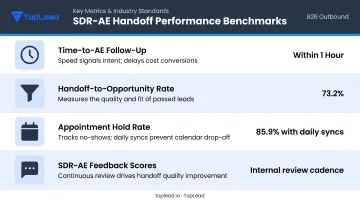
The Forrester benchmark is worth keeping in mind: companies with a formal handoff stage close 9.3 deals per 1,000 inquiries versus 4.6 without one. If your handoff-to-opportunity rate is low, that's where to start.
Build a Handoff Playbook
A playbook turns best practices into repeatable behavior. It should document:
- Pre-handoff checklist covering what SDRs must complete before marking a lead as transferred
- CRM documentation requirements specifying which fields are mandatory, not optional
- A standardized handoff email template SDRs use every time
- AE follow-up SLAs defining the specific time windows that constitute "on time"
- A feedback review cadence noting who reviews handoff quality, how often, and against what criteria
Assign one owner to each element of the playbook — distributed ownership without clear responsibility tends to leave gaps unfilled. CSO Insights found organizations with a formal, charter-based enablement approach achieved 55.1% win rates versus 39.2% for those with an ad hoc approach — a gap largely driven by process consistency.
Run Regular Joint Reviews
Weekly or biweekly SDR-AE reviews serve one purpose: identifying where leads are stalling and fixing the process upstream. A few examples of how this plays out in practice:
- An AE flags that three recent handoffs lacked budget context → the SDR adds a budget question to the qualification script
- An SDR notices top-qualified leads converting at lower rates → the AE revisits how the first call is structured
Over a quarter, those adjustments compound. Teams that run structured joint reviews consistently tend to see higher hold rates and shorter average sales cycles — because qualification gaps get caught before they reach the AE's calendar.
Frequently Asked Questions
What are common sales rules for lead response and handoff (3-3-3, 70-30, 5-minute rule)?
These rules govern follow-up speed (5-minute rule), multi-channel contact cadence (3-3-3), and conversation balance in discovery calls (the talk-to-listen ratio). Together, they guide how AEs should respond after receiving a handoff — though only the 5-minute rule has strong research backing from the MIT/InsideSales study.
How should account executives handle lead handoffs?
AEs are responsible for reviewing the handoff brief before the first call, following up within their SLA, and continuing the relationship without making the prospect repeat themselves. At handoff, the AE's job is to receive context and pick up where the SDR left off — not start the qualification over.
What information should an SDR include in a handoff to an AE?
The brief should cover:
- Prospect identity, title, and company context
- Pain points and what triggered their interest
- Engagement history and any objections raised
- Decision-making context: stakeholders, timeline, and budget
- Confirmed next step or meeting
Everything gets logged in the CRM before the handoff is considered complete.
What is the ideal AE response time after receiving a handoff?
Same day at minimum; within the hour when possible. The MIT/InsideSales research shows contact and qualification odds fall sharply after 30 minutes. For warm handoffs especially, delayed follow-up signals disorganization and erodes the trust the SDR worked to build.
How do you measure whether your SDR to AE handoff process is working?
Track four metrics: handoff-to-opportunity conversion rate, appointment hold rate, time-to-follow-up after handoff, and qualitative SDR-AE feedback on lead quality and brief completeness. Reviewing all four together in a biweekly SDR-AE session surfaces patterns that individual metrics miss.
What is a warm transfer and when should SDRs use it?
A warm transfer is a direct introduction from the SDR to the AE — either live on a call or via a personal email where the SDR recaps the conversation before stepping back. Use it for high-intent, time-sensitive prospects where losing even a day of momentum risks the deal going cold.