Introduction
The financial advisory market has never been more crowded. The Investment Adviser Association reported 15,870 SEC-registered investment advisers in 2024, managing a record $144.6 trillion in assets — and every one of them is competing for the same high-value clients you are.
The difference now is where those clients are looking. Prospects research advisors online, read reviews, and compare credentials before ever making contact. A PwC survey of high-net-worth investors found 46% planned to change or add a wealth relationship within 12–24 months — a significant pool of prospects actively looking for someone new.
Advisors still relying on cold calls, purchased lists, and occasional referrals are losing ground to peers running structured, multi-channel strategies. This article covers 11 actionable lead generation strategies, from foundational tactics to advanced outreach, with practical guidance on how to implement each one.
Key Takeaways
- Targeting the right prospects consistently outperforms chasing raw volume
- Digital channels like SEO, LinkedIn, and email build inbound pipelines with compounding returns over time
- Referrals and professional networks still convert at higher rates than most outbound tactics
- Webinars, workshops, and dinner seminars build trust faster than most digital-only approaches
- A specialized appointment-setting partner adds predictable pipeline without expanding your internal team
Why Modern Financial Advisors Need a Smarter Lead Generation Approach
Most advisors know their referral network isn't enough. What fewer recognize is why their outbound efforts aren't working either.
The Problem with Outdated Tactics
Cold calling, generic direct mail, and purchased lead lists share a common flaw: they prioritize reach over relevance. The results reflect it.
- Purchased lead lists are rarely exclusive — the same list may be sold to multiple competing advisors in your market
- Direct mail to prospect lists averages roughly a 10.8% response rate across industries, with conversion rates significantly lower for high-consideration services like wealth management
- Cold outreach yields inconsistent results when leads haven't self-selected into your funnel
Those numbers tell part of the story. The deeper problem is trust. Financial advisory is a relationship business, and cold outreach with no prior connection starts that relationship at a deficit.
What a Modern Approach Actually Looks Like
Effective lead generation today requires four capabilities working together:
- Inbound visibility: qualified prospects find you before you reach out
- Outbound precision: targeting the right people, not just the most people
- Relationship depth: referrals and warm introductions that carry pre-built trust
- Scalable prospecting: consistent pipeline without consuming your billable hours
The 11 strategies below address each of these — starting with the ones most advisors overlook.
11 Lead Generation Strategies for Financial Advisors
These strategies span inbound and outbound, digital and in-person, DIY and outsourced. Most advisors don't need all 11 — but understanding the full menu helps you build the right mix for your practice.
Strategy 1: Define Your Ideal Client Profile (ICP)
Every other strategy on this list becomes more effective — or less wasteful — based on how clearly you've defined who you're trying to reach.
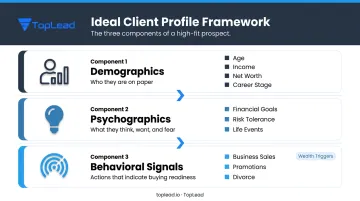
Your ICP should document:
- Demographics: age range, income, net worth, career stage
- Psychographics: financial goals, risk tolerance, major life events (retirement, liquidity events, inheritance)
- Behavioral signals: recent wealth triggers like business sales, promotions, or divorce
A practical starting point: pull your top 10 existing clients and look for patterns. What industries do they work in? What were their financial concerns when they first came to you? What's their investable asset range? Build your prospecting profile around those shared traits, not around who you'd ideally like to serve in theory.
A precise ICP makes every downstream strategy more efficient — better targeting, better messaging, better conversion.
Strategy 2: Build an SEO-Optimized Website
The average financial advisor generates about 2.5 leads per month from their website, according to research cited by InvestmentNews. That number can grow substantially with intentional SEO.
Key elements of a lead-generating advisor website:
- A clear value proposition specific to your niche and geography
- Pages targeting local search terms (e.g., "retirement planner in Sacramento" or "fiduciary advisor for business owners in Austin")
- Lead capture forms tied to a specific offer — free consultation, downloadable retirement guide, etc.
- Content that answers the questions your ideal clients are actually searching
Don't overlook Google Business Profile. Advisors who claim, complete, and actively maintain their profile show up in map results when prospects search for local advisors — a high-intent moment most advisors miss entirely.
Strategy 3: Publish Thought Leadership Content
Consistent content does two things at once: it improves your search visibility, and it gives prospects something to evaluate before they ever reach out.
An advisor who publishes monthly articles on tax-efficient retirement strategies for physicians will attract physician clients organically — answering their specific questions before a pitch ever happens.
Effective content doesn't require a high production budget. What it requires is consistency and relevance:
- 2–4 well-researched articles or LinkedIn posts per month, tied to your ICP's actual concerns
- Topics that map to specific financial events: business liquidity, generational wealth transfer, Roth conversion windows
- A consistent publishing schedule — sporadic posts build no momentum
Getting featured as an expert source in local publications also belongs here. Community visibility drives inbound credibility over time.
Strategy 4: Leverage LinkedIn Strategically
LinkedIn concentrates the exact audience most financial advisors want to reach: executives, business owners, pre-retirees, and professionals with growing wealth. It's also one of the few platforms where unsolicited outreach — done well — is welcomed.
Three areas to focus on:
- Profile optimization: your LinkedIn profile should read as a client-facing resource, not a resume — lead with what you do and who you help, not where you've worked
- Content engagement: comment on and engage with prospects' posts before sending connection requests — this warms the relationship before any direct outreach
- Advanced search: use LinkedIn's filters to find prospects by geography, job title, industry, and company size
The most common mistake is leading with a pitch. LinkedIn outreach that opens with a relevant observation, a useful insight, or a shared connection converts far more consistently than one that opens with a service offer.
Strategy 5: Run Targeted Email Campaigns
Email still delivers, but only when it's segmented. Finance industry emails average a 21.56% open rate and 2.72% click rate according to Mailchimp benchmarks — but segmented campaigns generate 100.95% higher click rates than non-segmented ones.
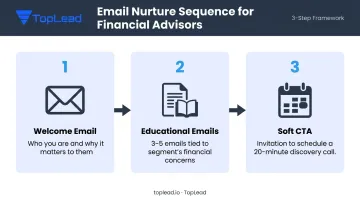
A basic advisor nurture sequence:
- Welcome email — who you are, what you do, why it matters to them specifically
- 3–5 educational emails — tied to that segment's financial concerns (retirement timing, tax planning, succession)
- Soft CTA — an invitation to schedule a 20-minute discovery call
The highest-performing emails aren't time-based — they're trigger-based. An email sent when a prospect's company announces an IPO, when they receive a visible promotion, or when they approach retirement age will outperform any generic drip campaign.
Strategy 6: Build a Structured Referral Program
55% of new advisor clients come from referrals, according to Cerulli data cited by PLANADVISER. Yet most advisors generate referrals passively — waiting for satisfied clients to mention them unprompted.
A structured approach changes the math:
- Ask for introductions at defined relationship milestones: after a successful annual review, following a major plan milestone, after resolving a complex situation
- Make it easy by giving clients something specific: a one-paragraph bio they can forward, or a clear description of who you're looking to meet
- Build a professional referral network — CPAs, estate attorneys, and mortgage brokers regularly interact with people navigating major financial decisions. Three to five complementary professionals who reciprocate referrals can be more productive than your entire client base combined.
Strategy 7: Host Educational Workshops and Webinars
Workshops and webinars work because they flip the dynamic — instead of you approaching prospects, qualified prospects come to you.
The topic drives attendance. Generic financial wellness presentations attract generic audiences. Specific, timely topics draw the right people:
- "What Business Owners Need to Know Before Selling Their Company"
- "Retirement Planning When Interest Rates Are Still High"
- "Estate Planning Essentials for Families with $1M+ in Assets"
The follow-up matters as much as the event. Attendees who receive a personalized email within 24–48 hours — referencing something specific from the session — convert at meaningfully higher rates than those who get a generic thank-you message.
One RIA replaced costly dinner seminars with free estate planning events and generated $25 million in new AUM through that channel. When the topic matches your audience's most urgent concerns, the format delivers.
Strategy 8: Use Targeted Paid Advertising
Paid search and social ads can generate qualified leads quickly — but only with tight execution.
Google Ads works best targeting high-intent queries: "fiduciary financial advisor near me," "retirement planner [city name]," "wealth management for business owners." Broad campaigns without specific keyword targeting burn budget fast.
LinkedIn Ads and Facebook Ads allow demographic and behavioral targeting by job title, income level, age, and geography — effective for reaching pre-retirees or small business owners who wouldn't find you through organic search.
A few guardrails:
- Always send paid traffic to a dedicated landing page, not your homepage
- Include a specific offer (free consultation, downloadable guide) rather than a generic "contact us" CTA
- Start with a limited budget and test one audience segment before scaling
Strategy 9: Engage in Community Networking and Lead Groups
Local networking groups — BNI chapters, Chamber of Commerce events, industry associations — give you access to warm referral pipelines from people who already know you. These relationships compound over time, but only when you show up consistently.
The advisors who get the most from networking aren't pitching — they're contributing. Answering questions, making introductions, sharing knowledge without expecting immediate return. That positions you as a trusted resource rather than someone working the room.
Formal groups are just the starting point. Sponsoring community events, appearing on local podcasts, or leading financial literacy workshops at libraries and community colleges all build name recognition that generates inbound leads over months and years.
Strategy 10: Host High-Touch Dinner Seminars
Dinner seminars remain one of the highest-quality prospect pipeline strategies when executed correctly. The failure mode — and it's common — is treating them as volume plays.
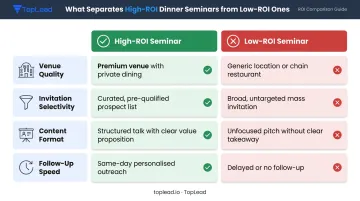
What separates high-ROI dinner seminars from low-ROI ones:
- Venue quality: a premium setting signals the caliber of your practice
- Invitation selectivity: 20 pre-qualified, targeted guests consistently outperform 100 generic attendees
- Content format: education-first, not sales-first — prospects should leave having learned something valuable
- Follow-up speed: a personalized follow-up within 48 hours dramatically increases conversion
Note that some advisors are rethinking the dinner seminar format as client expectations evolve — free educational events (workshops, webinars) can achieve similar results with a more contemporary image.
Strategy 11: Partner with a Specialized Appointment-Setting Service
For advisors who want to grow their pipeline without becoming their own prospecting department, outsourcing to a qualified appointment-setting firm creates a separate, predictable lead flow.
A specialized U.S.-based SDR team handles prospecting, outreach, and qualification under your brand — delivering sales-ready meetings with verified decision-makers directly to your calendar. You focus on advising, not cold outreach.
What to evaluate when choosing a partner:
- Do they verify decision-maker authority before booking?
- Is pricing pay-per-appointment, or a flat retainer regardless of results?
- Is there a reschedule or replacement guarantee for no-shows?
- Do they have demonstrated experience in financial services specifically?
TopLead, for example, has arranged over 25,000 qualified appointments across industries, with financial services clients including Edward Jones, UBS, Wells Fargo Advisors, Raymond James, LPL Financial, and John Hancock.
Their pay-per-appointment model runs $300–$350 per qualified lead, guarantees 4–6 appointments per month, and includes a replacement guarantee if a prospect cancels or no-shows. No long-term contracts — advisors can scale up or pause based on capacity.
Their SDRs operate under the advisor's brand, using multi-channel sequences across email, LinkedIn, and phone. First appointments typically arrive within 2–4 weeks of campaign launch.
How to Build a Lead Generation System That Actually Converts
Executing all 11 strategies simultaneously isn't realistic — and isn't necessary. Pick 2–3 that align with your strengths, your ICP, and your available time, then execute them consistently before adding more.
Qualify Before You Invest Time
Generating leads is only half the equation. Every prospect entering your pipeline should be scored against your ICP before you invest serious relationship-building time:
- Investable assets meet your minimum threshold
- Life stage aligns with the services you provide
- A financial need exists that you're positioned to solve
Advisors who qualify leads early see shorter sales cycles and higher close rates. Without that filter, you end up burning hours on prospects who were never a fit.
Solve the Follow-Up Gap
RAIN Group research indicates it takes an average of 8 touchpoints to secure an initial meeting in B2B sales. Most advisors stop at one or two.
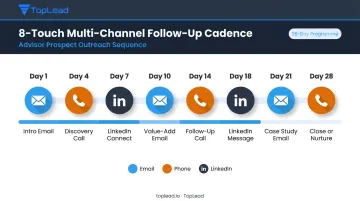
A defined follow-up cadence — across email, phone, and LinkedIn — is the difference between a leaky pipeline and one that converts. The specific channel matters less than the consistency. Map out your touches in advance: if a prospect attends a webinar, what happens on day 1, day 4, day 10, and day 21?
Conclusion
Lead generation for financial advisors has moved well past referrals and cold calls. The advisors growing fastest are running layered systems: organic inbound through SEO and content, relationship-based pipelines through referrals and networking, and scalable outbound through events, LinkedIn, and targeted ads.
The 11 strategies in this article give you the full toolkit — from foundational (ICP definition, SEO) to high-leverage (dinner seminars, outsourced appointment setting). Start with the channels where your best clients have historically come from, then layer in one or two new acquisition methods as capacity allows.
For advisors who want to accelerate pipeline growth without building an internal prospecting function, TopLead offers a pay-per-appointment model backed by a reschedule-or-replacement guarantee. With over 15 years of experience and 25,000+ appointments arranged for American firms including Edward Jones, Wells Fargo Advisors, LPL Financial, Raymond James, and UBS, TopLead acts as a virtual SDR team — taking prospecting off your plate so you can stay focused on closing and client relationships.
Frequently Asked Questions
What is the most effective lead generation strategy for financial advisors?
There's no single best strategy — effectiveness depends on your niche, target client, and available resources. LinkedIn outreach, structured referral programs, and niche content marketing consistently deliver the highest ROI — particularly when combined rather than used in isolation.
How do financial advisors get leads without cold calling?
Inbound strategies like SEO, thought leadership content, and educational workshops generate warm inbound interest without cold outreach. On the outbound side, LinkedIn prospecting, referral networks, and personalized email campaigns create warmer initial contact than unsolicited phone calls.
What qualifies as a qualified lead for a financial advisor?
A qualified lead matches your ICP on the key criteria — investable assets, life stage, financial goals — and has shown some level of intent, such as requesting a consultation, attending a seminar, or engaging with your content.
How much does lead generation typically cost for financial advisors?
Costs vary significantly by channel. Kitces research puts average advisor client acquisition cost at roughly $3,119, and InvestmentNews data shows advisors spend about $16,000 per year on marketing. DIY content and SEO carry low direct costs but require significant time; outsourced appointment setting typically runs $300–$350 per qualified appointment.
How long does it take for lead generation strategies to show results?
Paid ads and events can produce leads within weeks. SEO and content marketing typically take 3–6 months to build meaningful momentum. A blended approach — some short-term tactics, some long-term — ensures you have pipeline activity now while building compounding returns over time.
Should financial advisors outsource lead generation?
Outsourcing works well for advisors who want predictable pipeline growth without pulling time away from client service. Choose a partner with real financial services experience, verified decision-maker outreach, and performance-based pricing — where accountability is built into the model.