The appeal is real. But outsourcing carries its own failure modes — and companies that skip the due diligence often end up burning budget on low-quality meetings that frustrate their AEs and produce no pipeline.
This post covers both sides without spin: what SDR outsourcing actually is, the genuine advantages, the real risks, how it compares to in-house, and a clear framework for deciding which path makes sense for your business.
Key Takeaways
- Outsourcing SDR work cuts costs and accelerates pipeline, but only if you have a validated ICP and documented messaging before handing anything off
- Most outsourcing failures trace back to handing an undefined target to an external team, not to the provider itself
- In-house SDRs offer better brand immersion; outsourced teams offer speed, flexibility, and lower staffing risk
- The right metric isn't retainer vs. salary — it's cost per qualified meeting
- Performance-based models (pay-per-appointment, no long-term contracts) reduce financial exposure significantly
What Is SDR Outsourcing?
SDR outsourcing means partnering with a third-party provider to run your top-of-funnel sales functions — prospecting, cold outreach across email, phone, and LinkedIn, lead qualification, and booking meetings with decision-makers — while your internal team focuses on demos and closing.
This is not a "set it and forget it" arrangement. Effective programs require a well-defined ICP, active direction from your side, and genuine collaboration with the provider. The distinction that matters most when evaluating vendors is managed SDR agency vs. headcount rental:
- Managed agency: Brings pre-built playbooks, trained reps, reporting infrastructure, and QA processes
- Headcount rental: Provides reps without systems, strategy, or accountability frameworks
The market for outsourced sales services is growing — Zion Market Research values it at $2.71B in 2024, projected to reach $4.21B by 2034. That growth reflects real demand. Whether that demand translates into results depends almost entirely on which type of provider you choose and how you structure the engagement.
Advantages of Outsourcing SDR Services
Significant Cost Savings Compared to In-House Hiring
The base salary is the smallest part of what an in-house SDR actually costs. Bridge Group analysis put fully loaded SDR compensation at $106K–$141K, including OTE, management allocation, tools, training, taxes, and benefits.
That figure doesn't include one-time recruiting fees (SHRM puts average cost-per-hire near $4,700) or the productivity drag during ramp.
Outsourced SDR programs typically run on monthly retainers in the $3K–$10K/month range, or on pay-per-appointment structures at $300–$800 per meeting (agency benchmark data, useful as directional context). On an annual basis, the gap between fully loaded in-house costs and outsourced retainers can be substantial.
The catch: savings are only real when the provider delivers qualified meetings. High email volume with zero pipeline is more expensive than a pricier provider with strong conversion. That's why time-to-pipeline matters as much as cost.
Faster Time-to-Pipeline
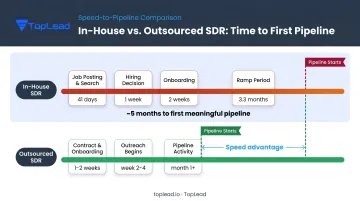
Hiring, onboarding, and ramping an in-house SDR takes months. The 41-day hiring timeline is just the search phase — add onboarding and the Bridge Group's ~3.3-month ramp benchmark and you're often looking at five months before meaningful outreach volume hits your pipeline.
Outsourced programs can typically begin outreach within two to four weeks of engagement start. For companies with near-term pipeline pressure, that difference carries a direct revenue cost: delayed deals and missed quarters.
Access to Specialized Outbound Expertise
Established outsourced providers bring what would take most companies six to twelve months to build internally:
- Pre-built multi-channel outreach sequences tested across industries
- Trained reps familiar with common objection patterns
- Refined ICP targeting and list-building processes
- QA infrastructure and performance monitoring frameworks
This expertise is immediately deployable. Building it in-house requires hiring people who already have it, or investing in extensive trial-and-error while your pipeline suffers.
Scalability Without Headcount Risk
Outsourced programs run on retainer or project contracts. That means:
- Scaling volume up during growth phases without additional hiring cycles
- Pausing or reducing scope during slow quarters without layoff costs
- Testing a new vertical or ICP segment without committing permanent headcount
- Exiting without the legal and financial complexity of terminating employees
This flexibility is particularly valuable when validating a new market or managing seasonal pipeline demand.
Frees Internal Teams for Revenue-Generating Work
Salesforce research across 4,000+ sales professionals found that sales reps spend 60% of their time on non-selling tasks — prospecting, data entry, scheduling, follow-up administration.
When SDR work is outsourced, AEs and founders recover that capacity for demos, negotiation, and closing. That shift alone can move the needle on pipeline velocity — without adding a single headcount.
Disadvantages of Outsourcing SDR Services
Risk of Poor ICP Alignment and Low Lead Quality
The most common reason outsourced SDR programs fail is an undefined or poorly transferred ICP. When targeting criteria are vague, reps default to broad outreach — booking meetings that look good in activity reports but frustrate AEs who can't close them.
The feedback loop is costly: unqualified meetings waste AE time, erode trust between sales and leadership, and burn budget with no pipeline to show for it. Outsourcing amplifies what's already working — it won't fix a targeting problem that hasn't been solved internally first.
Before engaging any provider, your company needs:
- A documented ICP with specific firmographic and behavioral criteria
- Clear qualification standards (what must be true for a meeting to count)
- At least a hypothesis about which messaging angles resonate with that ICP
Communication and Visibility Gaps
In-house SDRs absorb context naturally — product updates from Slack, competitive intel from demo debriefs, objection patterns from team calls. Outsourced reps don't have this ambient exposure, and without intentional process-building, messaging drifts stale or misaligned.
Structured check-ins, shared communication channels, and transparent reporting dashboards keep this risk in check. The point is that none of it happens automatically — it takes deliberate process-building on both sides.
Inconsistent Brand Voice
Messaging drift has a direct downstream effect on brand perception. Every cold email and call is your company's first impression with that prospect, and without thorough onboarding on tone, messaging nuances, and positioning, outsourced outreach can sound generic — or worse, off-brand in a way that permanently closes doors with high-value targets.
This risk is sharpest in tight, vertical-specific markets where word spreads fast among the exact decision-makers you're trying to reach.
Variable Quality Across Providers
The outsourced SDR market spans a wide quality range. Providers differ significantly in:
- Vertical-specific expertise and relevant references
- Multi-channel capabilities vs. email-only execution
- Reporting transparency and data ownership policies
- Whether SLAs are tied to qualified meetings or raw activity volume
- Compensation models (activity-based vs. outcome-based)
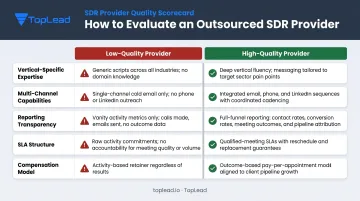
Choosing on price alone is the fastest path to high email volume with zero qualified pipeline.
When vetting providers, evaluate:
- References from companies in your vertical with similar deal sizes
- SLAs defined around qualified meetings, not calls made or emails sent
- Data ownership policies — who keeps the prospect list and outreach history
- Compensation model alignment (are they incentivized by activity or outcomes?)
Reduced Control and Transparency Risk
Outsourcing means a third party has first contact with your prospects. Companies that don't establish data ownership agreements, reporting standards, and performance benchmarks upfront can end up with little visibility into what's being said on their behalf — and no clean exit if it's not working.
Outsourced SDR vs. In-House: Key Differences
The table below maps the most consequential differences across both models. Use it to identify which trade-offs your business is best positioned to absorb — not to find a universal answer.
| Dimension | In-House SDR | Outsourced SDR |
|---|---|---|
| Year 1 total cost | $106K–$141K+ (compensation alone, per Bridge Group) plus recruiting, software, equipment | $36K–$120K+ annually depending on retainer or per-meeting model |
| Time to first outreach | 4–5+ months (hiring + ramp) | 2–4 weeks depending on provider onboarding |
| ICP alignment | High — embedded in org culture and feedback loops | Variable — requires strong onboarding and active management |
| Brand voice consistency | High — immersed in company context | Manageable with investment; inconsistent without it |
| Scalability | Slow — headcount-bound | Fast — contract adjustments |
| Turnover risk | High — Bridge Group data shows average SDR tenure around 1.4 years | Shifts to provider's team; still requires monitoring |
On turnover: both models carry continuity risk. In-house, it shows up as employee churn that restarts a costly recruiting and ramp cycle. Outsourced, it shows up as provider-team instability. The question is which risk you're better positioned to manage.
Cost-per-qualified-meeting — not retainer fee versus salary — is the right unit to compare. A $5K/month provider delivering 8 qualified meetings is cheaper than a $3K/month provider delivering 2.
When Does Outsourcing SDR Services Make Sense?
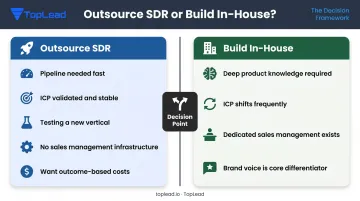
Outsourcing is the right move when:
- Pipeline is needed faster than a 3–6 month in-house hiring cycle allows
- The ICP is validated and outbound messaging is documented (not still being figured out)
- You're testing a new vertical or segment without committing permanent headcount
- Leadership lacks the infrastructure to hire, train, and manage SDR performance
- You want fixed, predictable cost tied to outcomes rather than salary overhead
Build in-house when:
- Long-term GTM strategy requires deep, evolving product knowledge embedded in the team
- The ICP shifts frequently and demands tight, real-time feedback loops between SDRs and product
- You have dedicated sales management capacity to develop and coach SDR talent
- Brand voice is a core competitive differentiator that genuinely requires full organizational immersion
For American companies that need pipeline speed without giving up control, performance-based outsourced models meaningfully lower financial exposure. TopLead, for example, operates on a pay-per-appointment model with decision-maker verification, a reschedule or replacement guarantee, and no long-term contracts — meaning clients pay only for qualified outcomes, not activity volume.
With over 25,000 appointments arranged across financial services, insurance, accounting, and PEO verticals, the model is built around the quality concerns that make outsourcing relationships most likely to fail. If a meeting doesn't happen, it gets replaced — and clients aren't locked into extended commitments while waiting to see results.
Frequently Asked Questions
Frequently Asked Questions
What are the advantages of using SDRs?
SDRs generate consistent pipeline through prospecting and lead qualification, freeing account executives to focus entirely on closing. A dedicated SDR function prevents AEs from splitting attention between top-of-funnel work and deal progression.
How much does it cost to outsource SDR services?
Outsourced programs typically run $3K–$10K/month on retainer, or $300–$800 per qualified appointment on performance models. Compare this against fully loaded in-house SDR costs of $106K–$141K+ annually. Cost per qualified meeting — not the headline fee — is the number that actually matters.
What is the difference between in-house SDRs and outsourced SDRs?
In-house SDRs are embedded employees with deep product knowledge and cultural context. Outsourced SDRs are managed by a third party, optimized for high-volume top-of-funnel execution. The core trade-offs — control, ICP alignment, and ramp time — can be narrowed with strong onboarding, but not eliminated without it.
When should a company outsource its SDR function?
Outsourcing works best when pipeline is needed quickly, the ICP is clearly defined, and the company lacks the infrastructure to hire and ramp internally. It's an accelerator of a sales strategy that already exists — not a substitute for one that doesn't.
How do I choose the right outsourced SDR partner?
Prioritize vertical-specific references, SLAs tied to qualified meetings (not raw activity), clear data ownership terms, and a compensation model aligned with outcomes. Avoid providers who measure success in email volume or call attempts without connecting those to pipeline.
Does outsourcing SDR services actually work?
Results vary, and success depends on having a validated ICP, clear qualification criteria, and active collaboration with the provider. Outsourcing amplifies what's already working — companies with undefined targeting or no AE capacity to handle booked meetings will see those problems magnified, not solved.