The reason is structural. Cybersecurity buyers are trained skeptics. The same people you're trying to reach spend their careers defending against social engineering and deceptive outreach — so generic email blasts and mass LinkedIn sequences don't just underperform, they actively damage your credibility.
This guide breaks down what actually works: how to define a sharp ICP for the cybersecurity market, which inbound and outbound strategies move the needle, the tools worth using, and when building an in-house SDR team makes sense versus outsourcing to a specialized partner.
Key Takeaways
- Cybersecurity buyers evaluate 12 pieces of content before talking to a vendor — trust must be built before any sales conversation
- The buying committee typically spans 4–8 stakeholders, making single-threaded outreach ineffective
- Top-performing programs pair industry-specific inbound content with ABM outbound and intent data signals
- Free risk assessments and no-pitch webinars are among the highest-converting top-of-funnel offers in this category
- Outsourcing accelerates qualified decision-maker appointments fast; in-house SDRs pay off once you have a repeatable playbook in place
Why Cybersecurity Lead Generation Requires a Different Playbook
Security Buyers Default to Distrust
American CISOs and IT security leaders are hard to reach not because they're too busy, but because professional skepticism is part of their job description. Vendors who open with feature dumps or pressure-laden cold outreach get filtered immediately — often before a human even reads the message.
What breaks through is credibility established before the first sales touchpoint. That means:
- Case studies with measurable, specific outcomes
- Demonstrated compliance expertise (SOC 2, CMMC, NIST)
- Thought leadership tied to threats your buyers are actively tracking
According to the TechTarget/ESG 2024 Media Consumption Survey, 87% of technology buyers say online information alone is sufficient to build a vendor shortlist without ever speaking to a sales rep. Your content is doing sales work whether you treat it that way or not.
The Buying Committee Is Large and Slow
A typical cybersecurity purchase involves 4–8 stakeholders — CISO, CIO, CFO, legal/compliance, and often a procurement layer on top. The ESG survey found the average B2B technology buying team has 9 people involved in a purchase decision.
That's not a single-champion sale. Single-threaded outreach — one SDR emailing one contact at one account — stalls because no individual stakeholder typically has unilateral authority to move a deal forward.
Timing Beats Volume
Cybersecurity purchases are frequently reactive. A ransomware attack on a competitor, a failed SOC 2 audit, or a new regulatory deadline can compress a six-month buying cycle into six weeks. This makes timing and intent signals more valuable in this category than in almost any other B2B vertical. The companies that reach the right account at the right moment — not the ones sending the most emails — win the deal.
Define Your ICP and Buyer Personas Before You Prospect
Identify Your Target Industries and Firmographic Fit
Not every company is a security buyer. The highest-value targets cluster around industries with regulatory exposure, breach liability, or critical infrastructure risk.
| Industry | Primary Compliance Driver | Typical Buying Trigger |
|---|---|---|
| Healthcare | HIPAA | Breach notification, OCR audit, EHR system upgrade |
| Financial Services | PCI-DSS, SOX | Breach incident ($6.08M average cost per IBM 2024), audit failure |
| Manufacturing/OT | NIST CSF, CISA guidelines | ICS/SCADA vulnerability, operational disruption |
| SaaS/Cloud | SOC 2, ISO 27001, third-party risk | Customer security questionnaire, new enterprise deal |
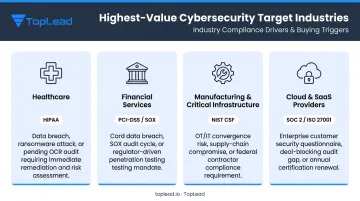
IBM's 2024 data shows financial sector breach costs averaged $6.08M, 22% above the global average — a concrete number for financial services outreach. For healthcare, HHS OCR has collected nearly $145 million in HIPAA settlements across 152 enforcement cases, giving compliance teams a direct liability reference.
Firmographic criteria that indicate buying readiness:
- 200–2,500 employees (large enough to have security budget, small enough to lack mature programs)
- Existing SIEM or EDR tools (signals security maturity and openness to expansion)
- Active compliance obligations (SOC 2 Type II, HIPAA, PCI-DSS)
- Recent funding round or leadership hire in a security role
Map the Buying Committee
Once you've identified the right accounts, you need to reach the right people inside them. Each stakeholder evaluates your solution through a different lens:
- CISOs care about technical depth: does it integrate with their existing stack, and does it demonstrably reduce threat exposure?
- CIOs weigh business alignment, total cost of ownership, and how disruptive the implementation will be.
- CFOs need ROI justification and risk quantification they can present to the board.
- Legal and compliance leads focus on regulatory coverage, audit trail completeness, and liability reduction.
One message can't do all of that work. Your outreach sequences and supporting content need to address each role separately. A case study that leads with breach cost reduction speaks to the CFO; one that leads with detection-and-response improvement speaks to the CISO.
Document the Triggers That Open Buying Windows
Three categories of buying triggers should inform when and how you reach out:
- Reactive triggers: a publicized breach in the same industry, a failed audit, or a public regulatory action. These create immediate urgency and compress evaluation timelines.
- Compliance-driven triggers: upcoming certification deadlines (SOC 2 renewal, HIPAA assessment cycle, PCI-DSS re-certification). These are calendar-predictable and allow proactive outreach timed to the deadline.
- Proactive triggers: new CISO hire, board-level security mandate, recent funding round, or M&A activity. These signal organizational change and budget availability.
TopLead's U.S.-based SDR teams integrate external trigger events — funding rounds, leadership changes, hiring surges — directly into campaign planning, allowing outreach timing to align with the moment an account is most likely to be receptive.
Inbound Lead Generation Strategies for Cybersecurity Companies
Build Trust With Threat-Informed Content
Generic cybersecurity content gets ignored. Content tied to specific, timely threats your target vertical is actively managing gets read, shared, and used to evaluate vendor credibility.
High-performing inbound assets for security buyers:
- Industry-specific threat reports (e.g., "2025 Ransomware Trends for Mid-Market Healthcare")
- Compliance prep guides mapped to specific frameworks (HIPAA, SOC 2, PCI-DSS)
- Incident response playbooks customized by company size or vertical
- Breach cost calculators or risk quantification tools
The TechTarget/ESG data shows tech buyers consume an average of 12 pieces of content across 5 content types before building a vendor shortlist. That consumption happens largely before any vendor conversation — which means your content library is doing qualification work before your sales team ever gets involved.
Gated lead magnets work when the value clearly outweighs the privacy concern. Security professionals are highly protective of their contact information, so a generic "cybersecurity tips" PDF won't convert. A compliance readiness checklist for their specific regulatory environment will.
Optimize for Search and Organic Discovery
53% of technology buyers spend significant time with search engines during the vendor evaluation process. That traffic goes to whoever owns the relevant keyword combinations.
Build dedicated solution pages targeting industry-plus-problem queries:
- "healthcare cybersecurity compliance solutions"
- "SOC 2 compliance for SaaS startups"
- "OT security for manufacturing companies"
Broad category pages ("cybersecurity services") have too much competition and too little buyer intent. Vertical-specific pages rank faster and attract higher-quality visitors already in a buying context.
Offer Free Audits and Assessments
A free cybersecurity risk assessment is one of the highest-converting top-of-funnel offers in this space. Two reasons it works:
- Delivers immediate, tangible value that security buyers can justify accepting
- Surfaces the prospect's specific gaps before your sales team has invested significant time
Prospects who engage with a free audit reveal their current security posture, existing tools, compliance obligations, and pain points. That information makes every subsequent sales conversation more relevant and faster to close.
Host No-Pitch Webinars on Specific Threats
"Promotional" webinars that spend 45 minutes on product demos convert poorly with security audiences. Topic-specific, educational sessions — "How Mid-Market Manufacturers Can Defend Against OT Ransomware" — consistently outperform because they signal expertise without demanding anything in return.
30% of technology buyers are likely to accept a vendor call after viewing an effective webinar, per TechTarget/ESG research. The webinar builds enough credibility that a follow-up email sequence can secure the meeting.
Repurpose each webinar into: a follow-up blog post, a short-form LinkedIn clip, a nurture email summarizing the key takeaways, and a resource page that captures ongoing search traffic.
Outbound Strategies That Reach Skeptical Security Buyers
Account-Based Marketing for High-Value Accounts
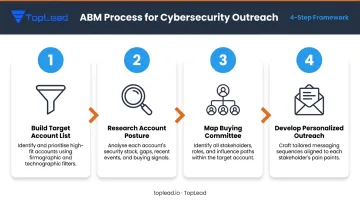
ABM is worth the extra effort in cybersecurity because deal sizes justify deep account research. The process:
- Build a short target account list (25–100 accounts) based on ICP criteria — industry, size, compliance environment, tech stack
- Research each account's current posture — recent breach news, compliance announcements, leadership changes, job postings in security roles
- Map the buying committee at each account — identify the CISO, CIO, CFO, and compliance lead
- Develop personalized outreach that references the account's specific context, not a generic category pitch
The Momentum Cyber CYBERscape map includes over 1,000 unique cybersecurity vendors competing for the same accounts. That kind of competition means a generic pitch gets ignored — knowing that a prospect recently posted three security engineer roles or announced a SOC 2 audit is what makes outreach land.
LinkedIn and Social Selling
Once you've mapped the buying committee, LinkedIn is where those stakeholders are actually reachable. CISOs, IT directors, and security operations leaders are active on the platform in ways they aren't on email. LinkedIn Sales Navigator allows you to filter by title, company size, industry, geography, and seniority — and to monitor activity signals like posts about compliance challenges or reactions to breach news.
Effective LinkedIn outreach for security buyers:
- Open with a specific, researched pain point, not a product introduction
- Reference something real (a regulatory change in their industry, a recent public incident)
- Connect with multiple stakeholders at the same account, not just one champion
- Use InMail sparingly and only when the message is genuinely relevant
TopLead's work with a cybersecurity MSP found that LinkedIn InMail outperformed cold email 3:1 for that vertical after three weeks of A/B testing — a meaningful difference that justifies prioritizing LinkedIn in the channel mix.
Multi-Channel Outreach Sequences
No single channel is enough. A structured multi-touch sequence that combines email, LinkedIn, and phone significantly outperforms any one channel used alone.
A practical sequence structure for cybersecurity outreach:
- Email 1 — References a specific compliance trigger or threat relevant to their industry. No product pitch.
- LinkedIn connection — Personalized note that references the same context.
- Email 2 — Value-add content (link to relevant report, compliance checklist, or webinar recap).
- Phone call — Brief, context-rich. Reference the prior emails and the industry trigger.
- LinkedIn follow-up — Engage with their content before sending a final message.
TopLead integrates intent data from Bombora and 6sense to identify companies actively researching cybersecurity topics, then prioritizes those accounts in the outbound queue. When a prospect is already mid-research cycle, the same five-touch sequence carries significantly more weight — the timing does part of the persuasion work.
Top Tools for Cybersecurity Lead Generation
Prospecting and contact data:
- LinkedIn Sales Navigator — Decision-maker discovery, activity monitoring, InMail
- ZoomInfo — Enterprise-grade firmographic filtering; best for mid-market and enterprise budgets
- Apollo.io — Strong B2B database at a more accessible price point; well-suited for startups and growth-stage companies
- Lusha — Contact data verification and enrichment
Intent and signal tools:
- Bombora — Company Surge data identifying active research on cybersecurity topics
- 6sense — Account-level intent scoring and predictive prioritization (Forrester Wave Leader, Intent Data Providers, Q1 2025)
- SpyCloud — Dark web monitoring that surfaces companies with exposed credentials — a high-urgency, high-conversion signal for outbound prioritization
Once intent signals identify the right accounts, outreach tools convert that intelligence into booked meetings.
Outreach and CRM:
- HubSpot or Salesforce — Pipeline tracking, lead scoring, multi-touch attribution
- Outreach or Salesloft — Structured email sequencing and cadence management
- CRM integration — Connects outbound activity to revenue outcomes and surfaces which channels are actually producing pipeline
In-House SDR Team vs. Outsourcing
The Real Cost of Building In-House
In-house SDRs offer full control over messaging and deep product knowledge. The trade-off is time and cost. A new SDR typically requires 90 days to reach baseline productivity and six months to become consistent. Factor in recruiting, salary, benefits, management overhead, and tool costs, and the investment is significant before the first qualified meeting is booked.
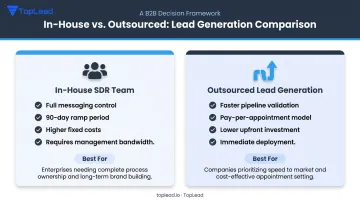
Building in-house makes sense when you have a repeatable outbound playbook, enough deal volume to justify the headcount, and the management bandwidth to ramp and retain SDR talent.
When Outsourcing Makes More Sense
When you're still validating your ICP, outsourcing is the faster path to pipeline. It also makes sense when your deal size justifies a per-appointment model or you need qualified decision-maker meetings rather than raw contact lists.
TopLead's pay-per-appointment model is built for exactly this scenario. Standard packages deliver 4–6 qualified leads per month at $300–$350 per lead, with a reschedule or replacement guarantee if a prospect cancels or no-shows — and no long-term contracts. For technology and SaaS clients, TopLead functions as a virtual SDR team: handling prospecting, qualification, and appointment setting while your sales team stays focused on closing.
Most clients begin seeing qualified appointments within the first 2–4 weeks of campaign launch, with performance improving as messaging is refined across the 3–6 month campaign lifecycle.
Key questions to ask any outsourced lead gen partner:
- Do they have experience with technology or security buyers specifically?
- How do they verify that a booked prospect is a genuine decision-maker?
- Is their outreach multi-channel, or single-channel?
- What happens if an appointment doesn't meet the agreed qualification criteria?
Frequently Asked Questions
How do you get leads for cybersecurity?
Cybersecurity leads are generated through inbound tactics (vertical-specific content, free risk assessments, SEO-optimized solution pages) and outbound tactics (ABM, LinkedIn outreach, intent-driven email sequences). The critical differentiator versus generic B2B approaches is vertical specificity and trust-building before any sales conversation.
How much do B2B cybersecurity leads cost?
Cost varies by channel and qualification depth. Qualified, verified decision-maker appointments in cybersecurity generally run $500–$1,500+ per appointment, given longer sales cycles and higher deal values. Most programs blend organic, outbound, and paid channels to manage overall cost per pipeline opportunity.
Which platform is best for B2B cybersecurity lead generation?
No single platform wins. LinkedIn Sales Navigator is best for reaching security decision-makers directly. ZoomInfo or Apollo.io are best for building filtered prospect lists. Bombora or 6sense are best for identifying in-market accounts. High-performing programs combine at least two of these.
What is B2B in cybersecurity?
B2B cybersecurity refers to companies selling security products and services to other businesses — endpoint security vendors, MSSPs, compliance consultancies, and cloud security SaaS providers. It's distinct from other B2B categories because of complex buying committees, high-scrutiny evaluations, and longer sales cycles.
How long does it take to see results from a cybersecurity lead generation campaign?
Outbound and paid campaigns can generate initial meetings within 30–60 days. Organic and content-based strategies build over 4–6 months, so most cybersecurity programs plan around a 3–6 month campaign horizon.
Should cybersecurity companies build an in-house SDR team or outsource?
Early-stage companies or those without a repeatable outbound motion typically reach pipeline faster through outsourcing. Companies with established processes and consistent deal volume may benefit from in-house. The key evaluation criteria are ramp time tolerance, available budget, and whether you need qualified appointments or just contact lists.