Introduction
Closing deals is what drives revenue — but someone has to fill the pipeline first. That's the tension most B2B sales leaders live with daily: your Account Executives need a steady stream of qualified meetings, but building an in-house SDR team is slow, expensive, and notoriously hard to manage.
Recruiting takes months. New SDRs average 3.2 months to ramp, according to Bridge Group's 2023 SDR Metrics Report, based on data from U.S. B2B sales organizations. And with SDR attrition sitting at 39%, you're often back at square one before the first hire reaches full productivity.
Sales Development as a Service (SDRaaS) cuts through that cycle. Instead of hiring and re-hiring, you get a dedicated team that handles prospecting, qualification, and appointment-setting — and starts delivering pipeline from week one.
This guide covers everything you need to know: what SDRaaS is, how it works step by step, who benefits most, and how to choose a provider worth trusting.
TL;DR: Key Takeaways
- SDRaaS hands off prospecting, qualification, and appointment-setting to a managed third-party team
- No recruiting, no ramp time — campaigns can launch and book meetings within weeks
- Strong providers verify decision-maker access and use email, LinkedIn, and phone before booking
- Pay-per-appointment pricing means you pay for results, not headcount
- Best fit: SaaS, financial services, insurance, professional services, and PEO/HR outsourcing
What Is Sales Development as a Service?
Sales Development as a Service (SDRaaS) is an outsourced model where a third-party provider supplies a trained SDR team, outreach tools, targeting strategy, and performance reporting to manage your top-of-funnel sales process — prospecting, qualifying leads, and booking sales-ready appointments with decision-makers.
The "as-a-service" framing mirrors what happened with software. Just as SaaS replaced the need to own and maintain IT infrastructure, SDRaaS replaces the need to hire, train, and manage a prospecting function. Clients pay for outcomes — confirmed appointments with qualified prospects — rather than salaries, benefits, and tooling.
What SDRaaS Is Not
There's a lot of noise in this space, so the distinctions matter:
- Not a contact list vendor — a list gives you names; SDRaaS delivers conversations with people who fit your ICP and are ready to engage
- Not a marketing automation agency — SDRaaS is human-led outreach, not automated email blasting
- Not a boiler-room cold-calling service — quality providers apply structured qualification frameworks and verify decision-maker status before any meeting is booked
SDRaaS vs. Sales as a Service
These terms are related but not interchangeable:
- Sales as a Service — a broader model covering the full revenue function, from prospecting through to closing
- Sales Development as a Service — specifically top-of-funnel: prospecting, qualification, and appointment-setting before a deal is handed to an Account Executive
TopLead operates squarely in the SDRaaS category: SDRs open the relationship, book the meeting, and hand off to your internal team to close.
What a Complete SDRaaS Engagement Includes
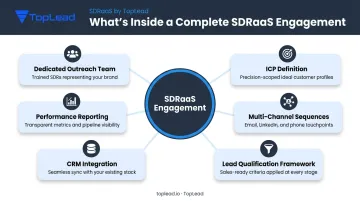
A well-structured SDRaaS engagement typically covers:
- Dedicated outreach team — trained SDRs, a project manager, and quality control support
- ICP definition — target company profile built around firmographics, intent signals, and pain points
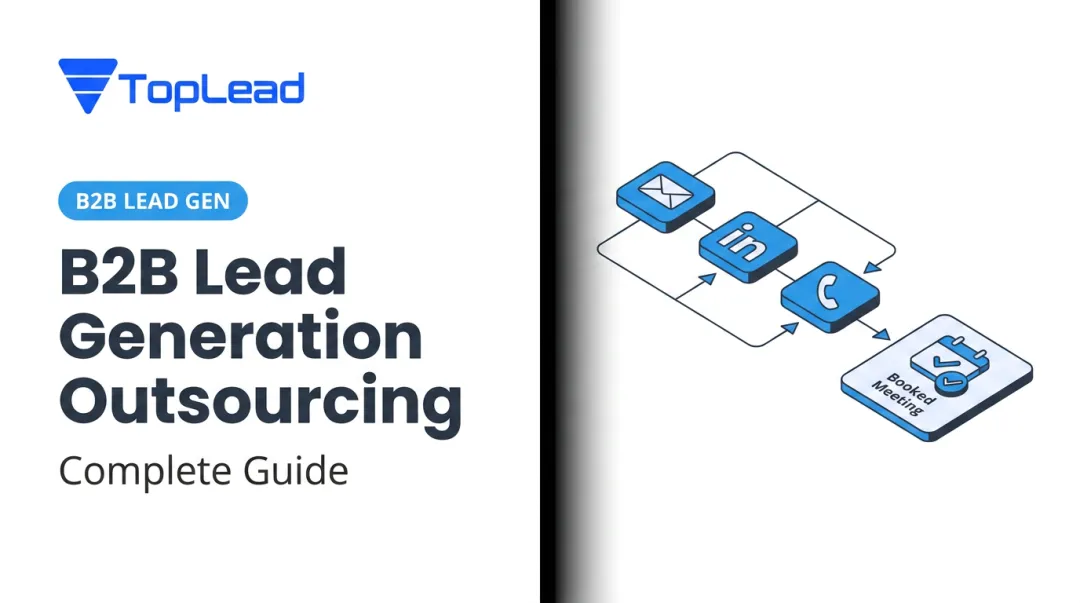
- Multi-channel prospecting sequences — email, LinkedIn, and phone working in coordination
- Lead qualification framework — typically BANT (Budget, Authority, Need, Timeline) or a comparable model
- CRM integration — data logged and synced with platforms like Salesforce, HubSpot, or Pipedrive
- Performance reporting — weekly metrics on outreach activity, meetings booked, show rates, and attribution
The result is a virtual SDR team embedded in your pipeline — not an arms-length vendor, but a function that operates as if it's part of your organization.
How Sales Development as a Service Works
Step 1 — ICP Definition and Target List Building
Every campaign starts with alignment on your Ideal Customer Profile. This includes company size, industry, geography, revenue, technology stack, job titles, and pain points.
Rather than targeting "any SaaS company," a well-defined ICP narrows the focus — for example, software firms between 20 and 150 employees, in a specific growth stage, using particular tools. The tighter the ICP, the more relevant the outreach and the higher the conversion rate downstream.
TopLead builds prospect lists using multi-source American data engines combined with manual verification — fresh, verified contacts only.
Step 2 — Multi-Channel Outreach Sequences
Single-channel outreach underperforms significantly. Salesloft's B2B cadence research found that email-only cadences had 77% lower response rates and call-only cadences had 91% lower response rates than multi-channel approaches.
Each channel serves a distinct role:
- Email — personalized outreach, value-based nurture, and awareness-building
- LinkedIn — relationship development, social proof, and topical engagement
- Phone — direct qualification conversations and timely follow-up with context
TopLead sequences move prospects through three phases: awareness (sharing relevant insights), engagement (personalized follow-up tied to their specific pain points), and conversion (a direct invitation to meet). Each channel reinforces the others as part of a coordinated sequence.
Step 3 — Lead Qualification
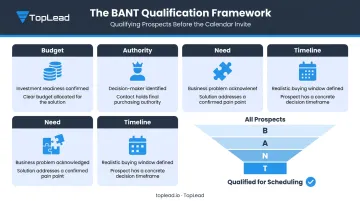
Not every response is a qualified lead. Before any appointment is booked, prospects are screened against a structured qualification framework — BANT:
- Budget — investment readiness, not just price sensitivity
- Authority — decision-maker or strong influencer in the buying process
- Need — a clear, acknowledged business problem your solution addresses
- Timeline — a realistic window for moving forward
TopLead also qualifies based on ICP fit, engagement level, company size, and whether the opportunity is genuinely worth a salesperson's time. Only prospects who clear every filter move forward to appointment scheduling.
Step 4 — Appointment Setting and Decision-Maker Verification
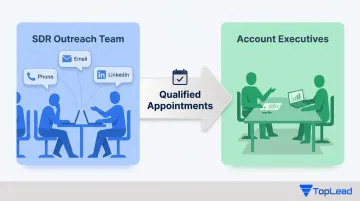
Once a prospect clears qualification, the SDR schedules a confirmed meeting between that prospect and your sales rep or Account Executive. The critical differentiator here is who gets booked.
Many providers hand off meetings with gatekeepers or junior contacts who can't make a buying decision. TopLead verifies that every booked appointment is with an actual decision-maker — business owners, CFOs, HR directors, or relevant executives depending on your product.
If a prospect cancels or no-shows, TopLead reschedules or replaces the appointment at no additional cost.
Step 5 — Reporting, CRM Handoff, and Optimization
At the point of handoff, your CRM receives:
- The booked appointment with calendar confirmation
- Qualification notes — pain points, goals, prior interactions
- Attribution data (which channel drove the conversion)
Weekly performance reports cover contacted vs. replied, meetings booked, call show rates, lead qualification status, and channel-level attribution. Each weekly cycle feeds back into the campaign — adjusting messaging, tightening targeting, and refining sequences so that months two and three consistently outperform month one.
Key Benefits of Outsourcing Sales Development
Faster Pipeline Without the Hiring Lag
Building an in-house SDR team takes time most companies don't have. Between posting the role, interviewing, onboarding, and ramping, you're often looking at 3–4 months before a new SDR produces consistent pipeline — and RAIN Group research puts full productivity for complex sales roles at 6–12 months.
With SDRaaS, most clients begin seeing qualified appointments within 2–4 weeks of campaign launch. The infrastructure — team, tools, sequences, data sources — is already built.
Predictable Costs, Not Hidden Overhead
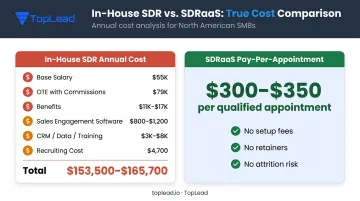
The fully loaded cost of an in-house SDR adds up fast:
| Cost Category | Estimate |
|---|---|
| Base salary (Bridge Group, 2023) | ~$55,000/year |
| OTE including commissions | ~$79,000/year |
| Benefits (typically 20–30% of salary) | $11,000–$17,000/year |
| Sales engagement software | $800–$1,200/year per seat |
| CRM, data tools, training | $3,000–$8,000/year |
| Recruiting cost (SHRM, 2023) | ~$4,700 per hire |
Factor in management time and the 39% annual attrition rate, and the true cost of an in-house SDR function is far higher than the salary line suggests.
TopLead's pay-per-appointment model converts this unpredictable overhead into a known cost: $300–$350 per qualified appointment, with no setup fees, retainers, or hidden costs. You pay for meetings, not headcount.
Your Closers Stay Focused on Closing
Salesforce's 2026 State of Sales report found that sales reps spend only 40% of their workweek actually selling — with 18% of time going to prospecting alone.
When Account Executives handle their own pipeline development, they're doing the most time-consuming, lowest-conversion work at the expense of the highest-value activity: closing. SDRaaS fixes this by ensuring your sales team receives a steady stream of pre-qualified, context-rich meetings — so their time goes where it generates revenue.
Scalability Without the HR Burden
Ramping up an in-house team to enter a new market or respond to a strong quarter means recruiting, hiring, and onboarding — and if the opportunity passes, you're managing layoffs. SDRaaS lets you scale outreach up or down based on market conditions, campaign focus, or seasonal demand, without any of that operational complexity.
That flexibility is built into how TopLead structures engagements. Standard packages deliver 4–6 qualified leads per month for businesses building consistent pipeline, while custom campaigns support companies entering new verticals, targeting enterprise accounts, or running multi-segment outreach.
Access to Specialized Expertise and Proven Playbooks
A strong SDRaaS provider brings institutional knowledge that takes years to build internally. That includes vertical-specific messaging frameworks, objection-handling scripts refined through real conversations, and sequencing strategies tested across thousands of campaigns.
TopLead's playbooks reflect over 25,000 appointments set across dozens of industries. Financial services campaigns lead with operational efficiency and risk management themes. PEO messaging zeroes in on compliance pressure and administrative overload — because those are the actual buyer concerns.
A newly hired in-house SDR simply doesn't arrive with that context. Building it takes months of iteration that most sales teams can't afford to wait on.
In-House SDR Team vs. Sales Development as a Service
| Dimension | In-House SDR Team | Sales Development as a Service |
|---|---|---|
| Upfront cost | High (recruiting, onboarding, tools) | Low (no setup fees with pay-per-appointment) |
| Time to first appointment | 3–6+ months | 2–4 weeks |
| Scalability | Slow; requires hiring/firing | Fast; adjust campaign scope as needed |
| Management burden | High (coaching, performance, retention) | Low (provider manages the team) |
| Tool investment | Separate (CRM, engagement software, data) | Included in engagement |
| Accountability | Internal performance management | Provider accountable for appointment quality |
| Attrition risk | High (~39% annual SDR turnover) | None — provider absorbs staffing risk |
In-house SDRs are often the right long-term play for large enterprises with the budget, management capacity, and time to build a dedicated function.
For companies that need pipeline now, are testing a new market, or lack the internal infrastructure to support an SDR team, SDRaaS is typically the faster and more cost-effective path.
Many companies run both: an outsourced SDR function fills the top of the funnel while an internal team handles warm leads and closes deals. This hybrid approach combines the speed of outsourced prospecting with the long-term capability building of an in-house team.
Who Benefits Most from Sales Development as a Service?
SDRaaS delivers the strongest results for:
- B2B companies without a dedicated outbound function — no existing SDR team, no outreach infrastructure
- Startups and growth-stage companies that need pipeline quickly without adding headcount
- Established businesses entering new markets where they lack existing relationships or brand recognition
These companies span several verticals where SDRaaS has a particularly strong track record.
Industries Where SDRaaS Consistently Performs
- Financial services and wealth management — Financial advisors spend nearly 20% of their time on business development. Outsourcing prospecting reclaims that time for client-facing work. (Clients include Edward Jones, UBS, Wells Fargo Advisors, LPL Financial, and Raymond James.)
- Insurance and employee benefits — Buyers need multiple touchpoints before they engage. A multi-channel sequence is far more effective than a single cold call, which is why clients like Aflac, Hub International, and AON have used this approach.
- SaaS and technology — Median B2B SaaS sales cycles run 6 months with ACVs around $56,000–$62,000. At that deal size, qualified top-of-funnel activity pays for itself quickly.
- Professional services (accounting, consulting, legal) — Buyers prefer referrals but respond to peer-level, insight-led outreach tied to their actual pain points. TopLead typically sees ROI within the first 90 days for these firms.
- PEO and HR outsourcing — NAPEO data shows PEO clients grow at more than twice the rate of comparable employers — attractive category, crowded market. Consistent top-of-funnel activity is the differentiator.
Who SDRaaS Is Not Right For
- Businesses with a purely inbound model that generates sufficient pipeline without outbound
- Companies with very short transactional sales cycles that don't require a qualification step
- Organizations that aren't yet positioned to close the meetings that would be booked — if your sales process isn't ready, booked appointments won't convert
How to Choose the Right Sales Development as a Service Partner
Evaluation Criteria
Ask any prospective provider these questions before signing:
- How do you define a qualified appointment? If the answer is vague, the appointments will be too.
- Do you verify decision-maker access before booking? This is the single biggest quality differentiator between providers.
- What does your replacement or reschedule guarantee cover? A no-show policy reveals how confident the provider is in their own quality standards.
- Can I see real outreach sequences? Opaque providers with templated, generic scripts are a warning sign.
- What CRM platforms do you integrate with? No integration means manual data entry and slower follow-up.
- How do you report on performance? You need visibility into activity, messaging outcomes, and attribution — not just a monthly meeting count.
Red Flags to Watch For
- Volume-over-quality positioning ("hundreds of leads per month" with no qualification criteria)
- No clear definition of what constitutes a qualified appointment
- Generic outreach scripts not tailored to your ICP or industry
- No CRM integration or reporting transparency
- Overpromising guaranteed sales without explaining the qualification process
- Missing compliance mentions (CAN-SPAM, TCPA, the National Do Not Call Registry) — non-compliant outreach creates legal exposure for US campaigns
What a Results-Focused SDRaaS Model Looks Like
TopLead runs on a pay-per-appointment model, meaning you pay for confirmed meetings — not contact lists or activity reports. Here's what that looks like in practice:
- Over 15 years of B2B experience, with 25,000+ appointments arranged across North America
- 4–6 qualified leads per month through multi-channel outreach (email, LinkedIn, and phone)
- Every appointment verified with a confirmed decision-maker before it hits your calendar
- Cancellations and no-shows rescheduled or replaced at no additional cost
- No long-term contracts required
Ultimately, what separates a quality SDRaaS partner from a mediocre one is accountability: can they clearly define "qualified," consistently deliver on it, and back it up when things go sideways?
Frequently Asked Questions
What does Sales as a Service mean?
"Sales as a Service" is a broad model where a third-party provider manages part or all of the sales function — from prospecting through to closing — on behalf of a business. SDRaaS is a subset of this, focused specifically on the top-of-funnel activities before a deal is handed to a closer.
What is the difference between an in-house SDR and a Sales Development as a Service provider?
An in-house SDR is a full-time employee you recruit, train, manage, and retain. A SDRaaS provider is an external team that brings its own processes, tools, and expertise, delivering qualified appointments without the overhead of employment costs or the ongoing risk of attrition.
How much does Sales Development as a Service typically cost?
Pricing varies by model. Retainer-based engagements often start around $8,000–$10,000 per month. Pay-per-appointment models, like TopLead's, average $300–$350 per qualified appointment — with no setup fees or long-term contracts.
How quickly can a Sales Development as a Service team start booking meetings?
Most providers can begin outreach within 2–4 weeks of ICP alignment and onboarding. TopLead clients in accounting and 401(k) advisory typically see their first appointments within 2–3 weeks of campaign launch. That's a fraction of the 3–6 months it typically takes to hire and ramp an in-house SDR.
What industries benefit most from Sales Development as a Service?
SDRaaS delivers the strongest results in B2B industries with longer sales cycles and high average contract values — financial services, SaaS, insurance and employee benefits, professional services (accounting, consulting, legal), PEO/HR outsourcing, and healthcare technology.
How do I know if the leads I receive are truly qualified?
A quality provider applies a structured qualification framework (such as BANT) and verifies that the booked contact is an actual decision-maker with authority to buy. Before signing with any provider, ask exactly how they define a "qualified appointment" — and whether they offer a replacement guarantee if a booking doesn't meet that standard.