Introduction
Financial advisors are among the highest-value revenue producers in any wealth firm. Yet Cerulli's Q2 2025 research shows advisors spend just 3 hours per week actively prospecting in a 40-hour work week — while burning 9 hours on administrative tasks. For a professional billing at advisory rates, that's a costly misalignment of time.
Outsourcing back-office and investment operations has been standard practice for years. What's changed is that growth-oriented firms are now applying the same logic to the top of their pipeline: outsourcing prospecting, outreach, and appointment setting to specialized teams built specifically for this function.
This article breaks down five concrete, operations-focused reasons wealth firms are making that shift, and what separates firms that execute it well from those that don't.
Key Takeaways
- Outsourced sales teams handle prospecting and appointment setting so advisors focus on closing and client relationships
- Wealth-specific expertise means outreach is built for compliance constraints, HNW audiences, and financial services gatekeepers
- Pay-per-appointment pricing replaces fixed hiring costs with fees tied directly to results
- Every appointment arrives verified — decision-makers only — which compresses sales cycles and lifts close rates
- No long-term contracts allow firms to scale up or down without the obligations of full-time headcount
What Is an Outsourced Sales Team for Wealth Firms?
An outsourced sales team (typically a specialized SDR or appointment-setting partner) takes on top-of-funnel sales activities that wealth firms need but rarely execute consistently in-house. The output is sales-ready meetings with qualified prospects — not brand impressions, raw contact lists, or unverified leads. This includes:
- Prospecting and multi-channel outreach (email, phone, LinkedIn)
- Lead qualification and decision-maker verification
- Calendar booking with confirmed, scheduled appointments
The outsourced team handles everything before the first advisor conversation. Advisors engage only with prospects who have already been qualified, confirmed, and scheduled — which is precisely where most in-house prospecting efforts break down.
Firms like TopLead, a U.S.-based team that has arranged over 25,000 appointments across wealth management, RIA, and financial services clients including Edward Jones, UBS, Wells Fargo Advisors, and Raymond James, operate precisely in this space: delivering confirmed appointments rather than raw leads, on a pay-per-appointment basis with no long-term contract required.
5 Strategic Reasons Wealth Firms Hire Outsourced Sales Teams
Reason 1: Prospecting Expertise Built for Financial Services
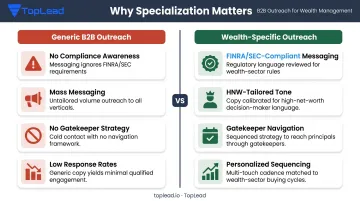
Wealth management prospecting is categorically different from standard B2B outreach. It demands a specific skill set most generalist sales teams don't have:
- Navigating gatekeepers at family offices and corporations
- Communicating credibly with HNW individuals and business owners
- Respecting compliance constraints under FINRA Rule 2210 and SEC Advisers Act requirements
- Matching tone and timing to a high-trust, high-scrutiny environment
Generic outreach in financial services erodes credibility fast. Specialized outsourced teams enter with messaging frameworks, segmentation methodologies, and outreach sequences already refined for financial services audiences — no learning curve, no compliance missteps.
Research from HubSpot shows personalized cold outreach can increase response rates by up to 26%, and 78% of decision-makers have arranged meetings based on relevant outreach. The operative word is relevant — generic sequences don't move prospects in a relationship-driven industry.
KPIs directly impacted:
- Appointment conversion rate
- Outreach response rate
- Lead quality entering the pipeline
- Advisor hours spent on prospecting
When this matters most: Firms moving from referral-only growth to structured prospecting, advisors entering new segments (corporate retirement plans, business owners), or teams expanding into institutional channels.
Reason 2: Predictable Pipeline Without In-House Build Costs
Building an internal SDR function means hiring, onboarding, training, managing, and retaining sales development reps. According to TOPO's benchmark data, the average SDR ramp time to full quota is 3.2 months — and average tenure sits at just 15.5 months. By the time a rep is fully productive, the firm may be preparing for their departure.
The all-in cost adds up fast. Glassdoor's 2025 data puts median US SDR total pay at $103,000 annually. Factor in BLS-reported benefits (29.9% of compensation), tools, recruiting fees, and management overhead, and a single SDR runs $140,000–$160,000 per year — before booking a single qualified meeting.
Outsourced models, particularly pay-per-appointment structures, shift that entirely. TopLead's average cost per appointment falls between $300 and $350 — a variable cost tied directly to delivered results rather than fixed headcount. For a firm receiving 4–6 qualified appointments per month, that's a predictable acquisition cost with no sunk cost risk.
KPIs directly impacted:
- Cost per appointment
- Cost per acquired client
- Pipeline velocity
- Monthly qualified leads generated
When this matters most: Growth-stage RIAs and boutique firms that can't justify an internal SDR build but need consistent pipeline activity to hit AUM targets.
Reason 3: Verified Decision-Maker Access and Lead Qualification
One of the most expensive inefficiencies in wealth management sales is time spent in appointments with the wrong person — wrong role, wrong asset level, no decision-making authority. That wasted meeting costs advisor time, delays the pipeline, and lowers overall close rates.
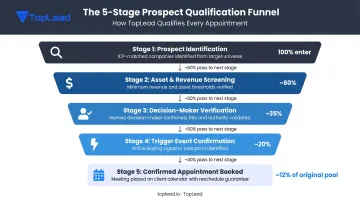
Specialized outsourced teams qualify prospects before any meeting is booked. TopLead's process, for example, filters prospects across investable assets, business revenue, decision-maker role, current advisor relationships, and trigger events (such as a pending business sale, liquidity event, or retirement transition). No meeting goes on the calendar until those criteria are confirmed.
Kitces research from 2024 identifies that effective advisor sales processes target a qualified-lead rate of 75% and a conversion rate of 50%–80% for qualified prospects. The gap between that and what self-prospecting advisors typically achieve is where outsourced qualification creates measurable value.
For corporate retirement plan pursuits, business owner prospects, or institutional channels, the entry point matters as much as the pitch. Walking in through a receptionist or a junior HR coordinator often ends the opportunity before it starts.
KPIs directly impacted:
- Close rate
- Sales cycle length
- Advisor hours per closed client
- Appointment-to-client conversion ratio
Reason 4: Scalability Without Long-Term Hiring Risk
Wealth firm growth is rarely linear. AUM inflows spike with market conditions. New service lines open new prospect segments. Geographic expansion creates temporary demand for concentrated prospecting activity. An internal sales team cannot flex to match those dynamics without significant cost and disruption.
Outsourced teams solve this structurally. Prospecting activity scales up during expansion phases and pulls back during consolidation — no severance costs, no underutilized headcount, no termination disruption.
The 2025 Schwab RIA Benchmarking Study found that 78% of RIA firms reported hiring in 2024, with recruiting ranked as the second-highest strategic priority. That pressure exists precisely because talent is difficult to acquire and retain — making flexible, outcome-based outsourcing a practical relief valve.
TopLead's no-long-term-contract model adds another layer of flexibility. Firms can engage on standard monthly packages or build custom campaigns around specific segments or growth initiatives, then adjust scope as results and priorities evolve. No exit penalties, no rigid commitments.
KPIs directly impacted:
- Pipeline capacity vs. growth phase alignment
- Cost per campaign vs. fixed headcount cost
- Time-to-market for new segment outreach
- Headcount risk exposure
Reason 5: Advisors Focus on Closing, Not Prospecting
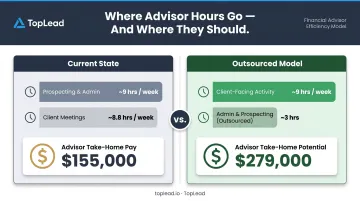
The opportunity cost of advisor-led prospecting is more significant than most firms calculate. Kitces research found that business development and marketing consume roughly 9 hours per week for lead advisors — compared to approximately 8.8 hours spent in actual client meetings.
Prospecting and client meetings are consuming nearly identical shares of advisor time — which means revenue-generating work is competing with pipeline-building work for the same hours.
Every hour an advisor spends on cold outreach, scheduling, and initial qualification is an hour not spent on discovery conversations, client reviews, referral cultivation, or proposal delivery — the activities that directly produce revenue and deepen retention.
The numbers behind that shift are substantial:
- Kitces found that freeing advisor capacity through support roles can raise a lead advisor's take-home pay from $155,000 to $279,000 by enabling them to serve more clients
- McKinsey's 2025 analysis estimated that centralizing lead generation can free 3%–4% of advisor capacity — meaningful in an industry facing a projected shortage of 100,000 advisors by 2034
When advisors work exclusively from pre-qualified, pre-scheduled appointments, conversion rates improve and client relationships deepen faster — creating a growth trajectory that referral-only models struggle to match.
What Happens When Wealth Firms Skip the Outsourced Sales Model?
The most common alternative is advisors self-prospecting on an inconsistent, reactive basis. Pipeline slows when advisors are busy with existing clients, then spikes when they have capacity. That boom-bust rhythm makes revenue forecasting nearly impossible.
The risks compound over time:
- Over-reliance on referrals: Cerulli's 2026 research shows 54.2% of new clients come from client, friend, or family referrals. That channel is variable, hard to systematize, and insufficient for firms with aggressive AUM growth targets.
- Unqualified meetings drain capacity: Without structured qualification, advisors absorb low-probability appointments that raise effective acquisition costs and lower close rates across the board.
- Growth becomes reactive, not planned: Firms delay building scalable prospecting infrastructure until growth slows — then face a 3–6 month lag before any structured prospecting program produces results.
Referrals will always matter in wealth management. But firms that rely on referrals alone give up control over their own growth trajectory — and when referral flow slows, there's no pipeline to fall back on.
How to Get the Most Value from an Outsourced Sales Partner
Outsourced sales partnerships produce better results when firms do the upfront work. That means entering the relationship with clearly defined target client criteria — minimum asset thresholds, industry focus, geography, decision-maker roles, and qualifying trigger events. The more precisely an outsourced team can filter, the higher the appointment quality.
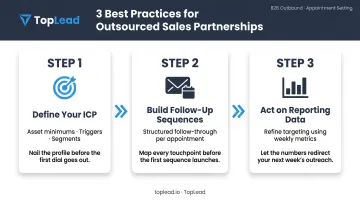
Three practices that separate high-performing engagements from average ones:
Document your ICP before launch. Firms that arrive with defined ideal client profiles — asset minimums, company size, prospect triggers — see faster ramp-up and fewer wasted appointments than those leaving targeting to the vendor.
Build follow-up sequences around each appointment. Outsourced meetings generate value only when advisors follow through promptly and personally. Structured follow-up sequences drive significantly higher conversion rates than treating each meeting as a one-off event.
Review reporting data to refine targeting, not just track outcomes. Weekly metrics — contacted-to-replied ratios, show rates, channel attribution across LinkedIn and email — reveal which segments and messages are working. TopLead provides this data in real time, and firms that act on it consistently improve performance over the course of a campaign.
That optimization loop works best when appointment data doesn't sit in a separate system. CRM integration with platforms like Salesforce, HubSpot, or Pipedrive pushes meeting details directly into the firm's existing workflow — eliminating manual entry and keeping the full pipeline visible in real time.
Conclusion
Firms that outsource sales development do so because they understand the economics of pipeline building — and the real cost of advisor time spent prospecting instead of advising.
The five advantages reinforce each other and compound over time:
- Predictable pipeline produces consistent AUM growth
- Qualified appointments improve close rates and shorten sales cycles
- Freed advisor capacity deepens client relationships and drives referrals
Together, these create a structural edge over competitors still relying on self-prospecting and referral networks alone.
Firms that build this capacity early avoid both the cost of an internal SDR build and the lost growth that comes from delayed action. Firms that keep waiting on structured prospecting don't just grow slower — they hand appointments and AUM directly to competitors who already made the move.
Frequently Asked Questions
What is an outsourced sales team for financial wealth firms?
An outsourced sales team handles prospecting, outreach, lead qualification, and appointment setting for a wealth firm, delivering confirmed meetings with verified decision-makers directly to the advisor's calendar. Advisors receive pre-qualified appointments and focus exclusively on converting them.
How much does an outsourced sales team cost compared to hiring in-house?
In-house SDRs carry all-in costs of $140,000–$160,000+ annually when salary, benefits, tools, and recruiting overhead are included. Pay-per-appointment models like TopLead's convert that fixed cost into a variable one, with appointments averaging $300–$350 each — so the firm pays only for delivered results.
How long does it take to see results from an outsourced sales team?
Specialized teams with existing financial services playbooks typically begin generating qualified appointments within the first few weeks of onboarding. Full campaign momentum generally builds over a 3–6 month lifecycle as messaging is refined and targeting tightened.
Can outsourced sales teams comply with financial industry regulations?
Experienced US providers build compliance into every touchpoint, covering CAN-SPAM, TCPA, and do-not-call requirements. TopLead incorporates trust-and-compliance-aware messaging specifically tailored to the fiduciary and regulatory environment wealth firms operate in.
What should wealth firms look for when choosing an outsourced sales partner?
Prioritize financial services specialization, a documented qualification process, transparent reporting and CRM integration, a pay-for-performance model with a reschedule or replacement guarantee, and a client list that includes recognizable wealth management firms.
Is outsourced sales appropriate for small or solo advisory practices?
Yes. Smaller firms and solo practitioners benefit most from consistent pipeline activity without the overhead of a full internal hire. Look for a partner offering flexible, no-long-term-contract engagement that scales with your practice.