The confusion is understandable. Both involve outreach, both target prospects, and both feed the sales process. But they operate at different funnel stages, produce different outputs, and require different benchmarks to evaluate. Conflating them means you might invest heavily in filling a pipeline that still isn't converting — or try to book meetings with contacts who were never properly qualified in the first place.
According to Salesforce, sales reps already spend 60% of their time on non-selling tasks, with lead research alone consuming 21% of their workday. Choosing the wrong strategy — or the wrong sequence — compounds that problem directly.
This article breaks down exactly what each strategy does, where it fits in the funnel, and how to identify which one (or which combination) your pipeline actually needs right now.
Key Takeaways
- Lead generation identifies, attracts, and qualifies prospects matching your Ideal Customer Profile — it fills the top of the funnel.
- Appointment setting converts qualified prospects into booked meetings with verified decision-makers.
- Lead generation builds long-term pipeline volume; appointment setting delivers faster, more measurable ROI by moving leads to the decision stage.
- The right choice depends on where your pipeline is actually breaking down — not on which strategy sounds more appealing.
- The strongest B2B revenue programs run both in sequence — lead generation feeds the pipeline, appointment setting converts it.
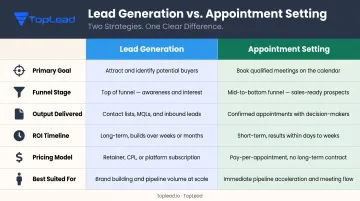
Appointment Setting vs. Lead Generation: Quick Comparison
Before diving into the mechanics of each, here's how they stack up across the dimensions that matter most for ROI decisions:
| Dimension | Lead Generation | Appointment Setting |
|---|---|---|
| Primary Goal | Identify and qualify prospects | Convert qualified prospects into meetings |
| Funnel Stage | Top of funnel | Middle of funnel |
| Output Delivered | Engaged contact list with intent scores | Confirmed calendar events with decision-makers |
| ROI Timeline | 3–6+ months | Weeks to 90 days |
| Pricing Model | Retainer or flat fee | Pay-per-appointment |
| Best Suited For | New markets, undefined ICP, pipeline building | Active sales teams with qualified pipeline that isn't converting |
These two functions work in sequence, not competition. Running lead generation without appointment setting leaves qualified contacts stalled in the funnel. Running appointment setting without solid lead generation means booking meetings with poorly fitted prospects who waste your sales team's time.
The pricing model distinction carries real ROI implications. Flat-fee lead generation places risk on the buyer: you pay regardless of lead quality. Pay-per-appointment models tie cost directly to qualified meetings held, making the ROI calculation far more transparent and predictable.
What Is Lead Generation?
B2B lead generation is the systematic process of identifying, researching, and engaging prospective buyers who match your Ideal Customer Profile. It goes beyond purchasing a contact list — it includes data validation, personalized multi-channel outreach, and lead scoring before any handoff to sales.
Core Lead Generation Activities
- Define your ICP and map your total addressable market before outreach begins
- Initiate contact with cold or warm prospects via email, LinkedIn, and phone
- Attract inbound buyers through content and digital campaigns targeting active searchers
- Filter contacts by fit and intent through lead capture and qualification scoring
Each of these activities feeds into core metrics: reply rate, lead-to-opportunity conversion, and cost per lead. Belkins' 2024 benchmark report, based on 7.5 million client emails across 40 industries, found a 27.7% average open rate and a 5.1% average reply rate for B2B cold outreach — useful context for setting realistic expectations at this stage.
The Core Limitation of Lead Generation Alone
A reply or an opt-in signals interest, not readiness. Without a structured follow-up process, even high-quality leads stall. Research from InsideSales analyzing 5.7 million inbound leads found that conversion rates are 8x higher when response occurs within the first five minutes, but only 0.1% of leads were actually engaged that quickly. Lead momentum decays fast, and most organizations lack the process to capture it.
Use Cases for Lead Generation
Lead generation should be the primary investment when:
- You're an early-stage company that hasn't yet validated your ICP
- You're entering a new market or vertical with no existing prospect database
- Your CRM is outdated, sparse, or populated with contacts outside your current target profile
- You operate in a long nurture cycle (financial services, SaaS, insurance) where building familiarity before a sales call meaningfully improves downstream conversion
Once your pipeline foundation is in place, the question shifts from who to contact to how to convert them — which is where appointment setting takes over.
What Is Appointment Setting?
Appointment setting is the downstream process of taking qualified leads and converting them into scheduled, confirmed meetings between a verified decision-maker and your sales team. It's not cold calling at scale. It's a structured qualification-and-booking function that requires human judgment, objection handling, and disciplined follow-through.
Core Appointment Setting Activities
- Reviewing inbound and outbound responses for genuine buying intent
- Manually qualifying prospects against ICP criteria — authority, budget, pain point, timeline
- Booking meetings directly to the sales team's calendar with confirmed prospects
- Sending multi-channel reminders to protect show rates
Show rate is the metric that separates quality appointment setting from calendar stuffing. Filling a calendar with meetings that don't show up creates the illusion of pipeline without producing revenue.
What Separates High-Quality Appointment Setting
Three factors consistently distinguish effective programs:
- Confirming the prospect holds actual purchasing authority — not just a relevant job title
- Combining email, phone, and LinkedIn to build familiarity across touchpoints before the meeting
- Tying cost to qualified meetings held, not activity volume
Our pay-per-appointment model, delivered by U.S.-based SDR teams, reflects this accountability-first structure. Clients pay only for confirmed meetings with verified decision-makers — and if a prospect cancels or doesn't show, the appointment is rescheduled or replaced at no additional cost.
Our benchmark of 4–6 qualified decision-maker meetings per month, at an average cost per lead of $300–$350, gives clients a clear, measurable standard for what ROI-transparent appointment setting looks like.
Use Cases for Appointment Setting
Appointment setting delivers the highest ROI when:
- Your ICP is defined and your CRM has qualified contacts that aren't converting to meetings
- Your sales team is spending disproportionate time on prospecting instead of closing
- You operate in a high-value vertical — financial services, insurance, SaaS, PEO, or professional services — where a single closed deal from one qualified meeting justifies meaningful upfront investment
- Deal complexity is high and a live conversation with the right decision-maker is a prerequisite for advancing the sale
Key Differences That Impact ROI
Output and Measurability
Lead generation produces engaged contacts at varying levels of intent — success is measured by volume and lead quality scores. Appointment setting produces confirmed calendar events with verified decision-makers — success is measured by appointments held, show rate, and conversion to opportunity.
The latter is far easier to tie directly to revenue. A booked meeting with a confirmed decision-maker has a calculable pipeline value. A contact who opened an email does not.
Cost Structure and Risk Allocation
| Model | Who Bears the Risk | Payment Trigger |
|---|---|---|
| Flat-fee lead generation | The buyer | Cost incurred regardless of lead quality |
| Pay-per-appointment | The provider | Payment tied to qualified meetings held |
SalesAR's 2025 pricing guide — drawing on data from 650+ clients — puts qualified B2B appointment costs in the $350–$700 range per meeting. Clutch directory data cites $550–$1,700 depending on ICP complexity and seniority. Evaluate any cost-per-appointment figure against your average deal value, not in isolation.
Pipeline Predictability
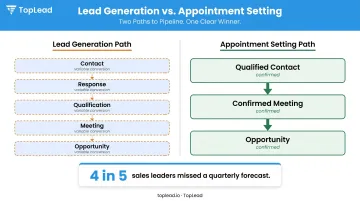
Xactly's 2024 Sales Forecasting Benchmark Report found that 4 in 5 sales and finance leaders missed a quarterly forecast in the prior year, with 52% reporting forecasts off by 10% or more. A significant driver: 60% of leaders were unsure of the quality of their pipeline data.
Appointment setting directly addresses this by delivering a defined number of qualified meetings within a set campaign window. That structure creates more forecastable pipeline than lead generation alone, where the path from contact to meeting to opportunity involves multiple uncertain conversion steps.
For companies with quarterly revenue targets or lean sales teams, that predictability translates directly into organizational confidence — not just better forecasts, but faster resource allocation decisions.
Quality vs. Quantity Tradeoff
Lead generation and appointment setting optimize for different things at different funnel stages:
- Lead generation: maximizes volume at the top of the funnel; ROI is longer-term and more indirect
- Appointment setting: maximizes conversion quality in the middle and bottom; ROI is compressed and directly measurable
Neither approach is broken. They serve different goals — and the right choice depends on where your pipeline is weakest.
Which Strategy Is Right for Your Business?
The answer starts with a simple diagnostic: where is your pipeline actually breaking down?
Identify Your Bottleneck First
Top-of-funnel bottleneck — Your CRM is empty, stale, or filled with contacts outside your current ICP. You have no consistent inflow of qualified prospects. Start with lead generation before anything else.
Mid-funnel bottleneck — Your CRM has qualified contacts but meetings aren't getting booked. Your sales team is spending significant time on prospecting instead of closing. Appointment setting will unlock faster pipeline velocity with the prospects you already have.
Guidance by Business Stage
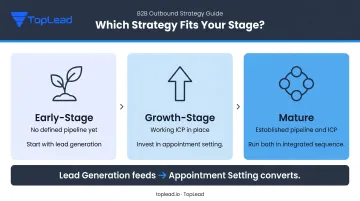
| Stage | Situation | Recommended Approach |
|---|---|---|
| Early-stage | No defined pipeline, unvalidated ICP | Start with lead generation to build and validate your prospect database |
| Growth-stage | Working ICP, inconsistent meeting flow | Invest in appointment setting to accelerate pipeline velocity |
| Mature | Active sales team, established pipeline | Run both in an integrated sequence — lead generation continuously feeds appointment setting |
The ROI Case for Combining Both
When lead generation and appointment setting operate as connected functions — with shared ICP data, aligned messaging, and a defined handoff process — every appointment is built on a verified, qualified foundation. Sales conversations happen with the right contacts at the right time, not whoever happened to respond to an email.
Consider a group health insurance agency running a broad outbound email campaign. They generate contacts but struggle to convert them into conversations — not because of low volume, but because the outreach isn't reaching decision-makers with actual authority over benefits decisions.
Shifting to a structured appointment setting program with defined qualification criteria typically produces fewer total contacts but far more meetings that advance toward a close.
That's the model TopLead, a 100% US-based agency, runs across financial services, insurance, SaaS, and PEO — with lead generation and appointment setting connected from ICP development through calendar delivery. Having arranged over 25,000 appointments, their 3–6 month campaign lifecycle gives the integrated approach enough runway to build consistent, compounding pipeline momentum.
If your sales team is closing deals but struggling to get in front of the right decision-makers consistently, the bottleneck is appointment setting — not effort. TopLead's pay-per-appointment model — with a reschedule/replacement guarantee and no long-term contract — offers a low-risk way to build predictable pipeline.
Conclusion
Neither strategy is universally superior. Lead generation fills your pipeline with prospects. Appointment setting turns those prospects into conversations. The right choice depends on where your pipeline is breaking — and what stage of growth you're in.
The businesses that shorten sales cycles and improve close rates don't pick one strategy over the other. They understand what each one does, sequence them correctly, and run them together. When that sequencing is right, every meeting is backed by real qualification — and every prospecting dollar has a clear path to closed revenue.
If you're evaluating where appointment setting fits into your outbound strategy, TopLead's pay-per-appointment model is built around exactly this: qualified meetings with verified decision-makers, no long-term contracts, and a direct line between outreach investment and pipeline results.
Frequently Asked Questions
What is lead generation appointment setting?
Lead generation appointment setting refers to the end-to-end process of identifying qualified prospects through lead generation, then converting those prospects into booked sales meetings through appointment setting. The two functions work in sequence — lead generation fills the pipeline, appointment setting activates it.
What is the difference between lead generation and appointment setting?
Lead generation attracts and qualifies prospects at the top of the funnel, producing engaged contacts. Appointment setting converts those contacts into confirmed meetings with verified decision-makers at the mid-funnel stage. The output differs: one produces a list, the other produces calendar events.
Which delivers better ROI: lead generation or appointment setting?
Appointment setting typically delivers faster and more directly measurable ROI because cost is tied to qualified meetings held. Lead generation builds longer-term pipeline value. Companies running both in sequence — where lead generation feeds a qualified appointment pipeline — consistently see stronger pipeline conversion rates than those using either function alone.
Can lead generation and appointment setting work together?
Yes — they're built to complement each other. Lead generation fills the pipeline with qualified prospects; appointment setting moves those prospects into sales conversations with verified decision-makers. Companies integrating both consistently see stronger pipeline conversion than those running either function alone.
How much does B2B appointment setting cost?
Costs vary by model. Retainer-based programs typically run $3,000–$10,000+ per month. Pay-per-appointment models charge per qualified meeting held — commonly $300–$700 per meeting depending on ICP complexity and target seniority. Compare cost per appointment against your average deal value to assess true ROI.
When should a B2B company choose appointment setting over lead generation?
Choose appointment setting when you have a defined ICP and a sales team ready to close, but your pipeline isn't converting into meetings. It's particularly effective in financial services, insurance, SaaS, and PEO — verticals where one closed deal far exceeds the cost of a single appointment.