Introduction
Most B2B lead generation problems aren't outreach problems. They're targeting problems.
Sales teams send hundreds of emails and make dozens of calls, only to hear silence — or worse, book meetings with contacts who have no budget authority, no relevant need, or no decision-making power. The outreach wasn't bad. The audience was wrong.
According to a 2025 Gartner survey of 632 B2B buyers, 73% actively avoid suppliers who send irrelevant outreach. That's not a response rate problem — it's an audience definition problem, and it removes you from consideration before a conversation even starts.
Audience definition controls who you reach, how you message them, and whether outreach converts into real pipeline. The five methods below build on each other — moving from broad account filters to increasingly precise signals that identify accounts most likely to buy right now.
Key Takeaways
- Firmographic profiling (industry, company size, revenue, geography) creates the baseline account filter before any outreach begins.
- Buyer personas must map to the economic buyer first — the person with actual purchasing authority.
- ICP mining from your best current customers surfaces the patterns that predict fast conversions and strong retention.
- Intent and behavioral data validate which accounts in your defined audience are actively in-market right now.
- Lead scoring and continuous refinement convert your audience definition into an operational system that sharpens with every campaign.
Way 1: Map the Firmographic Profile of Your Ideal Account
Firmographics are the first filter. Before you evaluate intent, persona, or timing, you need to know which types of companies belong on your list at all.
The Four Core Firmographic Dimensions
| Dimension | Why It Matters |
|---|---|
| Industry/Vertical | Determines use case, regulation, pain point relevance, and message language |
| Company Size | Signals buying committee complexity, budget capacity, and service needs |
| Revenue Range | Proxies deal size and whether the account can support your target contract value |
| Geography | Determines legal, coverage, and service fit — and focuses campaign resources |
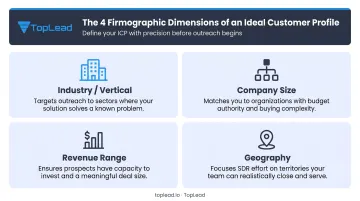
Each variable acts as an inclusion or exclusion filter. Miss one, and your list fills with accounts that technically qualify but practically won't convert — which is exactly why precision matters more than volume.
Why Precision Beats Volume
Targeting all "financial services" companies, for example, is nearly useless as a filter. That category spans retail banks, hedge funds, mortgage brokers, and insurance carriers — all with different budgets, buying processes, and decision-makers.
Narrowing to independent RIAs and wealth management firms with $50M–$500M AUM is a different exercise entirely. The use case is specific, the decision-maker profile is predictable, and you can craft outreach language that matches actual concerns — client acquisition, compliance burden, or practice growth.
TopLead's campaigns targeting regional banks across the United States for professional services clients demonstrate this directly — geographic and firmographic precision contributed to a 3-month sales lifecycle at around $325 cost per lead, faster than comparable national campaigns.
Starting Regional Before Going National
Even companies that sell nationally often find stronger early conversion rates in specific regions — markets where referral density, regulatory environment, or existing relationships create natural momentum. Starting with a tighter geographic radius sharpens campaign efficiency before you scale outward.
TopLead's manufacturing clients, for example, typically begin with regional targeting packages before expanding to national enterprise campaigns — a deliberate sequencing choice that improves early conversion rates and builds momentum before broader rollout.
Way 2: Build Buyer Personas Around the Decision-Makers Who Actually Buy
In B2B, a persona isn't a demographic profile — it's a map of purchasing authority. The real question isn't just who benefits from your solution. It's who controls the budget, who evaluates fit, and who can actually sign off.
The Buying Committee Reality
Forrester's 2024 State of Business Buying research found that an average of 13 people are involved in a B2B buying decision, with 89% of purchases crossing two or more departments. Meanwhile, Forrester also reported that 86% of B2B purchases stall during the process — and a separate Gartner study found 74% of B2B buyer teams experience unhealthy conflict during the decision.
Targeting one title isn't enough. Outreach that lands with a mid-level manager, an influencer without budget authority, or a gatekeeper stalls deals before they start.
The Three Roles That Matter Most
- Economic buyer — signs contracts and owns the budget. Reach them first; everyone else is a relay.
- Technical evaluator — assesses fit and flags risk. They rarely approve deals, but they can easily kill them.
- End user — lives with the outcome daily. Their adoption concerns rarely surface until late in the cycle, often after you think the deal is closed.
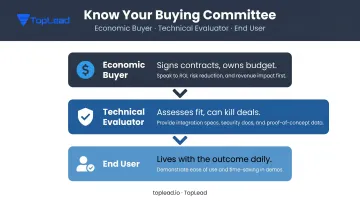
Effective lead generation targets the economic buyer first, with messaging shaped around their business priorities — not just product features.
Building Personas From Evidence, Not Assumptions
Personas built on internal assumptions about who "should" care about your solution often miss who actually buys it. The better approach: pull patterns from closed-won deals in your CRM, interview existing customers, and identify what roles, titles, and seniority levels appear most consistently among buyers who converted quickly and stayed.
TopLead's SDR Outreach model applies this directly. Before any outreach begins, SDRs are briefed on role-specific motivations: a founder typically prioritizes time savings and operational scale, a CFO focuses on cost predictability and risk reduction, and an HR director cares about compliance and employee experience. That differentiation shapes the qualification script from the first call.
Role-specific framing isn't just messaging polish — it determines whether a conversation advances or dies at "send me some information."
Decision-maker verification isn't an afterthought in this model. Before any appointment is booked, U.S.-based SDRs confirm purchasing authority — whether that's a business owner, CFO, controller, or HR director — so clients never spend time in meetings with people who can't move a deal forward.
Way 3: Mine Your Best Current Customers to Build a True ICP
ICP vs. Persona: A Critical Distinction
A buyer persona describes the individual inside a company. An Ideal Customer Profile (ICP) describes the company itself — the type of account most likely to buy, convert quickly, and retain long-term. You need both, but ICP development comes first.
How to Run the ICP Mining Process
Pull your top 10–20 customers by revenue, retention, or deal velocity. Then look for what they share:
- Industry and sub-vertical
- Employee count and revenue range
- Geographic region
- Technology stack
- Ownership structure (private, PE-backed, public)
- Buying trigger that brought them to you
Document those shared attributes. That pattern is your ICP.
Beyond firmographics, look at qualitative signals: How quickly did they move through the sales cycle? How much hand-holding did they require? Did they refer other customers? Did your solution solve their core problem cleanly, or did it require significant customization?
The Gap Between Who You Target and Who Converts
That mining process often surfaces a gap most teams don't expect. Many B2B teams define their ICP based on who they want to reach — often the largest or most prestigious accounts — rather than who has actually converted and retained. The two frequently differ.
Forrester recommends grounding ICP development in customer insights and win-loss analysis rather than assumption-based targeting. Compare target segments against actual closed-won accounts, retention rates, and deal velocity by segment. The data will surface mismatches fast.
TopLead sees this play out repeatedly. When clients arrive without a defined ICP, early campaign results show classic symptoms: targeting drift, broad lists, low response rates, and appointments with contacts who lack buying authority.
One American fintech client came in with a poor-fit pipeline. After TopLead rebuilt outreach around job function, company size, and funding stage, SQL quality rose 45% within three months.
A vague ICP like "any SaaS company" produces weak lists. An ICP built around "software companies with 20–150 employees, using a specific CRM, and currently hiring in RevOps" is immediately actionable.
Way 4: Use Intent and Behavioral Data to Validate Your Audience
The 95-5 Problem
Firmographic targeting identifies who could buy. Intent data narrows that down to who is actively researching right now.
This distinction matters because of what researchers call the 95-5 rule. John Dawes of the Ehrenberg-Bass Institute states that roughly 95% of potential buyers are not in-market at any given time, with only about 5% actively in a buying cycle. Your ICP-matched list likely spans thousands of companies — but only a small fraction are worth immediate outreach this quarter.
Two Layers of Intent Signals
First-party signals (from your own channels):
- Pages visited on your website, especially pricing or solution pages
- Email opens and click-through patterns
- Content downloads and demo requests
- LinkedIn engagement with your posts or ads
Third-party signals (from intent platforms):
- Keyword search activity in your solution category
- Competitor page visits tracked by platforms like Bombora or 6sense
- Content consumption patterns across the broader web
TopLead incorporates both layers — using platforms like 6sense and Bombora alongside engagement tracking across email and LinkedIn — to identify which US mid-market accounts within a defined ICP are showing active research behavior. The result: SDR time and budget shift toward accounts with a real chance of converting this quarter, not next year.
Building a Tiered Priority System
Not all ICP-matched accounts deserve the same urgency. A practical framework:
- Tier 1 (Immediate outreach): Matches ICP and shows active intent signals — recent site visits, content downloads, keyword activity, or competitor research
- Tier 2 (Structured nurture): Matches ICP but shows no current intent signals — maintain visibility with consistent touchpoints until buying behavior emerges
- Tier 3 (Monitor only): Partial ICP match — track for firmographic changes (funding, hiring, leadership transition) that might trigger a move to Tier 1
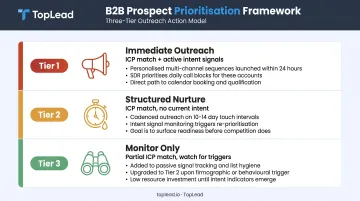
Treating a 5,000-account ICP list as one uniform outreach target is one of the fastest ways to exhaust a pipeline budget. The tiered model keeps high-intent accounts prioritized — and keeps lower-priority accounts warm until their timing changes.
Way 5: Score Leads and Continuously Refine Your Audience Definition
Turning Audience Definition Into an Operational System
Lead scoring translates everything in Ways 1–4 into a prioritization model. Each account or contact receives a score based on three input categories:
- Explicit fit: Company size, industry, revenue range, role, and seniority (firmographic match)
- Implicit behavior: Email replies, call engagement, LinkedIn response, meeting acceptance
- Urgency signals: Stated timelines, leadership involvement, expressed pain points
Higher scores trigger faster, more direct outreach. Lower scores enter nurture sequences. Forrester's guidance on lead scoring frames it as a testable model: scoring works when higher-scored leads convert to closed-won business more often than lower-scored leads. If they don't, the model needs adjustment — not just more volume.
Treating Audience Definition as a Living Document
Your ICP and scoring criteria are not a one-time deliverable. Campaign data surfaces patterns continuously, and those patterns should feed back into your targeting on a defined cadence.
Metrics that signal your audience definition needs revision:
| Metric | What It Reveals |
|---|---|
| Response rate by segment | Low rates suggest firmographic or persona misalignment |
| No-show rate on appointments | High rates indicate verification gaps or wrong authority level |
| Sales cycle length by industry | Slow segments may signal poor fit or wrong buying stage |
| Win rate by company size tier | Reveals whether your ICP skews too large or too small |
| Retention by segment | Separates attractive prospects from durable customers |
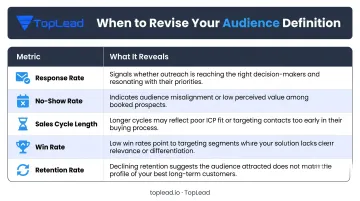
Tracking these metrics consistently is what separates reactive campaigns from ones that improve over time. TopLead reports on them weekly for active campaigns, using performance shifts to trigger ICP refinements mid-campaign rather than waiting for a quarterly post-mortem. When a logistics software client split outreach into industry-specific cadences with role-differentiated messaging, response rates improved 8x through audience refinement, not higher volume.
Quarterly reviews are a floor, not a ceiling. The more reliable trigger is the data itself: when response rates drop, win rates shift, or deal velocity slows in a segment you previously trusted, pull the audience definition back up and pressure-test every assumption in it.
Frequently Asked Questions
How do you define a B2B target market?
Defining a B2B target market starts with firmographic criteria (industry, company size, revenue, and geography) to identify which types of businesses your solution serves. Layer on the specific roles and decision-makers within those companies who hold purchasing authority, and you have both sides of the targeting equation.
What is the 95-5 rule for B2B?
At any given moment, roughly 95% of your B2B target market is not actively looking to buy — only about 5% is in an active buying cycle. Intent data and behavioral signals help identify which accounts to prioritize for immediate outreach versus long-term nurture.
What is the 3-3-3 rule in marketing?
The 3-3-3 rule is a targeting heuristic that encourages focusing on the right audience segments, with the right value propositions, through the right outreach channels. The underlying principle: audience definition must come before campaign execution.
What is the difference between a B2B buyer persona and an ICP?
An ICP describes the type of company that is the best fit for your solution (defined by firmographic attributes like industry, size, and revenue). A buyer persona describes the specific individual within that company who makes or influences the purchase decision. Without both, outreach often reaches the right company with the wrong message — or the right message to the wrong person.
How often should you update your B2B target audience definition?
Quarterly reviews are a practical minimum. More useful triggers include significant drops in response rates, declining win rates by segment, or any meaningful shift in your product offering, pricing, or go-to-market focus.
What firmographic data points matter most for B2B lead generation?
The highest-impact firmographic filters are industry/vertical, company size (employee count or annual revenue), geographic location, and ownership structure. The right combination depends on what your solution solves and at which level of the organization the buying decision is made.