That gap between potential and actual performance is where most companies lose money.
This guide covers the full picture: how to structure your SDR team, hire people who'll actually perform, manage and develop reps effectively, set compensation and metrics, and decide whether building in-house or outsourcing makes more sense for your stage.
Key Takeaways
- Structure your team across three tiers: Director, SDR Manager, and individual SDRs
- Hire for resilience and coachability first — sales experience is a bonus, not a requirement
- Effective management includes weekly 1:1s, call reviews, and proactive motivation alongside scorecards
- Track input metrics (calls, emails) alongside output metrics (meetings booked, SAOs) to diagnose exactly where reps break down
- If building in-house feels premature, outsourcing to a specialized provider can deliver faster pipeline with lower risk
How to Structure Your SDR Team
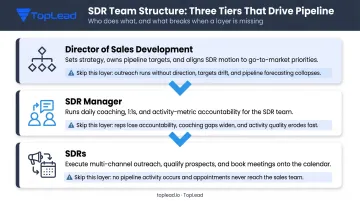
The Three-Tier Hierarchy
Most SDR teams that underperform share the same structural flaw: they have reps but no real management layer. All three tiers serve distinct functions:
- Director of Sales Development — Sets strategy, owns pipeline targets, aligns SDR activity with overall go-to-market motion
- SDR Manager — Handles day-to-day coaching, runs 1:1s, monitors activity metrics, and removes blockers
- SDRs — Execute outreach, qualify prospects, and book meetings for AEs
Skip the manager layer and your SDRs operate without feedback loops. Skip the director and your team executes without strategic direction. Both gaps kill pipeline quality.
Choosing the Right SDR-to-AE Ratio
There's no universal answer, but three models dominate:
| Model | When It Fits |
|---|---|
| 1:1 (one SDR per AE) | Complex, high-value deals with long sales cycles |
| 2:1 (two SDRs per AE) | High-volume outbound, shorter cycles, SMB-focused |
| 1:2 (one SDR, two AEs) | When AEs close quickly and SDRs can generate volume |
Product complexity, average deal size, and sales cycle length all influence which ratio makes sense. A 2016 Bridge Group study found the average ratio was 1 SDR to 2.5 AEs, though this varies significantly by company size and revenue.
Inbound vs. Outbound vs. All-Bound SDR Models
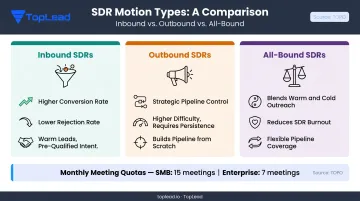
- Inbound SDRs follow up on warm leads from marketing — higher conversion, lower rejection
- Outbound SDRs cold prospect into target accounts — harder, but often more strategic control over pipeline
- All-bound SDRs handle both, which reduces burnout by balancing the grind of cold outreach with occasional warm wins
The model you choose should match your go-to-market motion. A startup selling to SMBs needs a different configuration than an enterprise software company targeting Fortune 500 procurement teams.
TOPO data shows monthly meeting quotas drop as ACV rises: 15 meetings for SMB deals, down to just 7 for large enterprise. Your team structure should scale with deal complexity, not just headcount.
How to Hire SDRs Who Actually Perform
What to Screen For First
Years of sales experience is a poor primary filter for SDR candidates. The role involves constant rejection, rapid learning, and representing your brand in a first human touchpoint. Traits that predict performance:
- Resilience: Recovers from a bad call and picks up the phone again without prompting
- Curiosity: Asks follow-up questions during the interview rather than just answering yours
- Coachability: Integrates feedback instead of defending their existing approach
- Clear communication: Articulates a value proposition concisely, without rambling
Candidates from service industries — hospitality, retail management, customer success — often make strong SDRs because they've built conversational stamina and customer empathy that pure academics haven't.
Skills Worth Testing Before You Hire
Don't just interview. Run a role-play scenario during the hiring process. Give candidates a simple objection ("We already work with a vendor") and watch how they handle it. What to look for:
- Acknowledges the objection before pivoting, rather than talking over it
- Asks a discovery question instead of launching straight into a pitch
- Stays composed under pressure rather than becoming defensive
Also test basic CRM familiarity and whether they can maintain a disciplined daily process — both are trainable, but candidates who already have both hit quota faster.
Onboarding: The 30/60/90 Framework
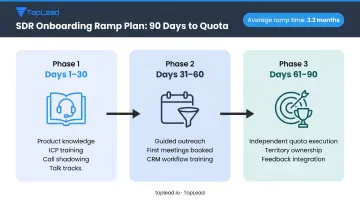
Bridge Group research puts average SDR ramp time at 3 months, with TOPO corroborating an average of 3.2 months to full quota. A structured 30/60/90 plan won't eliminate ramp time, but it compresses the unproductive portion:
- Days 1–30: Product knowledge, ICP deep-dive, shadowing calls, learning talk tracks and objection handling
- Days 31–60: Guided outreach with manager review, begin booking first meetings, CRM workflow training
- Days 61–90: Independent quota execution, territory ownership, feedback integration
That structure only holds if it's backed by documentation. An SDR playbook — covering buyer personas, objection responses, CRM protocols, and discovery frameworks — is what makes the framework repeatable. Tribal knowledge is a retention risk. If your playbook lives only in the heads of your top performers, every departure sets you back months.
How to Manage and Develop Your SDR Team
The Weekly Management Rhythm
Consistent, structured engagement drives SDR performance more than any dashboard. The core management rhythm looks like this:
- Weekly 1:1s (Monday or Tuesday): Cover what worked last week, one specific improvement area, and a concrete activity plan for the week ahead. Getting 1:1s done early gives reps time to execute on the feedback instead of rushing into the weekend
- Group call review sessions: Pull recorded calls from Gong or a similar tool, review as a team, identify what's working across the whole pod
- Role-play drills: Run objection scenarios regularly, not just during onboarding. Skills decay without practice
Salesforce's 2024 research found sales professionals spend only 28% of their week actually selling — the rest goes to admin and non-selling tasks. Your management rhythm should actively protect selling time, not add to the noise.
Diagnosing Underperformance Without Guessing
When a rep is missing targets, the problem is usually one of these:
- Quantity — Are they making enough calls and sending enough emails each day?
- Targeting — Are they reaching the right personas with authority to buy?
- Messaging — Are their emails and calls actually compelling enough to earn a response?
- Follow-through — Are they following up consistently, or letting warm prospects go cold?
Each requires a different fix. A quantity problem is a discipline or motivation issue. A targeting problem is often a data or ICP understanding issue. A messaging problem requires copy and call coaching. Call recordings and CRM activity reports surface the specific gap.
Keeping SDRs Accountable and Motivated
Set clear daily and weekly activity targets, track them visibly, and coach toward them, not over them. The difference between accountability and micromanagement is tone. "Let's figure out what's getting in the way" lands differently than "Why aren't you hitting your numbers?"
Motivation is the hardest ongoing management challenge, especially in remote or hybrid environments. Different reps respond to different incentives:
- Competition-driven reps respond to leaderboards and SPIFs
- Recognition-driven reps want public acknowledgment in team settings
- Income-driven reps need clear line-of-sight between their activity and their paycheck
Tailor your coaching approach to the individual. Proactively remove blockers too, whether that's a broken CRM workflow, unclear messaging, or a knowledge gap about a prospect vertical.
If an SDR can't execute because of a process problem outside their control, that's a management failure, not a performance failure.
SDR Compensation, Tech Stack, and Key Metrics
Compensation Structure
According to RepVue's verified data from 8,700+ submissions, U.S. SDR compensation benchmarks in 2026:
- Median base salary: $60,000
- Median OTE: $85,000
- Top performer annual comp: ~$130,700
That works out to roughly 71% base / 29% variable — slightly above the common 60–70% base guideline, which reflects how competitive SDR hiring has become. Variable pay should tie primarily to Sales Accepted Opportunities (SAOs), with a smaller portion tied to meetings booked. Add accelerators for reps who exceed targets: without them, there's no incentive to push past quota.
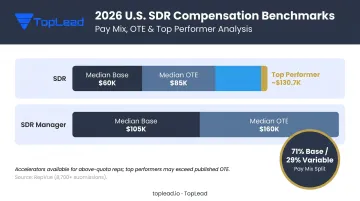
SDR managers earn significantly more: RepVue reports $105K median base and $160K median OTE for Sales Development Managers.
Tech Stack Essentials
Every SDR team needs four core tool categories:
| Tool Category | Purpose | Examples |
|---|---|---|
| Data provider | Contact intelligence, ICP list building | LinkedIn Sales Navigator, ZoomInfo |
| CRM | Lead tracking, pipeline visibility | HubSpot, Salesforce |
| Sequencing tool | Outreach cadence management | Outreach, Salesloft |
| Call recording/analytics | Coaching and performance review | Gong |
One warning: Salesforce research found reps use an average of 8 tools to close deals, and 42% feel overwhelmed by stack complexity. Add tools that reduce admin burden, not ones that create it.
Metrics That Matter
Track two categories and never conflate them:
Input metrics (what reps are doing):
- Daily calls made and outcomes
- Emails sent and reply rates
- LinkedIn touches per week
Output metrics (whether it's working):
- Meetings booked
- Sales Accepted Opportunities (SAOs)
- Pipeline generated and close rate on SDR-sourced deals
TOPO's benchmark: outbound SDRs averaged 35 dials and 40 emails per day, with 21.3 touches over 24 days per prospect. When output metrics drop but input metrics hold steady, the problem is usually messaging or ICP fit — not effort. That's where to look first.
Should You Build an SDR Team In-House or Outsource?
The Real Cost of Building Internally
Building an in-house SDR team involves more than salary. The full cost picture:
- SDR base salary: $60K median, plus ~30% in benefits and taxes
- Manager: $105K median base
- Tech stack: CRM, sequencing, data, and call recording licenses
- Ramp time: 3 months before productivity, 6 months before consistency
- Recruiting: 25–30 day time-to-fill per Bridge Group, plus HR bandwidth
- Attrition: Bridge Group estimates normal SDR turnover at 40–50% annually — meaning you're likely replacing half your team every year
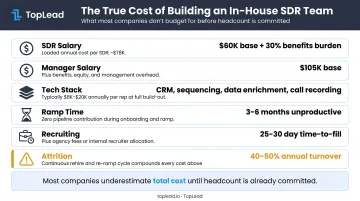
Most companies underestimate these costs until they've already committed headcount, signed software contracts, and waited out a full ramp cycle.
When Outsourcing Makes More Sense
For many companies, outsourcing is the faster, lower-risk path to building pipeline. It's worth evaluating when:
- You need qualified meetings now, not in 6 months after a ramp cycle
- You're testing a new market or persona before committing to headcount
- Your closers are spending time prospecting instead of closing
- You lack the management bandwidth to recruit, train, and coach an internal team
TopLead's U.S.-based pay-per-appointment model addresses several of the biggest in-house risks directly. Clients only pay for confirmed appointments with verified decision-makers, with no retainers, no setup fees, and a reschedule or replacement guarantee if a prospect cancels. The average cost per appointment runs $300–$350, with a commitment of at least 4–6 qualified meetings per month.
Each program includes:
- ICP development and prospect research
- Multi-channel outreach via email, phone, and LinkedIn
- CRM integration with Salesforce, HubSpot, and Pipedrive
- Real-time pipeline reporting
TopLead's embedded SDR Outreach option goes a step further: dedicated TopLead-trained SDRs operate as a branded extension of your team, with a campaign manager handling strategy and oversight. Across more than 25,000 appointments over 15 years serving American companies, the model has delivered results for companies ranging from boutique HR software firms (which tripled appointment rates in 60 days) to fintech companies that saw SQL quality rise 45% within three months.
Hybrid Is an Option
Outsourcing and building in-house aren't mutually exclusive. Many companies run a hybrid model: an external partner handles cold outreach and appointment setting while internal SDRs manage warm inbound leads or high-touch strategic accounts. This lets your internal team focus where their knowledge adds most value, while keeping cold pipeline flowing without the staffing overhead.
Frequently Asked Questions
What is an SDR team manager?
An SDR team manager oversees day-to-day operations, coaches reps toward pipeline targets, runs weekly 1:1s and call review sessions, and serves as the bridge between SDRs and senior sales leadership. They're responsible for both rep performance and the health of the overall outbound process.
What is an SDR manager's salary?
According to RepVue's verified data, U.S. Sales Development Managers earn a median base of $105,000 and median OTE of $160,000, with top performers reaching approximately $223,600. Compensation varies by company size, industry, and whether equity is included.
What is the ideal SDR-to-AE ratio?
Common models run 1:1 to 2:1 (SDRs to AEs). The right ratio depends on deal size, sales cycle length, and how much outreach volume is needed to keep AE calendars consistently full.
How long does it take to ramp a new SDR?
Most SDRs hit independent quota within 2–3 months, with consistent performance developing around the 6-month mark. A structured 30/60/90 onboarding plan and early call-shadowing can shorten that curve.
What metrics should an SDR team track?
Track both input metrics (daily call and email volume, LinkedIn touches) and output metrics (meetings booked, SAOs, pipeline generated). Input metrics show what reps are doing; output metrics show whether it's converting — together they help managers pinpoint exactly where a rep's process breaks down.
When should a company outsource its SDR function?
Outsourcing fits when you need pipeline quickly, are testing a new market, or lack the bandwidth to build an internal team. A pay-per-appointment model shifts financial risk away from you — paying only for qualified meetings, not for headcount or ramp time.