Inside sales and outside sales aren't just different job titles — they represent fundamentally different approaches to revenue. Each suits specific deal types, buyer profiles, and growth stages. Matching your model to your market can shorten sales cycles and improve close rates. Misaligning them wastes both.
Key Takeaways
- Inside sales = remote selling via phone, email, and video; built for speed, volume, and broad B2B reach
- Outside sales = in-person field selling; best suited for complex, high-value deals where executive trust and multi-stakeholder consensus matter
- Key differences span deal size, sales cycle length, cost structure, and scalability
- Most modern B2B companies benefit from a hybrid approach — inside sales for prospecting and qualification, outside sales for closing high-value opportunities
- The right model depends on product complexity, buyer expectations, market coverage needs, and budget
Inside Sales vs. Outside Sales: Quick Comparison
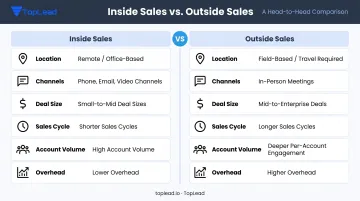
| Factor | Inside Sales | Outside Sales |
|---|---|---|
| Work Environment | Office or remote; no travel required | Field-based; regular travel to client sites |
| Primary Communication | Phone, email, video, LinkedIn | In-person meetings, events, site visits |
| Typical Deal Size | Small to mid-range | Mid to enterprise-level |
| Sales Cycle Length | Shorter; higher transaction volume | Longer; fewer, higher-value deals |
| Daily Customer Contacts | High volume; remote reps reach up to 4x more accounts | Lower volume; deeper per-account engagement |
| Cost Structure | Lower overhead; technology-driven | Higher overhead; travel and entertainment costs |
| Best For | SaaS, financial services, insurance, professional services | Manufacturing, healthcare, enterprise technology |
These are general benchmarks — real-world overlap is common. A SaaS company closing a $300K enterprise deal may still use outside sales tactics, while a manufacturing rep might qualify leads entirely by phone before visiting. Most modern B2B teams operate somewhere between the two extremes, mixing channels based on deal size and buyer preference.
What Is Inside Sales?
Inside sales is a remote-first selling model where reps engage prospects via phone, email, video conferencing, and social channels. According to Salesforce, inside sales reps typically handle shorter sales cycles and higher transaction volumes than their field counterparts.
What Inside Sales Reps Do Daily
A typical inside sales rep's day looks like this:
- High-volume prospecting across email, phone, and LinkedIn
- Lead qualification through discovery calls
- Virtual product demos via screen share
- Email sequence management and follow-up
- CRM pipeline updates and reporting
The productivity advantage is significant. McKinsey research shows that remote reps can reach 4x as many accounts in the same time as traditional field models — and generate up to 50% more revenue through broader coverage.
Where Inside Sales Performs Best
Inside sales works well when:
- Deals are in the small-to-mid value range and can close without an in-person meeting
- The product can be demonstrated via screen share
- Buyers are digital-first or time-constrained
- Geographic scale matters more than local depth
Strong industries for inside sales include SaaS, financial services, insurance, and professional services — sectors where buyers are comfortable making decisions through digital channels.
Use Cases of Inside Sales
In a typical inside sales pipeline, SDRs handle prospecting and qualification, then hand sales-ready leads to account executives who close remotely. The entire cycle — from first contact to signed contract — can happen without anyone boarding a plane.
For B2B companies without a dedicated in-house prospecting team, outsourced inside sales programs fill this gap. TopLead, for example, runs multi-channel outreach across email, phone, and LinkedIn on behalf of clients using U.S.-based SDR teams — booking verified decision-maker appointments directly onto the sales team's calendar so internal reps spend their time closing deals rather than hunting for them.
What Is Outside Sales?
Outside sales (also called field sales) involves reps traveling to meet prospects in person at client offices, conferences, trade shows, and networking events. Where inside sales prioritizes volume and efficiency, outside sales prioritizes depth and relationship quality.
Salesforce defines outside sales as managing longer sales cycles with fewer, higher-value deals. That's the core trade-off: less breadth, more depth per account.
What Outside Sales Reps Do Daily
Field reps spend their time differently than inside reps:
- Territory planning and account prioritization
- Executive presentations at client sites
- In-person product demonstrations or facility tours
- Relationship maintenance visits with existing accounts
- Industry conference and trade show networking
The emphasis is depth over volume. A field rep might manage a fraction of the accounts an inside rep handles but with far greater engagement per account.
Where Outside Sales Performs Best
Outside sales earns its cost in specific scenarios:
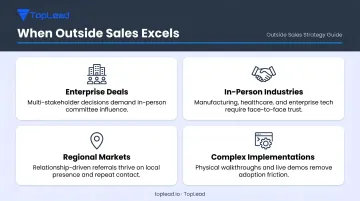
- Enterprise-level deals with multiple decision-makers and formal buying committees
- Industries with in-person expectations — manufacturing, healthcare, enterprise technology, and regulated financial services
- Regional markets where personal relationships drive referrals and repeat business
- Complex implementations where buyers need to see, touch, or experience the solution before committing
McKinsey's B2B research confirms that 40% of B2B customers still prefer meeting a sales rep in person when dealing with a new supplier — a number that matters most for high-stakes, first-time enterprise purchases.
The trade-off: outside sales carries higher ongoing costs from travel, entertainment, and typically higher base salaries. Scaling is slower, too — adding territory coverage requires hiring, training, and geographic planning that inside sales can bypass entirely.
Inside Sales vs. Outside Sales: Key Differences That Matter for B2B
Cost and ROI
Inside sales carries lower overhead. The core cost components are technology, salaries, and minimal travel — no hotel bills, flight expenses, or entertainment budgets. The Bridge Group's 2024 SaaS AE benchmark report puts median AE OTE at $190,000 with an $800K median annual quota.
Outside sales reps in wholesale and manufacturing roles had a BLS-reported median wage of $74,100 as of May 2024 — but that figure doesn't include travel, entertainment, and the longer ramp time that pushes total cost considerably higher.
Cost efficiency favors inside sales by default. Outside sales justifies the premium when average deal values are high enough to absorb it — typically enterprise contracts in the six-figure range.
At a glance, here's what drives each model's cost structure:
- Inside sales: CRM licenses, sales tools, salaries, and minimal travel
- Outside sales: Base salaries, commissions, travel, entertainment, and extended ramp time (often 6–9 months)
- Hybrid: Blended overhead with strategic field coverage for high-value accounts only
Sales Cycle and Deal Complexity
Inside sales supports shorter, more transactional cycles — well-suited to standardized offerings that don't require extensive customization. Outside sales is built for multi-stage cycles with complex stakeholder maps.
How complex are those stakeholder maps? Forrester's 2024 research found that an average of 13 people are involved in a B2B buying decision, with 89% of purchases involving two or more departments. Managing that dynamic almost always requires in-person executive engagement at some point.
Scalability
Scaling looks very different depending on which model you're running:
- Inside sales: Add reps, extend CRM access, replicate outreach sequences — infrastructure already exists
- Outside sales: Expand territories, hire regional reps, build local relationships — slower and more expensive to execute
- Growth timeline: Inside sales reaches national coverage faster; outside sales typically requires 12–18 months per new region
For companies targeting broad national B2B markets, inside sales is the more predictable path to scale.
Buyer Preferences by Industry
Not all buyers want the same experience. McKinsey's current B2B Pulse data shows a clear split: at any given buying journey stage, roughly one-third of B2B customers prefer in-person interactions, one-third prefer remote communications, and one-third prefer digital self-service.
That "rule of thirds" is why most modern B2B organizations don't pick one model — they build coverage across all three preferences. Notably, B2B buyers now use an average of 10 interaction channels, up from 5 in 2016. A single-channel strategy — whether inside-only or field-only — misses two-thirds of your potential buyers before a conversation even starts.
Which Sales Model Is Right for Your Business?
Decision Framework
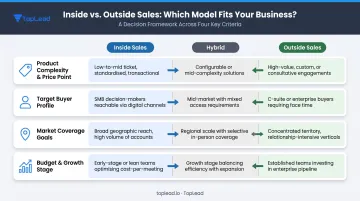
Use these four criteria to guide your choice:
- Product complexity and price point — Complex, highly customized, or six-figure offerings often justify outside sales. Standardized products with predictable outcomes suit inside sales.
- Target buyer profile — Digital-native buyers in SaaS or fintech are comfortable closing remotely. Traditional enterprise buyers in manufacturing or healthcare often expect in-person meetings for major purchases.
- Market coverage goals — Broad national reach favors inside sales. Deep regional penetration with relationship-driven referrals favors outside.
- Budget and growth stage — Inside sales requires lower upfront investment and reaches break-even faster. Outside sales demands more capital but suits organizations with proven enterprise deal flow.
Situational Recommendations
Choose inside sales if:
- You sell a scalable B2B product or service with a clear value proposition
- You need national reach without proportional headcount growth
- You're in an early growth stage with limited budget
Choose outside sales if:
- You're pursuing enterprise accounts where relationships close deals
- Your industry expects in-person demonstrations or site visits
- Local market presence is a competitive advantage
Consider a hybrid model when:
- Your pipeline includes both transactional and enterprise-level deals
- You need to qualify leads at scale before committing field resources
- Your team lacks the bandwidth to prospect and close simultaneously
Many B2B organizations in financial services, insurance, SaaS, and professional services run a hybrid motion where inside sales or outsourced SDR teams handle top-of-funnel prospecting and appointment setting, freeing senior reps to focus on closing.
The challenge is finding a reliable way to fill that top-of-funnel without diverting your best closers. TopLead addresses this directly for American companies — delivering sales-ready appointments with verified decision-makers so internal teams spend time on revenue-generating conversations, not cold outreach.
Conclusion
There's no universally superior model. The right choice comes down to what your buyers expect, how complex your deals are, and what your pipeline goals actually demand. Most B2B teams eventually run some version of both.
The more practical question isn't "inside or outside?" — it's "where does our prospecting break down?" If your pipeline stalls because reps spend too much time chasing unqualified contacts instead of closing, that's a structural problem. Auditing your current motion and identifying gaps in qualified appointments is the first step to fixing it. Auditing your current motion and identifying gaps in qualified appointments is the first step — and for many teams, outsourcing that prospecting layer to a dedicated appointment-setting program is what finally gets pipeline moving consistently.
Frequently Asked Questions
What is the difference between inside sales and outbound sales?
Inside sales describes where selling happens : remotely, from an office. Outbound sales describes who initiates contact — the seller reaches out proactively. Inside sales teams can run both inbound and outbound activity, so the terms describe different dimensions of a sales motion, not the same thing.
What are the four types of salespeople?
The Challenger framework actually identifies five profiles: The Challenger, The Relationship Builder, The Hard Worker, The Problem Solver, and The Lone Wolf. These archetypes appear across both inside and outside sales — a Challenger can thrive on phone just as well as in the boardroom.
What is the 30-60-90 rule in sales?
It's a ramp-up framework for new reps. The first 30 days focus on learning (product, tools, process); the next 30 on applying that knowledge in real conversations; the final 30 on hitting independent targets. It applies equally to inside and outside sales onboarding.
Is inside sales or outside sales better for B2B?
Neither is inherently better. The right model depends on deal size, buyer preferences, and product complexity. Most B2B companies today use a hybrid approach — inside sales for prospecting, outside sales for closing complex, high-value opportunities.
Can small businesses effectively use outside sales?
Yes, but most start with inside sales due to lower costs and faster scaling. Outside sales makes sense for local, high-value deals where relationships matter. As revenue and deal size grow, many small businesses add a field component or shift to a hybrid model.
What is a hybrid sales model?
A hybrid model combines inside and outside sales within one organization. Inside sales or SDR teams handle prospecting and qualification; field reps take over for in-person closing of high-value deals. It's the most common structure in modern B2B companies.