Introduction
Most professional services firms — consultants, accountants, financial advisors, legal practices — are competing for the same pool of decision-makers. Referrals still matter, but waiting for them is no longer a growth strategy.
Professional services are built on trust and expertise, which makes cold outreach feel off-brand. Without a repeatable system, though, pipeline becomes unpredictable — and growth stalls the moment referrals slow down.
This guide walks through how to build that system: defining your ideal client, running multi-channel outbound campaigns, establishing inbound authority, and qualifying leads efficiently — whether you're a solo practitioner or a 50-person firm.
Key Takeaways
- Referrals create inconsistent pipelines; sustainable growth requires systematic outbound and inbound working together
- A precise Ideal Client Profile (ICP) is the foundation; without it, outreach fails regardless of channel
- LinkedIn, cold email, and phone work best in coordinated multi-touch sequences, not as standalone tactics
- Inbound content builds compounding authority over 6–12 months; start outbound immediately while inbound develops
- Only a fraction of prospects are ready to buy at any given time; nurture sequences keep your firm top-of-mind until they are
Why Lead Generation Is Different for Professional Services Firms
Professional services firms sell expertise and trust, not tangible products. Buyers can't evaluate quality before they sign an engagement letter — credibility-building and lead generation are the same process. That creates structural challenges that product sales don't face.
The Referral Dependency Problem
Hinge Research found that more than 70% of professional services buyers identify asking a friend or colleague as their primary way to find a new firm. Referrals feel safe — they deliver pre-qualified, pre-warmed prospects.
The problem is control. You can't predict when referrals arrive, which industries they come from, or whether they match your ideal client profile. Some firms run 95% of new business through referrals. That works until a key referral source goes quiet — and then the pipeline dries up fast.
The B2B Buying Committee Reality
Professional services deals rarely involve one decision-maker. According to Forrester's 2026 State of Business Buying report, the typical B2B purchase involves 13 internal stakeholders and 9 external influencers. Add decision timelines that routinely stretch 3–12 months, and a single-touch referral model can't sustain consistent growth.
The Shift to a System-First Mindset
High-growth professional services firms don't wait for leads — they build proactive systems that run in parallel with relationship-building. That means:
- Targeting specific decision-makers through outbound prospecting on a defined schedule
- Publishing content that builds authority and draws in pre-qualified prospects over time
- Running nurture sequences that keep the firm visible across a 3–12 month buying window
- Defining lead qualification criteria so sales effort goes to the right opportunities
Define Your Ideal Client Profile Before You Launch Anything
Broad targeting wastes budget and dilutes messaging. A precise Ideal Client Profile (ICP) built before any campaign launches will consistently outperform broad outreach — and it's the step most firms skip.
What Goes Into an ICP
An effective ICP for professional services firms covers three layers:
- Firmographics: Industry, company size, revenue range, geography, growth stage
- Decision-maker demographics: Title, role, seniority, buying authority
- Psychographics: Core pain points, risk tolerance, compliance pressures, budget priorities
The psychographic layer is where most firms underinvest. Professional services buyers aren't primarily motivated by features — they're motivated by risk mitigation, operational pressure, regulatory compliance, or competitive urgency. Messaging that speaks to those emotional drivers consistently outperforms generic service descriptions.
How to Build Your ICP From Existing Data
The fastest path to an accurate ICP is analyzing your best current and past clients:
- Identify the industries that represent your most profitable engagements
- Map the titles that made the buying decision, not just who you worked with day-to-day
- Document the trigger events that prompted each client to seek help — a merger, audit, rapid growth, leadership change
- Note what differentiated your firm in their decision
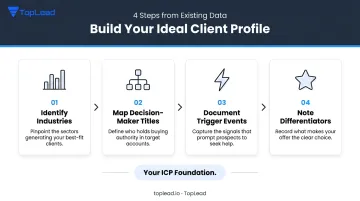
Those patterns, taken together, form the foundation of your ICP.
The Practical Output
A completed ICP should fit on one page and identify:
- A single primary niche — not three, not two
- One core business problem the firm solves for that niche
- One key differentiator that matters to that buyer
This document drives all subsequent decisions: channel selection, messaging, content topics, and outreach targeting.
TopLead builds this ICP collaboratively with each client before any outreach begins, identifying the specific segments most likely to convert rather than defaulting to broad market categories.
Build a Multi-Channel Outbound Lead Generation System
Outbound is how professional services firms generate predictable pipeline on a defined timeline. While inbound builds authority, outbound lets you target specific decision-makers now — which matters when you have near-term revenue goals.
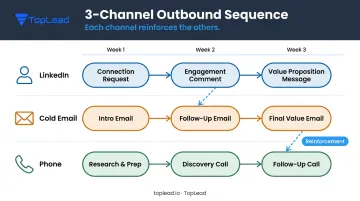
The most effective outbound systems combine three channels in coordinated sequences, not as isolated tactics.
LinkedIn Outreach
LinkedIn is the strongest B2B outreach channel for professional services because the data is self-reported and professionally maintained. According to LinkedIn Marketing Solutions, 89% of B2B marketers use LinkedIn for lead generation, and it generates leads at more than 2x the rate of the next-highest social channel.
Effective LinkedIn outreach for professional services follows a clear structure:
- Connection request: Reference something specific about the prospect — a recent post, a mutual connection, a relevant industry event
- Opening message: Lead with a relevant insight or question tied to their role, not a pitch
- CTA: Offer a 15-minute exploratory conversation, not a demo or proposal
LinkedIn also improves response rates across all other channels. When a prospect has seen your profile before receiving an email or a call, the familiarity reduces friction significantly.
Cold Email Outreach
Cold email remains effective when built on verified contact data and role-specific messaging. Woodpecker's analysis of over 20 million cold emails found average open rates around 53% and reply rates between 1% and 8.5% — a wide range that largely reflects list quality and targeting precision.
For professional services, a 3–5 touch email sequence spaced over 2–3 weeks works better than repeated identical follow-ups:
- Touch 1: Short, direct value proposition tied to a known pain point
- Touch 2: A relevant case study or specific outcome example
- Touch 3: A different angle — industry insight, compliance consideration, or risk factor
- Touch 4–5: Social proof and a soft "break-up" message that leaves the door open
List hygiene matters here. High bounce rates damage sender reputation and reduce deliverability for future campaigns — keep hard bounce rates below 0.5%.
Phone Outreach and Coordination
Phone works best as a coordination layer, not a standalone tactic. A call that references a recent email or LinkedIn message lands very differently than a cold dial with no context.
For high-value professional services engagements, phone confirmation and follow-up after initial digital touchpoints significantly improves show rates and response quality. The conversation also allows for real-time qualification in ways email cannot.
That coordination is the point. Running all three channels in sequence — where each touchpoint reinforces the others — is far more effective than relying on any single channel.
Firms that want to run this system at scale without pulling billable professionals off client work can partner with a specialized B2B appointment-setting agency. TopLead, for example, runs coordinated email, LinkedIn, and phone campaigns under the client's brand through a pay-per-appointment model. A small consulting firm targeting regional banks achieved 6+ qualified leads per month at $325 per lead within a three-month campaign window using this approach.
Leverage Inbound Marketing for Long-Term Lead Flow
Inbound and outbound serve different functions. Outbound generates pipeline now. Inbound builds compounding authority over time so that prospects arrive already familiar with the firm — warmed up, self-qualified, and far easier to convert.
The three highest-ROI inbound tactics for professional services:
- SEO-optimized blog content targeting the specific questions decision-makers search before hiring a firm — "how to choose a fractional CFO," "signs you need an outsourced compliance team"
- Gated content such as frameworks, research reports, or diagnostic tools that capture contact details in exchange for genuine value
- Email newsletters delivered consistently to an existing database — even a small list of 500 warm contacts, nurtured with useful content monthly, produces conversations over time
Each of these tactics compounds over time — but that's also the catch. Content takes 6–12 months to build meaningful organic traffic. Treating inbound as a replacement for outbound, and waiting on that runway before generating pipeline, means leaving months of potential revenue on the table.
Start outbound now and build inbound in parallel. Outbound fills the short-term pipeline; inbound reduces your cost of acquisition as it matures. Run both, and each one makes the other more effective over time.
Qualify, Score, and Nurture Leads Into Clients
Generating leads without a qualification system just creates noise — every lead entering the pipeline should be evaluated against ICP criteria before any sales effort is invested.
MQLs vs. Sales-Ready Leads
A Marketing Qualified Lead (MQL) has expressed some form of interest — downloaded a guide, visited a service page, opened multiple emails. They're worth nurturing but not yet ready for a sales conversation.
A Sales-Ready Lead (SRL) has demonstrated buying signals: requested a consultation, visited pricing or case study pages multiple times, or responded directly to outreach. These deserve immediate follow-up.
Simple Lead Scoring for Professional Services
Prioritize leads who have done two or more of the following:
- Engaged with multiple content assets (guides, blog posts, newsletters)
- Visited service-specific or case study pages
- Made a direct inquiry or responded to outreach
- Triggered a relevant intent signal (company merger, audit announcement, leadership change)
The Nurture Reality
Adobe/Marketo research found that half of all leads in a given system are not yet ready to buy — and that companies excelling at lead nurturing generate 50% more sales-ready leads at 33% lower cost.
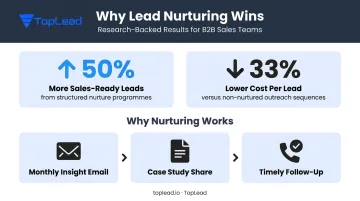
A nurture sequence for professional services doesn't need to be complex. Simple, consistent touchpoints keep the firm visible until the prospect's buying window opens:
- Send a monthly email with one useful insight or industry observation
- Share a relevant case study when a prospect shows renewed engagement
- Follow up with a timely note when relevant industry news breaks
When to Build In-House vs. Partner with a Lead Gen Agency
The In-House Trade-Off
Building an internal SDR function offers control and brand continuity. The costs are real, though. ZipRecruiter data from May 2026 puts the average US SDR salary at $55,018 per year, with total compensation often reaching $100K+ when benefits and management overhead are included. Factor in ramp time — typically 3–6 months before consistent results — and the timeline to positive ROI can easily push past 9–12 months.
When Outsourcing Makes More Sense
Outsourcing lead generation is particularly well-suited for firms where:
- Billable professionals are doubling as business development reps
- No dedicated SDR or sales function exists in-house
- The firm needs pipeline in the next quarter, not next year
- Adding headcount isn't a realistic near-term option
What to Look for in a Lead Gen Partner
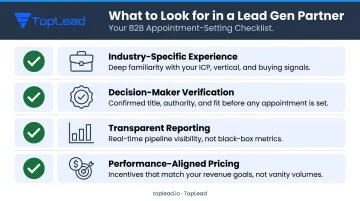
Not all agencies are equal, and for US firms vetting a partner, geography matters too. For professional services, the non-negotiables are:
- Industry-specific experience — generic outreach doesn't work in trust-based verticals
- Decision-maker verification — every appointment should be with someone who has actual purchasing authority
- Transparent reporting — weekly metrics on contacted rates, replies, bookings, and show rates
- Performance-aligned pricing — pay-per-appointment models mean you only pay for results; retainer-only models don't share that risk
TopLead, for example, works on a pay-per-appointment basis — delivering a minimum of 4–6 qualified leads per month at $300–$350 per appointment, with a replacement guarantee covering no-shows and cancellations. There are no long-term contracts, so firms can assess lead quality before scaling up.
Frequently Asked Questions
How much do lead generation services for professional services cost?
Costs vary by model. In-house SDR teams carry salary, benefits, and management overhead — often $80,000–$120,000+ annually per rep. Outsourced agencies range from retainer models to performance-based pricing. TopLead's pay-per-appointment model averages $300–$350 per qualified lead, with a guaranteed minimum of 4–6 leads per month.
What is the 5-minute rule for leads in professional services?
InsideSales/XANT research across 5.7 million inbound leads found that following up within 5 minutes of inquiry produces conversion rates more than 8x higher than waiting longer. Most firms miss this window entirely — 57% of first contact attempts happen after a week.
What are the 4 laws of lead generation for professional services?
Four principles drive consistent lead generation:
- Target the right people using a clearly defined ICP
- Deliver messaging that speaks directly to their specific pain points
- Reach them through the right channels at the right time
- Follow up with a structured nurture process built for long buying cycles
What is the difference between inbound and outbound lead generation?
Inbound attracts prospects through content, SEO, and referrals — higher trust, but inconsistent volume that takes months to build. Outbound proactively reaches targeted decision-makers via email, LinkedIn, and phone — more predictable volume, but requires more qualifying. High-growth firms use both in parallel.
How long does it take to see results from a lead generation campaign?
Outbound campaigns can begin generating appointments within 4–8 weeks. Inbound strategies typically take 6–12 months to build meaningful organic lead flow. A combined approach delivers short-term pipeline through outbound while inbound compounds over time.
What are the best lead generation channels for professional services firms?
LinkedIn and targeted cold email are the strongest outbound channels for reaching decision-makers directly. SEO-driven content and thought leadership are most effective for inbound authority-building. Referral programs remain valuable but shouldn't be the only source. The highest-performing firms use all of these in a coordinated system.