Meanwhile, Kaseya's 2024 MSP Benchmark Survey found that acquiring new customers jumped from 24% to 36% as MSPs' top challenge in a single year. The pressure is real, and it's growing.
Appointment setting addresses this directly. Not as a marketing concept, but as an operational process that puts qualified sales conversations on the calendar — consistently, at scale, and with the right people. This article breaks down what appointment setting actually means for IT and MSP businesses, the specific advantages it creates, and what happens when it's missing from your growth model.
Key Takeaways
- Appointment setting connects MSP sales teams with verified decision-makers — CIOs, IT Directors, and C-suite buyers — not just contact lists
- Each new MSP client represents months or years of recurring revenue; qualified meetings have compounding pipeline value
- 72% of MSPs depend on referrals, but fewer than half have a formal program in place
- Core advantages include direct access to decision-makers, shorter sales cycles, and a predictable MRR pipeline
- Results compound over time — treat it as an ongoing function, not a one-off campaign
What Is Appointment Setting for IT & Managed Service Providers?
Appointment setting is a distinct, end-to-end process: identifying target accounts, reaching verified decision-makers through multi-channel outreach, qualifying their fit and buying intent, and booking confirmed meetings with your sales team. The output is a live conversation with someone who has the authority, need, and context to move a deal forward — not just a name on a list or a number to call.
Where It Sits in the MSP Sales Motion
Understanding what appointment setting produces makes it easier to see where it fits. It sits between lead generation and the sales close — a critical gap that most MSPs either underestimate or try to patch with an overloaded sales rep. Raw leads — whether from a webinar, a trade show, or a LinkedIn search — rarely become sales-ready opportunities on their own. They require research, outreach, qualification, and follow-up before they're worth a sales rep's time.
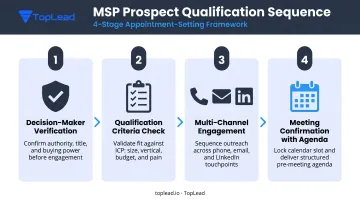
Appointment setting handles all of that. By the time a meeting lands on the calendar, the prospect has been:
- Verified as a decision-maker with purchasing authority
- Qualified against defined criteria (company size, tech environment, pain points, timing)
- Engaged through multiple touchpoints across phone, email, and LinkedIn
- Confirmed for the meeting with a clear agenda
The result: your sales team spends time closing, not chasing. Discovery work that typically drags down conversion rates is handled before the meeting ever gets booked.
Key Advantages of Appointment Setting for IT & MSPs
The advantages below map to real numbers in your pipeline: conversion rates, sales cycle length, and monthly recurring revenue. These aren't abstract benefits.
Direct Access to IT Decision-Makers
IT purchasing decisions sit with a narrow group. CIOs, IT Directors, VPs of Operations, CTOs — these roles control vendor selection, and they're notoriously difficult to reach through generic email blasts or inbound content alone.
The challenge compounds in larger organizations. Technology-sector buying teams average 12 to 14 participants, according to LinkedIn research, meaning any single outreach attempt may land several layers below the actual decision-maker.
Structured appointment setting solves this through:
- Verify decision-maker authority before any meeting is booked
- Build targeted lists based on title, company size, tech stack, and growth signals
- Run multi-channel outreach (phone, email, LinkedIn) that navigates gatekeepers professionally
- Treat administrative contacts as partners to reach the right person faster
Every meeting with the wrong person has a real cost. Salesforce research shows sales reps already spend 60% of their time on non-selling tasks — adding unqualified meetings to that load compounds the problem.
KPIs impacted: decision-maker contact rate, meeting-to-opportunity conversion rate, qualified pipeline opportunities per month
Mid-market accounts and new geographic markets see the biggest lift here — buying committees are larger, gatekeeping is tighter, and generic outreach rarely reaches the right desk.
Shorter Sales Cycles and Higher Close Rates
When a sales conversation starts with a pre-qualified decision-maker — someone already assessed for need, budget, authority, and timeline — the early stages of discovery are partially complete before anyone opens a slide deck.
MSP sales involve complex conversations: compliance requirements, infrastructure assessments, service level expectations, and transition planning. Starting from a warm position reduces the number of cycles needed to reach a proposal.
TopLead's U.S.-based SDR teams apply qualification frameworks including BANT, MEDDICC, or CHAMP depending on client preference for MSP campaigns. Before a meeting is booked, SDRs confirm prospects against:
- Company size and industry fit
- Decision-maker authority (IT manager or C-suite level)
- Active need signals — tech stack data, growth trends, or signs of vendor dissatisfaction
- Openness to a conversation and realistic timeline
The practical result: fewer stalled proposals, lower no-show rates, and more consistent win rates. RAIN Group research found that top-performing outbound prospectors achieve 2.7x more conversions than average sellers — and pre-qualification is a core driver of that gap.
KPIs impacted: average sales cycle length, proposal-to-close rate, meeting show rate, win rate by lead source
For MSPs with small sales teams and high average contract values, one wasted sales cycle can move the needle on quarterly revenue. Pre-qualification is where that waste gets cut.
Predictable Pipeline and Scalable MRR Growth
For an MSP, revenue predictability is a business requirement. Monthly recurring contracts mean MRR forecasting, headcount planning, and service capacity decisions all depend on knowing how many new clients are likely to close in a given quarter.
Appointment setting creates that predictability by converting sales from a reactive activity into a managed process with measurable inputs and outputs:
- A defined monthly outreach volume
- A consistent qualification threshold
- A target number of qualified meetings per month
- Pipeline value that can be projected forward
Referral-only or purely inbound growth creates peaks and valleys that make planning difficult. A steady flow of qualified appointments smooths that curve. Because outreach volume can be scaled up or down deliberately, MSPs can adjust pipeline activity in proportion to growth targets without building out large in-house sales teams.
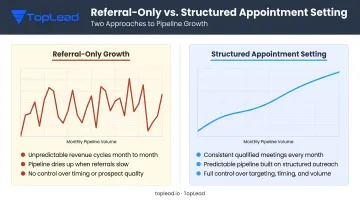
KPIs impacted: qualified appointments per month, pipeline value per campaign period, MRR growth rate, customer acquisition cost per new client
MSPs transitioning from founder-led sales to a scalable model feel this most acutely. When brand recognition is limited and inbound volume is thin, a structured outbound program becomes the primary engine for new MRR.
What Happens When Appointment Setting Is Missing
Operating without a structured appointment setting function isn't a neutral position. It creates specific, measurable consequences:
- Revenue becomes tied to who existing clients happen to know — unpredictable, unscalable, and nearly impossible to forecast against quarterly targets.
- Reps spend time on outreach that produces low-quality meetings, high no-show rates, and wasted capacity without a systematic qualification process.
- Geographic expansion and vertical entry stall because the existing network can't supply the proactive outreach they require.
- MSPs end up responding to whatever opportunities surface rather than targeting the client mix, contract size, and service type that fits their delivery model.
Kaseya's benchmark data reflects this directly: 20% of MSP executives cited lack of a lead-generation strategy as a top acquisition challenge, while a separate finding flagged the absence of a dedicated sales representative as the chief constraint on new customer growth. For MSPs that haven't built a proactive outbound function, these conditions aren't exceptions — they're the operating baseline.
How to Get the Most Value from Appointment Setting
Appointment setting delivers compounding returns when it runs consistently, not just when the pipeline runs thin. Results improve over time as targeting, messaging, and qualification are refined against real prospect data.
What Consistent Execution Looks Like
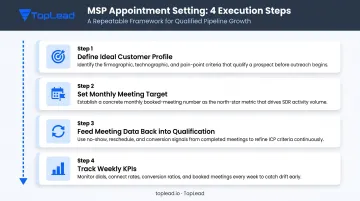
Effective appointment setting isn't plug-and-play. It requires ongoing management:
- Define a clear Ideal Customer Profile covering industry, company size, tech stack, pain points, and geographic focus. For MSPs, this might mean targeting healthcare organizations using aging infrastructure, or professional services firms without a dedicated IT vendor.
- Set a minimum monthly meeting target and hold the program to it. Pipeline planning depends on predictable inputs.
- Feed meeting data back into qualification. Every conversation reveals something about what's working — response patterns, objections, and timing signals should all inform the next outreach cycle.
- Track KPIs weekly: contacted vs. replied, meetings booked, show rate, and pipeline value generated. Without consistent measurement, optimization is guesswork.
When to Build In-House vs. Outsource
Some MSPs hire a dedicated SDR and build the function in-house. That works — but it carries real cost and time commitments. For teams without that capacity, outsourcing to a specialized B2B partner accelerates results without the overhead.
An in-house SDR carries a median total compensation of $103,000 (Glassdoor, 2025) in the United States, plus recruiting, onboarding, management overhead, and tooling costs. Most take 60–90 days to reach full productivity.
TopLead's pay-per-appointment model functions as a virtual SDR team for IT and MSP clients. Campaigns for this vertical typically include:
- ICP development using tech stack usage data and company growth signals
- Multi-channel outreach to IT managers and C-suite executives
- BANT/MEDDICC qualification before any meeting is booked
- CRM integration with Salesforce, HubSpot, Pipedrive, or similar platforms
- Weekly reporting on contact rates, booked meetings, show rates, and pipeline attribution
- A reschedule/replacement guarantee (cancelled or no-show meetings are replaced at no additional cost)
Most MSP clients see first appointments within two to four weeks of campaign launch, with consistent monthly pipeline velocity — averaging 4–6 qualified meetings per month — building steadily over the first two to three months as outreach is optimized.
Conclusion
Appointment setting isn't a theory for MSPs — it's the mechanism that puts sales teams in front of qualified decision-makers, shortens complex technical sales cycles, and creates the predictable pipeline that recurring revenue businesses require to plan and grow.
The longer it runs as a consistent practice, the more refined the targeting and the tighter the qualification becomes. Monthly output stabilizes into something you can actually forecast. MSPs that treat it as an ongoing function — not a reactive campaign — are the ones that hit growth targets consistently.
For MSPs ready to move beyond referral dependency, structured appointment setting is where that shift starts. Pick the right partner, define your ICP tightly, and treat every booked meeting as data — because that's what turns a program into a pipeline.
Frequently Asked Questions
What is the main goal of an appointment setter?
The primary goal is to connect your sales team with qualified, verified decision-makers who have a genuine need, budget, and realistic timeline — not to book as many meetings as possible. Every appointment should have a credible path to a business conversation, not just a confirmed time slot.
How is appointment setting different from cold calling for IT companies?
Cold calling is a single-channel tactic focused on initial contact. Appointment setting is an end-to-end process: prospect research, multi-channel outreach, qualification, and confirmed meeting scheduling. The outcome is a pre-qualified conversation with a verified decision-maker, not just a contact attempt.
How many qualified appointments should an MSP expect per month?
Results vary by target market, outreach volume, and qualification criteria. A well-structured program typically delivers a consistent monthly cadence. TopLead's benchmark for IT and MSP campaigns is 4–6 qualified appointments per month, with a cost per lead under $350 and ROI visible within the first three months.
Should MSPs build an in-house appointment setting team or outsource?
In-house teams offer control but require significant investment: median SDR compensation runs around $103,000 annually, before overhead, training, and ramp time. Outsourcing provides faster deployment, experienced SDRs, and scalable capacity. The right choice depends on budget, growth stage, and whether your outreach volume justifies a dedicated internal role.
What metrics should IT companies track to measure appointment setting performance?
Track these five consistently: qualified appointments per month, decision-maker contact rate, meeting show rate, meeting-to-opportunity conversion rate, and pipeline value generated per campaign period.
How long before appointment setting delivers results for an MSP?
Early meetings typically appear within two to four weeks of campaign launch. Consistent pipeline velocity (qualified meetings arriving reliably each month) usually develops over two to three months as targeting and messaging are refined against real prospect data.