Introduction
Building a B2B lead list used to mean hours of manual research, purchased contact databases, and a CRM full of contacts that went stale before SDRs could dial them. The result is familiar: low reply rates, wasted outreach hours, and a pipeline that runs on guesswork instead of signal.
AI-driven lead list building changes that equation. It uses machine learning, real-time data enrichment, and behavioral signals to automatically identify and prioritize the decision-makers most likely to buy — without the manual research overhead.
This guide is for B2B sales leaders, SDR managers, and marketing teams who want to understand how the AI process actually works, what separates high-quality lists from low-quality ones, and what still requires human judgment to get right.
Key Takeaways
- AI replaces manual prospecting by automatically sourcing, enriching, and scoring contacts that match your ICP
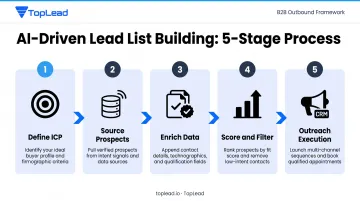
- The process runs in five stages: ICP definition → prospect sourcing → data enrichment → lead scoring → outreach execution
- List quality depends on ICP precision, data freshness, and the intent signals your AI tools are trained to detect
- AI-built lists still require human judgment — especially to convert prospects into verified, sales-ready appointments
What Is AI-Driven Lead List Building?
AI-driven lead list building uses machine learning, predictive analytics, and real-time data enrichment to compile targeted contact lists of decision-makers most likely to buy — without manual research.
The output is a regularly refreshed list of high-fit prospects that sales teams can act on immediately, rather than a static spreadsheet that goes stale within weeks. Salesforce defines predictive lead scoring as using data science and machine learning to identify shared traits among leads that converted — the same logic drives how AI builds and ranks lead lists.
How It Differs from Traditional List Building
| Approach | Method | Output |
|---|---|---|
| Traditional | Purchased lists, manual CRM searches, basic demographic filters | Static contact file with minimal context |
| AI-driven | Real-time firmographic, technographic, behavioral, and intent data | Prioritized, enriched, and scored prospect list |
Speed matters, but the sharper advantage is precision. AI processes firmographic, behavioral, and intent signals simultaneously — filtering out low-fit accounts before a rep ever sees the list. Manual methods simply can't operate at that resolution.
Why B2B Sales Teams Are Turning to AI for Lead List Building
The business case comes down to two problems: wasted SDR time and deteriorating data quality.
Salesforce reported in 2024 that 81% of sales teams were experimenting with or had fully implemented AI — and that teams using AI were 1.3x more likely to report revenue growth in the prior year. The adoption curve is steep because the underlying problem is severe.
The SDR Time Problem
Sales reps spend up to 70% of their time on non-selling tasks, including manual research and administrative work. For SDR-heavy teams, that means the majority of compensation spend goes toward activities that don't directly generate revenue.
AI list building reclaims that time. When ICP matching, data sourcing, and contact enrichment happen automatically, SDRs spend their hours on actual conversations rather than spreadsheets. Data quality is the other side of that same problem.
The Data Decay Problem
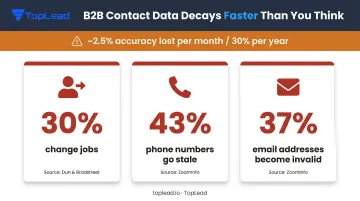
B2B contact data erodes fast. According to Dun & Bradstreet, accuracy drops by an estimated 2.5% per month — roughly 30% per year. ZoomInfo puts the annual churn in sharper terms:
- 30% of people change jobs
- 43% of phone numbers go stale
- 37% of email addresses become invalid
A list built six months ago is already degraded enough to skew your pipeline. AI tools that pull from continuously refreshed databases keep your contacts current — so outreach actually reaches the right people.
How AI Builds a B2B Lead List: Step-by-Step
The end-to-end flow looks like this: AI ingests your ICP definition, then sources, enriches, scores, and delivers a prioritized list of verified prospects — all inside a single automated workflow that replaces hours of manual effort.
Step 1: Define Your Ideal Customer Profile (ICP)
AI is only as precise as the ICP it's given. The attributes AI needs to work from include:
- Industry and sub-vertical (e.g., commercial insurance brokers, not just "insurance")
- Company size — employee count and revenue range
- Geography — state, region, or metro area
- Target job titles — decision-makers with actual purchasing authority
- Buying triggers — hiring events, funding rounds, new leadership, technology changes
- Pain points tied to your specific offer
The more granular the ICP, the more accurate the output. Vague inputs produce bloated lists; specific inputs produce workable ones.
TopLead's US-based team begins every engagement with an alignment workshop to build this definition from real business data. The goal is narrowing broad categories like "any SaaS company" down to precise parameters: software companies between 20 and 150 employees showing hiring signals in HR roles.
Step 2: Source Prospects Using AI-Powered Databases and Signals
AI tools scan real-time databases — LinkedIn Sales Navigator, ZoomInfo, Apollo, and others — combined with intent signals to surface companies that currently match the ICP.
Relevant signals include:
- Hiring events and job postings
- Funding announcements
- Technology stack changes
- Leadership transitions
- Content engagement and competitor research activity
Bombora, for example, analyzes billions of consumption events monthly across 18,000+ intent topics. Apollo's Buying Intent feature tracks 15,000+ topics with weekly data from providers including Bombora and LeadSift. These signals tell you not just who fits your ICP, but who is actively researching solutions like yours right now.
Step 3: Enrich Each Lead with Verified Data
Once prospects are sourced, raw records are rarely complete. Enrichment fills the gaps before any contact touches your outreach queue.
AI appends missing contact fields (email, phone, job title, company details), validates accuracy by cross-referencing multiple sources, and flags duplicates or outdated records. Clay's waterfall enrichment, for instance, searches 150+ databases sequentially to maximize coverage for each contact.
TopLead's enrichment process validates email deliverability, confirms North American phone number accuracy, verifies active employment, and cross-checks company details before any contact enters an outreach sequence. The goal: zero bounced emails from bad data.
Step 4: Score and Filter Leads by Fit and Intent
A verified, enriched list still needs prioritization. Not every ICP match is worth equal attention, so AI assigns a lead score combining:
- Firmographic fit — how closely the company matches ICP criteria
- Behavioral intent — what signals suggest active buying interest
High-scoring leads go to the top of the outreach queue. Poor-fit contacts get filtered before SDRs ever see them. TopLead's scoring framework weights company size, role, and industry alongside implicit signals like email engagement and meeting acceptance — plus urgency indicators like stated timelines and active leadership involvement.
Step 5: Connect the List to Outreach Execution
AI-built lists feed directly into outreach sequences via CRM integrations. TopLead connects with Salesforce, HubSpot, Pipedrive, and Close.io, pushing qualified contacts and engagement history into client CRMs without manual data entry.
From there, multi-channel outreach begins. TopLead campaigns average 6–8 strategic touchpoints across email, LinkedIn, and phone before conversion — each channel reinforcing the others:
- Email for personalized value-based sequences
- LinkedIn for human connection and social proof
- Phone for timely follow-ups with context-rich conversations
TopLead's SDR team doesn't just send messages to a job title. Before an appointment is confirmed, SDRs directly qualify whether the prospect holds actual purchasing authority. That means asking targeted questions to clarify internal stakeholders, budget expectations, and evaluation timelines.
Key Factors That Affect AI Lead List Quality
Getting the process right matters, but several variables determine whether the output is useful:
- ICP precision — Broad ICP definitions produce bloated, low-fit lists. Granular inputs reduce the number of contacts SDRs waste time pursuing.
- Data source freshness — AI tools pulling from real-time or frequently updated databases produce more accurate lists. Static snapshots degrade rapidly given 30% annual data decay.
- Intent signal quality — The richest signal sets (hiring data, funding events, technology changes, content engagement) produce more actionable prioritization. Not all tools detect the same signals.
- CRM data hygiene — AI list quality degrades when the underlying CRM contains outdated, duplicated, or inconsistently formatted records. Clean inputs are a prerequisite for clean outputs. According to Gartner, poor data quality costs organizations an average of $12.9M per year.
- Compliance — B2B teams operating across jurisdictions must confirm AI tools comply with GDPR, CCPA, and CAN-SPAM. Non-compliance can result in blocked domains and legal exposure regardless of list quality.
For agencies managing outreach on behalf of clients — like TopLead's SDR programs — compliance isn't a checkbox. Permission-based contact sourcing and opt-out handling need to be built into the process from day one, not patched in after a legal problem surfaces.
Common Misconceptions About AI Lead List Building
Misconception 1: A longer list means a stronger pipeline
Volume-first thinking leads to burned-out SDRs, poor email deliverability, and wasted budget. Google's sender guidelines require bulk senders to keep spam rates below 0.10% — making list relevance a deliverability control, not just a campaign-performance issue. Gong research shows that industry-specific personalization correlates with an 88% increase in prospect response rates.
A smaller, well-targeted list will outbook a bloated one every time.
Misconception 2: AI-built lists are immediately ready to use
AI outputs still require human validation — particularly for decision-maker confirmation, intent signal interpretation, and context behavioral data cannot capture. Recent company restructurings, frozen budgets, and organizational changes won't show up in a database.
Before any high-volume send, a human review step is essential — not a nice-to-have.
Misconception 3: A lead list equals pipeline
An AI-built lead list is an input to the sales process, not an outcome. Converting contact data into booked meetings still requires:
- Qualified, personalized outreach
- Consistent follow-through across touchpoints
- Human engagement at key decision moments
The list creates the opportunity. Everything after that depends on how well your outreach executes on it.

When AI Lead Lists Need Human Support to Convert
Complex Buying Environments
AI handles research, prioritization, and initial signal detection well. It struggles when deals involve multiple decision-makers with different priorities. Forrester reported in 2024 that an average of 13 people are involved in a single B2B buying decision, and 86% of B2B purchases stall during the buying process.
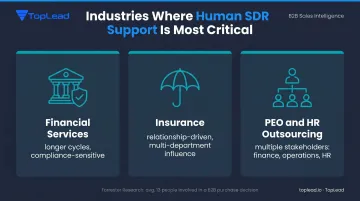
Industries where human SDR support is most critical include:
- Financial services — longer cycles, higher scrutiny, compliance-sensitive conversations
- Insurance — relationship-driven with multi-department influence, especially in employee benefits
- PEO and HR outsourcing — founders initiate, but finance, operations, and HR all weigh in on the final decision
In these verticals, an AI-generated job title match isn't enough. TopLead's SDRs conduct direct qualification conversations to confirm that the contact has actual purchasing authority — not just a relevant title.
The Over-Automation Risk
Generic AI-personalized messages sent at scale damage domain reputation and burn through your total addressable market. Salesloft's 2023 Revenue Benchmark analysis found personalization averaged only 10–14% across 20 industries, meaning the vast majority of sales emails weren't meaningfully personalized.
For B2B companies that want AI-informed list quality without managing the full tech stack, a specialized lead generation partner eliminates that risk. TopLead combines AI-driven prospecting with experienced SDR teams and decision-maker verification — focused on verified outcomes, not contact volume.
The model is built around predictable results:
- Pay-per-appointment pricing averaging $300–$350 per qualified meeting
- Guaranteed minimum of 4–6 appointments per month
- Reschedule or replacement guarantee on no-shows
- 25,000+ appointments delivered across 15+ years serving United States companies
Frequently Asked Questions
How do sales leaders use AI in their sales process?
Sales leaders use AI to automate ICP-based prospect sourcing, lead scoring, and outreach prioritization — freeing SDR teams to focus on high-value conversations. The practical impact is more pipeline from the same headcount, with SDRs spending time on prospects that actually fit rather than building lists from scratch.
Which AI tool is best for lead generation?
The best tool depends on your go-to-market approach. Apollo combines contact enrichment with intent signals; ZoomInfo prioritizes broad B2B intelligence; Clay fits teams building custom multi-source workflows. Many B2B teams skip tool sprawl entirely by partnering with an agency that manages the full stack on their behalf.
What's the difference between an AI-built lead list and a manually built one?
AI-built lists use real-time enrichment, intent signals, and automated scoring to identify and prioritize best-fit contacts. Manually built lists rely on static filters and individual research — they take longer to build, go stale faster, and can't scale without adding headcount.
How accurate is AI-generated contact data?
Accuracy varies by provider — ZoomInfo claims 95%+ contact accuracy; Lusha states 98% email and 86% phone accuracy. Both figures depend on update frequency and whether email verification is applied before outreach. Skipping verification increases bounce rates and damages sender reputation.
Can AI lead list building replace a human SDR team?
No. AI handles the research, enrichment, and prioritization that previously consumed SDR time. Human SDRs remain essential for building rapport, handling objections, navigating multi-stakeholder buying committees, and confirming that the right decision-maker is engaged before a deal progresses.
What data does AI need to build an effective B2B lead list?
AI needs a well-defined ICP: industry, company size, geography, target job titles, and buying triggers. Salesforce identifies behavioral, firmographic, and technographic data as the core inputs. The more specific your ICP, the more precise the output — which is why ICP definition is the most important step in the process.