Introduction
Signing a contract with the wrong prospecting service doesn't just waste budget—it can stall your revenue growth for an entire quarter while your team processes appointments that were never real opportunities to begin with. Many B2B companies discover this the hard way, paying for contact lists that never convert.
The gap between prospecting services is wider than most buyers expect. Some hand off a spreadsheet of names. Others book calendar appointments with verified decision-makers who have confirmed buying authority. That gap directly determines whether you get a stalled pipeline or actual revenue movement.
The criteria you use to evaluate vendors matters just as much as which vendors you consider. Choosing based on price or a polished sales deck is how companies end up locked into 12-month contracts with no performance recourse.
This article covers 10+ concrete criteria to assess any B2B sales prospecting service before you sign—so your next vendor decision is grounded in evidence, not a sales pitch.
Key Takeaways
- Evaluate prospecting vendors on lead qualification standards, decision-maker verification, and performance guarantees—not price alone
- Missing multi-channel outreach, CRM integration, or transparent reporting leaves you flying blind on pipeline performance
- Pricing model structure (pay-per-appointment vs. flat retainer) directly affects your financial risk
- Short-term or month-to-month contracts protect you until a vendor earns the right to a longer commitment
- Use a weighted scorecard across all criteria before committing
What Are B2B Sales Prospecting Services?
B2B sales prospecting services are outsourced functions where a third-party agency identifies, qualifies, and engages potential buyers on your behalf. But that description covers a wide range of actual deliverables.
There are three distinct categories:
- Lead list vendors — deliver raw contact data (names, emails, company info) with minimal qualification
- Appointment setters — engage prospects directly and book calendar meetings with decision-makers
- Full-cycle SDR-as-a-service — act as an embedded extension of your sales team, managing outreach, qualification, and pipeline handoff end-to-end
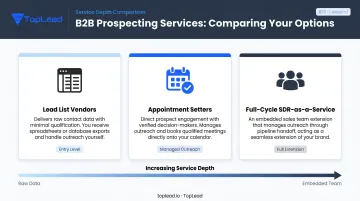
Understanding what a service actually delivers is the starting point for evaluation. Paying appointment-setter prices for a contact list is one of the most common and costly mistakes buyers make.
Why Businesses Outsource Prospecting
Building an in-house SDR team requires hiring, training, tooling, and a ramp period that typically runs around four months before consistent output begins. That timeline carries real costs in both direct spend and delayed pipeline.
Outsourcing collapses that ramp time and lets sales leadership redirect closers to closing deals. Two conditions make it work:
- A clearly defined Ideal Customer Profile (ICP) so the partner knows exactly who to target
- A sales process ready to absorb new appointments at volume
Without both, even a high-performing prospecting partner generates chaos rather than pipeline.
10+ Criteria to Evaluate B2B Sales Prospecting Services
Selecting a prospecting service isn't a generic procurement decision. The right criteria depend on your industry, deal complexity, sales cycle length, and internal capacity. The criteria below connect vendor capabilities to measurable pipeline outcomes—so you can make an apples-to-apples comparison across proposals.
1. Lead Qualification Standards
The first question to ask any prospecting vendor: do you qualify leads against our ICP using firmographic, technographic, and behavioral criteria—or do you hand off a contact with a name and email?
Qualification depth determines downstream conversion rates. A vendor with a rigorous framework might evaluate:
- Firmographic fit — company size, revenue range, industry, geography
- Technographic signals — current tools and systems that indicate readiness
- Behavioral intent — email engagement, content downloads, hiring signals, funding events
Ask prospective vendors to describe their qualification framework specifically. What criteria disqualify a lead before it becomes a booked appointment? A vendor who can't answer that question clearly has no real qualification process.
2. Decision-Maker Verification
Forrester reports that the typical B2B buying decision now involves 13 internal stakeholders. In that environment, booking a meeting with someone who has influence but no budget authority wastes your sales team's time and inflates apparent pipeline without driving revenue.
Robust verification goes beyond job title. It includes:
- Confirming the prospect holds actual purchasing authority (not just a relevant-sounding title)
- Org-chart research to identify where the prospect sits in the decision chain
- Cross-referencing via LinkedIn and company directories before logging the appointment as qualified
TopLead, for example, verifies every appointment against role and authority before it reaches a U.S. client's calendar—specifically targeting HR directors, CFOs, controllers, and business owners depending on the vertical. Vendors who skip this step are delivering names, not pipeline.
3. Industry and Vertical Expertise
A generalist prospecting firm may lack the contextual knowledge needed to speak credibly with prospects in specialized verticals like financial services, healthcare, or SaaS. Industry fluency shortens warm-up time, improves connection rates, and prevents your brand from being represented by messaging that sounds generic or uninformed.
When evaluating vertical expertise, ask for:
- Campaign examples in your specific industry—with outcomes, not just descriptions
- Familiarity with the buyer personas and objections common in your space
- Sample outreach messaging used in comparable engagements
If a vendor can't produce concrete examples from your vertical, assume they'll be learning on your dime.
4. Multi-Channel Outreach Capabilities
Single-channel outreach produces diminishing returns. Gong's analysis of 300 million+ cold calls found that average cold-call connect rates sit at just 5.4%, but email reply rates nearly doubled—from 1.81% to 3.44%—when cold calling was combined with email outreach. That's a measurable multichannel lift.
Effective prospecting services combine phone, email, and LinkedIn in coordinated sequences. Ask vendors:
- What channels do you use, and in what order?
- How many touchpoints per contact, and over what time window?
- How does your cadence vary by vertical or buyer persona?
The channel mix should align with where your target buyers actually engage. A vendor who only uses email blasts is leaving significant response volume on the table.
5. Pricing Model and Cost Transparency
Three pricing models dominate this space, and each carries different financial risk:
| Model | How It Works | Risk Profile |
|---|---|---|
| Retainer-based | Flat monthly fee regardless of output | High buyer risk—you pay whether or not appointments materialize |
| Pay-per-lead | Volume-focused; charges per contact delivered | Quality risk—lead volume inflates, qualification suffers |
| Pay-per-appointment | Billed only for delivered, qualified meetings | Lowest buyer risk—vendor incentives align with your pipeline |
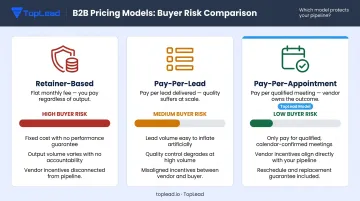
The pay-per-appointment model is worth prioritizing. You pay for outcomes, not effort. Before comparing proposals, research what a competitive cost-per-qualified-appointment looks like in your industry so you have a benchmark when evaluating quotes.
6. Performance Guarantees and SLAs
Any credible prospecting service should commit in writing to a minimum number of qualified appointments per month and offer a reschedule or replacement guarantee for no-shows. No-shows are more costly than they appear—RevenueHero's analysis of 6,428 B2B meetings found a 6.5% no-show rate representing an estimated 209.5 hours of lost sales time.
SLAs should also cover:
- Campaign launch timeline (when does outreach begin after contract signing?)
- Definition of what constitutes a "qualified" appointment in contractual terms
- What triggers the replacement guarantee—cancellation, no-show, or both
No performance guarantee is a red flag. It means the vendor isn't confident enough in their output to back it.
7. Reporting Cadence and Transparency
Black-box reporting—monthly summaries with no access to call recordings, email logs, or campaign activity—creates accountability gaps. You need visibility into what's actually being done on your behalf.
Before signing, ask:
- What does your reporting dashboard show, and how often is it updated?
- Can I access individual call recordings and email engagement data?
- How are appointment notes structured when meetings are handed off to my team?
Weekly reporting cadence with real-time CRM sync is the standard to hold vendors to. If a vendor can't show you a sample dashboard during the sales process, transparency likely won't improve after you sign.
8. CRM Integration and Tech Compatibility
A prospecting service that can't push appointment data directly into your CRM creates manual data entry overhead and breaks pipeline visibility. Salesforce research found that sales reps spend only 28% of their week selling—manual handoff processes eat into that already-thin slice.
Ask vendors to confirm:
- Which CRM platforms they integrate with natively (Salesforce, HubSpot, Pipedrive, etc.)
- How appointment data, contact records, and meeting notes are structured on handoff
- Whether calendar invites sync automatically and how quickly lead activity appears in your system
Vendors who treat CRM integration as optional will create friction every time an appointment is delivered.
9. Contract Terms and Exit Flexibility
Long lock-in contracts shift all the risk to the buyer before the vendor has demonstrated results. A 12-month commitment with steep cancellation penalties is a sign the vendor isn't confident in their own output.
Look for:
- Month-to-month options after an initial campaign period (typically 3–6 months for ramp)
- Clear definitions of what triggers auto-renewal
- Cancellation terms that don't penalize you for a vendor's underperformance
Shorter initial commitments or performance-triggered renewals protect your position. A vendor willing to operate without a long-term contract is signaling confidence in their output.
10. SDR Team Quality and Training
The SDRs making calls and sending emails on your behalf are representing your brand. Their quality reflects directly on how prospects perceive your company.
Key questions to ask:
- What are your hiring standards for SDRs? What do you screen for?
- What does the training process look like for a new client engagement?
- Are SDRs dedicated to my account or shared across multiple clients?
Dedicated reps who understand your value proposition deeply outperform shared reps rotating across industries. This distinction should factor into vendor selection—particularly if you're in a specialized vertical where off-script conversations can damage relationships.
11. Track Record, Client References, and Case Studies
Past performance in similar industries and with companies of comparable size is the most reliable predictor of future results. Testimonials alone are not enough on their own—ask for documented case studies and at least two client references in your vertical or at a comparable deal size.
When you speak with references, ask specifically about appointment quality, not just volume. Were the prospects actually decision-makers? Did appointments convert into pipeline? What was the show rate?
A vendor with 25,000+ documented appointments across recognizable clients carries significantly lower risk than one with a polished website and no verifiable track record.
Red Flags to Watch Out For When Evaluating Prospecting Services
Not all warning signs are obvious. Watch for these specifically:
- Vague qualification definitions — If a vendor can't define "qualified" in contractual terms, they'll interpret it however protects their payout
- No performance guarantee — Refusing to commit to minimums or offer no-show replacements suggests the vendor doesn't trust their own output
- Opaque campaign methodology — Unwillingness to share outreach sequences, channel mix, or data sourcing signals a vendor who won't operate as a real partner
- Compliance gaps — Vendors who can't explain their CAN-SPAM and TCPA protocols, or lack U.S.-based oversight, expose your brand to real legal risk
- Unrealistic volume promises — Any vendor promising outsized appointment volumes before scoping your ICP is optimizing for the sale, not the delivery
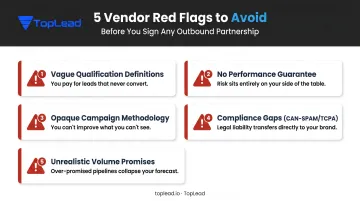
Compliance deserves a direct question in your vendor call. The FTC imposes penalties up to $53,088 per violating email, and the FCC's 2024 ruling tightened TCPA consent revocation requirements. Ask specifically how data is sourced and how opt-outs are handled.
How TopLead Can Help Fill Your Pipeline
TopLead is a B2B appointment-setting and lead generation agency based in Northern California, with over 15 years of experience and more than 25,000 qualified appointments arranged for clients across the U.S. The company operates as a virtual SDR team—not a list vendor—delivering booked meetings with verified decision-makers directly onto client calendars.

The service runs on a pay-per-appointment model with a reschedule or replacement guarantee, which directly addresses the pricing risk and performance guarantee criteria outlined above. Clients pay for qualified outcomes, not activity or effort. There are no long-term contracts required.
Measured against the criteria covered in this guide, here's how TopLead maps to each:
- Decision-maker verification on every appointment—SDRs confirm buying authority before the meeting is booked, not after
- Multi-channel outreach across email, LinkedIn, and phone, run as coordinated sequences rather than isolated touches
- CRM integration with Salesforce, HubSpot, Pipedrive, and Close.io, with real-time calendar delivery and full contact notes on handoff
- Weekly reporting with access to call recordings, outreach activity data, and campaign performance metrics
- No long-term contracts, with campaign lifecycles typically running 3–6 months and first appointments often delivered within the first two to four weeks
TopLead serves verticals including financial services, insurance, PEO/HR outsourcing, SaaS, professional services, and healthcare. Clients include Edward Jones, Aflac, UBS, Wells Fargo Advisors, Insperity, and Hub International.
Conclusion
Choosing a B2B sales prospecting service is a strategic decision that should be evaluated against concrete, measurable criteria—not vendor pitch quality or price alone.
Build a weighted evaluation scorecard using these criteria before comparing proposals. Start with a short-term engagement, measure appointment quality against your actual close rate, and scale only once you have real data. That process protects your pipeline and holds every vendor to the same standard.
If you're evaluating options, TopLead operates on a pay-per-appointment model with no long-term contracts and a reschedule/replacement guarantee — structured specifically to meet the accountability criteria outlined here.
Frequently Asked Questions
What is the difference between a B2B lead generation service and a sales prospecting service?
Lead generation typically delivers contact data or inbound interest signals—names, emails, and company details. Sales prospecting services, particularly appointment setters, engage prospects directly through outbound outreach and deliver booked meetings with verified decision-makers ready for a sales conversation.
How much do B2B sales prospecting services typically cost?
Pricing varies by model. Retainer-based services charge a flat monthly fee regardless of output; pay-per-appointment models tie costs directly to delivered meetings, making budgeting more predictable. Request scoped proposals based on your specific ICP and target volume rather than relying on industry averages.
How long does it take to see results from an outsourced prospecting service?
Most campaigns require a 4–8 week ramp period for messaging calibration, list refinement, and initial data gathering before consistent appointment volume develops. Meaningful pipeline data is typically available within a 3–6 month campaign window.
Should I outsource sales prospecting or build an in-house SDR team?
In-house SDRs build institutional knowledge over time but require significant hiring, tooling, and ramp investment upfront. Outsourcing offers faster deployment and lower overhead, making it the practical choice for companies without an established sales development function.
What is a pay-per-appointment model and how does it protect the buyer?
This model bills only for delivered, qualified appointments rather than for time or effort. It reduces the buyer's financial risk and keeps vendor incentives aligned with pipeline quality: if the vendor doesn't deliver meetings, they don't get paid.
What questions should I ask a prospecting service during an initial sales call?
Ask: How do you define a qualified appointment? What guarantee do you offer on no-shows? Which CRMs do you integrate with natively? Can I see a sample reporting dashboard? Do you have client references in my vertical? These five questions will reveal more about a vendor than most hour-long presentations.