The pricing model isn't just a billing preference — it shapes incentives, determines who carries the risk of underperformance, and directly affects how quickly your sales team sees qualified conversations. A retainer that produces three meetings in month one hits very differently than a pay-per-appointment model where you don't pay until the calendar invite lands.
According to Clutch's lead generation market data, most U.S. agencies charge $3,000–$15,000/month for SMB and mid-market retainers, while pay-per-appointment pricing spans $200–$1,000 per qualified meeting depending on industry and decision-maker seniority. Understanding what drives those numbers — and which structure fits your business — is what this article is built to answer.
Key Takeaways
- Retainer agencies charge a fixed monthly fee ($3K–$15K+ for SMB/mid-market; $20K+ for enterprise) regardless of meetings produced
- Pay-per-appointment agencies charge only when a qualified meeting is delivered ($200–$1,000/meeting); no cost for empty pipeline months
- Quality varies enormously in both models — the differentiator is how rigorously appointments are qualified before delivery
- Retainers suit companies with longer sales cycles, complex ICPs, and a 6–12 month growth horizon
- Pay-per-appointment suits companies that need pipeline within 30–60 days and want predictable cost per meeting
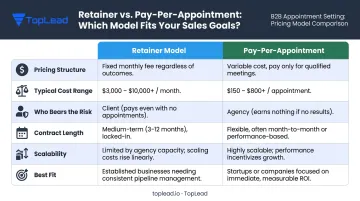
Retainer vs. Pay-Per-Appointment: Quick Comparison
| Factor | Retainer Model | Pay-Per-Appointment |
|---|---|---|
| Pricing Structure | Fixed monthly fee | Fee per qualified meeting delivered |
| Typical Cost Range | $3K–$15K+/month (SMB/mid-market); $20K+ enterprise | $200–$1,000 per meeting |
| Who Bears the Risk | Client pays regardless of output | Agency absorbs cost until delivery |
| Lead Quality Controls | Depends on agency investment | Tied to qualification criteria agreed upfront |
| Contract Length | Often 3–12 month minimums | Frequently month-to-month or flexible |
| Scalability | Scales with added budget | Scales by adjusting volume targets |
| Best Fit | Mid-market to enterprise; long sales cycles | Companies needing immediate, predictable pipeline |
Hybrid models combine a base retainer with a per-appointment performance bonus. This structure works well when you need strategic campaign management from the agency but also want output accountability baked into the contract.
What Are Retainer-Based Lead Generation Agencies?
A retainer model charges a fixed monthly fee that covers the agency's full cost of delivery: SDR salaries, prospecting tools, data subscriptions, outreach infrastructure, and campaign management. That fee applies whether the agency books eight meetings or two.
Why Retainers Dominate Enterprise Lead Generation
The math makes sense for sustained, complex campaigns. Building a high-performing outbound pipeline requires email deliverability warm-up (which takes weeks), multiple rounds of messaging iteration, audience refinement, and multi-channel coordination. Retainers fund that sustained effort — typically across a 6–12 month horizon — rather than paying per transaction.
SalesHive's internal SDR cost analysis puts the fully loaded annual cost of an in-house SDR at $110,000–$160,000, plus $2,000–$8,400/year in tools. An outsourced retainer at $6,000–$12,000/month typically costs less once you account for hiring, ramp time (3+ months), and management overhead.
What Drives Retainer Costs Higher
Several variables push retainer fees toward the upper end of the range for American companies evaluating agencies:
- SDR geography — U.S.-based reps command higher costs than offshore alternatives
- Channel breadth — adding LinkedIn, cold calling, and paid intent signals to email increases operational complexity
- ICP complexity — niche audiences with tight qualification criteria require more research and customization
- Strategy depth — setup, playbook development, and ongoing strategic advisory typically add $5,000–$25,000 in one-time fees
Use Cases Where Retainers Make Sense
Retainer models fit companies with:
- Deal values high enough (enterprise SaaS, cybersecurity, fintech, manufacturing) that a single closed deal justifies months of investment
- Sales cycles long enough to require multi-touch engagement rather than a single qualifying call
- Buying committees spanning multiple decision-makers across different roles and functions
The key limitation: clients pay the full retainer during the ramp period — typically 4–8 weeks — before a single meeting is booked. That's real cost exposure before any pipeline appears.
What Are Pay-Per-Appointment Lead Generation Agencies?
In a pay-per-appointment model, the agency absorbs all costs of prospecting, outreach, and qualification. The client pays only when a qualified meeting with a verified decision-maker is confirmed and booked on their calendar.
What Separates Quality From Low-Quality PPA
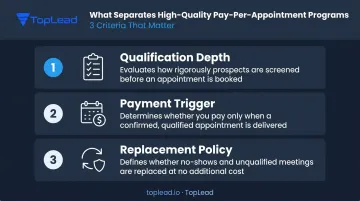
Not all pay-per-appointment programs are equal. The distinction between a high-value model and a glorified contact list comes down to three things:
- Qualification depth — does the agency verify decision-maker title, company fit, budget potential, and confirmed interest (BANT-style criteria) before the meeting lands on your calendar?
- Payment trigger — are you paying per scheduled meeting, per held meeting, or per qualified held meeting? The gold standard is the last option
- Replacement policy — does the agency replace or reschedule no-shows at no charge, or do those count against your quota?
DemandZEN's qualification framework defines a qualified appointment around the right person, right company, right timing, and confirmed BANT criteria — and flags meeting volume alone as a vanity metric. If fewer than 30% of delivered meetings convert to legitimate sales opportunities, the qualification process needs immediate attention.
What Pricing Actually Looks Like
Clutch's market data benchmarks pay-per-appointment at $200–$1,000 per qualified meeting, with variation driven by industry, decision-maker seniority, and exclusivity. Higher-complexity ICPs and C-suite targets sit toward the upper end of that range.
TopLead — a U.S.-based agency with 25,000+ appointments delivered for clients including Edward Jones, Aflac, and UBS — prices qualified appointments at $300–$350 per meeting, with a guaranteed minimum of 4–6 per month. Each engagement includes:
- ICP list development and decision-maker verification
- Multi-channel outreach via email, LinkedIn, and phone
- Calendar booking and CRM integration
- Reschedule or replacement guarantee for no-shows
At that price point, this scope reflects what a mature pay-per-appointment model should deliver.
Use Cases Where Pay-Per-Appointment Works Best
This model suits companies that:
- Need pipeline within 30–60 days without a long ramp budget
- Have a well-defined ICP and a clear value proposition their SDRs can communicate quickly
- Want their sales team focused on closing, not prospecting
- Are scaling a sales team and need a predictable, steady flow of qualified conversations
Industries with documented traction among US mid-market companies include financial services, insurance, professional services, and wealth management — sectors where a single closed deal returns many multiples of the per-appointment cost.
Which Pricing Model Delivers Better B2B Results?
Neither model is universally superior. The decision depends on four variables:
- Your average deal size (LTV)
- Your sales team's closing capacity
- How quickly you need pipeline
- How much budget you can commit before seeing ROI
A Simple ROI Framework
Before committing to either model, run this calculation:
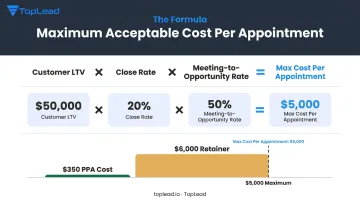
Maximum Acceptable Cost Per Appointment = Customer LTV × Close Rate × Meeting-to-Opportunity Rate
For example: if your average customer is worth $50,000, your close rate is 20%, and 50% of meetings become real opportunities, your maximum acceptable appointment cost is $5,000. At that ceiling, a $350 appointment fee gives you substantial headroom — a $6,000 retainer producing two meetings puts you right at the limit with no buffer.
Highspot's 2026 B2B sales cycle research notes average B2B sales cycles run 60–120 days — which means don't judge ROI before enough time has elapsed for your closed-won data to catch up to your pipeline data. That lag is worth keeping in mind as you match the model to your timeline.
Situational Recommendations
Choose a retainer if:
- You have a 6–12 month growth horizon and can sustain investment through ramp
- Your ICP requires omnichannel execution and multi-stakeholder messaging
- You need 20+ meetings per month at scale
Choose pay-per-appointment if:
- You need qualified conversations within 30–60 days
- You want predictable cost per meeting with no ramp exposure
- Your sales team is built to close but needs a reliable top-of-funnel feed
One practical difference: in a retainer, the risk of underperformance sits with the client. In a pay-per-appointment model with a replacement guarantee — the structure TopLead uses — that risk shifts to the agency. For any company that has already spent a retainer budget on thin results, that's a meaningful change in accountability.
How to Evaluate B2B Lead Generation Agencies Before You Commit
Regardless of pricing model, four criteria determine whether an agency will perform:
1. Qualification Depth
Ask the agency to define "qualified" in writing — specific job titles, company sizes, BANT criteria, and what disqualifies a lead. Request a sample lead profile before you sign. Vague or shifting definitions are a signal the agency is optimizing for volume, not your pipeline.
2. Industry Experience
Generic outreach fails in specialized verticals. An agency with documented results in your industry already knows the objection patterns, buyer personas, and seasonal timing that a generalist learns on your dime. Ask for case studies or named clients in your space.
3. Reporting Transparency
Real-time access to outreach activity, meeting outcomes, and pipeline metrics is non-negotiable — a monthly PDF summary isn't transparency, it's a highlight reel. TopLead, for instance, provides weekly reporting on contacted vs. replied, booked meetings, call show rates, and channel attribution, with direct CRM sync to Salesforce, HubSpot, Pipedrive, and others.
4. Contract Flexibility
Premium agencies with conviction in their results don't need 12-month lock-ins to protect their revenue. Month-to-month or milestone-based terms signal confidence; rigid long-term contracts with no performance recourse signal the opposite.
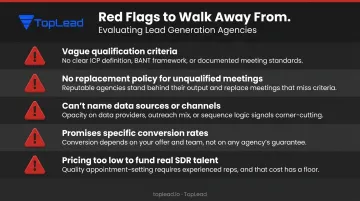
Red Flags to Walk Away From
- Vague or unmeasurable qualification criteria
- No replacement or dispute policy for unqualified meetings
- Unable to name their data sources or outreach channels
- Promises of specific conversion rates (those depend on your sales process, not theirs)
- Pricing so low it can't fund real SDR talent and proper data infrastructure
The agencies worth hiring integrate with your CRM from day one, flag quality issues early, and adjust targeting based on what actually converts — not what looked good in the pitch deck.
Conclusion
The pricing model an agency uses is a signal of where their incentives sit. Retainer agencies are betting on the long-term value of their strategic execution. Pay-per-appointment agencies are betting on their ability to deliver qualified meetings right now. Both bets can pay off. The right choice depends on your stage, budget, and how quickly you need pipeline moving.
For most B2B sales leaders, the real measure is simple: are qualified decision-makers showing up on your calendar, engaging with your offer, and converting into real pipeline? Whichever model you choose, hold the agency to that standard from day one. If they can't show early traction, a longer runway won't fix it.
TopLead's pay-per-appointment model is built around exactly that accountability — delivering verified decision-maker meetings with a reschedule or replacement guarantee, no retainer required. With over 25,000 appointments arranged across North America and a cost per lead averaging $300–$350, it's a concrete benchmark worth comparing against any agency you're evaluating.
Frequently Asked Questions
How much does a B2B lead generation agency typically charge per appointment?
Pay-per-appointment agencies generally charge $200–$1,000 per qualified meeting, depending on industry, decision-maker seniority, and qualification depth. Retainer-based agencies charge $3,000–$15,000+/month for SMB and mid-market programs, with enterprise programs exceeding $20,000/month.
What is the difference between a retainer and a pay-per-appointment lead generation model?
Retainers charge a fixed monthly fee for ongoing effort — regardless of how many meetings are produced. Pay-per-appointment means you only pay when a qualified meeting is confirmed and booked on your calendar, with no cost for pipeline months where output is low.
How do I verify that appointments booked by a lead gen agency are actually qualified?
Before signing, ask for a written definition of "qualified" that matches your ICP — including specific job titles, company criteria, and BANT thresholds. Request a sample lead profile and confirm there's a replacement or reschedule policy for any meeting that doesn't meet the agreed criteria.
Is pay-per-appointment better than a monthly retainer for B2B lead generation?
Pay-per-appointment works best for companies that need immediate, accountable pipeline without ramp exposure. Retainers are better suited for sustained, complex outbound campaigns with 6–12 month growth horizons and high meeting volume requirements.
How many qualified appointments per month should I expect from a B2B lead generation agency?
Quality agencies typically guarantee a minimum volume — for example, TopLead guarantees 4–6 qualified appointments per month. Set volume expectations based on your industry, ICP size, and campaign maturity — not just the agency's standard package terms.
What are the biggest red flags when evaluating a B2B lead generation agency?
Key red flags to watch for:
- Vague qualification criteria with no written ICP definition
- No replacement or reschedule guarantee for poor-quality meetings
- Inability to name data sources or outreach channels
- Pricing structures with no performance accountability
- Promises of specific conversion rates or results within days of launch