Introduction
Sales reps spend just 40% of their workweek actually selling — the other 60% goes to administrative tasks, internal meetings, and prospecting, according to Salesforce's 2026 State of Sales report. Prospecting alone consumes 16% of rep time. For small and mid-sized U.S. businesses, that lost capacity compounds fast.
B2B lead generation outsourcing hands that top-of-funnel work to a specialized external team, so your closers stay focused on closing. The result: sales-ready appointments without burning rep time on cold outreach.
This guide covers what outsourced lead gen actually is, how to evaluate partners, what it costs, and how to measure results.
Key Takeaways
- Sales reps spend 60% of their time outside active selling — outsourcing prospecting reclaims that capacity
- A quality outsourced partner delivers verified, sales-ready appointments, not contact lists
- Evaluate partners on decision-maker verification, qualification rigor, transparent reporting, and flexible contract terms
- Costs vary by model; pay-per-appointment aligns agency incentives with your outcomes
- Expect first appointments within 2–4 weeks; consistent pipeline output builds over 3–6 months
What Is B2B Lead Generation Outsourcing (and How Does It Work)?
B2B lead generation outsourcing means hiring a third-party agency to handle prospecting, qualification, and appointment setting on your behalf. The key word is active — a real outsourced partner isn't selling you a spreadsheet of contacts. They're engaging prospects, qualifying responses, and delivering people who are ready to talk to your sales team.
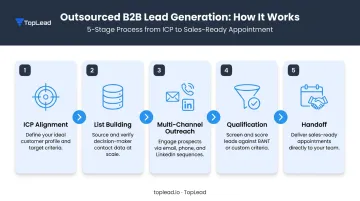
The typical process looks like this:
- ICP alignment: The agency learns your ideal customer profile, value proposition, and qualification criteria — before a single outreach goes out
- List building: Prospect lists are built using firmographic data, intent signals, and verified contacts matched to your ICP
- Multi-channel outreach: Sequenced campaigns across email, LinkedIn, and phone create multiple opportunities to connect
- Qualification: SDRs screen every response against your agreed criteria — no meeting gets booked without passing that filter
- Handoff: Sales-ready meetings land on your calendar, each with context notes so your team walks in prepared
Three Types of Outsourced Lead Gen Services
Not all outsourced providers do the same thing. Understanding the differences helps you match the right service to where your pipeline is actually breaking down. Here are the three main categories:
- Outbound sales services (SDR-as-a-service, appointment setting, cold calling) — Deliver the most sales-ready leads; the agency manages outreach and qualification end-to-end
- Demand generation services (content syndication, email automation) — Build awareness and warm up leads over weeks or months; better for longer nurture cycles
- Lead database services (list building, data validation, intent data) — Supply raw prospect data for your own team to work; you still own the outreach
The right choice depends on where your pipeline is breaking down. If your team has no time to prospect, outbound services address that directly. If you need raw data to feed an existing SDR team, a database service makes more sense.
Key Benefits of Outsourcing B2B Lead Generation
Speed to Launch vs. Building In-House
Recruiting, hiring, and ramping an in-house SDR takes time most American companies underestimate. New SDRs typically need 90 days to reach baseline productivity and up to six months to perform consistently — that's half a year before your investment generates pipeline.
An outsourced agency brings an established team, proven outreach sequences, and a built-in tech stack. Campaigns can launch in weeks, not quarters.
Cost Efficiency
The Bureau of Labor Statistics reports median annual wages for wholesale and manufacturing sales representatives at $74,100. Add benefits, tools, management time, and ramp costs, and the total rises significantly — for a single rep who may or may not hit quota.
TopLead's pay-per-appointment model, for example, prices qualified appointments at an average CPL of $300–$350, with a minimum of 4–6 qualified leads delivered per month. That structure ties cost directly to delivered outcomes rather than headcount.
Scalability Without Headcount Risk
Outsourcing lets you flex capacity based on market conditions — increase volume during a product launch, pull back during a slow quarter — without the HR complexity of hiring or laying off employees. For SMBs, that flexibility is often the deciding factor.
Sales Team Focus on Closing
When prospecting moves off your reps' plates, they spend more time on deals that can actually close. Two examples from TopLead clients:
- A fintech firm saw SQL quality rise 45% within three months after targeting by job function, company size, and funding stage
- A healthcare SaaS company doubled demo show-up rates after integrating TopLead's lead workflows directly into HubSpot
Access to Enterprise-Grade Prospecting Tools
Leading agencies invest in tools that would be cost-prohibitive for individual companies to license and manage: CRM integrations (Salesforce, HubSpot, Pipedrive), intelligence platforms (ZoomInfo, Apollo, Lusha), and multi-channel automation. Clients get immediate access to all of it without procurement overhead.
Common Challenges and Pitfalls to Avoid
The Quality vs. Quantity Trap
Some agencies optimize for appointment volume to hit contractual quotas. That's a problem. A contact list is not a lead list, and a pay-per-appointment model can still deliver low-value meetings if the qualification criteria are weak.
Here's what a poorly-qualified appointment looks like: your sales rep shows up to a call with an office manager who forwarded the meeting invite from their boss — who has no actual authority to purchase. The meeting was "booked," the agency hit its number, and your rep spent 30 minutes going nowhere.
Gartner data shows 73% of B2B buyers avoid suppliers that send irrelevant messaging. Volume-focused outreach that ignores ICP fit doesn't just waste time — it actively damages your brand with buyers you may need later.
Brand and Messaging Misalignment
External teams learn your voice over time, not instantly. In early engagements, outreach can come across as generic or off-brand if there's no structured onboarding process.
Prevent this with thorough documentation upfront:
- ICP definition — who you target and why they buy
- Messaging framework — your positioning and core value propositions
- Objection handling — how to respond to common pushback
- Draft review process — require agency approval before any outreach goes live
Dependency and Communication Risks
Over-relying on a single vendor creates pipeline vulnerability. Offshore teams can introduce time-zone friction and cultural nuance issues that affect how outreach lands with U.S. decision-makers.
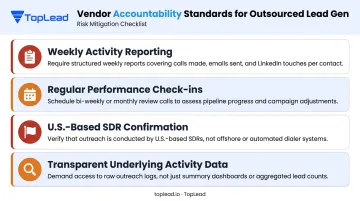
Protect yourself with clear accountability standards from day one:
- Require weekly reporting that shows activity, not just results
- Schedule regular check-ins to review messaging and performance
- Confirm all outreach is executed by U.S.-based SDRs if your buyers are domestic
- Walk away from any vendor that won't show you the underlying activity behind their numbers
How to Choose the Right B2B Lead Generation Partner
Industry Experience and ICP Fit
Generic outreach playbooks don't translate across verticals. A campaign that works for financial advisors looks nothing like one targeting SaaS buyers. Ask any prospective partner for industry-specific case studies and client references — not just aggregate metrics.
TopLead has arranged over 25,000 appointments across verticals including financial services, insurance, technology, professional services, and manufacturing in the United States — which means their SDR teams already know how buyers in your space think and what objections come up first.
Lead Qualification Rigor
This is where most agencies separate themselves. Ask specifically:
- How do you verify decision-maker authority before booking an appointment?
- What qualification framework do you use — BANT, MEDDIC, CHAMP, or something proprietary?
- What happens when an appointment no-shows?
TopLead verifies decision-maker status on every appointment — filtering for HR directors, CFOs, controllers, and business owners — and backs that with a replacement or reschedule guarantee. Agencies willing to put a guarantee behind their bookings are the ones that have earned confidence in their process.
Transparency in Process and Reporting
Before signing anything, ask to see how the agency builds prospect lists, what outreach sequences look like, how they handle objections, and what reporting you'll access. Vague references to "proven results" without supporting methodology are a red flag.
A credible partner should provide reporting that covers, at minimum:
- Contacted vs. replied rates by outreach channel
- Booked meetings and show rates
- Attribution by channel (email, phone, LinkedIn)
- CRM integration so you see activity in real time
TopLead delivers all of this weekly, with full CRM integration for real-time visibility into lead activity.
Pricing Model and Contract Terms
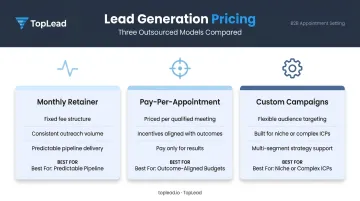
The three main structures:
| Model | How It Works | Best For |
|---|---|---|
| Monthly retainer | Fixed fee covering a set volume of outreach and appointments | Predictable pipeline needs |
| Pay-per-appointment | Priced per qualified meeting delivered | Aligning agency incentives with outcomes |
| Pay-per-lead | Priced per qualified lead (pre-appointment) | Earlier-stage qualification needs |
Avoid long-term lock-in contracts. Partners confident in their performance should be willing to work on shorter commitments. TopLead requires no long-term contracts — campaigns run on a 3–6 month lifecycle with flexibility built in.
Also confirm: who owns the leads generated? That data should transfer to you, not stay with the agency.
Multi-Channel Outreach Capability and Compliance
Single-channel campaigns underperform in today's B2B environment. Verify that your prospective partner runs coordinated email, phone, and LinkedIn sequences — not just bulk email blasts.
On compliance: any agency handling outreach on your behalf must meet CAN-SPAM requirements (opt-out mechanisms, truthful headers, physical address), TCPA rules for phone outreach, and GDPR/PECR obligations if targeting European contacts. Ask them to walk you through their data handling practices before you sign.
What Does It Cost to Outsource B2B Lead Generation?
Pricing Models and Trade-offs
Clutch's marketplace shows provider rates ranging from under $25/hour to $200–$300/hour depending on scope and specialization — but those hourly figures don't translate cleanly to campaign economics. A more practical breakdown by model:
- Pay-per-appointment ties cost directly to delivered meetings — at TopLead's average CPL of $300–$350, a floor of 4–6 qualified appointments per month puts typical spend at $1,200–$2,100, with no charge for meetings that don't meet criteria
- Monthly retainers provide predictable cost and consistent outreach volume; ideal when your appointment needs are stable
- Custom campaigns for niche audiences, complex ICPs, or multi-segment strategies are priced separately and allow for more flexible targeting and frequent adjustments
Factors That Shape Cost
Not all campaigns are priced equally. These variables drive cost up or down:
- Target audience seniority — C-suite outreach requires more tailored messaging and typically takes longer to convert
- Industry complexity — Regulated sectors like financial services and healthcare require compliance-aware outreach and specialized knowledge
- Geographic scope — Nationwide US campaigns require broader list-building and more outreach infrastructure
- Qualification depth — More rigorous criteria means fewer appointments, but higher-quality ones
Framing Cost as a Pipeline Investment
Evaluate outsourced lead gen cost against cost per qualified appointment and downstream pipeline value — not the monthly fee alone.
If a $1,500 monthly investment produces 5 qualified appointments and your average deal size is $25,000, a single close more than justifies the spend. Use that ratio — cost per appointment versus average deal value — as your benchmark when comparing providers.
How to Measure the Success of Outsourced Lead Generation
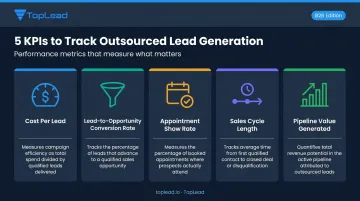
Core KPIs to Track
| Metric | What It Tells You |
|---|---|
| Cost Per Lead (CPL) | Marketing efficiency — are you paying a reasonable price for qualified meetings? |
| Lead-to-Opportunity Conversion Rate | Whether booked appointments actually become active pipeline opportunities |
| Appointment Show Rate | How well the agency is qualifying and confirming prospects before the call |
| Sales Cycle Length | Whether outsourced leads are moving through your pipeline faster than internally-sourced ones |
| Pipeline Value Generated | Total deal value created per campaign period — the ultimate ROI indicator |
Salesloft's analysis of 570 million sales interactions found SDRs average a 2.8% email reply rate. If your outsourced partner's campaigns are consistently outperforming that baseline, messaging and targeting are working.
Continuous Optimization
Tracking these numbers only matters if someone acts on them. A quality partner reviews performance data with you regularly — at minimum monthly — and uses it to refine targeting, messaging, and channel mix.
TopLead, for example, runs structured optimization sessions covering response rates, qualification outcomes, and channel attribution. After each meeting, clients log feedback directly in the platform — that input feeds back into the next campaign cycle, sharpening results over time.
Any partner worth hiring should be able to show exactly how activity metrics (emails sent, calls made, response rates) connect to outcome metrics (qualified appointments, pipeline created). If they can't draw that line, you're flying blind on budget that could be optimized elsewhere.
Frequently Asked Questions
What is the difference between outsourced lead generation and appointment setting?
Lead generation is the broader process of identifying, engaging, and qualifying potential buyers. Appointment setting is a specific deliverable within it — where the agency books a confirmed, qualified meeting between a prospect and your sales rep. Most quality outsourced partners do both as part of a single workflow.
When should a B2B company outsource lead generation instead of keeping it in-house?
The clearest triggers: your sales team is spending more time prospecting than closing, lead volume or quality is inconsistent, or you need to scale pipeline quickly without the time and cost of building an internal SDR team.
How do you ensure quality when outsourcing B2B lead generation?
Four non-negotiables to hold any agency to:
- Require decision-maker verification before any appointment is passed
- Insist on structured qualification criteria (authority, need, timing)
- Demand a replacement or reschedule guarantee for no-shows
- Track conversion outcomes monthly, not just appointment volume
What questions should I ask a B2B lead generation agency before signing?
Five questions worth asking before you sign anything:
- What industries have you served?
- How do you qualify and verify decision-makers?
- Who owns the leads generated?
- What does your reporting dashboard include?
- Are there long-term contract requirements?
How long does it take to see results from outsourced B2B lead generation?
Most outbound campaigns deliver first appointments within 2–4 weeks of launch. Consistent pipeline output with refined targeting generally matures over a 3–6 month lifecycle — plan your expectations accordingly.
How much does outsourcing B2B lead generation typically cost?
Pay-per-appointment models typically run $300–$350 per qualified meeting, with most programs delivering 4–6 appointments per month. Full-service monthly retainers vary by volume and complexity. Evaluate cost against pipeline value generated, not the fee alone.