Introduction
Pipeline targets keep climbing. Hiring budgets don't. For most CROs, that math eventually leads to the same conversation: outsourced SDRs.
The problem? A SaaStr survey of more than 1,200 respondents found that only 7% of companies report outsourced SDRs have truly worked — with another 26% saying they "sort of" worked. That's a sobering number for anyone considering this path.
The failure isn't in the concept. It's in the execution. Programs that generate real pipeline versus those that produce rejected meetings and strained AE relationships almost always trace back to what the CRO did, or didn't do, before, during, and after launch.
This guide covers four areas that separate the 7% from the rest: pre-launch readiness, team enablement, measurement, and the common failure modes that derail programs that should have worked.
Key Takeaways
- Outsourced SDR program success depends on the CRO's structure, not just the vendor chosen
- Document your ICP, target account list, and SDR-to-AE handoff protocol before outreach begins
- Track meeting quality and pipeline conversion rate, not raw call and email volume
- Choose a partner whose pricing aligns with outcomes — pay-per-appointment removes retainer risk entirely
Why CROs Are Turning to Outsourced SDRs
The cost case is straightforward once you break it down.
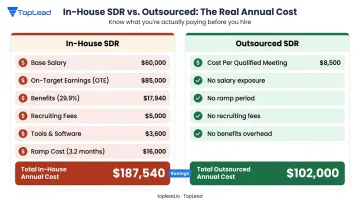
According to RepVue, the U.S. median SDR base salary sits at $60,000, with median OTE reaching $85,000. Stack on employer benefits — BLS data from December 2025 puts private-industry benefits at 29.9% of total compensation costs — plus recruiting fees, tools, and ramp time, and the fully loaded annual cost of a single in-house SDR climbs well above six figures before they've booked a single meeting.
TOPO's Sales Development Benchmark Report, based on 179 sales development leaders, puts average SDR ramp time at 3.2 months to reach full quota. That's roughly a quarter of budget consumption before consistent output begins.
The Flexibility Case
Beyond cost, outsourced SDRs solve a strategic problem that headcount can't: speed without permanence.
Common use cases where this matters:
- Testing a new vertical before committing to a hire
- Running outreach around a product release or seasonal push
- Exploring an ICP segment you've never targeted
Outsourced programs activate in weeks, not quarters — and without adding a permanent salary line that keeps burning whether results come or not, giving American companies a fast, low-risk path to test new pipeline motions.
The pricing model matters here. A pay-per-appointment structure — like the one TopLead uses, having arranged 25,000+ appointments for B2B companies across the U.S. — ties cost directly to qualified meetings delivered. No retainer, no activity fees. You only pay when a qualified meeting lands on the calendar — a fundamentally different arrangement than absorbing sunk costs on an underperforming hire.
How to Set Up Your Outsourced SDR Program for Maximum Impact
Nail Your ICP and Target Account List Before Day One
The single biggest reason outsourced SDR programs underperform is handing a vague ICP to the vendor on day one. TOPO data shows 35% of sales development leaders struggle with executing account-based strategies — and that's with in-house teams who already know the product.
Before outreach starts, a CRO must define four components:
- Firmographics — company size, revenue range, growth stage
- Technographics — CRM, marketing stack, tools that indicate fit
- Buying triggers — funding rounds, leadership changes, compliance deadlines, hiring surges
- Key personas — title, department, specific pain points, decision-making authority
From there, build a focused target account list — typically 200–500 accounts segmented by vertical and buying signal. A tighter list with genuine intent signals will consistently outperform a sprawling list with loose criteria. SDRs can go deeper on each account, personalize outreach, and surface patterns faster.
TopLead's onboarding process includes an ICP Alignment Workshop that helps clients move from broad targeting (any SaaS company) to precise, actionable profiles (software companies with 20–150 employees, rapid growth, using specific tools). That precision directly determines whether the meetings your SDRs book are ones your AEs will close.
Establish a Structured 30-Day Onboarding Period
Skipping this phase is where most outsourced programs quietly fall apart. Generic messaging doesn't improve with volume — it just fails faster.
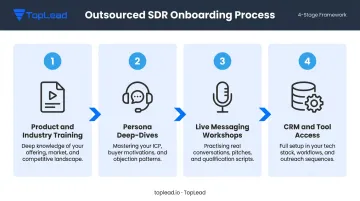
A structured onboarding must cover:
- Product and industry training — recorded demos, use cases, competitive positioning, objection context
- Persona deep-dives — shadow calls with AEs and CSMs to absorb how real conversations go
- Live messaging workshops — cold call openers, email sequences, objection handling rehearsal
- Full CRM and tool access — so SDRs operate inside your system, not alongside it
Without this foundation, outsourced SDRs default to template outreach that prospects can identify from the first sentence. At that point, sending more sequences only accelerates prospect fatigue.
Once onboarding is solid, the next priority is making sure both sides agree on what success actually looks like.
Define SLAs and Qualified Meeting Criteria in Writing
Output-based SLAs keep both sides accountable. Before outreach begins, lock in:
| Metric | Benchmark Range |
|---|---|
| Outbound activities per SDR per day | ~75 total (35 dials, 40 emails) |
| Meetings booked per month (SMB) | ~15 per SDR |
| Meetings booked per month (mid-market) | ~12 per SDR |
| Meetings held rate | ~80% (20% dropout expected) |
Source: TOPO 2019 Sales Development Benchmark Report; Operatix internal research across 500+ B2B SaaS campaigns
Equally important: write down exactly what a Sales Accepted Lead (SAL) means. A solid SAL definition covers:
- Attendee role and seniority (matches a defined persona)
- Company size match to ICP
- Identified pain point discussed during qualification
- Evaluation timeline confirmed
- Budget authority verified
Without this in writing, your weekly syncs become arguments about what counts as a meeting instead of conversations about improving the program.
Choose a Partner Whose Model Aligns Incentives with Outcomes
Retainer-based SDR services charge a fixed monthly fee regardless of what they produce. Pay-per-appointment models charge only for qualified meetings delivered. That structural difference determines whether your vendor is optimizing for activity or for outcomes.
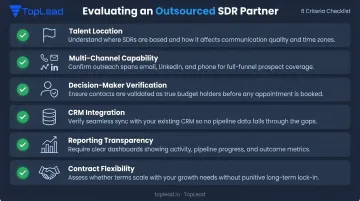
Beyond pricing model, evaluate partners on:
- Talent location — U.S.-based for North American B2B (time zone and cultural alignment matter)
- Multi-channel capability — phone, email, and LinkedIn outreach in coordinated sequences
- Decision-maker verification — confirmed authority, not just job title matches
- CRM integration — Salesforce, HubSpot, Pipedrive, and similar platforms
- Reporting transparency — weekly metrics on reply rates, meetings booked, show rates, and attribution
- Contract flexibility — no long-term lock-in while the program proves itself
Enabling Outsourced SDRs to Perform Like Part of Your Team
Build a Messaging Playbook They Can Actually Use
A complete SDR messaging playbook contains:
- ICP-specific value propositions by persona (not one-size-fits-all)
- Pain-point-led cold call openers (15–30 seconds, problem-first)
- Email sequence templates per persona (5–7 touch cadence)
- Top 10 objection handling responses
- Competitor differentiation talk tracks
The first 60 days are your critical messaging testing window. Run a structured iteration process each week:
- Track reply rates by template — identify what's generating responses
- Review call recordings — spot opener patterns that generate conversation
- Run A/B tests on subject lines and CTAs
- Adjust messaging based on data, not gut feel
A well-structured vendor partnership — like TopLead's weekly reporting and post-meeting feedback loops — keeps this iteration cycle running without requiring your team to manage it separately.
Create a Tight SDR-to-AE Handoff Protocol
Context loss is a higher risk with external SDRs than in-house ones. The handoff protocol needs four documented components:
- Meeting brief template: pre-call research, pain points discussed, next steps agreed, and stakeholders involved
- Required CRM qualification fields: BANT or MEDDIC criteria completed before the meeting counts
- Brief SDR-to-AE verbal handoff before each call — CRM notes alone miss the nuance
- CRM hygiene standards: what gets logged, by whom, and when
Also give outsourced SDRs visibility into open pipeline and closed-lost accounts. This prevents outreach to existing customers and enables smarter, more targeted prospecting against accounts where there's already some signal.
Run Ongoing Feedback Loops Between SDRs, AEs, and the CRO
Three feedback touchpoints should be built into the operating rhythm:
- Weekly SDR pipeline reviews: meetings booked, held rate, and AE feedback on quality
- Bi-weekly vendor debriefs: reply rates, objection patterns, and A/B test results
- Monthly AE feedback sessions: meeting quality ratings, discovery insights, win/loss patterns
Each channel diagnoses a different problem:
| Signal | Root Cause | CRO Action |
|---|---|---|
| AEs consistently rejecting meetings | Targeting issue — wrong accounts or personas | Tighten ICP, update account list |
| Dropping reply rates | Messaging issue — templates are fatiguing | Run new A/B tests, refresh sequences |
| High no-show rates | Qualification issue — meetings aren't real commitments | Revise SAL definition, add confirmation step |
Measuring What Matters: The CRO's SDR Performance Framework
Leading Indicators vs. Pipeline Metrics
Track these weekly as leading indicators:
| Metric | Average | Strong |
|---|---|---|
| Cold call connect rate | 5.4% (~19 dials per connection) | 13.3% (~8 dials) |
| Meetings booked per SDR/month | 12–15 | — |
| Meetings held rate | ~80% | — |
| SAL-to-SQL conversion | ~52.7% | — |
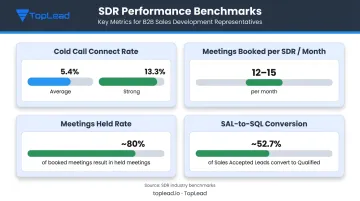
Sources: Gong analysis of 300M+ cold calls; Operatix research across 500+ B2B SaaS campaigns
Track these monthly as pipeline metrics:
- Meetings-to-SQL conversion rate — the real indicator of meeting quality
- Outsourced SDR pipeline as a % of total pipeline — TOPO data shows SDRs generate 57% of overall pipeline on average; Operatix puts the range at 30–45% for B2B SaaS
A meetings booked count means nothing in isolation. A meeting only counts when it converts to an SQL and eventually to pipeline. If your outsourced SDR program books 20 meetings a month but AEs reject 12 of them, you have a targeting problem, not a volume problem.
The ROI Formula
Use this to evaluate program performance:
(Pipeline Revenue Generated – Total Program Cost) ÷ Total Program Cost
Include indirect costs in your calculation:
- Leadership time saved on recruiting and managing in-house SDRs
- Faster market feedback on new ICPs without headcount risk
- Avoided hiring exposure before headcount is approved
A pay-per-appointment model makes this calculation cleaner: cost is directly tied to meetings delivered, with no retainer diluting the denominator.
Red-Flag Signals (Weeks 4–8)
If you see any of these in the first two months, the program has a structural problem that needs CRO intervention — not just more volume:
- Zero positive replies after significant email volume
- AEs rejecting more than half of booked meetings
- No-show rates exceeding 30%
- No repeat engagement from target accounts after multiple touches
These signals require diagnosis, not acceleration. That said, some ramp time is normal — expect 60–90 days before reaching consistent, steady-state output. First meetings typically appear at weeks 4–6, with the program strengthening as messaging is refined and account patterns become clearer.
Three Mistakes CROs Make That Kill Outsourced SDR Performance
Treating It Like a Hands-Off Vendor Relationship
CROs who disengage after contract signing consistently see weaker results. Regular involvement in messaging refinement, ICP calibration, and AE feedback is what separates programs that keep improving from ones that plateau after week eight.
Recommended cadence: weekly touchpoints for the first 60 days, then bi-weekly as the program reaches steady state.
Measuring Activity Instead of Outcomes
Holding SDRs accountable for call volume and email sends creates exactly the wrong incentives. It produces meetings AEs reject and pipeline that never converts.
Instead, track:
- Cost per qualified opportunity — what did each SQL actually cost?
- Meeting-to-SQL conversion rate — are the meetings worth showing up to?
When activity numbers look strong but conversion rates stay flat, the program is optimizing for the wrong thing.
Choosing on Price Alone
The headline cost difference between U.S.-based and offshore SDR providers often narrows considerably once training overhead, churn, conversion quality, and brand risk are factored in. An offshore team that produces meetings AEs won't take wastes more budget than a higher-priced U.S.-based provider with a strong show rate.
The real total cost comparison includes:
- Ramp and training time per new SDR hire
- Churn-driven restarts and lost pipeline momentum
- AE time spent on unqualified meetings
- Brand exposure from poor prospect interactions
A pay-per-appointment model lets you validate conversion quality before committing to scale — so budget goes toward pipeline, not experimentation.
Frequently Asked Questions
What is an outsourced SDR?
An outsourced SDR is a sales development representative provided by an external agency who handles outbound prospecting, outreach, and lead qualification on behalf of the client company. They integrate into the client's CRM and operate within the client's go-to-market motion, typically appearing indistinguishable from an in-house SDR from the prospect's perspective.
What is CRO outsourcing?
In a B2B sales context, CRO outsourcing means hiring an external or fractional Chief Revenue Officer to own revenue strategy and execution: SDR program governance, pipeline generation, and revenue operations. It eliminates the cost and tenure risk of a full-time hire.
How quickly can outsourced SDRs start generating pipeline?
Fast-start vendors can activate campaigns within weeks, but CROs should expect 60–90 days to reach consistent pipeline output. First meetings typically appear around weeks 4–6, with early weeks focused on messaging testing and ICP refinement.
What metrics should a CRO track for an outsourced SDR program?
Track cold call connect rate and positive reply rate as weekly leading indicators. Monthly, monitor meetings held rate, meetings-to-SQL conversion, and outsourced-SDR-sourced pipeline as a percentage of total pipeline.
How do you choose the right outsourced SDR provider?
Evaluate on industry specialization, talent location (U.S.-based for North American B2B), multi-channel capability, pricing model (pay-per-appointment vs. retainer), decision-maker verification practices, and contract flexibility.
What's the difference between a pay-per-appointment model and a retainer-based SDR service?
Retainer models charge a fixed monthly fee regardless of results. Pay-per-appointment models tie cost directly to qualified meetings delivered, making them a lower-risk entry point for CROs who want to validate output before committing long-term.