Introduction
Small business owners are one of the most valuable prospects in commercial insurance — and one of the most difficult to convert. They're the sole decision-maker, perpetually time-starved, and quick to dismiss anything that feels like a generic sales push.
The challenge isn't access. According to the SBA, there are over 36 million small businesses in the U.S., representing nearly every industry and geography imaginable. The challenge is relevance. A one-size-fits-all message lands nowhere with an owner who's already juggling operations, payroll, and compliance.
Solving that relevance problem requires a framework — not a list of tactics. This guide walks through a channel-specific, repeatable approach for insurance brokers looking to attract and convert SMB clients: from building digital presence and niche positioning to structured outbound prospecting.
Key Takeaways
- 77% of small businesses are underinsured — brokers who lead with education rather than quotes consistently outperform those who lead with price
- Local SEO, Google Business Profile, and industry-specific content help SMB owners find you when they're actively researching coverage options
- Coordinated outbound prospecting across email, LinkedIn, and phone reaches decision-makers faster than relying on inbound alone
- Referral partnerships with CPAs, commercial bankers, and PEO providers produce warm leads at the highest conversion rates
- Niche specialization by industry generates stronger word-of-mouth, clearer messaging, and easier content creation
Why Small Business Owners Require a Tailored Marketing Approach
SMB owners operate differently than corporate buyers. No procurement team, no RFP process, no committee. One person (often the founder) decides.
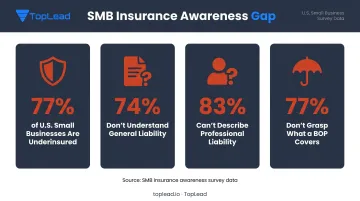
Hiscox research found that 77% of U.S. small businesses are underinsured, and the knowledge gap runs deeper than coverage limits. The same research found 74% don't understand General Liability, 83% can't correctly describe Professional Liability, and 77% don't grasp what a BOP covers. These aren't disengaged buyers — they're overwhelmed ones.
What This Means for Your Marketing Tone
SMB owners are cost-sensitive and skeptical of sales pitches — that's expected. The deeper insight is that they want guidance; they just don't trust advisors who lead with products. Brokers who position themselves as educators win disproportionately.
That educator-positioning advantage plays out even more sharply when you consider how SMB owners choose vendors in the first place:
- Enterprise buyers use formal vendor assessments, RFPs, and committee consensus
- SMB buyers rely on peer recommendations, Google reviews, and whether the broker clearly understands their specific industry
The practical implication: every channel and message should reinforce credibility, relevance, and ease of doing business. Not features, not price.
Build a Digital Presence That Attracts Small Business Prospects
Your website is the foundation. SMB owners research vendors online before making contact — BrightLocal's 2026 survey found 72% of consumers use Google to find local business information — and your site is often the first (and sometimes only) impression you make.
An effective broker website for the SMB audience should include:
- Industry-specific landing pages — "insurance for contractors," "restaurant coverage," "coverage for medical offices" — so owners immediately recognize you understand their world
- A clear value proposition that explains what makes you different, in plain language
- Client testimonials from similar businesses — social proof from a restaurant owner matters more to another restaurant owner than any claim you make about yourself
- Easy-to-find contact options — phone number, contact form, and ideally an online scheduling link visible above the fold
Optimize for Local and Industry-Specific SEO
Local SEO is what gets you found when a business owner searches "small business insurance broker in [city]." The core elements:
- Google Business Profile — claim it, complete every field, upload photos, and respond to every review. BrightLocal found 80% of consumers are more likely to use a business that responds to all reviews, and 47% won't consider a business with fewer than 20 reviews
- Location-based keywords — use city and neighborhood-level terms naturally in page titles, headers, and content
- Local citations — consistent NAP (name, address, phone) listings across directories reinforce local relevance
Blog posts, short guides, and FAQ pages targeting questions SMB owners actually search (such as "do contractors need general liability" or "what does a BOP cover for restaurants") generate compounding organic traffic over time. Done consistently, this content positions you as the subject-matter expert before any sales conversation begins — which matters when buyers are still comparing options.
Leverage Social Media and Email to Stay Top of Mind
LinkedIn and Facebook serve distinct purposes:
- LinkedIn — best for reaching owners of professional services, consulting, and service-based B2B businesses. Effective post types include coverage explainers, risk scenario posts, and industry news commentary
- Facebook — stronger for community-based businesses: retail, restaurants, trades. Local business groups and event pages drive real engagement with owners in your geography
Email nurture fills the gap between first contact and decision. A simple cadence triggered by a website form or initial consultation — alternating educational content, brief check-ins, and occasional offers — keeps you visible during the months-long consideration cycle most SMB buyers go through.
That persistence pays off. Mailchimp data puts the average open rate for business and finance emails at 31.35%, which is solid reach for professional services outreach when the content stays relevant to the reader's industry.
Outbound Prospecting: How to Reach Small Business Decision-Makers Directly
Most brokers wait for inbound. That's a pipeline problem.
Proactive outbound to verified business owner contacts compresses the time it takes to build pipeline — and unlike enterprise sales, American SMB owners are often reachable directly. No gatekeepers, no executive assistants. The owner picks up the phone.
Building a Targeted Prospect List
The foundation is list quality. Filter by:
- Industry — use NAICS codes to identify specific business types (restaurants, contractors, medical offices, etc.)
- Employee count — the U.S. Census Bureau's County Business Patterns database provides annual subnational data by industry and employment size, useful for market sizing by geography
- Geography — focus on licensed states or expand into new markets
- Business age — newer businesses often have coverage gaps or limits that no longer match their actual exposure
Commercial data providers like D&B, ZoomInfo, and similar U.S.-based data sources let you filter across these dimensions to build a workable prospect list.
The Multi-Channel Outreach Sequence
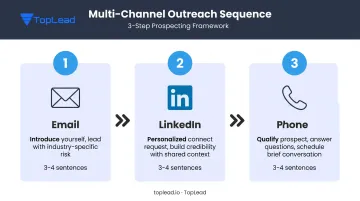
Single-channel outreach underperforms. A coordinated sequence across email, LinkedIn, and phone — with each touchpoint serving a distinct purpose — outperforms any one channel alone:
- Email — introduce yourself, lead with a specific risk relevant to their industry, make the value clear in 3-4 sentences
- LinkedIn — connect request with a brief, personalized note that builds credibility (mutual connection, shared industry knowledge)
- Phone follow-up — qualify the prospect, answer questions, and move toward scheduling a brief conversation
The messaging framework matters. Subject lines that name the prospect's industry and a specific risk ("Coverage Gap Most [Industry] Owners Miss") outperform generic openers. The ask should be small: a 15-minute conversation, not a pitch.
When Outbound Requires Scale
Brokers who want outbound results without building an internal SDR team have a working alternative. TopLead runs managed outbound campaigns for commercial brokers, qualifying each prospect across multiple dimensions before the first contact is made:
- Company size, industry, and geography
- Current carrier and policy renewal date
- Decision-maker verification
They've arranged appointments for insurance organizations including Aflac, Hub International, IOA, AON, Nationwide, Assured Partners, USI, and Epic. The service runs on a pay-per-appointment model with a reschedule/replacement guarantee.
Turn Referrals and Partnerships into a Reliable Lead Source
Referrals convert at higher rates than cold outreach. Wharton research found referred customers show higher contribution margins, stronger retention, and greater lifetime value — and in the SMB market, where owners are embedded in local business communities and actively share vendor recommendations, referral loops compound quickly.
Building a Structured Referral Program
The difference between a referral strategy and a referral hope is specificity. A structured program means:
- Identifying your best current clients : not your largest accounts, but the ones most satisfied and most connected in their industry community
- Making the ask explicitly : clients rarely refer unless asked directly. "Do you know any other [industry] owners who might benefit from a coverage review?" is a conversation, not an imposition
- Offering a meaningful incentive : a gift card, premium discount, or charitable donation in their name. The gesture signals that the referral has real value to you
Strategic Referral Partners
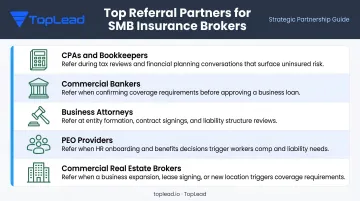
Beyond clients, the highest-value referral sources are professionals who interact with business owners during high-stakes financial moments:
- CPAs and bookkeepers who surface coverage gaps during tax preparation and financial reviews
- Commercial bankers required to confirm adequate coverage as part of loan processes
- Business attorneys involved during formation, contracts, and risk events
- PEO providers sitting alongside HR, benefits, and risk decisions at the same table
- Commercial real estate brokers connecting with businesses during expansion, when new coverage needs typically emerge
A co-referral arrangement formalizes these relationships: you actively refer clients to each partner, they introduce you in return, and both sides build pipeline without cold outreach. The brokers who systematize this early rarely need to prospect from scratch.
Lead with Education, Not a Sales Pitch
Most small business owners can't accurately describe their own coverage. A broker who proactively educates prospects builds the kind of trust that persuasion tactics can't replicate — and that starts well before any sales conversation.
Education-First Marketing Tactics That Double as Lead Capture
- Publish industry-specific risk guides as downloadable PDFs ("The 5 Coverage Gaps Most Contractors Don't Know About") — captures email addresses while delivering real value
- Host short webinars (30-45 minutes) on common SMB insurance mistakes — attracts high-intent prospects and positions you as the expert before any pitch
- Send a quarterly newsletter featuring real claims scenarios — actual examples of what went wrong outperform any product description
- Co-host events with complementary professionals (CPAs, HR consultants) on topics like year-end risk planning — their audience extends your reach, your content earns attendance
Each of these formats has a natural place for a call to action — a resource download, a follow-up consultation offer, or a simple opt-in. The content does the trust-building; the mechanism handles the list-building.
Niche Down to Stand Out in a Crowded SMB Insurance Market
Generalist brokers fight for price. Specialist brokers win on credibility — and credibility produces more consistent, durable growth.
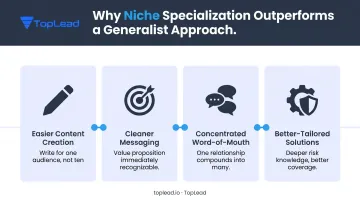
MarshBerry identifies vertical specialization as a key differentiator for insurance brokers, noting niches like construction, hospitality, healthcare, and technology as areas where focused brokers build durable competitive positions. The practical marketing advantages of specialization are significant:
- Content creation is easier — you write for one audience, not ten
- Messaging is cleaner — your value proposition is immediately recognizable to the right prospects
- Word-of-mouth concentrates — owners in the same industry talk to each other, and one strong relationship compounds into many
- You develop genuinely better-tailored solutions — deeper knowledge of a specific industry's risk profile produces better coverage recommendations, not just marketing claims
How to Identify the Right Niche
Start with your existing book of business. Look at where you have the most clients, the strongest retention, and the most organic referrals. That cluster is almost certainly your niche — it just hasn't been positioned as one yet.
Once identified, build the presence:
- Build a dedicated landing page for that industry covering specific coverage types, common risks, and client testimonials from that sector
- Publish industry-specific case studies, even anonymized examples of coverage gaps you identified and resolved
- Join that industry's trade associations and attend their events — being present where your target clients already gather outperforms most paid advertising
Frequently Asked Questions
What is the most effective marketing channel for insurance brokers targeting small business owners?
No single channel dominates. The combination of local SEO for inbound discovery, referral partnerships for warm leads, and targeted outbound prospecting for proactive pipeline development produces the best results. The right balance depends on your budget, sales cycle, and how established your referral network already is.
How do insurance brokers differentiate when small business owners are overwhelmed with options?
Niche specialization, education-first messaging, and a strong reputation backed by Google reviews and referrals from similar businesses are the most effective differentiators. These signals communicate relevance and credibility together, which is exactly what an overwhelmed SMB owner needs to make a fast trust decision.
How long does it typically take to convert a small business owner from first contact to closed client?
It varies considerably. A BOP for a sole proprietor may close in days; a complex commercial package for a growing business may take weeks to months. Consistent follow-up and a simple nurture sequence are critical for the longer cycles — most brokers lose deals not to competitors but to inaction.
Should insurance brokers use cold outreach to reach small business owners, or is it too intrusive?
Well-targeted, personalized outbound works when it leads with a risk insight specific to the prospect's industry rather than a product pitch. SMB owners are their own gatekeepers who pick up the phone and read their own email, making them more reachable than most brokers assume.
How important are online reviews for insurance brokers marketing to small businesses?
Critical. BrightLocal's 2024 research found 47% of consumers won't consider a business with fewer than 20 reviews, and 74% only trust reviews from the last three months. A current, well-maintained Google Business Profile with positive reviews directly influences both search rankings and buyer trust before any conversation happens.
What types of strategic partnerships generate the most referrals for insurance brokers serving small businesses?
CPAs, commercial bankers, and PEO providers are the highest-value sources because they interact with business owners during high-stakes financial decisions — exactly when coverage gaps surface naturally. A structured co-referral arrangement with even two or three of these partners can significantly grow your pipeline.