B2B appointment setting services take that front-end work off your plate. A provider identifies target accounts, reaches decision-makers, qualifies interest, and books sales conversations. This guide covers how the process works, what it costs, how to measure it, and how to pick a partner.
Key Takeaways
- A good campaign books conversations with prospects who match your agreed customer profile, not just full calendars.
- Results depend on targeting, qualification, messaging, follow-up, and your team's ability to act on meetings.
- Compare total cost per held, qualified meeting, not the headline price.
- Demand transparent reporting, CRM visibility, clear replacement terms, and relevant industry experience.
What Are B2B Appointment Setting Services?
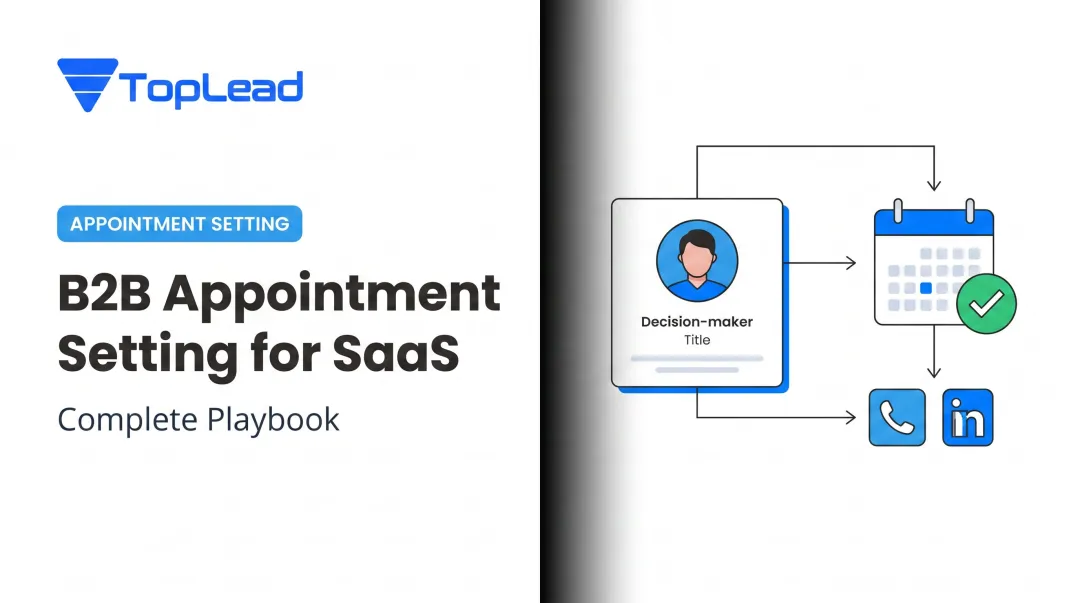
Appointment setting is outsourced support that builds prospect lists, finds the right contacts, runs outreach, qualifies interest, schedules meetings, and documents the handoff to your sales team.
What the service includes
- Building or refining target account lists
- Identifying decision-makers and relevant contacts
- Outreach by phone, email, and LinkedIn
- Qualifying interest against agreed criteria
- Scheduling meetings and sharing context with sales
Appointment setters create opportunities. They don't replace account executives, and they can't guarantee that every meeting becomes a customer.
How it differs from related sales activities
Terms get blurred, so keep them separate:
- Contact list: names and details, with no confirmed interest.
- Qualified lead: a contact who meets fit or interest criteria.
- Booked appointment: a confirmed meeting with a prospect who agreed to talk to sales.
- Sales-qualified opportunity: a deal your sales team confirms has real potential.
Salesforce's SDR guide describes the SDR role as researching and qualifying leads, conducting outreach, booking meetings, and briefing the sales rep. In practice, appointment setting sits between prospecting and closing. A booked appointment alone is not yet an opportunity.
Who can benefit
Appointment setting suits companies with identifiable buyers and a consultative sales process. Common fits include:
- SaaS and technology firms
- Professional services such as accounting and consulting
- Financial services and insurance
- PEO and HR providers
- Manufacturing and industrial services
- Healthcare technology
Readiness matters more than industry. Before outsourcing, make sure you have:
- A defined ideal customer profile
- A clear offer
- Sales capacity to take the meetings
- A repeatable discovery process
- A team that follows up quickly
How B2B Appointment Setting Works
Define the campaign before outreach begins
Provider and client should agree on the ideal customer profile (ICP): industries, company size, geography, job titles, buying triggers, and exclusions. Set the appointment goal too.
The campaign brief should also document:
- The value proposition and approved messaging
- Qualification questions
- Calendar rules and meeting format
- What makes a prospect unsuitable
Reach prospects through a coordinated sequence
Phone, email, and LinkedIn work best as a sequence, not isolated tactics. The channel mix should reflect buyer preferences, deal complexity, and compliance rules.
Personalization matters. Belkins' 2026 LinkedIn study reported an 8.2% reply rate for connection requests with a personalized note versus 5.3% without one. That's provider-reported observational data, not a universal benchmark, but it points the right way.
Human conversation, real research, and well-timed follow-up beat high-volume generic blasts. Automation helps with scheduling and reminders, not with replacing judgment.
Qualify before booking
Qualification typically checks business fit, authority, need, timing, budget or commercial suitability, and willingness to talk. Frameworks vary by provider, so ask which one is used. BANT (budget, authority, need, timing) is common.
Two things should hold true before a meeting lands on the calendar:
- The prospect knows why they're meeting.
- The sales rep gets context: pain points, current situation, stated goals, and prior outreach.
Manage scheduling, handoff, and improvement
Good providers handle confirmations, reminders, rescheduling, and no-show follow-up. Notes and conversation history should flow into your CRM.
Regular reviews should look at meeting quality, attendance, qualification accuracy, sales feedback, messaging performance, and downstream opportunities.

One example of an outsourced partner
TopLead, a U.S.-based B2B lead generation and appointment-setting agency in Modesto, California, has over 15 years of experience and more than 25,000 appointments arranged.
Its process typically covers:
- Phone, email, and LinkedIn outreach
- Decision-maker confirmation after interest is shown
- CRM integration and reporting
- Pay-per-appointment pricing, with rescheduling or replacement of canceled and no-show meetings at no extra cost
Confirm current terms with any provider before signing.
Benefits of Outsourcing B2B Appointment Setting
Free your team to close
Outsourcing moves repetitive prospect research, first-touch outreach, qualification, and scheduling away from account executives. They keep discovery and closing.
Build pipeline with less hiring risk
An in-house SDR team takes time to build. The Bridge Group's 2025 study of 351 companies found median SDR on-target earnings of $80,000, median annual attrition of 40%, and average ramp time of 3.0 months. That's a survey baseline, not a full cost of employment, and it isn't a direct comparison with outsourcing.
A specialized provider brings trained reps, data resources, and tested processes without you recruiting, training, and managing a full team first.
Know the limits
Outsourcing doesn't fix everything. These problems still produce poor results:
- Poor targeting
- Weak qualification
- Unclear messaging
- Slow follow-up
- Too little sales capacity to take meetings
You still own feedback and follow-through.
B2B Appointment Setting Pricing and Engagement Models
Common pricing structures
Providers generally use one of four models:
- Monthly retainer: a flat fee for a defined program.
- Dedicated SDR or team: you pay for assigned capacity.
- Pay-per-appointment: you pay for each meeting that meets agreed criteria.
- Hybrid: a base fee plus performance-based pay.
Published ranges vary widely and few are independently verified, so ask for written quotes rather than relying on a generic figure. Some dedicated-team providers quote a flat monthly rate without publishing list prices.
What drives cost
- Difficulty of the target market and industry complexity
- Appointment quality requirements
- Channels used and data sourcing
- Campaign volume and geographic scope
- SDR experience
- CRM integration and reporting depth
- Campaign length
Judge the model beyond the fee
Compare these numbers across providers:
- Cost per held, qualified meeting (total spend ÷ held qualified meetings)
- Show rate
- Meeting-to-opportunity conversion
- Sales-cycle length
- Customer acquisition cost, which Salesforce defines as sales and marketing expenses divided by new customers in the same period
- Replacement or reschedule terms and contract flexibility
Simple break-even calculation:
Break-even held meetings = program spend ÷ (meeting-to-opportunity rate × opportunity-to-win rate × profit per won customer)
Example: you spend $9,000 a month. 40% of held meetings become opportunities, 25% of those close, and each customer yields $12,000 profit.
Each held meeting is worth 0.40 × 0.25 × $12,000 = $1,200. You need 7.5 held meetings to break even. Use your own rates.

How to Choose a B2B Appointment Setting Partner
Assess experience with your market
Ask for case studies, references, and proof the team can speak credibly with your buyers. Check for knowledge of your buyer personas.
Confirm their definition of a qualified appointment
Ask:
- What criteria must be met before booking?
- Who approves the appointment?
- How are disqualified meetings handled?
- Are rescheduling and replacement policies in writing?
Examine outreach quality and compliance
Cover how they run outreach before you dig into the legal side:
- Channels used and level of personalization
- List accuracy and human involvement on calls
- Call coaching and opt-out handling
Then confirm they understand the rules:
- Telemarketing: The FTC's 2024 Telemarketing Sales Rule amendments extend the ban on material misrepresentations to B2B calls and expand recordkeeping. Most B2B calls are exempt from Do Not Call rules, but not from everything else.
- Email: CAN-SPAM has no B2B exception. Provide an opt-out and honor it within 10 business days.
- Call recording: California requires consent of all parties to record confidential calls.
- Privacy and LinkedIn: California's B2B data exemptions ended in 2023, and LinkedIn's User Agreement prohibits scraping and unauthorized automation.
Verify technology, handoff, and reporting
Look for:
- CRM and calendar integration with real-time updates
- Meeting notes and call recordings where appropriate
- Dashboards and a clear reporting cadence
- Clear ownership of post-meeting follow-up
Review commercial terms
Compare:
- Contract length, onboarding, and any testing period
- Minimum commitments, guarantees, and cancellation terms
- Data ownership
- Your responsibilities for accepting meetings
Shortlist providers that fit your market and sales capacity. Have each explain its qualification and reporting process. Choose the one that shows transparent alignment, not the one promising the biggest volume.

Frequently Asked Questions
Is appointment setting legit?
Yes, when it uses targeted outreach and agreed qualification criteria to arrange relevant sales conversations. Results depend on targeting, offer-market fit, and your follow-up, so verify a provider's process, reporting, and terms.
What does a B2B appointment setting service do?
It researches prospects, runs outreach, qualifies interest, schedules meetings, updates your CRM, and hands context to your sales team.
How much do B2B appointment setting services cost?
Pricing varies by engagement model, market complexity, channels, and qualification rules. Compare total cost per qualified, attended meeting rather than a generic industry figure.
What is the difference between a qualified lead and a booked appointment?
A qualified lead meets basic fit or interest criteria. A booked appointment is a confirmed meeting with a prospect who agreed to speak with sales.
Should I outsource appointment setting or build an in-house SDR team?
Outsourcing is faster to start and needs less management. In-house offers more control but means hiring costs, ramp time, and attrition. Some companies outsource first to validate their process.
How can I measure whether a campaign is working?
Track qualified meetings, show rate, qualification accuracy, sales acceptance, meeting-to-opportunity conversion, pipeline, and revenue. Activity volume alone tells you little.