The concept makes sense on paper. Outsource prospecting, get qualified meetings, let your AEs close. But somewhere between signing the contract and reviewing the first month's results, things break down. Packed calendars with no-shows. Meetings with contacts who have no budget or authority. Vendors hitting their meeting count while your AE team rejects half the bookings.
This article isn't a vendor comparison. It's a diagnosis — of what actually causes outsourced SDR programs to fail on both the vendor and client side, and what it takes to make one deliver real pipeline.
Key Takeaways
- Most outsourced SDR failures trace back to undefined qualification criteria and treating the vendor relationship as self-running
- Track AE acceptance rate and show-up rate — total meetings booked is a vanity metric
- Your ICP clarity, feedback loops, and playbook are often as responsible for failure as anything the vendor does
- A high-performing outsourced SDR partner functions as an extension of your sales team, not a black box delivering a spreadsheet once a week
The Real Reasons Outsourced SDR Programs Fail
No shared definition of a "qualified meeting"
This is the most common failure mode, and it happens before the first call is ever made.
When companies don't document who counts as a qualified prospect — company size, decision-maker title, budget range, specific pain point — SDRs default to booking anyone who agrees to a call. The vendor looks productive. The AE team is frustrated.
A qualified appointment means a decision-maker has acknowledged a relevant business problem and agreed to a conversation worth the AE's time. Without that definition in writing before Day 1, you're guaranteeing misalignment.
The "set it and forget it" trap
Companies hand over a product deck, a contact list, and their calendar integration — then wait for meetings to appear. Outsourced SDR programs don't work that way.
Effective programs require:
- Weekly AE feedback on meeting quality
- Messaging adjustments based on what's actually resonating
- Fast turnaround on targeting changes when a segment isn't converting
Without this collaboration, vendors keep repeating what isn't working. The Tenbound/Operatix 2022 outsourced SDR survey — which collected over 250 responses — found that training the agency on messaging was the second most cited challenge at 16.67%. That's a collaboration problem, not a vendor one.
The volume-over-quality incentive problem
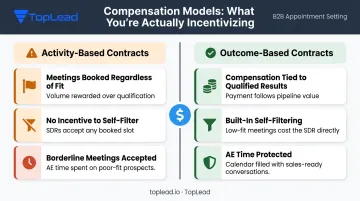
Most outsourced SDR vendors are measured — and paid — on meetings booked. That creates structural pressure to fill calendars with quantity, not quality.
The same Tenbound/Operatix survey found that quality of leads or appointments was the top challenge reported by clients at 18.58%. When a vendor has no financial reason to turn down a borderline meeting, borderline meetings get booked.
Contracts that tie compensation entirely to activity volume — calls made, emails sent, meetings scheduled — give vendors no incentive to self-filter. Look for models that attach accountability to qualified outcomes, not just effort.
SDR seniority mismatch
A junior SDR cold-calling a CFO at an American financial services or healthcare company gets screened out immediately — and a poorly handled interaction can damage your brand with a prospect you may want to approach again.
LinkedIn Sales Solutions data shows 90% of C-suite executives don't respond to impersonal B2B sales outreach. Matching SDR seniority and industry familiarity to your target buyer persona determines whether your program gets past gatekeepers at all.
The CRM black box
When outsourced SDRs work in their own tools and export a spreadsheet weekly, there's no feedback loop and no data you can use to improve.
All of the following need to live in your CRM from Day 1:
- Contact data and touch history from every outreach attempt
- Meeting notes with decision-maker context and next steps
- Activity logs you can audit if results deteriorate
Without this, you can't identify patterns in what's working — or retain any pipeline data when the engagement ends.
Red Flags That Predict a Failing Partnership
Watch for these before signing anything:
No real-time access to campaign data or call recordings. Weekly summary reports aren't transparency. A good partner should show you exactly what was said to which prospects and how those conversations are trending — not just a meeting count.
Flat-fee contracts with no performance accountability. If there's no replacement policy for no-shows and no defined meeting minimums tied to qualified criteria, you're paying for activity, not results.
Off-the-shelf contact databases with no manual verification. In specialized verticals like financial services, insurance, or PEO, the total addressable market may be only a few thousand companies. Burning through that list with bad data and untargeted outreach can damage a market for months. Platforms like ZoomInfo or Apollo frequently return stale contact info when used without manual verification layered on top.
A reputable partner addresses all three: real-time reporting, performance-based contracts, and verified prospect data. TopLead's pay-per-appointment model, for instance, includes a reschedule or replacement guarantee on no-shows — so clients pay only for confirmed, qualified appointments.
What "Results That Actually Work" Actually Looks Like
The metrics that should anchor every program
Total meetings booked is the starting point, not the finish line. The metrics that actually predict revenue impact:
| Metric | What It Tells You |
|---|---|
| AE acceptance rate | Are meetings worth the AE's time? |
| Show-up rate | Are booked meetings actually held? |
| Meeting-to-opportunity conversion | Are held meetings advancing to pipeline? |
| Cost-per-qualified-meeting | Is the program becoming more efficient over time? |
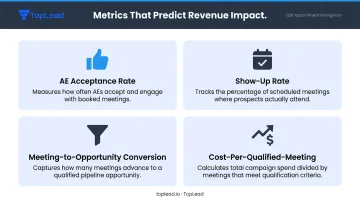
Cost-per-meeting should decrease as targeting and messaging are refined. A vendor whose cost-per-meeting never improves isn't optimizing.
What a high-quality appointment actually looks like
A real qualified appointment includes:
- A verified decision-maker with confirmed authority (not an influencer or gatekeeper)
- An acknowledged business pain that maps to your solution
- Budget awareness or at minimum a realistic buying window
- A clear next step agreed before the meeting is booked
TopLead's U.S.-based SDR teams verify decision-maker authority on every appointment — HR directors, CFOs, controllers, or business owners — before placing it on the client's calendar. The guaranteed minimum of 4–6 qualified leads per month is built around pipeline impact, not raw activity counts.
The multi-channel advantage
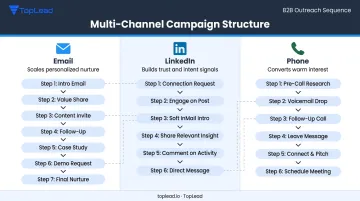
Single-channel campaigns consistently underperform. Outreach's 2025 sequence benchmark data shows that coordinated email, phone, LinkedIn, and video outreach can generate up to 2x higher response rates than email alone.
Each channel serves a different function:
- Email: scales personalized outreach and nurtures value over time
- LinkedIn: builds trust and surfaces intent signals before any direct ask
- Phone: converts warm interest into a confirmed meeting
TopLead's campaigns use 6–8 strategic touchpoints across these channels, sequenced to build familiarity without overwhelming the prospect.
Timeline expectations
Multi-channel execution takes time to calibrate — and that's where timeline planning matters. The Bridge Group's SDR benchmark data puts average SDR ramp at roughly 3.3 months, and outsourced programs follow a similar curve. TopLead's standard campaign lifecycle runs 3–6 months, with the first month focused on ICP refinement, messaging testing, and building awareness. Qualified pipeline builds as each channel's data informs the next round of optimization.
Expect the first appointments to come earlier than full pipeline velocity. A program generating 4–6 qualified meetings per month in month two should be compounding — not plateauing — by month four.
How to Set Your Outsourced SDR Program Up for Success
Define your ICP and meeting criteria before Day 1 — in writing
This is the single most important input you provide. Document:
- Target company size and revenue range
- Decision-maker titles (and which titles disqualify)
- Specific business pain your solution addresses
- Explicit disqualifiers (existing customers, wrong industry, wrong geography)
A well-defined ICP also enables your vendor to build suppression lists and avoid wasting outreach on existing pipeline or current accounts. Without this document, the vendor is guessing.
Co-create a living sales playbook
Don't draft a playbook once and file it away. Build it collaboratively and update it weekly based on:
- AE feedback on meeting quality
- Call recording reviews
- Reply rates and objection patterns
- Competitor context that comes up in conversations
TopLead contributes industry-specific messaging frameworks, multi-touch sequences, and SDR training. The playbook only stays effective if client-side feedback keeps it current.
Establish a formal feedback cadence
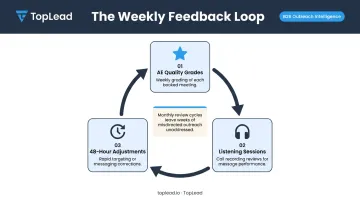
Structure it around three recurring actions:
- Weekly AE quality grades on each booked meeting
- Listening sessions on call recordings to identify which messages are driving replies
- 48-hour turnaround on messaging or targeting adjustments when a problem is identified
Programs that close this loop weekly consistently outperform those that review results monthly — by the time a monthly review surfaces a targeting problem, four weeks of outreach have already gone to the wrong contacts.
Insist on CRM integration and data ownership
All verified contacts, email addresses, LinkedIn profiles, and touch history should sync to your CRM in real time. TopLead supports integration with Salesforce, HubSpot, Pipedrive, Close.io, and Apollo.
When the engagement ends, that data becomes a permanent pipeline asset. It shouldn't disappear with the vendor relationship.
When Outsourced SDRs Work — and When They Don't
Scenarios where outsourced SDRs consistently deliver value
- Need qualified pipeline within 30–60 days without a 3-month hiring cycle
- Entering a new market or vertical where you lack existing relationships
- Testing ICP and messaging before committing to full-time headcount
- AEs are underutilized due to inconsistent top-of-funnel activity
Outsourced SDRs work best as a complement to a sales org with a proven value proposition. They execute outreach — but the strategy, ICP clarity, and messaging still have to come from you.
Scenarios where they tend to struggle
- Products requiring deep institutional knowledge to credibly represent
- Early-stage companies still iterating on product-market fit
- Organizations without internal bandwidth to collaborate on playbooks and feedback
Outsourcing the problem of not knowing your ICP or value proposition is an expensive mistake. The vendor can execute — but only if you can tell them what "good" looks like.
The key principle
The companies that report real results — consistent qualified pipeline, improving cost-per-meeting, growing close rates — are the ones that include their outsourced team in sales kickoffs, product updates, and messaging reviews. Not just weekly reports.
The more visibility your outsourced SDRs have into what's happening inside your sales org, the faster they calibrate and the better the pipeline quality gets.
Frequently Asked Questions
What is an outsourced SDR?
An outsourced SDR (Sales Development Representative) is an external sales professional or team hired to handle top-of-funnel prospecting, lead qualification, and meeting booking on your behalf — without the cost and ramp time of hiring in-house. They operate under your brand and pass qualified meetings to your AEs.
How long does it take to see results from an outsourced SDR program?
Most programs generate first meetings within the first few weeks, with consistent pipeline volume developing over 60–90 days as targeting and messaging are refined. Cost-per-meeting improves as the campaign matures. Programs with active feedback loops consistently outperform those left to run without check-ins.
What metrics should I use to measure outsourced SDR performance?
Go beyond meetings booked. Track AE acceptance rate, show-up rate, meeting-to-opportunity conversion, and cost-per-qualified-meeting. Together, these tell you whether the program is building real pipeline — not just logging activity.
Should I outsource SDRs or hire in-house?
Outsourcing works best when speed, cost efficiency, and market testing are priorities. In-house makes more sense when you have a proven playbook, high deal complexity requiring deep product expertise, or a long-term SDR-to-AE talent pipeline you're building. Many companies use both — outsourced for top-of-funnel volume, in-house for complex accounts.
How much does an outsourced SDR program typically cost?
Pricing models include monthly retainers, pay-per-appointment, and hybrids. The most important number is cost-per-qualified-meeting, not the headline monthly fee. For context, Glassdoor puts the average U.S. SDR salary at $102,708/year. Fully loaded with benefits and ramp time, in-house hiring rarely wins on cost for early pipeline development. TopLead's average cost per qualified lead runs $300–$350.
What do I need to provide an outsourced SDR team to set them up for success?
At minimum: a documented ICP with explicit qualification and disqualification criteria, a co-created sales playbook with objection handling and qualification questions, a regular AE feedback mechanism, and CRM access so all activity is tracked in real time. The vendor handles execution, but the quality of your inputs determines the quality of your pipeline.