Introduction
"Cold calling is dead." You've heard it. You've probably said it. And you'd be wrong.
Most cold calls fail because reps pick up the phone without a plan—no research, no relevant hook, no clear reason why this specific person should care right now. The channel isn't the problem. The preparation is.
Here's what the data shows: 82% of buyers will accept meetings with sellers who reach out proactively, according to RAIN Group research spanning 488 buyers across 25 industries. And 57% of C-level and VP buyers prefer to be contacted by phone. The channel isn't broken. The execution is.
This guide covers the full picture:
- What B2B cold calling actually is and why it still works
- How to prepare, structure, and run effective calls
- Handling objections and leaving voicemails that get callbacks
- Staying legally compliant
- When outsourcing prospecting makes more sense than building in-house
Key Takeaways
- Cold calling works when it's targeted and relevant—volume alone doesn't move the needle
- ICP definition and pre-call research matter more than the script
- A strong opener earns the conversation; discovery questions keep it moving
- Treat objections as qualification data and respond with a question
- Track conversations, meetings booked, and pipeline generated—not just dials
What Is B2B Cold Calling (and Why It Still Works)
B2B cold calling is outbound phone outreach to a business prospect who has had no prior contact with your company. The goal isn't to close on the first call. It's to start a relevant conversation, confirm there's a fit, and earn a next step — typically a discovery call or demo.
What separates cold calling from other outreach channels is real-time interaction. Unlike email or LinkedIn messages, a live phone call lets reps uncover pain, answer objections, and move deals forward in minutes. That responsiveness compounds even when no one picks up: Gong's analysis of 300 million cold calls found that failed call attempts alone nearly doubled email reply rates from 1.81% to 3.44%. Leave a voicemail, and that rate jumps to 5.87%.
Why Cold Calling Fails (and It's Not the Channel)
Cold calling fails when reps call the wrong people with the wrong message at the wrong time. Poor targeting and inadequate preparation sink most programs before the first dial.
The numbers back this up:
- Top-quartile reps achieve a 13.3% connect rate vs. 5.4% for average reps
- Top-quartile reps set meetings at 16.7% vs. 4.6% for average reps
- Cognism's 2026 report found the industry average success rate (meetings from conversations) was 2.7%, while their own team hit 11.3%
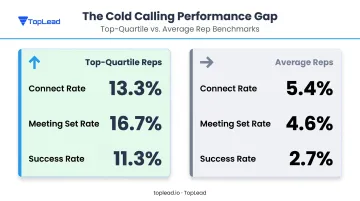
That gap between top and average performers comes down to one thing: what happens before the call even starts — who gets dialed, why, and with what opening.
How to Prepare for a B2B Cold Call
Define Your ICP and Build a Targeted List
An Ideal Customer Profile (ICP) defines the type of company most likely to buy from you and get value from your solution. Without one, you're calling random people and hoping something sticks.
Key ICP criteria to define:
- Firmographic: Company size, industry vertical, revenue range, geography
- Technographic: Existing tools and tech stack that indicate fit or compatibility
- Behavioral: Hiring surges, funding rounds, tech stack changes, leadership transitions
- Intent signals: Content consumption, competitor research, keyword activity
Your call list should be built on verified direct dials, confirmed roles, and recent trigger events—not bulk-purchased contact files that decay the moment they're exported. A clean, targeted list is what separates a meaningful connect rate from wasted dials.
Research Your Prospect Before You Dial
You don't need an hour of research per call. You need enough context to make the opening 20 seconds feel relevant. A quick pre-call check covering these points is sufficient:
- LinkedIn profile and current role
- Recent company news or announcements
- CRM history (any prior touches, past conversations)
- Hiring activity that signals growth or a specific pain
- Intent signals: content downloads, pricing page visits, webinar attendance
When your opener references something real—a recent hire, a funding round, a product launch—the prospect hears a reason to keep listening instead of a reason to hang up.
When to Call
Timing matters less than most reps think, but it still matters. Research consistently points to two windows:
- 10–11 AM performs best for talk time and engagement (Cognism, 2024)
- 2–3 PM is the second strongest window
Thursday tends to outperform other days for meetings booked. Monday mornings and Friday afternoons are reliably weak.
That said, trigger-based timing often beats any clock-based rule. Calling within days of a prospect's funding announcement, leadership hire, or product launch—when the reason for your call is directly tied to what just happened—creates relevance that no optimal time window can replicate.
The Cold Call Playbook: Openers, Scripts, and Conversation Flow
How to Open the Call
The first 20 seconds determine whether you get a conversation or a dial tone. Three opener types work consistently in B2B:
1. Permission-based: Acknowledge the interruption and ask for a moment.
"Hi [Name], I know I'm catching you out of the blue—can I have 30 seconds to explain why I called?"
2. Problem-led: Open with a pain point relevant to their role or industry.
"Hi [Name], I work with [industry] firms that are struggling to get consistent meetings with decision-makers. Is that something your team deals with?"
3. Trigger-based: Reference something specific that happened recently.
"Hi [Name], I saw [Company] just announced [hiring/funding/expansion]—we work with companies at that stage to help them scale their pipeline without adding headcount. Worth a quick conversation?"
Common opener mistakes to cut immediately:
- Starting with your company name before earning attention
- "Is this a good time?" (offers an easy exit)
- Self-focused language: "I wanted to reach out because we..."
Navigating the Conversation
Once you have a few seconds of attention, the core call flow looks like this:
- State your reason for calling — one sentence, specific and relevant
- Connect it to a pain point — something their role or industry commonly faces
- Ask an open-ended question — let them talk; this is where discovery starts
- Listen actively — don't fill silence with more pitch
- Propose a clear next step — a booked call, not a vague "I'll follow up"
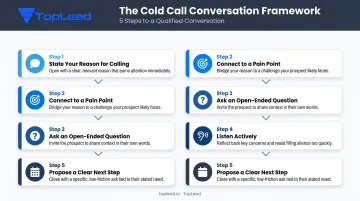
Tone matters as much as structure. Delivery tips that make a difference:
- Match the prospect's energy and pace
- Slow down if you're nervous; rushing reads as anxiety
- Let silence sit after a question — resist filling it
- Never apologize for calling; confident delivery signals genuine value
On gatekeepers: Treat them as allies, not obstacles. Be direct about why you're calling, and ask for the best way to reach the decision-maker rather than demanding a transfer. A clear value statement under 20 seconds signals a legitimate business conversation.
Closing: You're not closing a deal — you're booking a next step.
"Based on what you've shared, it sounds like [specific issue] is worth a deeper conversation. Would [day] at [time] work for a 20-minute call to walk through how we've helped similar teams?"
Handling Objections and Leaving Effective Voicemails
Turning Objections into Opportunities
When a prospect objects, they're still engaged. Staying on the line at all means the door isn't closed—it means they need a better reason to open it.
Gong's analysis of 300 million calls found that the top five objections account for 74% of all objections, split between dismissive (49.5%) and situational (42.6%). Knowing what's coming means you can prepare a response that keeps the conversation moving.
The Feel-Felt-Found framework works for most objections: acknowledge the concern ("I understand"), normalize it ("many of the [role]s I speak with feel the same way"), then pivot to what they discovered ("but what they typically find is..."). End with a question—not a close.
The four most common objections and how to handle them:
| Objection | Response Strategy |
|---|---|
| "I'm not interested" | "That's fair—can I ask what you're currently using to generate new meetings?" |
| "Send me an email" | "Happy to—before I do, can I ask one quick question so I can make it relevant?" |
| "We already have a provider" | "Good to know. What's working well, and what's one thing you'd change?" |
| "No budget" | "Makes sense. Is it a budget issue or more a priority question for this quarter?" |
The goal of every response is a question that keeps them talking—not pressure that makes them hang up.
Voicemail Strategy When Most Calls Go Unanswered
Even when your objection handling is sharp, most calls still won't reach a live person. A voicemail isn't the place to pitch—it's the place to build enough curiosity that the prospect recognizes your name when your follow-up email arrives minutes later.
Voicemail best practices:
- Keep it under 30 seconds (every second past 30 drops response rates)
- Lead with a relevant trigger or problem—not your company name
- State your number twice: at the start and at the end
- Reference the follow-up email you're about to send
- Sound conversational, not scripted
Example voicemail:
"Hi [Name], my number is [number]—I'll say it again at the end. I'm reaching out because we've been helping [industry] firms like yours book consistent meetings with decision-makers without adding headcount. Sending you an email right now with more context. Again, it's [number]. Talk soon."
After the Call: Follow-Up, Metrics, and Scaling
Log every call immediately in your CRM, noting outcomes against US business hours and time zones: outcome, objections heard, interest level, next steps. Memory degrades fast and missed notes break your follow-up. Send a follow-up email within 24 hours referencing the call and any information you promised.
A multi-touch cadence over 2–4 weeks—mixing calls, emails, and LinkedIn touchpoints—gives you the best shot at converting prospects who didn't commit on the first call. TopLead's internal data suggests 6–8 strategic touchpoints across channels before conversion is the norm in B2B, not the exception.
What Metrics Actually Tell You
Call volume is the least useful metric you can track. What actually indicates whether your cold calling program is working:
- Conversation rate — dials to real conversations (benchmark: 5–10% is solid per Salesloft)
- Meeting rate — conversations to booked meetings (top-quartile reps hit 16.7%, per Gong)
- Show rate — booked to held meetings
- Opportunity rate — meetings to qualified pipeline
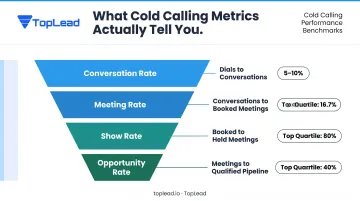
If your conversation rate is low, your list quality or timing is the problem. If your meeting rate is low, your opener or discovery is the issue. If your show rate is low, your confirmation process needs work.
When to Build In-House vs. Partner with a Cold Calling Specialist
Building an internal SDR team gives you full control—but it comes with real costs: hiring, onboarding, training, management, and a typical 90-day ramp before baseline productivity, with 6 months before consistency.
For many sales leaders, the numbers don't add up. Closers end up prospecting instead of closing, SDRs take months to hit stride, and turnover resets the clock entirely.
Partnering with a specialized B2B appointment-setting agency changes that equation. TopLead, for example, operates as a virtual SDR team—handling ICP development, outreach across email, phone, and LinkedIn, decision-maker verification, and real-time calendar booking across verticals including financial services, insurance, PEO, and accounting.
With more than 25,000 appointments arranged and a pay-per-appointment model backed by a reschedule/replacement guarantee (covering both cancellations and no-shows), sales leaders can redirect their closers to pipeline that's already moving. Pricing runs $300–$350 per qualified appointment, with a minimum of 4–6 appointments per month and no long-term contract required.
B2B Cold Calling Compliance: What You Need to Know
B2B cold calling is legal in the US. The federal Do Not Call Registry primarily targets consumer calls—most B2B calls are explicitly exempt. That exemption, though, comes with real conditions—federal, state, and industry-specific rules still apply.
Universal rules that always apply:
- Identify yourself and your company on every call
- Honor opt-out requests immediately and permanently
- Keep suppression lists updated
- Document your compliance processes
State-specific rules to know:
- California requires telephonic sellers to register with the state AG, post a $100,000 surety bond, and respect calling-hour limits (no calls before 8 AM or after 9 PM)
- Texas requires registration before telephone solicitations and recently expanded its rules via SB 140 (effective September 2025) to include text and image-based solicitations
Industry-specific rules:
- Financial services: FINRA Rule 3230 governs member telemarketing, including time-of-day restrictions, abandoned call limits, and DNC procedures
- Healthcare: HIPAA generally requires individual authorization before using protected health information for marketing purposes
- Medicare: CMS guidelines prohibit unsolicited calls to prospective enrollees
The cell phone rule: Even in B2B, using an auto-dialer to call cell phones without prior written consent creates TCPA exposure. Manual direct-dial calls to a prospect's business number are permitted—TCPA exposure arises specifically from auto-dialers, not from reps dialing by hand.
Frequently Asked Questions
What is cold calling in B2B?
B2B cold calling is outbound phone outreach to business prospects who have had no prior contact with your company. Unlike B2C cold calling, the goal is to start a relevant conversation and qualify fit—not to close on the first call. Success is measured by meetings booked, not deals signed.
Does B2B cold calling work?
Yes, when it's targeted, researched, and relevant. RAIN Group data shows 82% of buyers will accept meetings from proactive sellers. Poor results typically trace back to low-quality lists, generic messaging, or no clear reason for the call—not the channel itself.
Is B2B cold calling legal?
B2B cold calling is legal in the US. Most business-to-business calls are exempt from federal Do Not Call rules, though you must identify yourself, honor opt-out requests, and follow state rules (notably California and Texas) and any industry-specific regulations that apply to financial services or healthcare.
What is the 3-3-3 rule in sales?
The 3-3-3 rule is a pre-call research framework: spend 3 minutes on the prospect's LinkedIn, 3 minutes on the company website, and 3 minutes on recent news or trigger events. It gives you enough context to personalize the call without over-researching before you dial.
What is the best time to cold call in B2B?
Research points to 10–11 AM and 2–3 PM as the strongest windows, with Thursday outperforming other days for meeting bookings. Trigger-based timing — calling after a funding round or leadership change — often outperforms any fixed time-of-day rule.
How many cold calls does it take to get a meeting?
It varies by targeting quality and industry, but expect multiple touchpoints across a 2–4 week cadence. Gong data shows average reps convert conversations to meetings at 4.6%, while top-quartile reps hit 16.7%. List quality, message relevance, and timing alignment matter far more than raw call volume.