The reality is more complicated. The cost savings are real, but so are the risks — and the decision hinges on factors most guides skip entirely.
This article covers what offshore appointment setters actually are, the three hiring models available, honest benchmarks on cost and quality, and when a fully managed service delivers better ROI than building your own offshore team.
Key Takeaways
- Offshore appointment setters cost 60–75% less than domestic SDR hires, though management overhead, ramp time, and turnover can close that gap faster than expected
- Three hiring models to know: direct freelance, staffing agency, and fully managed outsourced firms — each trades off cost, control, and quality differently
- Lead quality is where most offshore programs fail — without tight ICP alignment and vetting, you get volume instead of value
- Philippines, Latin America, and Eastern Europe are the dominant sourcing regions, each suited to different use cases and communication needs
- For $25K+ deal sizes, a managed appointment setting service almost always outperforms a self-managed offshore hire on ROI
What Is an Offshore Appointment Setter?
An offshore appointment setter is a sales development professional — typically based in the Philippines, Eastern Europe, or Latin America — hired to handle outbound prospecting, qualify leads, and book meetings with decision-makers for U.S.-based companies.
Three Common Hiring Models
| Model | How It Works | Best For |
|---|---|---|
| Direct freelance hire | Hire via Upwork, OnlineJobs.ph, or LinkedIn directly | Budget-conscious teams willing to manage the hire themselves |
| Offshore staffing agency | Agency handles HR, compliance, and payroll | Companies wanting compliance coverage without full outsourcing |
| Fully managed outsourced firm | Dedicated SDR team with built-in training, management, and QA | Companies prioritizing speed, quality, and minimal management burden |
How Offshore Differs from Domestic Options
Each model carries different cost and management tradeoffs — and the differences run deeper than geography:
- In-house SDRs require full employment overhead, benefits, equipment, and a 3–6 month ramp before meaningful output
- Domestic outsourced agencies carry U.S. labor rates but offer built-in management infrastructure
- Offshore hires offer the lowest base cost but transfer all oversight responsibility to you — script development, daily management, call review, and quality control all land on your plate
That third option is where expectations most often break down. Without dedicated management infrastructure, cost savings get absorbed by the time your team spends compensating for it.
Benefits of Hiring Offshore Appointment Setters for B2B
Cost Savings
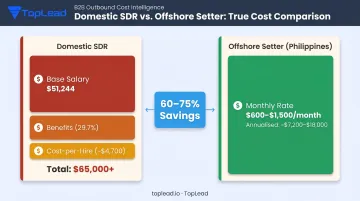
The cost differential is the primary driver, and it's substantial. PayScale reports U.S. SDR average base salary at $51,244, with total annual pay ranging from $45K–$81K. Factor in the BLS finding that benefits represent 29.7% of total employee compensation, plus SHRM's average cost-per-hire of ~$4,700, and a domestic SDR carries a fully loaded first-year cost well above $65,000.
By contrast, Philippines-based appointment setters on OnlineJobs.ph list rates ranging from $4–$6/hour to $600–$1,500/month depending on experience. That's a gap of roughly 60–75% before accounting for additional overhead.
The freed budget can fund outreach tools, CRM seats, and faster headcount scaling — provided quality standards are enforced from the start.
Access to a Deep Talent Pool
The Philippines ranks among the strongest offshore sourcing markets for U.S. B2B companies. The EF English Proficiency Index 2025 ranks the Philippines #28 of 123 countries with a High Proficiency score of 569 — well above the global average of 488.
The country's IT-BPM sector employs 1.9 million workers generating $40 billion in export revenue (IBPAP), creating a deep labor market with candidates who bring:
- Familiarity with U.S. business culture and communication norms
- Hands-on experience in objection handling and discovery calls
- Backgrounds spanning financial services, SaaS, insurance, and other B2B verticals
Scalability Without the Ramp-Up
A domestic SDR typically takes 3 months to reach baseline productivity and up to 6 months to become consistent, according to Bridge Group data. Offshore freelance hires and managed service providers can compress that significantly — TopLead, for example, delivers first qualified meetings within 2–4 weeks of campaign launch.
For teams facing a pipeline gap or entering a new vertical, that difference in ramp time is often the deciding factor.
Reduced Overhead
Offshore hires work remotely with their own equipment, eliminating office space, hardware costs, and domestic benefits packages. Deloitte's 2024 Global Outsourcing Survey of 500+ business leaders found 80% plan to maintain or increase outsourcing investment. Another 50% are already using outsourced services for front-office functions — including sales and marketing — because external staffing converts fixed infrastructure costs into variable, outcome-tied spend.
Risks and Challenges to Know Before You Hire
Lead Quality and Qualification Gaps
This is the most common failure mode. Without deep product training and a detailed ICP briefing, offshore setters default to volume metrics — more dials, more emails, more booked meetings regardless of fit.
RAIN Group research offers a useful framing: 82% of buyers will accept a meeting with a seller who reaches out proactively, but 58% of sales meetings are not valuable to buyers. That gap exists because meeting quantity and meeting quality are different targets.
That gap has real consequences. One unqualified meeting wastes a closer's time, disrupts their schedule, and signals to the prospect that your company doesn't understand their business. In financial services, insurance, or healthcare, that impression can permanently damage a relationship.
Communication and Cultural Nuance Risks
Strong English scores don't capture every dimension of sales communication. Handling objections, reading tone, knowing when to ease off — these skills come from experience in specific markets. A setter with solid language ability but limited U.S. business culture exposure can still leave prospects with the wrong impression.
In trust-driven industries, a single awkward call can cost more than the setter's monthly salary in lost opportunity.
Data Security and Compliance Exposure
Offshore appointment setters typically access:
- Your CRM and prospect database
- Email accounts or outreach tools
- Contact data that may include California residents (covered by CCPA) or EU data subjects (covered by GDPR)
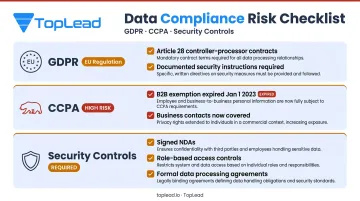
GDPR Article 28 requires formal controller-processor contracts and documented security instructions. CCPA's B2B exemptions expired January 1, 2023, meaning business contact data of California residents is now subject to consumer privacy rights. Offshore hires accessing your systems require signed NDAs, role-based access controls, and formal data processing agreements.
Management Burden and Hidden Costs
The "cheap labor" assumption usually doesn't survive contact with the actual management workload. Running an offshore appointment setter requires:
- Daily call recording review
- Script iteration and objection-handling updates
- CRM data quality audits
- Feedback loops between setter and closers
- Turnover management (Bridge Group data shows SDR attrition often runs 40–50% long-term)
Re-hiring and retraining within 6–12 months is common on freelance platforms, and each cycle carries its own cost in time, productivity loss, and pipeline disruption.
How to Find, Screen, and Hire Offshore Appointment Setters
Where to Source Offshore Talent
| Platform | Best For | Trade-off |
|---|---|---|
| Upwork | Wide talent pool, work-history reviews | More vetting required; variable quality |
| OnlineJobs.ph | Philippines-specific, lower rates | Minimal platform oversight |
| Experienced candidates, verifiable backgrounds | Higher cost; slower sourcing | |
| Offshore staffing agencies | HR compliance, managed payroll | Higher cost than direct hire |
Freelance platforms offer the lowest starting cost but require the most screening effort. Staffing agencies handle compliance infrastructure (contractor classification, data agreements) at a 20–40% premium over direct hire — worth it if legal exposure is a concern.
Key Skills and Traits to Vet For
Non-negotiables when evaluating candidates:
- English proficiency: CEFR B2+ minimum — assess spoken fluency, not just written
- CRM familiarity: HubSpot, Salesforce, or Pipedrive navigation (test with a short task)
- Proven objection handling on cold calls, not just high call volume
- ICP comprehension: Can they explain your ideal customer profile back to you accurately?
- Relevant industry background (a setter with SaaS experience ramps faster than a generalist for a SaaS client)
The single most valuable screening step is a live mock call. Script-reading ability and natural conversation are different skills — the mock call reveals which one you're actually getting.
Once you've identified strong candidates, compensation structure becomes the next decision.
Compensation Benchmarks by Region
| Region | Typical Rate Range | Notes |
|---|---|---|
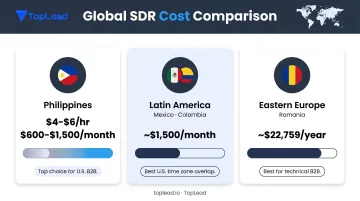
| Philippines | $4–$6/hr or $600–$1,500/month | Most common offshore choice for U.S. B2B |
| Latin America | ~$1,500/month (Mexico/Colombia benchmarks) | Strong time zone alignment with U.S. |
| Eastern Europe | ~$22,759/year base (Romania benchmark) | Stronger technical industry fit |
Structure engagements with a base rate plus performance incentive — for example, a per-qualified-appointment bonus. This aligns the setter's incentive with meeting quality, not just meeting volume.
How to Onboard and Manage Your Offshore Appointment Setting Team
Foundational Onboarding Requirements
Companies that skip this step consistently report poor show-up rates and low meeting quality. Before your setter makes a single call, prepare:
- Industry, company size, revenue range, geography, and buying triggers (your ICP document)
- Persona-specific scripts with tailored value propositions by role — a CFO pitch differs significantly from an HR Director opener
- An objection-handling playbook covering the 8–10 most common rejections with documented responses
- CRM data entry standards for consistent logging of call outcomes, contact status, and next steps
- Explicit qualification criteria defining what makes an appointment "qualified" — not just a booked slot
Ongoing Management Cadence
Performance degrades without active management. A sustainable cadence includes:
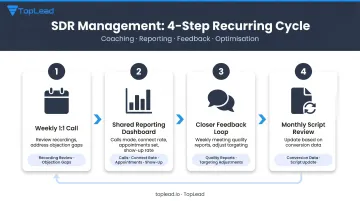
- Weekly 1:1 call — review recordings, address objection-handling gaps, and refine messaging
- Shared reporting dashboard tracking calls made, connect rate, appointments set, and show-up rate
- Closer feedback loop where your sales reps report on meeting quality weekly, letting the setter adjust targeting and opener language
- Monthly script review to update based on what's converting and what's generating low-quality conversations
Time Zone and Async Communication
Time zone gaps don't have to create communication gaps. For Philippines-based setters, a night-shift schedule puts your setter live during U.S. business hours — but the async structure still needs to be deliberate:
- Define overlap hours for real-time questions (even 1–2 hours/day matters)
- Use Loom for async video feedback on call recordings
- Use Slack or CRM notes for daily updates on appointments booked and prospect status
- Deliver calendar confirmations automatically via CRM integration so your sales team doesn't need to monitor offshore hours
When a Fully Managed Appointment Setting Service Makes More Sense
Managing an offshore appointment setter is a legitimate option — but it's not always the right one.
For companies with deal sizes above $25K, limited bandwidth to manage a remote hire, or an immediate need for qualified pipeline, the management overhead typically offsets the cost advantage. SaaS Capital's 2025 benchmark puts private B2B SaaS median ACV at $26,265 — meaning most mid-market SaaS deals clear that threshold, and a handful of unqualified meetings represents meaningful lost revenue.
The core tradeoff:
| Direct Offshore Hire | Fully Managed Service | |
|---|---|---|
| Cost per hire | Lower base cost | Higher, pay-per-appointment |
| Management burden | High — all on you | Handled by provider |
| Time to first meeting | 4–8 weeks with ramp | 2–4 weeks |
| Quality control | Requires daily oversight | Built into service |
| Turnover risk | High; you absorb it | Provider absorbs it |
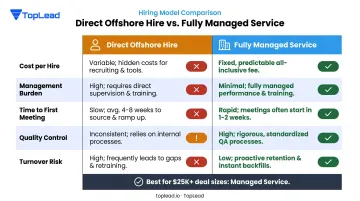
TopLead operates on this model. The U.S.-based B2B appointment setting agency has arranged 25,000+ appointments across financial services, insurance, SaaS, healthcare, PEO, and professional services. The pay-per-appointment structure runs $300–$350 per qualified appointment, with a guarantee of 4–6 qualified leads per month and a reschedule/replacement guarantee for no-shows.
Every appointment includes decision-maker verification — confirming buying authority, not just interest — before it lands on a client's calendar. The program includes:
- Multi-channel outreach across email, LinkedIn, and phone
- 3–6 month campaign lifecycle with transparent reporting
- CRM integration and real-time calendar delivery
- No long-term contract required
For teams where a slow quarter carries real revenue consequences, that structure shifts the execution risk off your plate entirely.
Frequently Asked Questions
What is staffing outsourcing?
Staffing outsourcing means hiring external professionals or firms — often in lower-cost countries — to handle specific business functions like sales development or appointment setting instead of building those capabilities in-house. It ranges from individual freelance hires to fully managed teams with built-in training and quality control.
How much does it cost to hire an offshore appointment setter?
Costs vary by region and experience. Philippines-based setters typically run $4–$6/hour or $600–$1,500/month. Latin America (Mexico, Colombia) benchmarks around $1,500/month. Eastern Europe runs higher — Romania benchmarks near $22,759/year base salary. Add management tools and time, and the all-in cost rises meaningfully.
Which countries are best for hiring offshore appointment setters?
The Philippines offers the strongest combination of English proficiency and U.S. cultural familiarity for most B2B campaigns. Latin America (Colombia, Mexico) provides better time zone overlap with U.S. hours. Eastern Europe suits technical B2B industries where regional business knowledge is a factor.
What skills should I look for when hiring an offshore appointment setter?
Prioritize English fluency at CEFR B2+ or above, CRM proficiency, demonstrated cold outreach experience, and the ability to qualify prospects against a defined ICP. Industry familiarity — particularly in your specific vertical — can cut ramp time by weeks.
What's the difference between hiring an offshore appointment setter directly and using an outsourced agency?
Direct hires give you more control and lower per-hour costs but require you to manage recruitment, training, quality review, and turnover. An outsourced agency handles all of that and is accountable for output quality — making it the better fit when speed and consistency matter more than per-hour cost savings.
How do I manage an offshore appointment setter across time zones?
Set 1–2 hours of daily overlap for real-time questions, and use Slack or CRM notes for async updates with Loom for call recording feedback. Schedule outreach during U.S. business hours and route appointment confirmations through CRM integration so your sales team receives them automatically.