The math is punishing for any sales leader managing quarterly targets. Meanwhile, 86.1% of sellers are already carrying higher pipeline quotas than last year, and 39.6% report their pipeline is weaker than it was 12 months ago.
B2B sales outsourcing offers a faster path. Rather than rebuilding an internal SDR function from scratch, you partner with a team that begins outreach within weeks — not quarters.
This guide covers what B2B sales outsourcing actually involves, why in-house pipeline building stalls, how outsourced teams accelerate qualified meeting generation, and what separates a genuine growth partner from a vendor selling contact lists.
Key Takeaways
- SDR ramp time averages 3 months and annual attrition runs 40–50%, so most companies see under 2 years of productive output per hire
- Outsourced teams typically launch outreach within 1–2 weeks, with first qualified meetings arriving in 30–60 days
- Multi-channel outreach (email + phone + LinkedIn) dramatically outperforms single-channel campaigns for B2B decision-maker access
- Pay-per-appointment models align provider incentives with client outcomes — you pay for confirmed meetings, not activity metrics
- Appointment quality determines whether outsourcing improves pipeline ROI — meeting volume alone tells you nothing
What Is B2B Sales Outsourcing?
B2B sales outsourcing means partnering with a U.S.-based external team to handle top-of-funnel sales activities — prospecting, outreach, lead qualification, and appointment setting — so internal reps focus exclusively on closing.
The right outsourcing partner acts as a virtual SDR team integrated into your sales process — not a contact list vendor that hands you a spreadsheet and considers the job done.
As TopLead puts it: "A contact list gives you potential targets. Appointment setting engages those targets. Lead qualification determines whether they are a fit. Sales-ready appointments create opportunities for your team."
The Three Common Engagement Models
| Model | What the External Team Does | Best Fit |
|---|---|---|
| Outsourced SDR / Lead Generation | Prospecting and list building; hands off sales-ready leads | Teams with strong closers who need top-of-funnel volume |
| Appointment Setting | Qualifies prospects and books verified meetings onto closers' calendars | Most B2B companies — protects closer time immediately |
| Full-Cycle Outsourcing | Manages the entire sales motion from first touch to closed deal | Early-stage teams without any internal sales capacity |
Most B2B companies start with appointment setting — it delivers the fastest impact without requiring an external team to learn the nuances of your close process.
Why Building Pipeline In-House Stalls B2B Growth
The fully loaded cost of an in-house SDR is rarely just the salary line. Add recruiting fees, benefits, tech stack licenses, and management overhead, and you're looking at $90,000–$130,000+ annually for a single seat — before that person books a single meeting.
Then factor in time. According to Bridge Group's SDR attrition research:
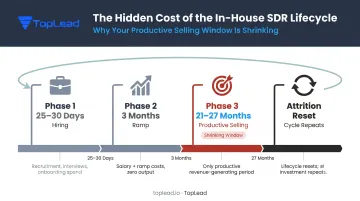
- 25–30 days to fill an open SDR role
- 3 months average ramp time to full productivity
- 40–50% annual attrition — including quits, terminations, and internal promotions
That attrition rate means a typical SDR seat turns over roughly every 24–30 months. Subtract the 3-month ramp, and you get approximately 21–27 months of fully productive selling time before the cycle resets. For many companies, that's two, maybe three hiring cycles just to sustain continuous pipeline coverage.
The Feast-or-Famine Pipeline Problem
The ramp cost is only part of the issue. The more persistent problem is structural.
Founder-led teams and lean sales organizations tend to run hot when closing deals and cold when prospecting. Pipeline collapses precisely when the team is busiest, and the damage shows up in the next quarter's numbers, not the current one.
The root issue is capacity. Prospecting and closing demand different workflows, different mental modes, and more dedicated hours than most lean teams can sustain simultaneously.
A few additional hidden costs compound this:
- ICP clarity lag — early-stage teams often spend months chasing the wrong companies before targeting tightens. That's expensive ramp time wasted on poor-fit prospects
- Messaging refinement — internal SDRs iterate messaging slowly because sample sizes are small and feedback loops are long
- Management overhead — SDR coaching, QA, and pipeline reviews consume senior time that could go toward closing
Taken together, these constraints make consistent pipeline coverage structurally difficult to achieve in-house — which is exactly the gap outsourced sales development is designed to fill.
How Outsourced Sales Teams Build Qualified Pipelines Faster
A well-structured outsourced program runs the entire top-of-funnel motion in parallel to your core selling activities. The sequence looks like this:
- ICP definition — firmographics (industry, company size, revenue range, geography), decision-maker titles, specific pain points, and buying triggers such as leadership changes, headcount growth, or technology adoption
- Prospect list building — verified data from platforms like LinkedIn Sales Navigator, ZoomInfo, Apollo, and intent tools like Bombora or 6sense that surface leads actively researching solutions
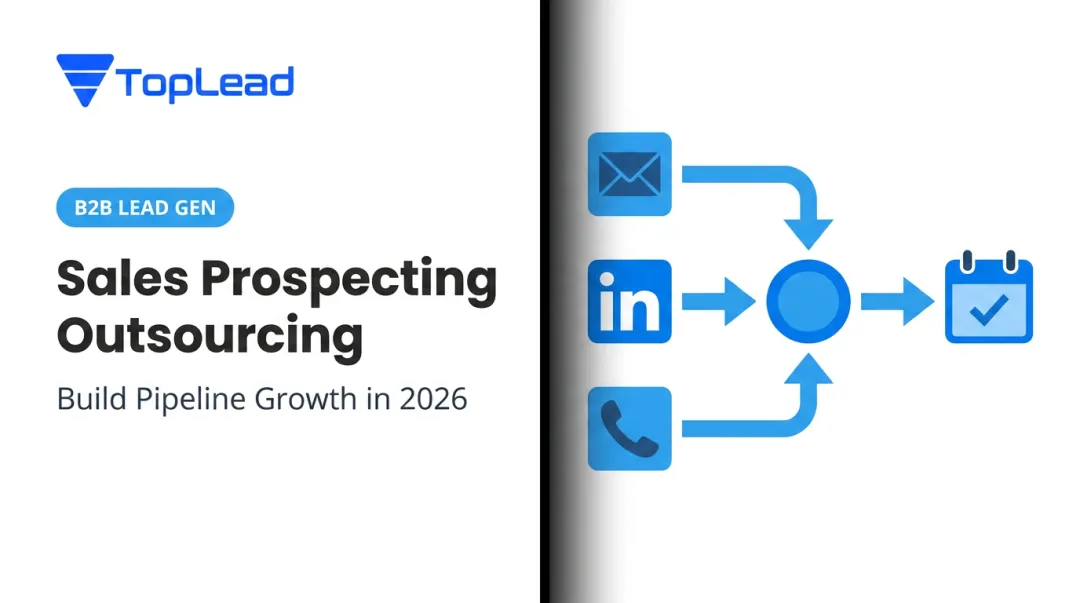
- Multi-channel outreach execution — coordinated email, phone, and LinkedIn sequences across multiple touchpoints
- Qualification layer — BANT or equivalent framework applied before any meeting reaches your calendar
- Calendar handoff — confirmed appointment delivered with full context: pain points discussed, stakeholders involved, budget and timeline notes, agreed next steps
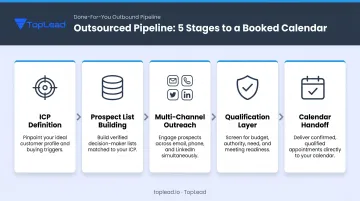
Each step builds on the last — and the quality of step one determines everything downstream. TopLead's ICP development process starts with an alignment workshop rather than a generic brief. Instead of targeting "any SaaS company," a refined ICP targets "software companies between 20 and 150 employees experiencing rapid growth using a specific tool stack." That specificity determines list quality and outreach conversion rates.
Multi-Channel Outreach That Reaches Decision-Makers
Single-channel outreach doesn't work. According to Salesloft's B2B research, email-only cadences produce 77% lower response rates and call-only cadences produce 91% lower response rates compared to coordinated multi-channel approaches.
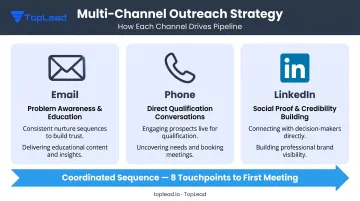
RAIN Group's prospecting research reinforces this: it takes an average of 8 touchpoints to get an initial meeting with a new prospect. Getting to 8 touches efficiently requires running email, phone, and LinkedIn simultaneously — not sequentially.
TopLead's three-channel approach assigns a distinct role to each:
- Email — personalized sequences for problem awareness and education
- Phone — direct qualification conversations with context from prior touches
- LinkedIn — social proof, credibility building, and human connection
The sequencing is intentional: each channel reinforces the message without overwhelming the prospect. Your internal closers stay focused on deals already in motion — the pipeline builds around them.
Lead Qualification and the Clean Handoff
Before a prospect reaches your calendar, TopLead screens for budget readiness, authority level, need, and timeline — applying BANT, MEDDICC, or CHAMP depending on the client's sales process. Decision-maker verification is embedded into qualification: confirmed business owners, CEOs, CFOs, HR directors, or department heads with actual purchasing authority.
A qualified appointment includes:
- Verified decision-maker role and budget authority
- Documented pain points discussed during outreach
- Stakeholders involved and their positions
- Budget and timing context
- Confirmed interest in a sales conversation
How fast you follow up after booking matters as much as how you book. An HBR study of 1.25 million sales leads found that companies contacting leads within 1 hour were nearly 7 times more likely to qualify them than those waiting just 60 minutes longer — and more than 60 times as likely as companies waiting 24 hours.
TopLead addresses this through direct CRM integration with Salesforce, HubSpot, Pipedrive, and Close.io. Lead activity syncs in real time, so internal reps receive immediate notification the moment a meeting is booked.
One healthcare SaaS client using the HubSpot integration doubled their demo show-up rates after enabling same-day follow-up visibility.
Outsourced vs. In-House: Cost, Speed, and ROI
Side-by-Side Comparison
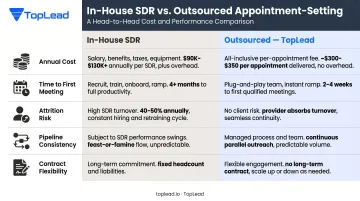
| Factor | In-House SDR | Outsourced (TopLead) |
|---|---|---|
| Annual cost | $90,000–$130,000+ fully loaded | ~$300–$350 per qualified appointment |
| Time to first meeting | 4+ months (recruiting + onboarding + ramp) | 2–4 weeks from campaign launch |
| Attrition risk | 40–50% annually; restart cycle | Provider absorbs turnover internally |
| Pipeline consistency | Feast-or-famine during busy close periods | Continuous parallel outreach |
| Contract flexibility | Fixed headcount cost; 90-day notice cycles | No long-term contract required |
A Simple ROI Example
Conservative assumptions: 6 qualified meetings per month, $50,000 average deal size, 20% close rate.
- Monthly pipeline generated: 6 × $50,000 = $300,000
- Monthly program cost: 6 × $325 (midpoint cost per appointment) = $1,950
- Pipeline-to-cost ratio: ~154:1
Even at a 10% close rate, a single closed deal at $50,000 covers roughly 25 months of program cost at TopLead's pricing floor. The math improves further as messaging and targeting sharpen across the 3–6 month campaign lifecycle: early months establish baseline performance, and later months build on it.
The Risk Profile Difference
In-house hiring locks in fixed headcount costs with no guarantee of output. If an SDR underperforms or leaves at month 4, you absorb the full recruiting and ramp cost again.
Outsourced pay-per-appointment models shift risk to the provider. TopLead's reschedule-or-replacement guarantee means clients don't pay for no-shows or unqualified attendees — the appointment is replaced at no additional cost. You pay for outcomes, not effort.
How to Choose the Right B2B Sales Outsourcing Partner
Not all outsourced programs are equal. Vet partners on these criteria before committing:
- Vertical-specific experience matters — generic B2B outreach doesn't transfer cleanly to niche sectors. A partner with a track record in financial services, insurance, PEO, or accounting understands buyer personas, compliance sensitivities, and sales cycles in ways a generalist can't replicate
- Ask about data sourcing upfront — what platforms they use for list building and how they verify decision-maker status before outreach begins
- CRM integration depth — real-time sync is the baseline; anything less recreates the cold-lead problem you hired them to fix
- Reporting cadence — weekly pipeline metrics (contacts reached, meetings booked, qualification rates, cost per meeting) are the minimum; monthly summaries are a red flag
- Contract flexibility — any partner requiring a 12-month minimum on a first engagement is asking you to absorb all the risk. That arrangement benefits one side
TopLead's client roster includes Edward Jones, Aflac, Hub International, LPL Financial, and Insperity — American companies operating in compliance-sensitive environments with sophisticated buyers.
Run a Pilot First
Before committing to a full campaign, run a structured 60–90 day pilot with agreed success metrics: cost per qualified meeting, lead-to-opportunity conversion rate, and sales cycle length for outsourced leads versus other sources.
A partner unwilling to start with a pilot is telling you something important about how they view accountability.
What Genuine Accountability Looks Like
- Weekly CRM-synced reporting with channel-level attribution (which sequences drove which meetings)
- Willingness to iterate messaging based on performance data, not just deliver volume
- Transparency when a channel underperforms and a plan to adjust
- A replacement guarantee that doesn't require you to argue for it
Common Mistakes That Kill Outsourced Pipeline Programs
Most outsourced pipeline programs don't fail because of bad prospecting — they fail because of avoidable structural mistakes. Here are the three that show up most often.
Vague ICP Definitions
When the ideal customer profile is too broad, outsourced teams cast a wide net and booking rates fall. A strong ICP includes:
- Firmographic criteria: industry, company size, revenue range, geography
- Specific decision-maker titles with confirmed budget authority
- Pain points the solution actually addresses
- Buying triggers that create urgency (new leadership, growth stage, missed targets)
Without a written Sales Qualified Appointment (SQA) definition in the service agreement, meeting volume can look healthy while pipeline conversion stays flat — and volume is not the same as pipeline progress.
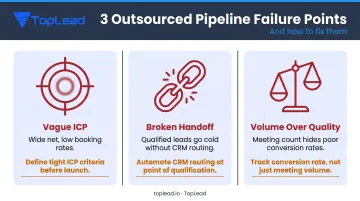
The Broken Handoff
Even a well-qualified lead goes cold fast without a structured handoff. The MIT/InsideSales.com lead response study found that waiting 30 minutes instead of 5 to call a new lead drops contact odds by 100 times and qualification odds by 21 times.
Preventing cold leads requires:
- Direct CRM integration with automated routing to the right closer
- Defined internal response time expectations (same day at minimum)
- Full qualification notes at handoff — not just a name and calendar invite
Chasing Volume Over Quality
Measuring success by meetings booked — regardless of quality — overwhelms closers with poor-fit prospects and inflates customer acquisition cost. The correct leading indicator is lead-to-opportunity conversion rate: how many outsourced meetings actually advance to a second conversation or proposal stage.
A program delivering 12 meetings per month with 20% conversion outperforms one delivering 20 meetings with 8% conversion. The closers' time and goodwill are finite resources.
Frequently Asked Questions
Can outsourcing B2B sales teams boost efficiency?
Yes, and the mechanism is straightforward. McKinsey's analysis of nearly 500 B2B companies found that non-selling activities consume two-thirds of the average sales team's time. Outsourcing top-of-funnel work recaptures those hours for closing, and top-quartile companies that offloaded non-selling tasks improved sales productivity by up to 30%.
What are the key KPIs for B2B sales outsourcing?
Measure outsourced programs on pipeline quality, not just activity. Key metrics to track:
- Qualified meetings booked and lead-to-opportunity conversion rate
- Pipeline value generated and cost per qualified meeting
- Sales cycle length and closed-won revenue from outsourced leads
Emails sent and calls made tell you nothing about whether the program is actually working.
What percentage of B2B buyers start the buying process with a referral?
According to Harvard Business Review, 84% of B2B buyers start the purchasing process with a referral, and peer recommendations influence more than 90% of all B2B buying decisions. Referrals are valuable but unpredictable — systematic outbound prospecting exists precisely to fill the gaps your referral network can't reliably cover.
How long does it take to see results from B2B sales outsourcing?
Most programs complete setup and launch outreach within 1–2 weeks, with first qualified meetings arriving within 30–60 days. Pipeline value compounds over a 3–6 month campaign lifecycle as messaging sharpens and targeting tightens — Month 3 consistently outperforms Month 1.
What is a pay-per-appointment model?
A pay-per-appointment model charges clients per qualified, verified meeting with a decision-maker — not a flat monthly retainer regardless of results. You pay for outcomes, not effort. The strongest versions include a reschedule-or-replacement guarantee so no-shows and unqualified attendees don't count against your budget. TopLead's model prices qualified appointments at $300–$350 each with a guaranteed minimum of 4–6 per month and no long-term contract required.