Introduction
B2B lead generation pricing is frustratingly opaque. The same scope of work — ICP research, outbound sequences, and qualified meetings — can cost $3,000 or $25,000 per month depending on the agency, the model, and how "qualified" is defined. Most agencies don't publish pricing at all, leaving buyers to negotiate quotes without a reliable benchmark.
That opacity compounds a deeper problem: the pricing model you choose shapes incentives as much as it shapes your invoice. A pay-per-lead structure rewards volume. A retainer rewards activity. A pay-per-appointment model rewards booked meetings with verified decision-makers. Each structure creates different behaviors — and choosing the wrong one drains budget regardless of who you hire.
Understanding the difference before you sign a contract is how you avoid paying for the wrong outcomes.
Key Takeaways
- Five core models: retainer, pay-per-lead, pay-per-appointment, hybrid, and commission-only — each with different cost and quality tradeoffs
- Cost ranges: retainers run $3,000–$25,000/month, pay-per-lead averages $20–$500, and pay-per-appointment runs $300–$1,000+
- What drives cost up: narrow targeting, C-suite decision-makers, longer sales cycles, multi-channel outreach, and compliance requirements
- Rule of thumb: one published B2B demand-gen benchmark places CPL at 1–3% of average deal size, so adjust expectations based on your lead-to-close rate
- Price alone is a poor filter: cheap pricing almost always signals weak qualification standards or deliverability risk
The 5 B2B Lead Generation Pricing Models Explained
Every agency operates under one of five core pricing structures. Each one rewards different behavior, and the wrong choice wastes budget even with a capable agency running your program.
Monthly Retainer
A fixed monthly fee covers a defined scope: ICP research, list building, messaging, outreach execution, and meetings booked. Typical range is $3,000–$25,000+/month, with higher pricing driven by enterprise scope, ABM programs, multi-channel outreach, and C-suite targeting.
Without accountability built in, retainers reward activity — emails sent, calls made — rather than outcomes. Before signing, negotiate:
- Minimum meeting quality standards tied to ICP fit
- Monthly performance reviews with transparent reporting
- Exit clauses if volume or quality benchmarks aren't met
Pay-Per-Lead (CPL)
Businesses pay a flat fee per lead matching agreed criteria. Ranges vary widely — $20–$200 for lower-qualification leads, up to $500–$1,000+ for deeply qualified outbound leads — because "lead" means different things to different agencies.
When revenue ties to lead volume, agencies optimize for volume. The gap between a "lead" (name, email, company fit) and a "sales-ready opportunity" (verified decision-maker, confirmed need, agreed next step) is where most CPL buyers get burned. If your qualification definition isn't explicit in the contract, assume the looser interpretation applies.
Pay-Per-Appointment (PPA)
Payment triggers only when a qualified appointment is booked with a verified decision-maker. This directly aligns agency incentives with sales outcomes — not contact volume or activity metrics. According to Callbox's 2024 B2B lead generation pricing guide, PPA rates run $300–$1,000+ per appointment, with the spread driven by industry complexity, ICP specificity, and qualification depth.
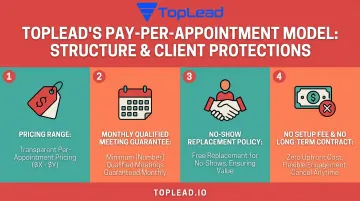
TopLead operates a U.S.-based pay-per-appointment model, averaging $300–$350 per appointment and guaranteeing 4–6 qualified meetings per month with verified decision-makers. Key protections built into the model:
- Reschedule or replacement guarantee for no-shows
- No setup fees or long-term contracts
- No retainer requirements
That structure makes it a lower-risk entry point for companies that need pipeline predictability without a multi-month commitment.
Hybrid Pricing
A base retainer covers research, setup, and outreach infrastructure. A variable performance fee kicks in for meetings booked or SQLs delivered. SalesAR documents one concrete structure: $2,000–$4,000/month base plus $150–$400 per qualified meeting.
This model solves the cold-start problem — agencies need funding to build infrastructure before results flow — while tying upside to outcomes. The opacity risk: buyers often compare headline retainer numbers without modeling total cost at peak meeting volume. Always ask for "total cost at target meeting volume" before signing.
Commission-Only / Revenue Share
Agencies earn 10–20% of first-year contract value from closed deals, with little or no base fee. The model is rare because it's structurally difficult: agencies front-load significant effort (research, copy, testing, outreach) before any revenue flows in, and they can't control close rates, sales team follow-up, or deal negotiation.
It works in two narrow scenarios:
- Established companies with documented close rates and high average contract values
- Niche services with tightly defined ICPs and short sales cycles
Commission-only arrangements typically collapse within 90 days without them.
Key Factors That Affect B2B Lead Generation Costs
Pricing doesn't happen in a vacuum. Five operational factors determine whether a $5,000/month program or a $15,000/month program is the right investment.
Target Market Size and Niche Specificity
Narrow targeting — CFOs at manufacturing firms with 200–500 employees in the Southeast, for example — requires manual research, custom messaging, and higher data acquisition costs. According to SalesAR's 2025 pricing research, targeting C-level executives can raise CPL by 60% compared to broader title targeting, while potentially improving customer lifetime value by 3x.
Broad markets are cheaper per lead but produce lower conversion rates downstream. Unit economics favor the more expensive, tighter list.
Lead Qualification Depth
Not all leads cost the same to produce — because not all leads are equal. Consider the difference:
- Surface-level leads (name, email, company fit): lower cost, higher discard rate downstream
- Deeply qualified leads (verified decision-maker role, confirmed budget authority, active pain point, agreed next step): more SDR time, more touchpoints, better tooling
That cost difference shows up in the per-lead or per-appointment price — but deeply qualified leads reduce wasted sales time on the back end. The Salesforce BANT framework (Budget, Authority, Need, Timeline) sets a practical floor for what "qualified" should mean in any lead generation contract.
Sales Cycle Length and Stakeholder Count
Complex B2B sales with multiple decision-makers — common among American enterprise tech, healthcare, financial services, and SaaS companies — require longer nurture sequences, more follow-up touchpoints, and more personalization. A $700 appointment in financial services isn't overpriced if it took 8 multi-channel touchpoints to book a CFO who controls a $500K annual budget.
Outreach Channels Used
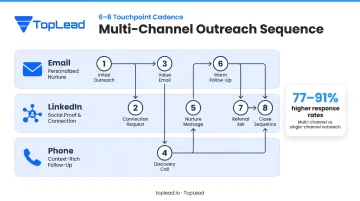
Single-channel (email only) programs cost less and produce fewer results. Multi-channel programs combining email, LinkedIn, and phone outperform single-channel outreach significantly — vendor benchmarks from Salesloft's 2024 community research suggest multi-channel sequences can generate 77–91% higher response rates versus single-channel approaches.
TopLead's US-based SDR teams run campaigns using 6–8 touchpoints across email, LinkedIn, and phone before conversion, with each channel serving a specific role: email for personalized nurture, LinkedIn for social proof and connection, phone for context-rich follow-up.
Industry Complexity and Compliance Requirements
Regulated industries carry additional costs. Messaging requires compliance review, data handling protocols must meet industry standards, and outreach cadences face stricter constraints. Belkins' 2026 industry CPL benchmarks reflect this directly: cybersecurity CPL runs $1,750–$2,800, insurance hits $1,120–$1,750, and banking/finance ranges $840–$1,680.
Typical Cost Ranges: What to Expect by Model and Industry
Cost by Pricing Model
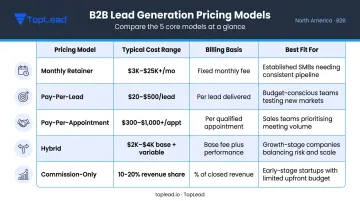
| Model | Typical Range | Billing Basis | Best-Fit Business |
|---|---|---|---|
| Monthly Retainer | $3,000–$25,000+/mo | Monthly | Established SMBs, enterprise |
| Pay-Per-Lead | $20–$500/lead | Per lead delivered | Testing phase, broad ICPs |
| Pay-Per-Appointment | $300–$1,000+/appt | Per booked meeting | Pipeline-focused SMBs |
| Hybrid | $2,000–$4,000 base + $150–$400/meeting | Monthly + variable | Growing companies, complex ICPs |
| Commission-Only | 10–20% of closed revenue | Per closed deal | High-ACV, short-cycle businesses |
Cost by Industry
Industry CPL benchmarks vary considerably. Higher-ACV industries justify higher CPL because a single closed deal can generate six figures in revenue:
| Industry | Published CPL Benchmark | Source |
|---|---|---|
| Financial services / Banking | $840–$1,680 | Belkins 2026 |
| Insurance | $1,120–$1,750 | Belkins 2026 |
| Cybersecurity | $1,750–$2,800 | Belkins 2026 |
| SaaS / Software | $700–$2,800 | Belkins 2026 |
| Healthcare / MedTech | $840–$1,190 | Belkins 2026 |
| Manufacturing | $150–$700 | SalesAR 2025 / Belkins 2026 |
| Professional services (legal, staffing) | $700–$2,800 | Belkins 2026 |
Note the manufacturing range discrepancy — it reflects different qualification assumptions between sources. Confirm the qualification standard before benchmarking against either number.
These benchmarks also serve as a gut-check when evaluating vendor proposals. If a quote looks suspiciously low for your category, that gap rarely means you found a bargain.
What "Cheap" Actually Signals
A vendor quoting $50 per qualified appointment in a complex enterprise category is flagging a real problem — usually one of these:
- Weak qualification standards — any calendar booking counts as a "meeting"
- High-volume, low-quality tactics — offshore boiler-room dialing with minimal ICP filtering
- Deliverability risk — mass cold email burning your domain reputation
Mailreach's 2026 deliverability research found that 83% of email delivery failures stem from poor sender reputation, and a healthy bounce rate stays below 3%. Vendors pricing aggressively often skip the infrastructure work (list verification, inbox warm-up, authentication) that protects your domain. The cost of repairing a damaged sending domain can exceed what you saved on the cheap program.
Before comparing prices, nail down how each vendor defines a "qualified lead" — and what happens when a meeting doesn't show. Those two questions reveal more about program quality than the rate card ever will.
How to Choose the Right B2B Lead Generation Pricing Model
The right model depends less on what sounds cheapest and more on three factors: how well-defined your ICP is, how stable your sales motion is, and how much risk you can absorb during the startup phase.
Match Model to Company Stage
| Company Stage | Recommended Model | Reason |
|---|---|---|
| Startup, still validating ICP | Project-based or CPL | Limits spend while testing; strict qualification rules required |
| Growing SMB with defined ICP | Hybrid or PPA | Accountability for outcomes, not just activity |
| Enterprise with proven sales motion | Retainer with outcome clauses | Volume and consistency; outcome standards protect against activity padding |
Companies in financial services, professional services, insurance, and similar high-ACV verticals that need verified decision-maker meetings — without long-term contract exposure — are well-suited to pay-per-appointment structures. TopLead's model offers 4–6 qualified meetings per month with no long-term contract, making it a practical fit for this buyer profile.
Evaluate What "Qualified" Means Before You Sign
The qualification definition is the most important clause in any lead generation contract. An agency that counts any calendar booking as an "appointment" is selling something entirely different from one that verifies budget authority, decision-making role, company fit, and active need — even when the headline price is identical.
TopLead's qualification standard, as one example, requires prospects to demonstrate ICP alignment, a defined business challenge the client can solve, and genuine openness to a sales conversation. Decision-maker verification confirms relevant authority — not just a corporate email address.
Tie CPL to Your Average Contract Value
A common B2B demand-gen benchmark places CPL at roughly 1–3% of average deal size.
A concrete example:
- Average deal value: $50,000
- 1–3% benchmark: $500–$1,500 per lead
- At a $350/appointment PPA rate with a 20% lead-to-close rate: $1,750 cost per closed deal → 3.5% of ACV
That's a defensible number. If your average deal is $5,000 and you're paying $500 per appointment, the math breaks down quickly — which is why model selection and ACV must align before you sign anything.
Prioritize Accountability Mechanisms Over Price
Three contract features that signal a credible provider:
- Meetings evaluated against ICP fit, not just whether a calendar invite was accepted
- Replacement or reschedule guarantee covering no-shows and misqualified leads
- Monthly performance reviews with transparent reporting — not quarterly summaries after budget is already spent
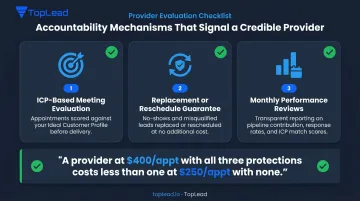
These protections matter more than the headline price. A provider at $400/appointment with all three protections costs less than one at $250/appointment with none.
Hidden Costs and Red Flags to Watch Before Signing
Quoted pricing rarely reflects the true cost of a program. Before signing, ask vendors to itemize every fee — including these commonly buried categories:
- Onboarding and setup fees ($1,500–$5,000 one-time) cover ICP workshops, list building, domain configuration, and copywriting. Some agencies fold these into month-one billing without disclosure.
- Tooling and software pass-throughs: CRM integrations, outreach platforms, and data enrichment tools are sometimes billed as separate line items. Ask explicitly whether these are included in the headline rate.
- Minimum commitment clauses: contracts that lock 6–12 months of spend regardless of performance shift all risk to the buyer. Prioritize vendors offering month-to-month flexibility.
TopLead doesn't charge setup fees — ICP alignment, messaging, and outreach infrastructure are included in the per-appointment model.
Pricing Red Flags That Predict Poor Outcomes
Watch for these patterns — each signals a vendor more focused on closing you than delivering results:
- Single-number quotes with no base/variable breakdown
- Guarantees of high meeting volumes before your ICP has been discussed
- "Cancel anytime" pitches from vendors with no domain or infrastructure investment — they have no sender reputation at risk and no accountability to protect
- Percentage-of-spend models that reward larger budgets rather than better efficiency
Conclusion
The right B2B lead generation pricing model is the one that aligns incentives between you and your provider — rewarding qualified meetings, not just activity or lead volume. Cost varies significantly based on model, ICP complexity, industry, and qualification depth.
Before you request a quote from any provider, keep these principles in mind:
- Tie payment to outcomes — qualified appointments, not raw lead counts or activity reports
- Factor in ICP complexity — niche audiences and multi-stakeholder deals cost more to work, and should
- Ask how quality is defined — a "lead" means different things to different vendors; get the criteria in writing
- Watch retainer-only structures — flat monthly fees with no performance accountability rarely self-correct
Understanding where your pricing model actually sits on this spectrum is what separates a vendor relationship that builds pipeline from one that burns budget.
Frequently Asked Questions
What is a good cost per lead in B2B?
One common benchmark places CPL at 1–3% of average deal size — so a $50,000 deal could justify $500–$1,500 per lead. A "good" CPL depends on your deal size and close rate, not a universal dollar figure.
What is the most common B2B lead generation pricing model?
Retainer-based pricing remains the most widely used model among agencies, but hybrid models — base retainer plus a performance fee tied to meetings or SQLs — are increasingly common because they balance infrastructure funding with outcome accountability better than a pure retainer.
What is pay-per-appointment pricing and how does it work?
You pay a flat fee only when a qualified appointment is booked with a verified decision-maker who meets your ICP criteria. The typical range is $300–$1,000+ per appointment depending on industry complexity and qualification depth. Payment is triggered by the outcome — a meeting — not by emails sent or contacts touched.
How do I choose between a retainer and a pay-per-appointment model?
Retainers work well for companies with a defined ICP that want consistent volume and can tolerate a 60–90 day ramp period. Pay-per-appointment is the better fit when you want outcome-based pricing, need to limit financial risk, or are testing a new market before committing to a multi-month engagement.
What hidden costs should I look out for in a lead generation contract?
The three most common: one-time setup and onboarding fees (often $1,500–$5,000), software and tooling pass-throughs billed separately from the headline rate, and minimum commitment clauses that lock spend for 6–12 months regardless of performance.
What is the average cost per lead by industry in B2B?
High-complexity industries carry the highest CPLs — financial services and cybersecurity often run $840–$2,800+ per qualified lead. Lower-complexity sectors like manufacturing or general professional services can fall in the $150–$700 range. Higher CPL in complex industries is typically justified by larger deal sizes, where a single closed deal more than covers the cost of acquisition.