Introduction
B2B companies are spending more on outbound and paid media while getting less in return. Gartner found that 67% of B2B buyers now prefer a rep-free buying experience, and privacy restrictions are making audience targeting increasingly unreliable. The traditional playbook — blast emails, buy ads, and wait for pipeline that rarely materializes — is producing diminishing returns across most verticals.
Affiliate-based lead generation offers a different model: pay external partners only when they deliver a qualified lead, appointment, or demo. There's no spend until a result is delivered.
This article breaks down how real B2B companies across financial services, insurance, and SaaS have used affiliate programs to build consistent, measurable pipelines. Each section pulls out the mechanics that worked so you can apply them directly.
Key Takeaways
- B2B affiliate programs pay partners per qualified lead or appointment — not per click or impression
- Financial services, insurance, and SaaS all have documented examples of affiliate-driven pipeline growth
- Quality of affiliate partners matters far more than quantity
- Commission structures that tie to completed demos, booked appointments, or MQLs outperform flat-fee or click-based models
- US businesses that want performance-based pipeline without building their own program can work with TopLead on a pay-per-appointment model
What Is a B2B Lead Generation Affiliate Program?
A B2B lead generation affiliate program is a performance-based arrangement where a company pays external partners — affiliates — a commission for generating qualified leads. The Performance Marketing Association defines performance marketing as a model where advertisers pay only when a specified action is completed: a lead, a sale, or another agreed outcome. That distinction separates affiliate programs from traditional advertising — spend is tied directly to outcomes, not impressions.
How B2B Differs from B2C Affiliate Marketing
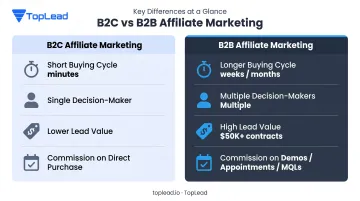
Standard B2C affiliate programs typically pay on a purchase — someone clicks a link, buys a product, affiliate earns a commission. B2B is structurally different:
- Longer buying cycles — weeks or months, not minutes
- Multiple decision-makers — committees, not individuals
- Higher lead value — a single qualified B2B lead may represent $50,000 or more in contract value
- Different conversion triggers — commissions tied to completed demos, booked appointments, or MQLs rather than product sales
Those structural differences also shape which affiliate partners deliver the most value.
Common Affiliate Partner Types in B2B Programs
- Industry-specific content publishers and buyer guides
- Software comparison and review platforms (G2, Capterra)
- Consultants and analysts in target verticals
- Email newsletter owners with niche professional audiences
- Outbound lead generation specialists with vetted prospect databases in specific industries
Why Affiliate Programs Are a Powerful B2B Lead Gen Channel
Cost Control and Performance Alignment
The core advantage is simple: you only pay when a qualified outcome is delivered. There's no wasted spend on impressions or clicks that never convert — the affiliate earns nothing unless they deliver a lead that meets your criteria. That structure pushes them to self-select the right prospects rather than drive volume for its own sake.
Credibility Amplification
Research from G2's 2024 Buyer Behavior Report found that 31% of B2B buyers consulted public review sites during their purchase process, up from just 13% in 2021. When a trusted industry newsletter or comparison platform recommends your solution, prospects arrive already primed. A sales rep doesn't need to build trust from zero — the affiliate already did it.
This pre-validation is especially valuable in high-consideration B2B purchases like insurance, financial services, or enterprise software, where buyer skepticism runs high.
How Affiliate Networks Scale Without Hiring
As your affiliate network grows, lead volume scales without requiring more internal headcount. A 2020 Forrester Consulting study of 454 companies found that mature partnership programs grow revenue nearly 2x faster than less-developed programs.
This matters most when you're targeting multiple verticals or geographies at once — coverage that would require substantial SDR hiring to replicate through direct outbound alone. Key reasons affiliate networks scale efficiently:
- No proportional headcount increase as lead volume grows
- Affiliates self-fund their own outreach and content costs
- New vertical coverage activates through partner recruitment, not internal buildout
- Performance-only payments keep cost-per-lead predictable at scale
Case Studies: B2B Lead Generation Affiliate Programs That Delivered Results
The following examples span financial services, insurance, and SaaS — three verticals where affiliate-driven lead generation has produced measurable pipeline outcomes and where the structural lessons apply broadly.
Case Study 1: Financial Services — Growing a Qualified Appointment Pipeline
SmartAsset AMP operates as a performance-based investor referral platform for financial advisors. Rather than charging advisors for ad placements or subscriptions, the model pays on matched, qualified investor referrals — structurally identical to an affiliate lead generation program.
How the program works:
- Advisors are matched with investors through SmartAsset's content and comparison platform
- SmartAsset's editorial and recommendation content attracts investors actively researching advisors
- Advisors pay for qualified referrals — not impressions, not clicks
Outcomes:
- SmartAsset AMP matches advisors with nearly 50,000 investors monthly
- The platform generated $30B+ in AUM in 2024
- Pure Financial Advisors reported $1B in new AUM sourced from SmartAsset referrals
Why it worked: SmartAsset's content affiliates reach investors during the research phase — when they're actively evaluating options, not passively scrolling. The platform's trusted editorial voice pre-qualifies buyer intent before the advisor ever enters the conversation. For financial advisory firms, RIAs, and wealth managers, that translates directly: being present where qualified buyers research options — and paying only for the resulting leads — delivers better ROI than broad-based paid media.
Case Study 2: Insurance — Scaling Lead Volume While Maintaining Quality Standards
Thimble's business insurance affiliate program offers a transparent, documented example of how commercial insurance companies can structure affiliate lead generation around quality rather than volume.
Program mechanics:
- The team recruits affiliates manually, reviewing each application for audience fit rather than reach alone
- Managed through Impact Radius, with commission paid at $30 per qualified lead
- Affiliates must be U.S.-based; the team evaluates each applicant individually
- Response time for applications is typically within 10 business days
Quality control approach:
- Manual affiliate review prevents partners with mismatched audiences from entering the program
- Commission is tied to a qualified lead — not a click, not a form fill
- The flat fee per qualified lead aligns affiliate incentives with delivering relevant small-business prospects
NEXT Insurance adds a complementary example at the integration level. A multinational payroll software company embedded workers' compensation purchasing directly into its payroll platform — letting small-business customers obtain coverage without leaving their existing workflow. The affiliate earns on embedded insurance transactions, meeting B2B buyers exactly where they already operate.
What these programs demonstrate: Flat-fee-per-qualified-lead structures, manual affiliate vetting, and platform-managed tracking are practical, documented mechanics that insurance brokers, financial services firms, and B2B service providers can adapt for their own programs.
Case Study 3: SaaS / Technology — Using Content Affiliates to Fill a Demo Pipeline
SaaS affiliate programs produce the most documented, quantifiable outcomes — the data below illustrates the gap between content-driven affiliate programs and generic traffic approaches.
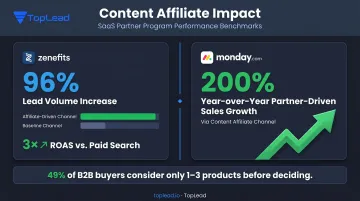
Zenefits (via Impact.com):
- Increased lead volume by 96%
- Achieved 3x ROAS compared with paid search channels
- Affiliate content — comparison articles, review posts, "best of" software guides — reached buyers deep in the evaluation stage
monday.com (via PartnerStack):
- Grew partner-driven sales by 200% year-over-year
- PartnerStack's partner network enabled monday.com to scale without proportional internal headcount increases
Why content affiliates outperform generic traffic affiliates in B2B SaaS:
The difference comes down to buyer intent at the moment of contact:
- Generic traffic affiliates drive volume — clicks from broadly targeted audiences who may have no active buying need
- Content affiliates drive qualified intent — a long-form comparison article ranking for "best project management software for teams" reaches buyers who have already identified a need and are actively evaluating options
That's a fundamentally different prospect than someone who clicked a banner ad.
G2's 2024 data shows 49% of B2B buyers now consider only 1–3 products before making a decision, versus 33% in 2023. Appearing in the right comparison content before that shortlist forms is worth more than any retargeting campaign.
What Made These Programs Work: Key Success Factors
Across all three verticals, the same structural elements separated successful programs from those that produced volume without pipeline value.
Quality-First Affiliate Selection
All three examples prioritized fewer, more relevant partners over large generic networks. Thimble manually reviews every applicant. SmartAsset's matching focuses on fiduciary-qualified advisors. monday.com and Zenefits targeted content publishers with specific software-buyer audiences.
Traffic volume is a poor proxy for partner quality. The right question is whether an affiliate's audience matches your ICP — not how large that audience is.
Commission Structures Tied to Sales Milestones
Effective B2B affiliate commissions pay on meaningful actions:
| Payout Trigger | What It Rewards |
|---|---|
| Completed demo | Intent to evaluate, not just curiosity |
| Booked qualified appointment | Decision-maker availability confirmed |
| MQL meeting defined criteria | Company size, title, and intent threshold met |
| Free trial from qualified business | Hands-on product engagement |
Paying on first click or raw form fill rewards volume. Paying on qualified milestones rewards pipeline — which is what actually drives revenue.
Clear ICP Guidance Communicated to Affiliates
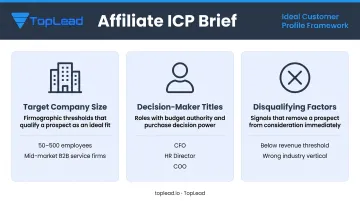
Successful programs gave affiliates explicit ICP criteria: company size, decision-maker title, industry, and intent signals. With that detail, partners can pre-qualify prospects rather than forwarding every form submission.
For B2B programs, this means briefing affiliates with the same level of detail you'd give an internal SDR:
- Target company size (e.g., 50–500 employees)
- Decision-maker titles (e.g., CFO, HR Director, COO)
- Disqualifying factors (e.g., below a revenue threshold, wrong industry)
Tracking Built for Long Sales Cycles
B2C affiliate programs can credit conversions within 24–48 hours. B2B buying cycles run weeks or months. Attribution windows of 30–90 days are standard for crediting affiliates accurately across multi-touch journeys.
Platforms like Impact.com (Salesforce integration), PartnerStack (HubSpot sync), and Awin/ShareASale (configurable attribution rules) all support the custom conversion events and longer windows B2B tracking requires. Without that infrastructure, you'll under-credit affiliates — and they'll stop sending leads.
Ongoing Affiliate Enablement
The programs that consistently outperformed treated affiliates as an extension of the sales team. In practice, that means:
- Regular ICP brief updates as your targeting evolves
- Messaging guides that reflect current positioning
- Performance feedback so affiliates know which leads are converting
- Tiered commission structures that reward consistently high-quality partners
How to Set Up a B2B Lead Generation Affiliate Program
Step 1: Define Lead Qualification Criteria First
Before recruiting any affiliate, answer:
- What decision-maker title must be in the meeting?
- What company size and industry qualifies?
- What intent signals or trigger events indicate readiness?
- What disqualifies a lead immediately?
This criteria becomes the commission trigger and the affiliate brief. Without it, affiliates send whatever they have.
Step 2: Choose the Right Tracking Platform
Three platforms with documented B2B CRM integration:
| Platform | CRM Integration | B2B Strengths |
|---|---|---|
| Impact.com | Salesforce native | Custom conversion events, lead and opportunity tracking |
| PartnerStack | HubSpot sync | Lead-to-contact mapping, flexible partner types |
| Awin/ShareASale | Configurable | Attribution rule customization, flexible commission logic |
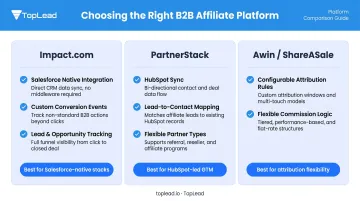
Key questions before committing: Does it support custom conversion events (not just clicks)? Can you set a 60–90 day attribution window? Does it integrate with your CRM natively?
Step 3: Recruit Affiliates by Vertical, Not by Audience Size
Identify 3–5 partner categories with direct access to your ICP:
- Industry newsletters your buyers actually read
- Comparison or review platforms in your category
- Consultants or analysts your prospects trust
- Trade association publications in your target vertical
Niche partners often outperform high-traffic generalists — especially in verticals your competitors have overlooked.
Step 4: Structure Commissions to Reward Quality
Set a flat fee per qualified lead or appointment — not per click or raw form submission. Add performance tiers that increase payouts for affiliates who consistently deliver leads that reach later pipeline stages. This aligns affiliate incentives with your actual revenue goals, not just lead volume.
Step 5: Consider Performance-Based Alternatives if You're Not Ready to Build a Program
Building an affiliate network takes time: vetting partners, setting up tracking, creating enablement materials, and managing commission disputes. For B2B companies that want the same performance-based logic without the infrastructure overhead, managed outbound programs are a practical alternative.
TopLead's pay-per-appointment model, run by U.S.-based SDR teams, operates on the same principle: clients only pay for sales-ready appointments with verified decision-makers. No retainers, no upfront fees — payment triggers only when a qualified meeting lands on the calendar, with a replacement guarantee on no-shows.
With 25,000+ appointments delivered across financial services, insurance, and other B2B verticals, the model shows that performance-based pipeline generation scales without requiring an internal affiliate management function.
Frequently Asked Questions
What is the difference between a B2B lead generation affiliate program and a referral program?
Affiliate programs involve external third-party publishers or partners — not existing customers — who are compensated for generating leads or sales through tracked links or campaigns. Referral programs reward current customers for recommending the product to their network.
How do you measure success in a B2B affiliate lead generation program?
Key metrics include cost per qualified lead, pipeline value influenced by affiliate-sourced leads, and how affiliate leads convert through the funnel compared to other channels. Raw lead volume is a vanity metric without quality tracking — MQL-to-SQL conversion rate from affiliate traffic tells you far more about program health.
What commission structure works best for B2B lead generation affiliates?
Flat-fee-per-qualified-lead models work well because they reward quality over volume. The fee should be tied to a meaningful milestone — a completed demo, a booked appointment, or an MQL that meets defined criteria. Tiered structures that increase payouts for consistently high-performing affiliates incentivize long-term partner investment.
How is B2B affiliate lead generation different from B2C?
B2B programs require longer attribution windows (30–90 days vs. 24–48 hours), account for multiple stakeholders in the buying decision, carry higher per-lead values, and define conversions as qualified appointments or MQLs rather than direct purchases.
What types of partners work best for B2B lead generation affiliate programs?
Industry-specific content publishers, software comparison and review platforms, trusted consultants or analysts in your target vertical, and email newsletter owners with niche professional audiences consistently outperform generic traffic affiliates. The defining criterion is whether their audience matches your ICP — not how much traffic they drive overall.
Can small B2B companies benefit from affiliate-based lead generation?
Yes. The performance-based model controls cost and risk, making it accessible for smaller companies that can't sustain large paid media budgets. The key is starting with clear ICP criteria and a small number of high-quality affiliate partners rather than trying to scale a large network before the program mechanics are proven.