Against that backdrop, how you prospect matters as much as who you prospect. Yet most sales teams that adopt multichannel prospecting never actually measure whether it's working. They add LinkedIn to their email sequences and call it a strategy — without tracking response rates, pipeline velocity, or cost per meeting.
This article focuses on the measurable, operational case for multichannel prospecting: what it improves, by how much, and why those gains compound when applied consistently.
Key Takeaways
- Multichannel prospecting coordinates email, phone, and LinkedIn into structured sequences that reach buyers on the channels they actually respond to
- It outperforms single-channel outreach on response rates, sales cycle length, and lead quality in trackable KPIs
- Engagement rates rise, pipeline velocity accelerates, and cost per qualified meeting drops when channels work together
- Single-channel dependence creates inconsistent pipelines that collapse when one channel underperforms
- ROI compounds when channels are sequenced deliberately, messaging is consistent, and performance data drives monthly optimization
What Is Multichannel Prospecting?
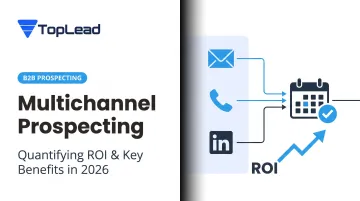
Multichannel prospecting is a coordinated outreach strategy that uses multiple communication channels — email, phone, LinkedIn, and sometimes video or SMS — in a structured sequence to reach decision-makers across the touchpoints they already use.
It's primarily applied in B2B pipelines where a single cold call or email rarely generates enough traction to move a deal forward, especially when targeting mid-to-senior-level buyers who receive dozens of outreach attempts each week and respond to very few of them.
The goal is straightforward: increase the probability of a qualified conversation at a lower cost and in less time than any single-channel approach allows. More channels only matter when they're sequenced with intent.
Why Sequence Matters
RAIN Group's appointment-setting research notes it can take more than 12 touches across multiple media to get a prospect to respond. Outreach's 2024 platform data puts the range at 5 touches for general outreach and 7 for cold contacts. Either way, the math is clear: one message on one channel is rarely enough.
Multichannel prospecting works because each channel reinforces the last. A LinkedIn connection request, followed by a personalized email, followed by a well-timed call doesn't feel like spam. It builds recognition, signals credibility, and gives a prospect enough context to respond with confidence.
Key Advantages of Multichannel Prospecting
The advantages below are tied to outcomes sales teams actually track: response rates, pipeline velocity, cost per appointment, and revenue conversion. Each is most powerful when channels are sequenced with consistent messaging, not deployed in isolation.
Higher Response Rates and Prospect Engagement
When prospects receive coordinated outreach across email, LinkedIn, and phone, cumulative exposure increases recognition and willingness to engage. Each channel removes a different barrier to response.
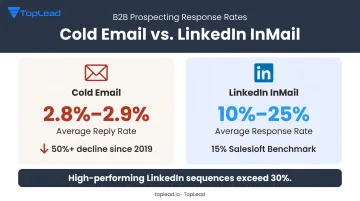
Email reply rates have dropped sharply without multichannel support. Outreach's 2024 sequencing data shows sales email reply rates have fallen more than 50% since 2019, with the current benchmark sitting around 2.8%–2.9% per sequence. LinkedIn changes the equation significantly. LinkedIn Sales Solutions reports InMail generates 10%–25% response rates — compared to the 3% average for email. Salesloft's platform data shows average InMail response at 15%, with high-performing sequences exceeding 30%.
KPIs directly impacted:
- Email reply rate
- LinkedIn connection acceptance rate
- Call pickup and callback rate
- Total meetings booked per 100 outreach contacts
Senior decision-makers receive high volumes of cold outreach and rarely respond to a single first-touch email. C-suite and VP-level buyers are where this advantage is sharpest — multi-channel visibility creates the repetition that earns a response.
Shorter Sales Cycles and Faster Pipeline Velocity
Multichannel prospecting shortens the path from first outreach to booked meeting by eliminating single points of delay. If a prospect misses your email, a LinkedIn message or call the next day keeps momentum rather than forcing a multi-day wait for a re-send.
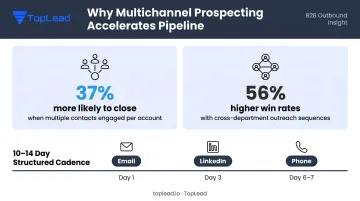
Structured cadences — typically 10–14 days across 3+ channels — maintain consistent presence without aggressive follow-up. Each additional channel adds urgency and familiarity, which accelerates the prospect's decision to engage.
This matters because slow early-stage cycles are expensive. Every extra week a deal spends in the pipeline consumes SDR time, management bandwidth, and marketing budget. Salesforce's 2026 data shows 57% of sales professionals say sales cycles are getting longer. Faster early engagement has gone from a nice-to-have to a real competitive edge.
Multichannel outreach also improves account coverage. Outreach's 2024 research found that engaging more than one contact at an account makes a deal 37% more likely to close, and cross-department multithreading improves win rates by 56%.
KPIs directly impacted:
- Time-to-first-response
- Time-to-booked-meeting
- Pipeline velocity (pipeline value ÷ sales cycle length)
- SDR productivity: meetings booked per rep per month
In complex B2B sales with multiple stakeholders, the multithreading data above is particularly relevant. The more decision-makers involved, the faster interest fades without sustained multi-channel momentum across the buying committee.
Lower Cost Per Qualified Lead and Measurable ROI
Multichannel prospecting requires more coordination than single-channel outreach, but it produces a lower cost per qualified meeting over time. Response rate improvements and shorter cycles reduce the total effort required to generate each appointment.
The ROI math is direct. If single-channel outreach books 2 meetings per 100 contacts and multichannel books 6, the cost per meeting drops by roughly two-thirds — using the same contact list and the same SDR time.
Beyond per-meeting cost, multichannel prospecting makes ROI predictable. When channels, sequences, and cadences are fixed, teams can model expected meetings per month, cost per pipeline dollar generated, and revenue attribution per channel. A scalable prospecting system produces those numbers consistently; a one-off campaign doesn't.
For cost benchmarking: TopLead's US-based pay-per-appointment model — coordinated email, LinkedIn, and phone outreach delivering verified decision-maker meetings — targets $300–$350 per qualified appointment. That figure is worth knowing before deciding whether to build multichannel prospecting in-house or partner with a specialized outreach provider.
KPIs directly impacted:
- Cost per qualified lead (CPL)
- Cost per booked meeting
- Customer acquisition cost (CAC)
- Channel ROI: revenue per dollar spent per channel
- Lead-to-opportunity conversion rate
For businesses scaling their SDR function, quantifying cost per meeting clarifies budget allocation, simplifies performance benchmarking, and turns the build-vs.-outsource decision into a numbers exercise rather than a gut call.
What Happens When Multichannel Prospecting Is Missing
Single-channel dependence creates one predictable problem: when that channel underperforms, the pipeline collapses. There's no alternative path to a meeting while email deliverability recovers or call connect rates bounce back.
The typical response — compensating with volume — makes the problem worse:
- Costs per contact climb as more outreach chases the same number of conversations
- SDR burnout accelerates when activity increases but results keep declining
- List fatigue and low personalization compound the problem over each subsequent cycle
The damage extends beyond pipeline volume. RAIN Group's research shows 82% of buyers review a seller's LinkedIn profile before deciding to accept a meeting. A prospect who encounters your brand once through a cold email — and never again — has no context and no reason to prioritize your outreach when they're ready to buy.
That buying window doesn't stay open. When prospects are ready to move, they call the name they recognize — and consistent multi-touchpoint presence is what builds that recognition before the conversation ever starts.
How to Get the Most Value from Multichannel Prospecting
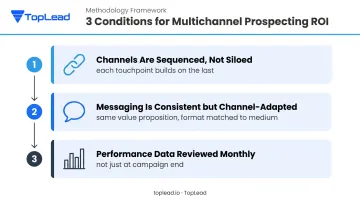
Multichannel prospecting delivers maximum ROI when three conditions are met:
- Channels are sequenced, not siloed — each touchpoint builds on the last rather than operating independently
- Messaging is consistent but channel-adapted — the core value proposition stays the same; the format and tone match the medium
- Performance data is reviewed monthly — not just at campaign end, when it's too late to adjust
The Build vs. Integrate Decision
For companies without a dedicated SDR function, the setup costs alone can stall a program before it gains traction. Building in-house requires:
- Sequencing tools and CRM integration
- List-building infrastructure
- SDR hiring and ramp time
- Ongoing performance management
For businesses that want multichannel outcomes without that overhead, outsourcing to a managed provider is a faster path to ROI. TopLead's U.S.-based SDR teams run coordinated email, LinkedIn, and phone outreach, delivering verified decision-maker appointments directly onto client calendars — with no long-term contract and a reschedule/replacement guarantee.
The Compounding Effect Is Real
TopLead's campaign data reflects a pattern consistent across B2B prospecting programs: month one focuses on launch and early traction. Months two through six show progressively sharper targeting, refined messaging, and stronger conversion quality.
A campaign evaluated only at week three looks nothing like the same campaign at month four. Teams that review channel performance monthly and act on the data see each cycle outperform the last. Over a 3–6 month lifecycle, that compounding turns a one-time outreach push into a functioning, self-improving pipeline system.
Conclusion
The real value of multichannel prospecting is operational and measurable. Three outcomes drive that value:
- Higher response rates — layered visibility breaks through where single-touch outreach fails
- Shorter sales cycles — removing single points of delay keeps prospects moving forward
- Lower cost per qualified meeting — higher conversion rates spread fixed costs across more outcomes
None of those gains come from adding channels randomly. They come from sequencing channels deliberately, maintaining consistent messaging, and treating performance data as an ongoing input — not a post-campaign report.
Multichannel prospecting is a pipeline infrastructure decision. Teams that run it as a continuously optimized system generate more qualified meetings at lower cost over time — and that's what scalable revenue growth actually looks like.
Frequently Asked Questions
What is multichannel prospecting?
Multichannel prospecting is a coordinated outreach strategy that uses multiple channels — email, phone, LinkedIn, and others — in structured sequences to reach decision-makers across the touchpoints they actively use. Repeated exposure across channels builds recognition before a cold call or email ever asks for a meeting.
How effective is multichannel prospecting?
Multichannel prospecting consistently outperforms single-channel approaches on response rates, meetings booked, and cost per qualified lead. Salesloft's analysis of 200M+ sales interactions found that email-only response rates were 77% lower and call-only rates were 91% lower than multichannel benchmarks.
Which prospecting method is the most effective and why?
Multichannel prospecting outperforms every single-channel method because it meets prospects where they are, builds familiarity across touchpoints, and keeps momentum going when one channel underperforms. That resilience — across algorithm changes, deliverability drops, or platform shifts — is what makes it the default choice for serious B2B teams.
What is a good ROI for multichannel prospecting?
ROI varies by industry and deal size, but a well-optimized multichannel program typically targets a cost per qualified meeting in the $250–$400 range for B2B. The clearest ROI signal is a declining cost per meeting over time paired with an increasing meeting-to-opportunity conversion rate — meaning the system is compounding, not just running.
How many channels should you use for B2B prospecting?
Most B2B teams get the best results from 3–4 channels: email, LinkedIn, and phone as the core, with video or SMS as optional supplements. Adding more channels only improves results when each is used with intention inside a structured cadence. Without sequencing, more channels just add noise.
How do you measure the ROI of multichannel prospecting?
Track these metrics consistently over time: cost per qualified meeting, meetings booked per 100 contacts, time-to-first-response, lead-to-opportunity conversion rate, and channel-specific response rates. The goal is to identify which channel combinations drive the most pipeline value and optimize sequences around what's working.