Introduction
Your pipeline is stalling. Deals are slower than they should be, your AEs have time on their hands, and the question on every sales leader's desk is the same: do we hire internally or bring in an agency?
It's not a simple call. B2B sales cycles averaged 10.1 months in 2025 according to 6sense, and the average buying group now involves 11 people. That complexity means a bad resourcing decision doesn't just hurt this quarter; it can delay meaningful revenue by six months to a year while you course-correct.
This guide breaks down the real cost, speed, and fit of each model across four dimensions: upfront cost, time-to-pipeline, scalability, and control. By the end, you'll have a clear picture of which model fits your growth stage and where each one tends to drain budget unexpectedly.
Key Takeaways
- Agencies deliver first qualified meetings in weeks (TopLead clients typically see appointments within 2–4 weeks); in-house teams take 4–6+ months from decision to consistent pipeline
- The all-in Year 1 cost of a single in-house SDR exceeds $109,000 in labor — not counting tech stack or management overhead
- In-house teams win on long-term brand alignment, but only after 18–24 months of sustained investment
- A hybrid model (agency-driven pipeline + one internal manager absorbing the playbook) is the most common winning path for mid-market B2B companies
- The right choice depends on your pipeline urgency, current ARR, and whether you can afford to wait
Agency vs. In-House: Quick Comparison
| Dimension | B2B Lead Gen Agency | In-House SDR Team |
|---|---|---|
| Year 1 Cost | ~$2,000–$5,000/month retainer, or ~$300–$350 per appointment (pay-per-appointment) | $109,000+ per SDR in labor alone — 2–3 SDRs runs $220K–$330K before tools or management overhead |
| Speed to First Meeting | 2–4 weeks from campaign launch | 4–6+ months (hiring + onboarding + ramp time) |
| Scalability | Adjust scope month-to-month with no headcount risk | Headcount-bound; scaling up or down requires recruiting cycles |
| Specialization | Pre-built outreach infrastructure and multi-channel execution ready from day one | Generalist hires requiring extensive training and tool setup |
| Control & Brand Alignment | Requires clear messaging frameworks upfront; strong agencies integrate directly with your CRM | Full oversight, faster internal feedback, deeper brand immersion over time |
What Is a B2B Lead Generation Agency?
A B2B lead generation agency is an external team that handles prospecting, outreach, qualification, and appointment setting — delivering sales-ready meetings directly to your closers without requiring you to hire, train, or manage SDR headcount.
The operational model differs significantly from older "contact list" vendors. Modern agencies bring:
- Pre-built, verified contact databases updated continuously (B2B data decays at roughly 22.5% per year, making list freshness a real operational challenge)
- Multi-channel outreach infrastructure across email, LinkedIn, and phone
- Experienced SDR teams ready to launch in weeks, not months
- CRM integration and transparent reporting from campaign launch
How TopLead's Workflow Works in Practice
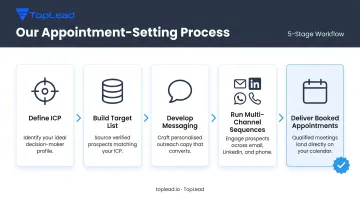
TopLead's onboarding process illustrates what a well-structured agency engagement actually looks like. The workflow runs in five stages:
- Define your ICP — target industry, company size, geography, decision-maker roles, and buying triggers
- Build the target list — manual prospect sourcing and verification against your ICP (no recycled lists)
- Develop messaging — custom scripts and outreach copy tailored to your market and buyer personas
- Run multi-channel sequences — coordinated email, LinkedIn, and phone outreach across 6–8 touchpoints
- Deliver booked appointments — meetings land directly in your calendar (Salesforce, HubSpot, Pipedrive, or Close.io), with qualification notes attached
Before any appointment is confirmed, every prospect clears a four-part verification check: decision-making authority (HR director, CFO, business owner), ICP fit, genuine interest, and willingness to take the meeting. That filter is what your closers actually receive — not a raw list of names.
Pricing Models and Risk Allocation
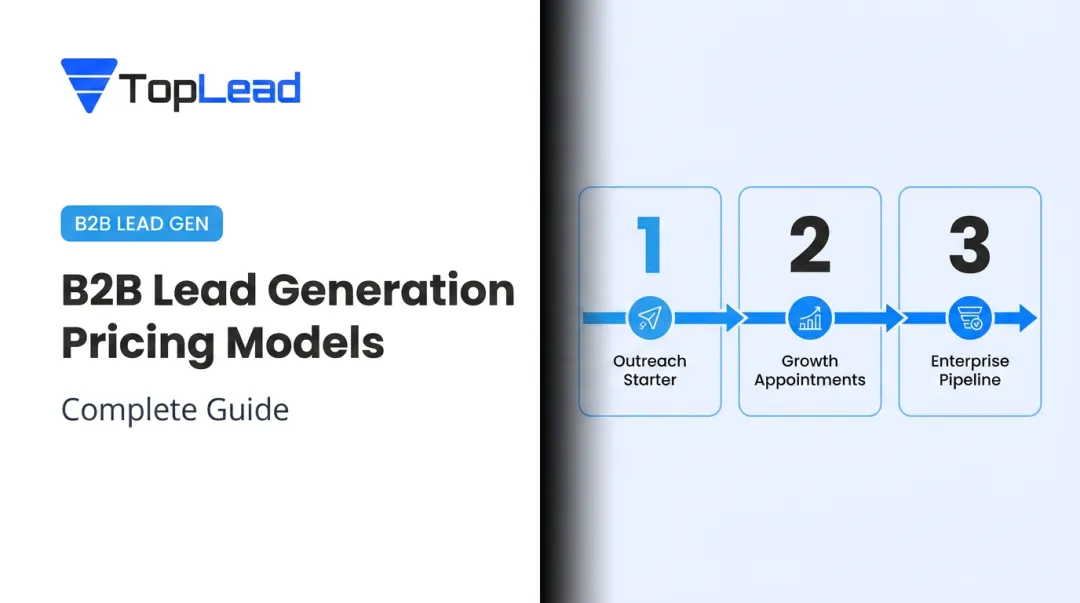
Agency pricing falls into three structures:
- Retainer-based — typically $2,000–$5,000/month; client carries performance risk
- Pay-per-appointment — client pays only for confirmed meetings (TopLead's model, averaging $300–$350 per appointment); agency carries performance risk
- Hybrid — base fee plus per-meeting incentives
The pay-per-appointment structure matters because it shifts performance risk to the agency. If an agency doesn't book meetings, they don't get paid. TopLead backs this with a reschedule/replacement guarantee: if a confirmed prospect cancels or no-shows, the appointment is replaced at no additional cost.
Best Fit for an Agency
Agencies are the stronger choice when:
- Qualified pipeline is needed within 60–90 days
- You're entering a new vertical or geography without an existing outbound playbook
- Your AE team is ready to close but starved for top-of-funnel activity
- Past in-house SDR builds have produced recurring attrition or inconsistent output
- Your business lacks the bandwidth to hire, manage, and coach a dedicated internal SDR team
What Is an In-House B2B Lead Generation Team?
An in-house B2B lead generation team — typically SDRs, BDRs, or a combined SDR/marketing function in an American company — handles prospecting and qualification internally before passing leads to account executives. You control the messaging, tools, performance management, and data.
The Real All-In Cost
Most companies anchor on base salary when budgeting in-house. That underestimates the true number — often by 40–50% or more.
Using verified data from RepVue's 8,720 SDR compensation submissions and BLS employer cost data:
- Median US SDR base salary: $60,000
- Median SDR OTE: $85,000
- Benefits load (BLS: 32.8% on base salary): ~$19,700
- Recruiting cost (LinkedIn 2024 benchmark): ~$4,700
- Year 1 labor floor per SDR: ~$109,400
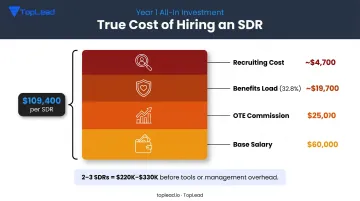
For a team of two to three SDRs, you're looking at $220,000–$330,000 in labor alone before technology (sales engagement platform, data provider, dialer, CRM seats) or management overhead.
The Ramp Time Problem
According to Bridge Group's 2023 SDR Metrics Report — based on 365 executives surveyed — the average SDR ramp time is 3.2 months. During that window, you're paying full salary for partial output.
Average SDR tenure runs approximately 15 months. That means the ramp-cost cycle repeats roughly every year and a quarter — and each replacement triggers another $4,700 in recruiting fees plus months of reduced output.
Where In-House Teams Win
The cost picture is real, but it doesn't tell the whole story. In-house teams offer real structural advantages — particularly for companies that have already validated their outbound motion:
- Brand immersion — internal SDRs absorb product knowledge, objection handling, and company culture in ways agency reps simply can't replicate at the same depth
- Faster feedback loops — messaging changes, product updates, and competitive intel travel instantly within an internal team
- Data ownership — all prospect history, sequences, and institutional knowledge stays inside the organization
- Long-term unit economics — once a tenured team is fully ramped, cost per qualified meeting can drop below agency retainer costs
Best Fit for In-House
In-house is the stronger choice when:
- You're at $10M+ ARR with the financial runway to sustain an 18–24 month build
- You have existing RevOps infrastructure and management capacity
- Your outbound messaging and sequences are already validated (ideally through a prior agency engagement)
- Your product requires deep domain expertise that would take an agency many months to absorb
Agency vs. In-House: Which Model Wins for B2B Lead Generation?
There's no universal answer — the right model depends on four factors:
- Pipeline urgency — how fast do you need qualified meetings on the calendar?
- Growth stage and ARR — can you absorb 18–24 months of build costs before favorable unit economics kick in?
- Internal capabilities — do you have RevOps infrastructure and a manager who can run an SDR team?
- Domain complexity — does your product require months of immersion before a rep can represent it credibly?
Making the Decision
Choose an agency if:
- You need pipeline in the next 60–90 days
- You're entering a new market or vertical without an existing outbound playbook
- Your AEs have capacity to close but no qualified meetings to close
Choose in-house if:
- You're at scale, with validated messaging and sequences already proven through testing
- You have management bandwidth and RevOps infrastructure to support a team
- You can sustain the 18–24 month investment before realizing strong unit economics
The Hybrid Path
For most mid-market B2B companies, the most practical path runs through both:
- Launch an agency engagement to generate immediate pipeline
- Hire one internal SDR manager to absorb the playbook and track what resonates
- Gradually build an in-house function as revenue scales and messaging is validated
This approach solves the core tension: you don't sacrifice speed while waiting to build internal capacity, and you're not flying blind when it's time to hire internally because you have validated data on what actually works.
TopLead's pay-per-appointment structure fits naturally into this approach. Clients get a tested outbound playbook and real performance data before making any permanent headcount decisions. With over 15 years in B2B lead generation and 25,000+ appointments delivered for clients including Edward Jones, Aflac, and Wells Fargo Advisors, TopLead guarantees a minimum of 4–6 qualified leads per month — with a reschedule/replacement guarantee, no retainer, and no long-term contract.
See what a performance-based appointment-setting program could add to your pipeline. Talk to TopLead today.
Conclusion
Neither model wins unconditionally. Agencies win on speed and Year 1 cost efficiency — especially when pipeline urgency is high and the internal team doesn't yet exist. In-house wins on long-term control and brand depth, but requires sustained investment most early-stage companies can't afford without slowing growth.
The companies that build pipeline fastest aren't necessarily the ones with the largest internal headcount. They're the ones that pick the right model for where they are right now — and stay willing to reassess as they grow. If you're at a stage where speed matters more than control, an agency partnership like TopLead's pay-per-appointment model lets you generate qualified meetings without the overhead or hiring timeline of an in-house team.
Frequently Asked Questions
Are B2B lead generation agencies or in-house teams better?
It depends on where you are in your growth. Agencies are better for speed and Year 1 cost efficiency; in-house is better for long-term scale once messaging is validated and you have the runway to sustain the build. Most mid-market companies use both in combination.
How much do B2B lead generation agencies cost?
Retainer-based agencies typically run $2,000–$5,000 per month. Pay-per-appointment models — like TopLead's — average $300–$350 per confirmed meeting, with the fee covering SDR labor, list building, outreach execution, CRM integration, and a reschedule/replacement guarantee. There are no additional charges for no-shows.
What is the typical ramp-up time for an in-house B2B lead generation team?
According to Bridge Group's 2023 SDR Metrics Report, average SDR ramp time is 3.2 months. Factoring in hiring time, the full pipeline impact of an in-house build typically isn't felt until 6–12 months after the decision to build, and often longer.
Can a B2B company use both an agency and an in-house team at the same time?
Yes, and it's a common and effective approach. Running an agency engagement generates immediate pipeline while an internal manager absorbs the outbound playbook. Over time, the internal team scales as revenue supports it — without the guesswork of building from scratch.
What should I look for when choosing a B2B lead generation agency?
Prioritize verified client reviews (not just curated testimonials), industry-specific case studies, and clear transparency around team structure and reporting. Also confirm:
- What's included in the fee (labor, list building, reporting, guarantees)
- How decision-maker verification works
- Whether pricing is performance-based or a flat retainer regardless of results