The channel you lead with — or whether you combine both — directly affects pipeline velocity, appointment quality, and cost per lead. This matters especially in competitive industries like financial services, insurance, and PEO/HR, where the nature of the sale makes channel selection genuinely consequential.
This guide breaks down how each channel works, where each performs best, and how to sequence them for maximum impact.
Key Takeaways
- Cold email scales easily for top-of-funnel awareness, but generic B2B outreach averages just 5–6% reply rates
- Phone outreach enables real-time qualification and immediate rapport, though connect rates hinge on rep skill and list quality
- Multi-channel sequences combining email, phone, and LinkedIn generate 2x higher response rates than email-only approaches
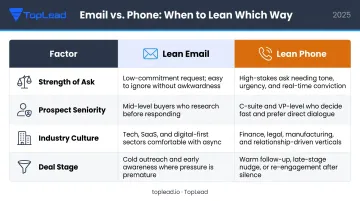
- Channel choice hinges on four factors: ask strength, prospect seniority, industry buying culture, and deal stage
- Neither channel wins in isolation. The strongest outreach programs sequence both.
Cold Email vs Cold Calling: Quick Comparison
Here's how the two channels compare across six key dimensions:
| Dimension | Cold Email | Cold Calling |
|---|---|---|
| Scalability | High — hundreds of prospects simultaneously | Low — one conversation at a time |
| Personalization | Moderate — firmographic data, but no live reading of tone | High — real-time adaptation |
| Response Rate | 1–6% average; up to 17% with advanced personalization | 5–13% connect rate depending on rep skill |
| Qualification Speed | Slow — async back-and-forth | Fast — qualify in a single call |
| Cost per Contact | Low — minimal time per outreach | High — significant time per dial |
| Best Use Case | Top-of-funnel awareness, nurturing, message testing | High-value prospects, re-engagement, strong asks |
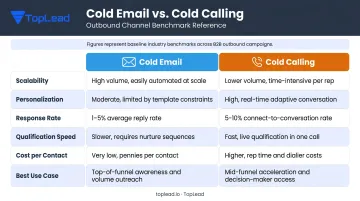
One caveat: these benchmarks shift considerably based on ICP fit, message quality, and how well the channels are sequenced together. Use them as a baseline, then adjust based on what your specific market and buyer profile actually produce.
What Is Cold Email?
In a B2B context, cold email is a targeted, research-backed outreach message sent to a prospect who has had no prior contact with your company. The key distinction from spam or bulk marketing is intent and targeting — a well-crafted cold email treats the recipient as an individual, not a record in a database.
Core Advantages
Used well, cold email offers four structural advantages over most other outbound channels:
- Reaches hundreds of prospects per day, with sequences running automatically
- Lets prospects respond when convenient — lower friction early in the funnel
- Enables A/B testing of subject lines, value props, and CTAs before full rollout
- Generates behavioral data (opens, clicks, replies) that sharpens follow-up strategy
Honest Limitations
The numbers here matter. Belkins' 2025 study of 16.5 million B2B emails found average reply rates dropped to 5.8% in 2024, down from 6.8% the prior year. Emailing 10+ contacts at the same company pulled that number down to 3.8%. Woodpecker's research on 20 million+ cold emails shows advanced personalization can push response rates to 17%, compared to 7% without it — but most campaigns don't hit that ceiling.
Other real limitations include:
- Inbox deliverability challenges — spam filters and domain reputation require ongoing management
- Sender infrastructure takes time to build and warm up properly
- No immediate feedback loop — you can't handle objections in the moment
CAN-SPAM Compliance
Cold email isn't a regulation-free zone in the United States. The FTC's CAN-SPAM Act applies to all commercial emails — including individual B2B prospecting — with no carve-out for business-to-business outreach.
Core requirements include:
- Accurate sender information and non-deceptive subject lines
- A physical postal address in every message
- A working opt-out mechanism honored within 10 business days
Violations can trigger penalties of up to $53,088 per email. For cross-border campaigns, GDPR and CASL layer additional consent and data-handling obligations on top.
Best-Fit Use Cases for Cold Email
Cold email tends to perform best when:
- You're running top-of-funnel awareness outreach across a large prospect list
- You're testing new messaging before committing to a full campaign
- You're nurturing prospects who showed intent signals (pricing page visit, content download) but haven't responded to a call
- Your buyer persona is tech-savvy — SaaS, marketing, startup buyers who check email regularly and prefer a low-pressure entry point
What Is Cold Calling?
Cold calling is a direct, real-time phone call to a prospect with no prior relationship — designed to open a conversation, qualify interest, and move toward a meeting within a single interaction. That synchronous format is what gives it power — and what makes it demanding.
Core Advantages
- Conveys tone, conviction, and empathy in ways email can't replicate
- Qualifies prospects on the spot — no waiting for a reply
- Addresses objections as they surface, not in a follow-up three days later
- Creates conversational momentum that written outreach rarely matches
Gong's analysis of 300 million+ cold calls found that top-quartile reps connect with 13.3% of prospects and book 18 meetings per month — compared to just 2 meetings for average reps. The variance is large, which means list quality, timing, and rep skill determine whether phone outreach scales.
Honest Limitations
- Hard to scale — even productive reps handle one conversation at a time; HubSpot's 2025 survey found that among daily cold callers, 30% make 20–50 calls per week
- Reach friction — Gong's data shows average reps need 19 calls to generate one conversation, while top-quartile reps need 8
- Skill-dependent — handling rejection, navigating gatekeepers, and maintaining energy across a full day of dials requires experienced reps
- Higher cost per contact than email due to time investment per attempt
Those limitations don't disqualify calling — they just define where it's worth deploying. Cold calling tends to outperform email when:
Best-Fit Use Cases for Cold Calling
- You're targeting C-suite or senior decision-makers who rarely respond to unsolicited email
- The deal size justifies the time investment per call attempt
- A prospect has gone dark after an email sequence — a call re-engages differently
- You need to make a strong ask: requesting a meeting, demo, or referral
- You're working in financial services, insurance, PEO/HR, or professional services — industries where trust and personal relationships drive buying decisions
This last point is where much of TopLead's experience lives. Across 25,000+ appointments arranged for clients in financial services, insurance, and PEO/HR, the pattern holds: buyers in these verticals want a conversation before they'll consider a meeting. A cold email can open the door — but a phone call is usually what gets someone to walk through it.
Cold Email vs Cold Calling: Which Should You Choose?
Framing this as a binary choice is the wrong starting point. The better question is: which channel do you lead with, and how do you sequence the other behind it?
Four Factors That Drive the Decision
| Factor | Lean Email | Lean Phone |
|---|---|---|
| Strength of ask | Low-commitment (share a resource, gauge interest) | High-commitment (request a meeting with a decision-maker) |
| Prospect seniority | Mid-level influencers, operational buyers | C-suite, senior executives, owners |
| Industry culture | SaaS, marketing, startups | Financial services, insurance, PEO, professional services |
| Deal stage | Early awareness, nurturing | Re-engagement, qualification, closing |
The Multi-Channel Case
Neither channel consistently outperforms the other in isolation, but sequencing both together produces a measurable lift. Outreach's 2025 sequence data found coordinated email, phone, LinkedIn, and video sequences see 2x higher response rates than email-only approaches. That same research showed multi-channel sequences generated a 7% response rate versus 5% for email-only.
Gong's data adds another angle: leaving a voicemail alongside email outreach increased email reply rates from 2.73% to 5.87% — more than doubling email response just by adding a phone touch, even without a live connection.
A typical high-performing sequence runs:
- Email — introduces context and value, low pressure
- Call — references the email, attempts live connection or leaves a voicemail
- Follow-up email — acknowledges the call attempt, re-states the ask concisely
- LinkedIn touch — adds a human layer and builds familiarity
That sequencing logic — each channel reinforcing the last rather than starting from scratch — is what separates high-performing outreach from spray-and-pray tactics. TopLead's campaigns, for instance, run 6–8 coordinated touchpoints across email, phone, and LinkedIn, and this approach has proven particularly effective in financial services and insurance, where prospects typically require multiple exposures before agreeing to a meeting.
When to Bring In Outside Help
Building and running a coordinated multi-channel outreach program in-house is resource-intensive. It requires a strong ICP, warmed sender infrastructure, trained SDRs, and a sequencing strategy that holds up over a 3–6 month campaign.
For teams that don't have the bandwidth to manage all of that, a specialized U.S.-based appointment-setting partner can handle the execution while the internal team focuses on closing.
TopLead's embedded SDR model is structured to reduce that risk: clients pay $300–$350 per qualified appointment with a reschedule or replacement guarantee, and there are no long-term contracts to lock into. TopLead's reps work under the client's brand, managing the full sequence from ICP development through calendar booking and CRM integration — so the internal team inherits a booked meeting, not a half-run outreach program.
Conclusion
Cold email wins on scale and cost efficiency. Cold calling wins on speed to qualification and relationship depth. Neither is universally superior — the strongest outbound programs use both, sequenced deliberately.
The practical answer is sequencing. Lead with the channel that matches your ask and your buyer, then layer in the other to increase touchpoints and reinforce the message. For industries like financial services, insurance, and PEO/HR, phone remains the critical conversion channel — but email and LinkedIn create the context that makes that call more likely to land.
For B2B teams that want that sequencing executed without rebuilding their outreach infrastructure, TopLead runs managed outbound programs that handle ICP development, multi-channel outreach, and prospect qualification end to end. With over 25,000 qualified appointments arranged across the U.S. — for clients including Edward Jones, Aflac, Wells Fargo Advisors, and LPL Financial — the pay-per-appointment model keeps accountability clear and ties results directly to meetings on your calendar.
Frequently Asked Questions
What is the difference between email prospecting and cold calling?
Email prospecting is written and asynchronous — your prospect reads and responds on their own schedule. Cold calling is real-time and synchronous — you're in a live conversation that can qualify or advance a deal in minutes. The core difference is immediacy, scalability, and the nature of the interaction.
Is cold calling or cold emailing more effective for B2B sales?
Neither is universally superior. Cold calling tends to be stronger for high-value, relationship-driven deals and senior decision-makers. Cold email excels for broad top-of-funnel outreach, nurturing, and message testing. Effectiveness depends on your ICP, your offer's relevance, and the industry you're selling into.
Can you use cold email and cold calling together in a sales sequence?
Yes — and you should. A multi-channel sequence (email → call → follow-up email) consistently outperforms single-channel outreach by giving prospects multiple touchpoints. Outreach's research shows this combination generates 2x higher response rates than email alone.
What is a good response rate for cold email vs cold calling?
For cold email, generic B2B campaigns average 1–6% reply rates; advanced personalization can push that to 17% in targeted campaigns. For cold calling, average reps connect with around 5.4% of prospects; top-quartile reps reach 13.3%. Quality of targeting and personalization significantly impacts both numbers.
Is cold calling still effective in 2026?
Yes. Gong's analysis of 300 million+ cold calls shows top-performing reps book 18 meetings per month through cold calling alone. HubSpot's 2025 survey found 68% of sales organizations still use it — though rep skill and list quality remain the primary drivers of results.
What industries respond better to cold calling vs cold email?
Financial services, insurance, PEO/HR, and professional services tend to respond better to cold calling — trust and personal relationships drive buying decisions in these verticals. SaaS, marketing, and startup buyers often prefer the lower-pressure entry point of a well-crafted cold email, particularly at the top of the funnel.