Introduction
Hiring an in-house SDR sounds straightforward until you add up the real numbers. According to Betts Recruiting's 2025 compensation analysis, entry-level SDR base salaries run $55,000–$70,000, with OTE adding another 20–60% on top.
Layer in benefits (29.9% of total compensation per BLS data), a recruiting cost of nearly $4,700 per hire, a 3-month ramp before they hit baseline productivity, and annual attrition of 25–35% — and you're looking at a significant, recurring investment before a single qualified meeting lands on your calendar.
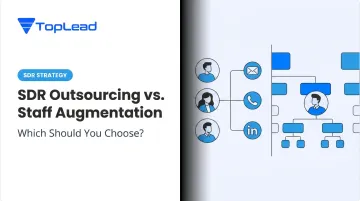
That's why B2B sales leaders increasingly evaluate two alternatives: SDR outsourcing (contracting an agency to run the function end-to-end) and SDR staff augmentation (embedding external SDR talent directly under your management).
Both models address the same capacity problem — but through fundamentally different approaches, with different tradeoffs on cost, control, and speed.
This article breaks down how each model works, compares them across cost, control, and flexibility, and gives you a clear framework for choosing based on your company's current stage, resources, and growth goals.
Key Takeaways
- SDR outsourcing: A third-party agency recruits, trains, and manages its own reps — you define targets and success criteria; they own execution.
- Staff augmentation: External SDR talent embeds into your team, follows your playbook, and reports to your sales lead — you retain full strategic and day-to-day control.
- Outsourcing fits best when your ICP is validated, messaging is proven, and you need pipeline results without adding management overhead to your team.
- Augmentation fits best when your sales motion is still evolving, your product requires discovery-led selling, or you want to build internal knowledge rather than permanently outsource it.
- The right call depends on your sales maturity, leadership bandwidth, and how much control you want to retain over execution.
SDR Outsourcing vs. Staff Augmentation: Quick Comparison
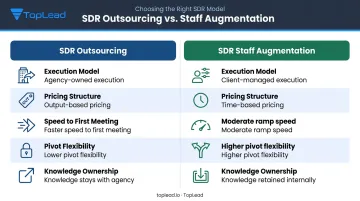
| Dimension | SDR Outsourcing | SDR Staff Augmentation |
|---|---|---|
| Management Control | Agency owns day-to-day execution | Client manages directly |
| Cost Structure | Pay-per-appointment or retainer; tied to outputs | Fractional/contract rate; tied to time |
| Speed to First Meeting | Faster — established infrastructure and playbooks | Moderate — depends on client onboarding |
| Flexibility to Pivot | Lower — scope changes require renegotiation | Higher — messaging adjusts in real time |
| Knowledge Retention | Stays with the agency | Stays inside your organization |
| Best-Fit Scenario | Validated ICP, defined campaign, limited internal management bandwidth | Evolving ICP, complex product, testing before full-time hire |
The core trade-off is straightforward: outsourcing hands off execution in exchange for speed and simplicity; augmentation keeps you in control but puts the management burden on your team. Where you land depends on your current sales infrastructure, ICP clarity, and how much internal bandwidth you can commit.
What Is SDR Outsourcing?
SDR outsourcing means contracting a specialized agency to run outbound prospecting on your behalf. The agency recruits, trains, and manages its own reps. You define the target market and success criteria — they own everything else, from outreach through qualified meeting delivery.
How Outsourced SDR Engagements Work
Most outsourced SDR relationships operate under one of two commercial structures:
- Retainer-based: A fixed monthly fee covers a defined scope of outreach activity, regardless of meetings generated
- Pay-per-appointment: You pay only for confirmed, qualified meetings with verified decision-makers
Upfront, a reputable agency will scope your ICP, target account list, messaging framework, and qualification criteria before a single outreach touchpoint goes out. Ongoing client involvement is typically lighter — campaign review calls, feedback on lead quality, and strategic direction rather than daily management.
Core Benefits
- No recruiting, onboarding, or training burden
- Access to established outreach infrastructure, tooling, and proven playbooks
- Faster time to first meeting compared to building in-house
- Predictable cost tied to outputs rather than headcount
- Immediate access to domain expertise in specific verticals
The Key Limitation
Outsourced SDR teams own the process. That means less day-to-day visibility into messaging and ICP targeting. Scope changes mid-engagement often require renegotiation — which makes it harder to pivot quickly when your go-to-market is still evolving.
When Outsourcing Works Best
- Your ICP is validated and messaging is proven
- You have a specific campaign objective with defined success metrics
- Internal sales leadership lacks bandwidth to manage an SDR function directly
- You're entering a new vertical where a specialist agency already has domain expertise and decision-maker contacts
Use Cases of SDR Outsourcing
TopLead's pay-per-appointment model, run by U.S.-based SDR teams, illustrates how specialized outsourcing differs from generic agency retainers. Clients pay only for confirmed appointments with verified decision-makers, with multi-channel outreach (email, LinkedIn, phone) handled end-to-end — including a reschedule or replacement guarantee if a prospect cancels or no-shows.
The ICP, messaging, qualification criteria, and outreach sequencing are all scoped upfront. The client's sales team receives confirmed, sales-ready meetings with decision-makers who have already been qualified.
Across 15+ years serving American financial services, insurance, PEO, and professional services firms — including Edward Jones, LPL Financial, Aflac, and Insperity — TopLead has arranged more than 25,000 appointments for B2B companies nationwide. That depth of vertical experience means faster ramp time, pre-built decision-maker relationships, and industry-specific messaging that an internal team would need years to develop.

What Is SDR Staff Augmentation?
SDR staff augmentation means bringing in a fractional, part-time, or contract SDR who embeds directly into your team. They work under your management, use your CRM and sequencing tools, follow your playbook, and report to your sales lead or founder.
How It Works Operationally
The embedded SDR participates in team standups, collaborates on handoff criteria with AEs, and adjusts messaging based on live prospect objections. Over time, they accumulate product context and institutional knowledge — which means performance typically improves the longer the engagement runs.
Fractional engagements can start quickly. According to Whistle, fractional SDRs can bypass the 60–90 days typically required to hire a skilled SDR and begin contributing within days, though meaningful pipeline results still take time to develop.
Core Benefits and Best-Fit Scenarios
Staff augmentation works best when you have the internal bandwidth to manage the relationship. When that's in place, the model offers real advantages:
- Retains full control over messaging, ICP targeting, and day-to-day execution
- Allows strategy pivots without renegotiating a vendor scope
- Keeps playbook refinements and institutional knowledge inside your organization
- Reduces hiring risk — evaluate fit and output before committing to a permanent role
One requirement is non-negotiable: augmented SDRs need active internal direction. This model breaks down when there's no dedicated sales leader available to coach, review performance, and set weekly priorities. If leadership bandwidth is already stretched, that oversight burden lands on someone with a full plate.
Use Cases of SDR Staff Augmentation
Staff augmentation fits B2B companies at earlier stages of their outbound motion. It's a strong fit when:
- Messaging needs to flex weekly as you refine your ICP
- The product requires nuanced, consultative outreach that's hard to hand off to a managed service
- A 60–90 day fractional engagement lets you evaluate fit, process, and output before committing to a full-time hire
- Building internal sales capability matters more than offloading operational complexity
Engagement durations range from short 60-day pilots to multi-quarter arrangements, making it a practical bridge between freelance help and a permanent hire.
SDR Outsourcing vs. Staff Augmentation: Which Is Right for Your Business?
Once you understand how each model works, the real question is which one fits your current situation. Three diagnostic questions cut through the noise:
- How validated is your ICP and messaging?
- Do you have internal bandwidth to manage an embedded SDR?
- Are you running a defined campaign or building a long-term repeatable motion?
Choose SDR Outsourcing If:
- Your ICP is validated and messaging has been tested in the field
- A specific campaign objective exists with defined success metrics
- Internal sales leadership can't absorb SDR management overhead
- You're targeting a complex B2B vertical where a specialist agency already has domain expertise, decision-maker contacts, and proven playbooks
- HubSpot notes that ACV below $1,000 typically can't sustain outsourced SDR economics — if your ACV is well above that threshold, outsourcing becomes economically viable
Choose Staff Augmentation If:
- Your ICP is still evolving and messaging requires real-time adjustment
- Discovery-led selling is required — something that can't be scripted upfront
- You want to build institutional sales knowledge internally
- You're testing whether a full-time SDR hire makes sense before committing to headcount
Cost Framework
Here's how the cost drivers compare across all three models:
| Model | Cost Components | Key Risk |
|---|---|---|
| In-House SDR | $55K–$75K base + 20–60% OTE + 29.9% benefits + ~$4,700 recruiting + 3-month ramp loss | Attrition (25–35% annually) restarts the entire cycle |
| Outsourced SDR Agency | Retainer or pay-per-appointment (e.g., $300–$350/meeting at TopLead's benchmark) | Scope changes require renegotiation; less pivot flexibility |
| Fractional/Augmented SDR | Contract rate — falls between a pure agency retainer and a fully loaded in-house hire | Requires active management; limited knowledge if rep exits |
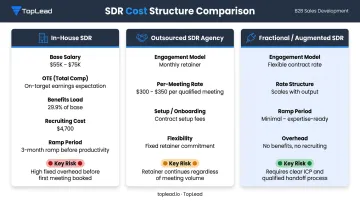
No single model is cheapest in isolation. The right comparison is cost per qualified meeting, accounting for ramp time, attrition, and actual pipeline generated.
The Hybrid Approach
Some B2B companies sequence the models deliberately: use outsourced SDR to validate ICP and outbound messaging quickly, then transition to staff augmentation or in-house hiring once the motion is proven. This way, you're not committing to internal headcount before you know what works.
Real-World Example: Financial Services Outsourcing
Consider a mid-sized financial services firm — an RIA or independent insurance broker — trying to reach HR directors, CFOs, and business owners with a complex value proposition. Their internal team generated referrals but had no systematic outbound motion.
Cold outreach got filtered by gatekeepers, meetings were inconsistent, and pipeline was unpredictable quarter over quarter.
The challenge wasn't effort. It was access and infrastructure. Reaching the right decision-makers in financial services and insurance requires verified contact data, outreach compliant with US regulations like the TCPA and the National Do Not Call Registry, and messaging that speaks to specific pain points (operational efficiency, cost reduction, risk management) not generic sales scripts.
Working with an outsourced SDR specialist with established domain expertise in that vertical addresses all three gaps at once. The agency brings existing decision-maker contact data, proven multi-channel outreach sequences, and industry-specific messaging — no internal build-out required.
The conditions that made outsourcing the right call:
- Defined ICP (HR directors, CFOs, and business owners at companies with 50–500 employees)
- Complex B2B vertical requiring domain-specific messaging
- No internal SDR management capacity
- Specific campaign objective: generate qualified decision-maker appointments within a 90-day window
TopLead has served companies like Edward Jones, LPL Financial, Aflac, and Insperity in this capacity, handling end-to-end outreach, decision-maker verification, and appointment delivery across financial services and insurance.
The 25,000+ appointments arranged across these engagements reflect what's possible when domain expertise, contact access, and outreach infrastructure are already in place.
If your situation mirrors this — needing qualified decision-maker appointments without building an internal SDR function from scratch — TopLead's pay-per-appointment model offers a direct path to predictable pipeline. You pay for confirmed meetings, not activity.
Conclusion
There's no universal winner between SDR outsourcing and staff augmentation. The logic is simpler than the debate suggests:
Outsourcing fits when your sales motion is already proven. Your ICP is defined, your messaging converts, and you need pipeline without adding management overhead.
Augmentation fits when your motion is still being shaped. You need the flexibility to pivot, build institutional knowledge, and adjust without renegotiating vendor scope every quarter.
Choosing the wrong model at the wrong stage is costly. A company with an unvalidated ICP that outsources will likely burn through budget before finding a message that works.
The reverse is equally expensive. A company with proven messaging that hires augmented SDRs ends up spending leadership time managing a function they could have outsourced entirely.
Evaluate where you actually are today, not where you plan to be in six months. That answer will point you to the right model.
Frequently Asked Questions
What is SDR outsourcing?
SDR outsourcing means contracting a specialized agency to run outbound prospecting on your behalf. The agency recruits, trains, and manages its own reps, owns the outreach process, and delivers meetings or qualified leads as output — while you define target markets and success criteria.
Is staff augmentation considered outsourcing?
Staff augmentation is a form of outsourcing, but a distinct one. In traditional outsourcing, the vendor owns delivery end-to-end. With staff augmentation, external talent embeds into your team under your direct management, so you retain control over process, tools, and daily execution.
What are the types of outsourcing relevant to sales?
SDR outsourcing typically falls under business process outsourcing (BPO) or professional services outsourcing. BPO applies when a provider owns a managed function end-to-end; professional services outsourcing applies when the focus is specialized sales expertise rather than a fully delegated process.
When should a B2B company choose SDR outsourcing over staff augmentation?
SDR outsourcing fits best when your ICP is validated, messaging is proven, and the goal is generating meetings without adding internal management overhead. It's especially effective for B2B companies targeting complex verticals where a specialist agency already has domain expertise.
How much does SDR outsourcing cost compared to staff augmentation?
Outsourced SDR costs vary by model: pay-per-appointment pricing benchmarks around $300–$350 per qualified meeting, while agency retainers can start around $9,950 per month. Augmented SDR contract rates typically fall between an agency retainer and a fully loaded in-house hire, which carries $55K–$75K base plus benefits, recruiting, and ramp costs.
Can a company switch from SDR outsourcing to staff augmentation later?
Yes — many B2B companies use outsourcing to validate their outbound motion and ICP, then transition to staff augmentation or in-house SDR hiring once messaging and targeting are proven. Sequencing the two models this way reduces risk at each stage and avoids committing to internal headcount before you know what works.