Introduction
Your American account executives are talented closers. So why are they spending afternoons on demo calls with procurement assistants who have no budget authority, no defined pain, and no timeline to buy?
The pipeline upstream is broken. And for most SaaS companies, the culprit is appointment setting that treats every booked meeting as a win regardless of quality.
According to G2's 2024 Buyer Behavior Report, 49% of B2B software buyers take four or more months to decide on purchases over $20,000, and 69% prefer to engage a salesperson only after they've already made their decision.
By the time a prospect agrees to a demo, they've likely already evaluated competitors. Putting the wrong person in that seat doesn't just waste the call — it hands the deal to whoever qualified their pipeline better.
This playbook covers what SaaS teams actually need: ICP definition, multi-channel outreach cadences, qualification standards, and the in-house vs. outsourced decision — built specifically for how SaaS buyers behave.
Key Takeaways
- SaaS appointment setting requires persona-specific outreach, not generic cold email blasts
- ICP definition must include technographics, growth signals, and buying triggers alongside job titles
- Multi-channel cadences (email + LinkedIn + phone) outperform single-channel outreach
- Qualify for authority, need, and timing before any meeting hits an AE's calendar
- Track meeting-to-opportunity conversion, not raw meetings booked
What Makes B2B Appointment Setting Different for SaaS Companies
In most B2B verticals, appointment setting means getting a decision-maker on the phone. In SaaS, it's more complicated.
A qualified SaaS appointment requires all four of the following — and most outbound programs only verify one or two:
- The contact has decision-making authority or direct influence
- The company fits your ICP
- A relevant problem exists
- The prospect is aware enough of that problem to have a productive conversation
The Multi-Stakeholder Reality
Gartner's 2025 research of 632 B2B buyers found that buying groups range from 5 to 16 people across as many as 4 functions, with 74% of buyer teams showing unhealthy conflict during the decision process. For SaaS, that typically means:
- An economic buyer (CFO or VP Finance) focused on ROI and total cost
- A technical evaluator (CTO, IT Director, or developer) concerned with security and integration
- An end-user champion (department head or ops manager) who owns day-to-day workflow
- A procurement gatekeeper in enterprise deals
Appointment setting that targets only one persona without understanding the committee structure will book meetings — but rarely create opportunities.
Lead Generation vs. Appointment Setting
Lead generation fills the top of the funnel with contacts. Appointment setting converts qualified intent into a scheduled conversation. Confusing the two is how SaaS teams end up with a full pipeline and no revenue.
A contact list gives you targets. Appointment setting engages those targets, verifies their fit, and delivers a confirmed meeting with someone who has the authority, the awareness, and a problem your product solves.
Step 1: Define Your SaaS ICP and Target the Right Decision-Makers
Most SaaS appointment setting fails before the first email is sent. Teams target job titles instead of buyer situations.
A "VP of Operations" at a 15-person seed-stage startup and a "VP of Operations" at a 500-person Series C company have different budgets, different problems, different procurement processes, and different tolerance for switching costs. Treating them the same wastes outreach on prospects who will never convert.
The ICP Dimensions That Actually Matter
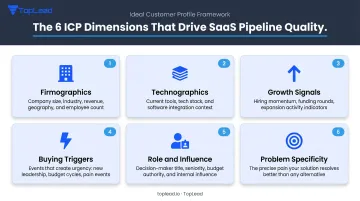
Before any outreach begins, SaaS teams need clarity on six dimensions:
- Firmographics: Company size (headcount and revenue band), industry vertical, and geographic region
- Technographics: Current tech stack — specifically, tools your product replaces, integrates with, or competes against
- Growth signals: Recent funding rounds, headcount expansion, new office openings, or active hiring in roles your software serves
- Buying triggers: A pain event that would prompt evaluation of your category — a failed audit, a competitor exit, a scaling milestone
- Role and influence: The specific job function with authority or direct influence over the purchase decision
- Problem specificity: The concrete operational problem your product solves for this persona, not a generic category
In practice, a well-defined ICP is specific enough to feel almost narrow. For example: software companies between 50 and 250 employees, $5M–$50M in revenue, currently using a specific CRM, with recent funding or active RevOps hiring. Those signals together indicate a company that's likely in an active buying window.
Mapping the SaaS Buying Committee
Once the ICP is defined, the next step is mapping who to contact first.
Appointment by persona, not title is the governing principle. The message that books a meeting with a CFO is entirely different from the message that gets a CTO on a call:
- Finance buyers: Lead with cost reduction, ROI, and payback period
- Technical evaluators: Lead with integration depth, security posture, and implementation timeline
- Operational champions: Lead with time-to-value and workflow impact
Even the right message sent to the right persona fails if the timing is wrong. That's where intent signals come in. Only about 5% of buyers are actively in-market at any given time, so outreach to a cold list without intent filtering reaches mostly people who aren't evaluating anything. A company that just posted a RevOps hire, received Series B funding, or switched off a competitor tool is dramatically more likely to take a meeting than an identical company showing none of those signals.
Step 2: Build a Multi-Channel Outreach Cadence for SaaS
Single-channel outreach doesn't work. Salesloft's analysis of 200 million sales interactions found that email-only cadences produced 77% lower response rates than multi-touch, multi-channel approaches — and call-only cadences were 91% lower.
SaaS buyers are active across channels. A coordinated sequence that combines email, LinkedIn, and phone builds the familiarity and context needed to earn a meeting.
The Recommended Outreach Sequence
A SaaS appointment-setting cadence should span 2–3 weeks, with each touchpoint referencing or building on the prior one:
| Day | Channel | Action |
|---|---|---|
| 1 | Initial outreach — problem-framing, outcome-focused | |
| 2 | Connection request with context note | |
| 4 | Phone | First call — reference the email |
| 5 | Follow-up with a relevant case study or data point | |
| 7 | Value message or comment on their content | |
| 9 | Phone | Second call with new angle |
| 10 | Final outreach — direct ask with easy scheduling | |
| 14 | Phone | Last attempt before moving to nurture |
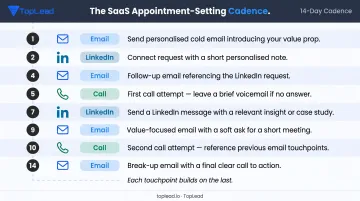
The key word is coordinated. Each touchpoint should feel like a continuation, not a fresh cold outreach.
Crafting Outreach Messaging That Books SaaS Meetings
Specificity is what separates meetings booked from emails ignored. A cold email that references a prospect's current tool, a recent company announcement, or a pain point tied to their specific role converts at a much higher rate than a generic pitch. Keep openers under 100 words, lead with outcomes rather than feature lists, and include one clear call-to-action.
The data backs this up. Salesloft's 2023 benchmark report found that 86% of sales emails had no personalization. The average SDR sends 150 emails per week and receives a 2.8% reply rate. Personalization is the lever.
LinkedIn plays a distinct role beyond connection requests. Commenting on a prospect's posts or referencing shared context in your note warms the outreach before the email sequence even lands. This matters most for senior SaaS buyers (VPs and C-suite executives), who are far more active on LinkedIn than they are on the phone.
Email deliverability is an operational prerequisite. According to Validity's 2025 Email Deliverability Benchmark, the software industry sees only 80.9% inbox placement, with 10.6% of emails landing in spam. Sending from your primary company domain without proper warming puts that domain at risk. Separate sending domains, DMARC/SPF/DKIM authentication, and domain warming aren't optional — they're the baseline for outreach that actually reaches inboxes.
For SaaS teams that prefer not to manage this infrastructure internally, TopLead's U.S.-based multi-channel approach handles email, LinkedIn, and phone outreach with dedicated decision-maker verification and domain health management as part of the service.
Step 3: Qualify SaaS Appointments the Right Way
Meeting volume is the wrong success metric. An unqualified demo wastes an AE's time and erodes morale. Compounded across a quarter, it produces a pipeline that looks full but closes at nothing.
The Qualification Framework
A practical approach for SaaS adapts BANT to fit modern software buying behavior:
- Budget: Does the prospect understand the approximate investment category, and is there a budget owner involved or identified?
- Authority: Can this person influence or approve a purchase? Are they the economic buyer, a champion, or just an information gatherer?
- Need: Does a real, specific problem exist that your product category solves? A vague interest in "improving operations" doesn't qualify. A specific pain tied to a measurable business impact does.
- Timing: Is there a reason to act within a defined window — a renewal date, a growth milestone, or a recent trigger that creates urgency?
SDRs should probe for these through discovery questions embedded in the confirmation flow — not as a checklist interrogation, but as a natural conversation about the prospect's current situation.
Reducing No-Shows
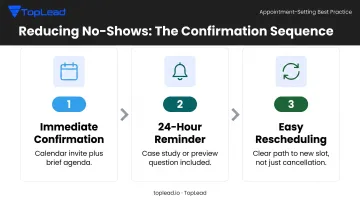
Once an appointment is booked, the work isn't done. A strong confirmation sequence protects the meeting:
- Immediate confirmation with calendar invite and brief agenda
- 24-hour reminder that includes a relevant case study, a specific question for the prospect to consider, or a one-line preview of what the call will cover
- Easy rescheduling option (not just cancellation) — high-intent buyers who can't make the original time should have a clear path to a new slot, not a cancellation link
Handling Common Objections
Three objections come up constantly in SaaS outbound:
- "We already have a solution": Don't concede. Ask what it does well and where the gaps are. Most incumbents have at least one significant limitation — your job is to surface it, not argue.
- "Not the right time": Probe for what "right time" looks like. If there's a real trigger on the horizon, schedule the conversation for then. If there's no trigger at all, this may be a disqualify.
- "Send me some information first": Counter with a specific question: "Happy to send something over — what's the specific problem you're trying to solve? That'll help me make sure I send what's actually relevant." This converts information requests into qualifying conversations.
Know when to disqualify. A prospect with no budget awareness, no defined need, and no trigger has no reason to show up — and every reason to waste your AE's calendar slot.
In-House SDR Team vs. Outsourcing Appointment Setting for SaaS
This decision comes down to timing, volume, and how much management bandwidth your team has to run a structured sales development program.
Building In-House
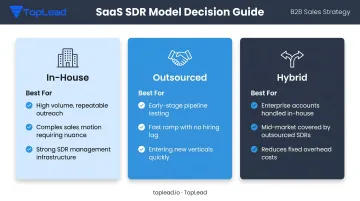
An in-house SDR team makes sense when outbound volume is high, the sales motion is complex enough to require deep product knowledge, and the company has the management infrastructure to support it. The tradeoffs are real:
- Bridge Group research puts SDR attrition at 25–35% in 2023, with anticipated rates of 40–50% in normal market conditions
- SDR ramp time historically averages 3 months before consistent results
- Fixed costs include salary, benefits, tools (sequencer, data provider, CRM), and ongoing training
Those costs accumulate well before the first qualified meeting lands on your calendar.
Outsourcing
Outsourcing makes more sense in three situations:
- Early-stage SaaS testing a new market or ICP and not ready to commit to a full internal headcount
- Growth-stage teams that need pipeline now and can't wait 90 days for a new hire to ramp
- Companies entering new verticals or geographies where an experienced partner brings existing targeting knowledge
When evaluating outsourced partners, look for pay-per-appointment pricing (not retainer-only), decision-maker verification on every booking, and a replacement guarantee if a meeting doesn't hold. TopLead structures its program around exactly these terms — with appointments running $300–$350 each, a guaranteed minimum of 4–6 qualified meetings per month, and no long-term contract requirement.
The Hybrid Approach
Many scaling SaaS companies land here: a small internal team handles strategic, high-ACV enterprise accounts while an outsourced partner drives top-of-funnel prospecting across mid-market. The split typically delivers three advantages:
- Reduces fixed headcount costs during periods of variable pipeline demand
- Provides outbound scalability without waiting on hiring cycles
- Lets internal SDRs focus time on the highest-complexity, highest-value opportunities
Key Metrics to Track SaaS Appointment Setting Performance
Track these metrics. They don't carry equal weight.
The Metrics That Matter
| Metric | Why It Matters |
|---|---|
| Meetings booked vs. meetings held (show rate) | Reveals qualification and confirmation process quality |
| Meeting-to-opportunity conversion rate | The truest signal of appointment quality |
| SQL conversion rate | Shows whether opportunities are real or just exploratory |
| Cost per qualified appointment | Enables ROI comparison across channels and vendors |
| Sales cycle length by appointment source | Identifies which pipeline sources close faster |
Raw meetings booked is a misleading indicator on its own. It can be inflated through low-quality targeting that fills the calendar with curious prospects instead of buyers. Meeting-to-opportunity conversion is the real test — it shows whether appointments involve people with genuine intent, budget awareness, and a problem your product solves.
Diagnosing Pipeline Problems with Metrics
Your metrics tell a specific story when something is off:
- High booking rate, low show rate: Weak qualification or poor confirmation follow-up. The appointments aren't valuable enough for prospects to protect the time.
- High show rate, low meeting-to-opportunity conversion: ICP misalignment or messaging that attracts curiosity rather than intent. Prospects are engaging, but they lack purchase intent — a sign ICP criteria need tightening.
- High cost per qualified appointment: Outreach list lacks intent-signal filtering, casting too wide a net across your ICP.
Reporting Cadence
Expect three reporting layers from a well-run appointment setting program:
- Weekly: Outreach volume by channel, response rates, meetings booked and held
- Monthly: Pipeline attribution — which appointments converted to opportunities and what stage they reached
- Quarterly: ICP definition review, messaging performance assessment, channel mix evaluation
Frequently Asked Questions
What makes B2B appointment setting different for SaaS companies?
SaaS deals involve multi-stakeholder buying committees spanning finance, IT, and operations — each requiring different messaging and qualification criteria. The demo-centric sales motion makes an unqualified meeting far more costly than in transactional B2B verticals, where shorter conversations carry lower stakes.
How many appointments should a SaaS company expect per month from outsourced appointment setting?
Results vary by ICP complexity and target market. A structured program should deliver a predictable guaranteed minimum — typically 4–6 qualified meetings per month. Quality indicators like show rate and meeting-to-opportunity conversion matter far more than raw volume.
What outreach channels work best for SaaS appointment setting?
A coordinated multi-channel sequence combining cold email, LinkedIn outreach, and phone follow-up consistently outperforms any single channel. Channel effectiveness depends on the seniority and role of the target persona — senior buyers are more reachable on LinkedIn, while mid-level decision-makers often respond better to phone follow-up.
Should a SaaS company build an in-house SDR team or outsource appointment setting?
Early-stage and growth-stage SaaS companies typically benefit from outsourcing — lower fixed costs and faster ramp make it the practical starting point. Mature companies with high outbound volume often justify building internally, though many successful teams run a hybrid: internal SDRs for high-ACV enterprise accounts, outsourced for mid-market prospecting.
How do you qualify a B2B appointment for a SaaS product?
A qualified SaaS appointment requires four elements:
- Decision-making authority or direct influence
- Company profile that matches your ICP
- A relevant pain point or triggering event
- Enough context for a productive discovery conversation
Budget awareness (not commitment) and a reason to act within a defined window confirm the prospect is worth a demo slot.
Why is meeting-to-opportunity conversion rate more important than the number of meetings booked?
Raw meeting volume can be manufactured through low-quality targeting. Meeting-to-opportunity conversion reveals whether appointments are with buyers who have real intent, budget awareness, and a problem your product solves — making it the most reliable indicator of whether your appointment setting program is actually working.