According to Salesforce's 2026 sales statistics, sales reps spend 60% of their time on non-selling tasks like administrative work and internal approvals. That's not a productivity problem. It's a structural one.
Sales prospecting outsourcing has become the strategic lever B2B companies use to solve it. This guide covers what outsourced prospecting is, when it makes sense, how it works, what results to expect, and how to choose a partner worth trusting.
TLDR
- Outsourced prospecting hands off top-of-funnel tasks—research, outreach, qualification—to a specialized external team
- It delivers qualified meetings faster and cheaper than ramping in-house SDRs from scratch
- It works best when you have a defined ICP, a proven offer, and internal closers ready to convert
- Look for a partner with multi-channel outreach, decision-maker verification, and transparent reporting
- Pay-per-appointment models reduce financial risk by tying cost directly to outcomes
What Is Sales Prospecting Outsourcing?
Outsourced prospecting means delegating your top-of-funnel sales activities—account research, list building, cold outreach, lead qualification, and appointment setting—to a specialized external agency or SDR team rather than building those functions in-house.
To be clear on scope: this is not full sales outsourcing. Outsourced prospecting is narrowly focused on pipeline creation: everything that happens before your first real sales conversation. Your internal team keeps full ownership of discovery calls, demos, negotiations, and the customer relationship. The external team fills your closers' calendars. That's it.
Why This Handoff Matters
Salesforce data shows reps spend 60% of their time on non-selling tasks. When account executives handle their own prospecting, they're trading their highest-leverage activity (closing) for their lowest (research and cold outreach). That's a structural problem, not a motivation one.
Outsourcing prospecting is an attention-allocation decision, not just a headcount one. The question isn't whether you can afford an outsourced partner. It's whether you can afford to keep burning closing capacity on top-of-funnel tasks.
Gartner's 2024 research reinforces this: chief sales officers who outsource select sales roles increase channel agility and grow revenue—provided they evaluate partner fit carefully before committing.
Outsourced Prospecting vs. Hiring an In-House SDR
The fully loaded cost of a U.S.-based in-house SDR clears $113K before you account for tools or management. Here's how that stacks up against outsourcing:
| Dimension | In-House SDR | Outsourced Prospecting |
|---|---|---|
| Ramp time | 3–4+ months before full productivity | Campaigns launch in weeks |
| Loaded annual cost | $113K+ (salary, OTE, benefits) before tools or management | Pay-per-appointment; $300–$350 per qualified meeting |
| Scalability | Requires new headcount to scale | Adjust scope without hiring |
| Quality control | Dependent on individual rep | Managed team with established playbooks |
| Management overhead | Requires dedicated sales leadership | Handled externally |
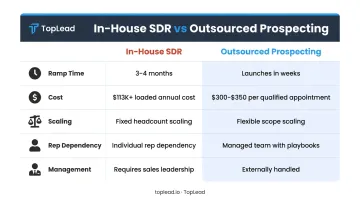
The $113K+ in-house floor comes from real data. RepVue reports a $60K median base and $85K median OTE for U.S. SDRs in 2026. The Bureau of Labor Statistics puts benefits for sales occupations at roughly 33% of wages—adding approximately $28K to that OTE figure. That's before software, data subscriptions, recruiting fees, or management time.
And that assumes the SDR works out. Bridge Group data puts average SDR tenure at roughly 1.4 years, meaning you're absorbing ramp cost repeatedly.
Outsourcing converts that fixed overhead into a variable cost tied directly to results: you pay for confirmed meetings, not for headcount that may or may not ramp.
When to Outsource: 5 Signs Your Business Is Ready
Outsourced prospecting delivers results in specific conditions. Before investing, check whether your situation fits.
Sign 1: Your Pipeline Is Inconsistent or Running Dry
Feast-or-famine meeting cycles signal that prospecting isn't getting dedicated, consistent attention. An outsourced team runs structured daily outreach cadences, ensuring qualified meetings flow in regardless of internal capacity or shifting priorities.
Sign 2: Your Reps Are Spending More Time Researching Than Selling
If your sales team is doing their own prospecting, they're losing closing hours to list building, CRM updates, and cold sequences. Outsourcing recovers that time and redirects it to discovery calls, demos, and deal negotiation—where it actually moves revenue.
Sign 3: Hiring and Ramping SDRs Is Too Slow or Costly
An in-house SDR typically needs 3–4 months before reaching full productivity. That's months of salary, management attention, and training investment before you see pipeline contribution. Outsourced teams launch using proven playbooks with trained reps already in place—weeks, not quarters.
Sign 4: You're Entering a New Market or Vertical
Expanding into an unfamiliar industry or buyer persona without tested messaging is expensive. An experienced outsourced partner has already prospected in similar markets and brings proven outreach sequences built for those buyers. That means faster product-market fit validation through real prospect feedback—without the cost of building from scratch.
Sign 5: Your Closers Have Capacity but Not Enough Meetings
If your account executives have open calendar slots but no consistent stream of qualified opportunities, you have a top-of-funnel problem—not a closing one. Outsourced prospecting solves exactly this by delivering verified, decision-maker-level appointments to your closers' calendars.
How Outsourced Sales Prospecting Works in 2026
Modern outsourced prospecting is not the call-center model of years past. Top programs combine ICP-driven targeting, intent data, multi-channel outreach, and continuous optimization. Here's how a quality engagement actually runs.
Step 1: ICP Definition and Strategy Alignment
Every quality engagement starts with a deep-dive onboarding session. This is where you define:
- Firmographic criteria: company size, revenue range, industry, geography
- Technographic and behavioral signals: tech stack, hiring patterns, growth triggers
- Title targets and buying committees: primary decision-makers plus key influencers
- Qualification criteria: what makes a meeting "accepted" vs. just "booked"
- KPIs: meetings accepted, pipeline generated, cost per qualified appointment
Skipping or rushing this step is the most common cause of poor appointment quality downstream. TopLead's onboarding process, for example, centers on an ICP Alignment Workshop that maps not just decision-makers but entire buying committees—identifying influencers who shape vendor selection even when they don't sign contracts.
Step 2: Data Sourcing, List Building, and Verification
The outsourced team sources and verifies prospect data using platforms like ZoomInfo or Apollo, then applies ICP filters to produce a tiered target account list. Decision-maker verification—confirming title, authority, and contact accuracy before outreach—is what separates quality providers from those who just generate contact volume.
This matters because Salesforce reports that 73% of B2B buyers actively avoid sellers who send irrelevant outreach. The list is not just a database exercise—it's a relevance filter.
Step 3: Multi-Channel Outreach Execution
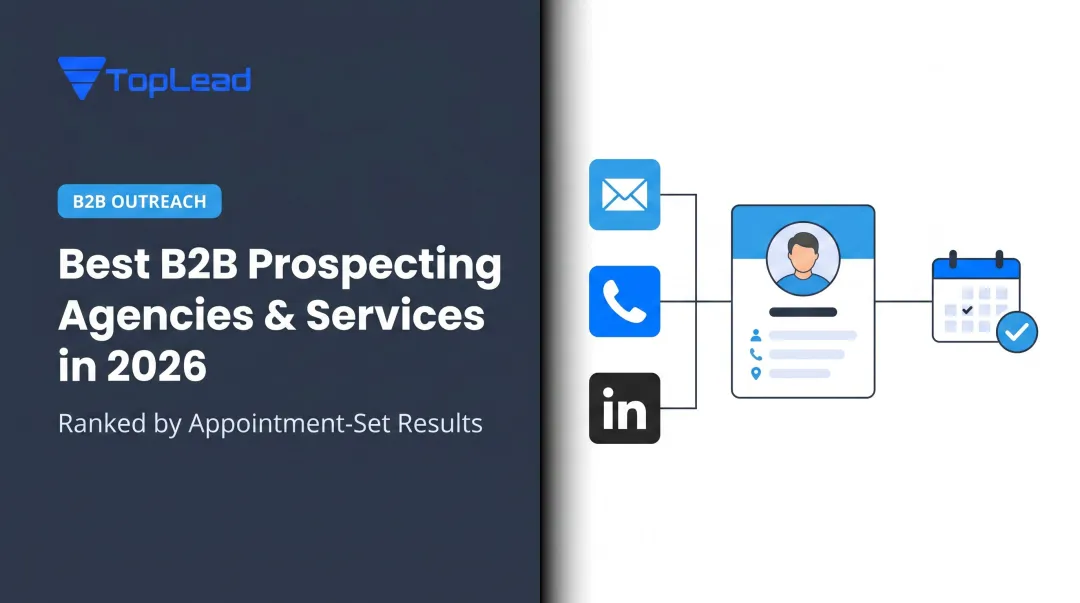
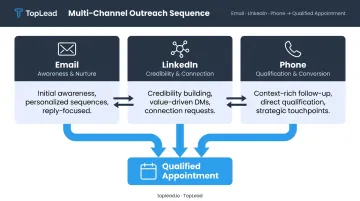
Top providers don't run single-channel campaigns. Effective outreach combines:
- Email: Personalized sequences focused on replies and conversations, not open rates
- LinkedIn: Connection requests, value-driven DMs, and relationship building that improves response rates across all other channels
- Phone: Context-rich follow-up integrated strategically into the sequence, not used as a blunt-force tactic
Each channel serves a distinct function. Email creates initial awareness. Phone enables direct qualification. LinkedIn builds credibility and familiarity before the ask. TopLead's multi-touch sequences are built with behavioral triggers and dynamic variables, so every touchpoint feels personalized—without requiring manual effort on each individual contact.
Step 4: Lead Qualification and Appointment Setting
As prospects engage, the outsourced team qualifies them against agreed criteria—budget, authority, need, timeline—before booking any meeting. A booked appointment should come with a context note covering the conversation summary, stated pain points, objections raised, and company background. That context is what allows your closer to walk in prepared rather than starting from scratch.
Step 5: Reporting, Feedback, and Optimization
Quality programs provide transparent reporting on outreach activity, engagement rates, meetings booked, and pipeline contribution. The critical element is the feedback loop: AEs score every appointment, and that scoring directly informs how the outsourced team refines targeting and messaging across the campaign lifecycle.
TopLead uses qualification frameworks (BANT, MEDDICC, or CHAMP based on client preference) to structure post-meeting feedback that feeds back into campaign optimization. The result is a system that sharpens targeting and messaging with every campaign cycle.
Top Benefits of Outsourcing Sales Prospecting
Faster Time to Pipeline
Outsourced teams launch in weeks rather than months, using pre-built playbooks and trained reps. Most clients—including those working with TopLead—begin receiving qualified appointments within the first 2–4 weeks of campaign launch, compared to the 3–4 month ramp before an in-house SDR reaches full productivity.
Predictable, Scalable Growth
Outsourced prospecting converts unpredictable pipeline into measurable output. Performance-based models like pay-per-appointment tie spend directly to results, eliminating guesswork around SDR productivity. When market conditions shift, you scale campaign scope up or down without the friction of hiring or laying off headcount.
Your Closers Close More
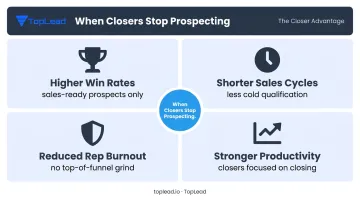
When you offload prospecting entirely, account executives focus exclusively on qualified conversations. The results compound across your entire revenue team:
- Higher win rates as AEs engage only sales-ready prospects
- Shorter sales cycles with less time spent on cold qualification
- Reduced rep burnout from removing the grind of top-of-funnel work
- Stronger overall productivity, since closers spend their hours closing
According to Salesforce research, high-performing sales teams are 1.7x more likely to use dedicated prospecting resources that keep sellers focused on closing.
Common Challenges and How to Navigate Them
Misaligned ICP and Lead Quality
If your partner doesn't deeply understand your buyer, they'll book meetings with the wrong people. The solution is front-loading the onboarding phase: document your ICP in granular detail, set explicit meeting acceptance criteria, and establish a fast AE feedback loop where every appointment gets scored. Tie contract incentives to accepted meeting quality, not raw booking volume.
Lack of Visibility and Brand Consistency
An external team represents your brand on every call and email. Without regular oversight, messaging drifts fast. Require CRM integration so all activity is logged and visible, and review outreach samples on a recurring cadence. Treat the outsourced team like internal SDRs — include them in product updates and messaging reviews so they represent you accurately.
TopLead, for example, keeps clients actively involved in team training and messaging calibration throughout the engagement, not just at onboarding.
Premature Campaign Abandonment
Outsourced prospecting compounds over time. Many companies abandon programs at 30–45 days before targeting and messaging have had time to optimize. Commit to at least a 60–90 day pilot before making a performance judgment. In the early weeks, focus metrics on learning—reply rates, objection patterns, engagement signals—rather than pipeline volume alone.
How to Choose the Right Outsourced Prospecting Partner
Criterion 1: Industry Experience and Verified Results
The right partner should demonstrate a proven track record in your specific industry or buyer type—not just generic B2B experience. Ask for relevant case studies, campaign performance benchmarks, and examples of appointment quality. Look for partners who can show measurable volumes of verified decision-maker appointments, not just leads or contact lists.
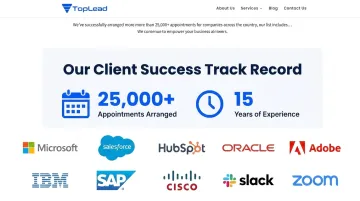
TopLead is one concrete example. Over 15 years, they've arranged more than 25,000 appointments for B2B companies across financial services, insurance, technology, healthcare, manufacturing, and professional services. Clients include Edward Jones, Aflac, Wells Fargo Advisors, Insperity, and UBS.
Their standard packages deliver 4–6 qualified leads per month with a reschedule or replacement guarantee.
Criterion 2: Pricing Model and Contract Terms
Pricing structure reveals where incentives are aligned. Retainer-only models can reward activity over results. Look for performance-based options where cost ties to confirmed outcomes.
TopLead's pay-per-appointment model averages $300–$350 per qualified appointment with no long-term contract requirement, which lets you run a true pilot without overexposure. The table below shows how that compares to standard retainer programs:
| Model | Typical Cost | Contract Required | Tied to Results? |
|---|---|---|---|
| Pay-per-appointment (TopLead) | $300–$350/appointment | No | Yes |
| Retainer-based programs | $5,000–$15,000/month | Often yes | No |
Criterion 3: Reporting Transparency and CRM Integration
A trustworthy partner provides real-time access to campaign data: outreach activity, engagement metrics, appointment notes, and pipeline contribution—all synced to your CRM. Vague or delayed reporting is a red flag.
Before signing, clarify exactly what you'll receive: shared dashboards, bi-weekly performance reviews, and appointment notes delivered with every booked meeting. TopLead integrates with Salesforce, HubSpot, Pipedrive, and other major platforms, with appointments delivered directly to the client's calendar and full outreach activity logged for visibility.
Frequently Asked Questions
What are the 4 types of outsourcing?
One common taxonomy covers professional/knowledge-based, IT/technology, manufacturing/production, and business process outsourcing (BPO). Sales prospecting outsourcing falls under the BPO or professional services category, depending on how the engagement is structured.
What are the 5 P's of prospecting?
According to ATD's framework, the 5 P's are Purpose, Preparation, Personalization, Perseverance, and Practice. A quality outsourced prospecting partner systematizes all five through structured processes and consistent execution.
Is outsourcing illegal in the US?
Outsourcing is entirely legal in the United States. Companies should ensure their data practices comply with applicable privacy regulations — particularly CCPA when targeting California-based contacts.
How much does outsourced sales prospecting cost?
Costs vary by model. Retainer-based programs typically run $5,000–$15,000 per month. Performance-based pay-per-appointment models average $300–$350 per qualified appointment, so ROI ties directly to confirmed meetings.
How long does it take to see results from outsourced prospecting?
Most programs deliver initial qualified meetings within the first 2–4 weeks. Consistent pipeline volume typically builds by the 60–90 day mark as targeting and messaging are refined through early campaign data.