This article focuses specifically on getting qualified leads — prospects who match your Ideal Customer Profile (ICP), hold real buying authority, and are actually in a position to make a decision. You'll walk away with six concrete, low-cost strategies and a framework for qualifying leads faster once they start coming in.
Key Takeaways
- A qualified B2B lead fits your ICP, holds decision-making authority, and shows active buying intent
- The six strategies covered: referral systems, multi-channel outreach, SEO content, email nurturing, strategic partnerships, and outsourced lead gen
- Quality consistently beats volume — fewer, better-fit leads produce higher close rates and shorter sales cycles
- Speed matters: responding to a new inbound lead within the first hour significantly boosts your conversion odds
What Makes a Lead "Qualified" in B2B Sales?
Before deploying any of the strategies below, you need a clear definition of what you're actually targeting. Without it, you'll chase the wrong targets.
MQLs vs. SQLs: Why the Distinction Matters
A marketing qualified lead (MQL) has shown engagement signals — downloaded a guide, attended a webinar, opened a sequence — but hasn't been vetted for sales readiness.
A sales qualified lead (SQL) has been confirmed as ready for a direct sales conversation.
Forrester research puts the problem in stark terms: in lead-centric MQL processes, the typical conversion rate from inquiry to closed-won is less than 1%. That's what happens when engagement gets mistaken for readiness to buy.
The fix is straightforward: qualify against specific criteria before a lead ever reaches your sales team.
The Four Criteria of a Qualified B2B Lead
Every strategy in this article should be filtered through these four criteria:
- ICP fit — matches your target industry, company size, and job role
- Pain point alignment — has a genuine problem your solution addresses
- Decision-making authority — can make or meaningfully influence the purchase
- Buying intent or timing — is actively evaluating solutions or approaching a relevant trigger event
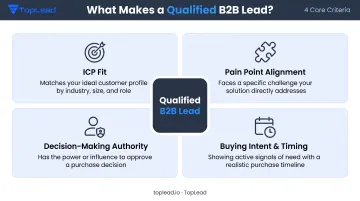
Skip any one of these and you're likely booking meetings that won't close — wasting your sales team's time on conversations that were never going to convert.
6 Low-Cost Strategies to Get Qualified B2B Leads Fast
Strategy 1: Build a Referral Engine That Generates Warm Leads Consistently
Referrals are the highest-quality, lowest-cost lead source in B2B. They enter conversations with built-in trust, close faster, and cost almost nothing to acquire compared to outbound or paid channels. Research from Influitive's survey of 600+ B2B sales and marketing professionals found that companies with referral programs report faster deal closing and higher lifetime customer value.
The problem is that most teams treat referrals as random windfalls rather than a repeatable system.
To systematize referrals:
- Identify your top 10–20 satisfied customers — especially recent wins or renewals
- Create a simple referral ask (a short email or a script for a 5-minute call)
- Share your ICP criteria with referral partners so they refer the right contacts, not just anyone they know
- Build a two-sided incentive structure — recognition, reciprocal referrals, or added service value all work. Monetary rewards are optional
The last point is often skipped, but it matters. A referral partner who doesn't know your ICP will refer whoever comes to mind. One who understands exactly who you serve will make introductions that actually go somewhere.
Track referral sources in your CRM. Over time, you'll identify which customers and partners generate the most valuable introductions — and those are the relationships worth deepening.
Strategy 2: Use Multi-Channel Outreach to Reach Decision-Makers Directly
Cold email alone is a diminishing-return strategy. Decision-makers are inundated on every single channel, but especially email. A coordinated sequence across LinkedIn, email, and phone increases meaningful touchpoints without dramatically increasing cost.
A basic multi-channel sequence:
- LinkedIn connection request with a short, personalized note referencing something specific to their role or company
- Follow-up email that leads with a relevant pain point or insight — not a product pitch
- Brief phone call once familiarity is established across the first two channels
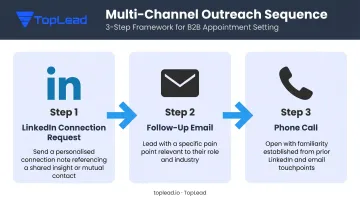
Each touchpoint should add something. If you're just repeating the same ask in a different format, you're not building familiarity — you're just creating noise.
The targeting step most teams skip: Spend real time upfront identifying the right contact before sending anything. Look for job title fit, company size alignment, and recent triggers — a funding round, a hiring surge, a leadership change, or relevant news. Better targeting at the top means dramatically higher reply rates without sending more volume.
Personalizing at scale: One research-backed personalization hook per message — referencing a prospect's specific challenge, a recent post, or a company event — consistently outperforms generic templates. It's low-effort relative to the response rate lift it produces.
This is the same multi-channel framework TopLead's U.S.-based SDR teams use across campaigns — combining email, LinkedIn, and phone with decision-maker verification before any meeting is booked. The result: 25,000+ verified appointments delivered for B2B clients across financial services, insurance, PEO, and professional services. Teams that want this model without building SDR infrastructure in-house can outsource it entirely (Strategy 6 covers exactly that).
Strategy 3: Create SEO-Driven Content That Pre-Qualifies Prospects
SEO has a built-in qualification advantage most channels don't: by the time a prospect finds your content through search, they're already researching a solution to a problem they're actively trying to solve. That makes them more qualified than a cold contact before you've said a word.
Targeting commercial-intent keywords — like "best [your service] for [industry]" or "how to solve [specific pain point]" — pulls in prospects who are already researching options, making them more qualified than a cold contact by definition.
How to turn content into a lead-capture system:
- Publish 3–5 well-optimized articles targeting specific ICP pain points
- Embed gated assets (checklists, calculators, templates) within high-traffic posts
- Use the content as the qualifier; the gated asset collects contact info
The tradeoff is time. SEO takes 3–6 months to build momentum. But unlike paid ads, once content ranks, it generates leads without ongoing spend. For B2B teams with tight budgets, a handful of well-targeted articles can outperform sporadic ad campaigns once they hit their stride.
Strategy 4: Nurture Existing Contacts with Targeted Email Sequences
Most B2B companies are sitting on an underutilized asset: a dormant list of past inquiries, trial sign-ups, event attendees, and newsletter subscribers who never converted. These contacts already know who you are. They just weren't ready when you first connected.
Demand Gen Report's 2023 Lead Nurturing & Acceleration Benchmark Survey found that 43% of marketers said their lead nurturing strategies needed improvement — which means most teams haven't cracked this yet.
A simple 3-part re-engagement sequence:
- Email 1: A useful resource relevant to their role (guide, insight, or practical tip)
- Email 2: A case study showing results for a company similar to theirs
- Email 3: A low-friction CTA — a brief discovery call or a direct check-in: "Does this challenge still apply to you?"
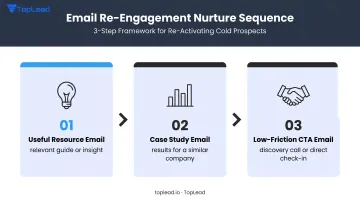
The goal of nurture isn't to sell on first contact. It's qualification — moving contacts from passive interest to active intent. The sequence surfaces people who are ready now, without requiring you to generate new contacts from scratch.
Strategy 5: Build Strategic Partnerships for Mutual Lead Sharing
While nurture works your existing list, partnerships expand your reach without adding to your outreach workload. The concept is straightforward: identify companies that serve the same ICP but offer non-competing services, then establish a reciprocal referral arrangement.
A B2B SaaS company and an accounting firm serving the US mid-market, for example, are a natural fit. Their clients are your prospects, and vice versa. These partnerships cost nothing and tap into your partner's trusted existing relationships.
Practical steps to get started:
- List 5–10 potential partner types whose clients match your ICP
- Draft a simple co-referral agreement (even an informal email commitment works)
- Schedule quarterly check-ins to keep the relationship active — partnerships decay without consistent contact
- Consider co-hosted webinars or collaborative content to accelerate mutual lead flow
The key to making partnerships work long-term is consistency. Quarterly check-ins and shared results keep both sides engaged — and referral volume tends to increase as trust builds.
Strategy 6: Partner with a Specialized B2B Lead Gen Agency
For many B2B teams, the build-vs.-buy decision comes down to time and cost. Hiring and training an in-house SDR team involves base salary, benefits, tools, recruiting fees, ramp time (typically 3–6 months to full productivity), and management overhead. RepVue data puts the median SDR base at $60,000 with a median OTE of $85,000 — and that's before tools, benefits, or the cost of ramp.
For teams that need qualified pipeline now, outsourcing to a specialized B2B lead gen agency removes the ramp period entirely.
What to look for in a B2B lead gen partner:
- Decision-maker verification (not just contact lists)
- Multi-channel outreach capability
- Transparent, real-time reporting
- Industry or vertical specialization
- Performance-based pricing with no long-term lock-in
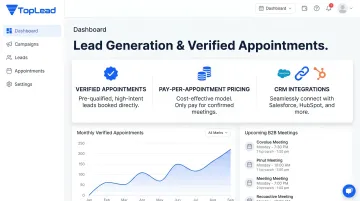
TopLead operates on a pay-per-appointment model with verified decision-makers, a reschedule/replacement guarantee, and no long-term contracts. Standard packages deliver a guaranteed minimum of 4–6 qualified appointments per month at an average cost of $300–$350 per appointment — with CRM integration into Salesforce, HubSpot, Pipedrive, and other major platforms.
Outsourcing makes the most sense when:
- You have a defined ICP but limited bandwidth for outbound prospecting
- You're entering a new market or vertical and need traction fast
- Your team has tested outreach but struggles to generate consistent, qualified output
- Every sales hour is too valuable to spend on cold prospecting
How to Qualify Leads Faster Once They Enter Your Pipeline
Getting leads into your pipeline is only half the job. Moving them through it efficiently requires a consistent qualification framework.
Use a Simple Qualification Checklist
BANT (Budget, Authority, Need, Timeline) remains one of the most practical frameworks for initial qualification. For a first call, you can compress this to three questions:
- Do they have the problem you solve?
- Do they have authority to make or influence a buying decision?
- Is there an active timeline?
A consistent checklist prevents reps from spending hours on poor-fit prospects. It also creates a shared language across the team for what "qualified" means.
Respond Within 5 Minutes — The Data Is Clear
Speed matters more than most teams realize. The foundational InsideSales.com/MIT Lead Response Management Study — conducted across 100,000 dials and 15,000 leads — found that contacting a lead within 5 minutes versus 30 minutes produced 100x higher contact odds and 21x higher qualification odds. Even waiting 10 minutes instead of 5 reduced qualification odds by 4x.
Fast follow-up catches prospects while buying intent peaks — courtesy is just a bonus.
Track Lead Source Quality Over Time
Not all channels deliver equally qualified leads. Review your pipeline monthly:
- Which sources are generating SQLs vs. MQLs?
- Which channels produce leads that actually close?
- Where is time being wasted on poor-fit contacts?
Shift effort toward the highest-converting sources. Even a 10–15% shift in budget toward your top-performing channel can compound into a meaningfully shorter sales cycle over a quarter.
Frequently Asked Questions
What is the 2-2-2 rule in sales?
The 2-2-2 rule is a follow-up cadence where a sales rep follows up 2 days after an initial meeting, then 2 weeks later, then 2 months later. The goal is to stay top of mind without overwhelming the prospect during a longer decision-making process.
What is the 10-3-1 rule in sales?
The 10-3-1 rule describes a common B2B conversion ratio: for every 10 prospects you reach, roughly 3 will agree to a meeting, and 1 will become a customer. Qualifying leads more rigorously at the top of the funnel directly improves all three numbers.
What makes a B2B lead "qualified" vs. unqualified?
A qualified B2B lead meets four criteria: ICP fit (right industry, company size, and role), a genuine pain point your solution addresses, decision-making authority or meaningful influence, and an active buying timeline or triggering event.
How quickly should you follow up with a new B2B lead?
Following up within 5 minutes of an inquiry produces contact and qualification rates far higher than waiting even 30 minutes — a pattern documented repeatedly across B2B sales studies. Same-day follow-up vastly outperforms next-day. The window of peak intent closes fast.
What is the cheapest way to generate qualified B2B leads?
Referrals from satisfied customers are the highest-quality, lowest-cost source — they require almost no spend and enter conversations with built-in trust. Email nurturing of existing contacts is a close second: reactivating even 5–10% of a dormant list can refill your pipeline at near-zero cost.
How many leads does it take to close one B2B deal?
It varies by industry and sales cycle length, but the 10-3-1 rule is a useful benchmark. The more important lever is qualification quality at the top of the funnel — better-fit leads improve your close rate without requiring more volume.