Introduction
Most accounting firms don't have a visibility problem — they have a pipeline problem. Every business theoretically needs accounting services, yet many CPA and bookkeeping firms still depend almost entirely on word-of-mouth, waiting for referrals that arrive unpredictably and dry up when the pipeline runs thin.
The challenge isn't that good clients don't exist. It's that most firms lack a repeatable system for finding them. Generic marketing tactics don't account for how accounting buyers actually make decisions — through trust, expertise signals, and extended due diligence, not impulse.
This guide covers inbound and outbound lead generation strategies built specifically for accounting firms:
- What actually works (and what doesn't)
- How to qualify the leads you attract
- How to build a pipeline that produces consistent, measurable growth
Key Takeaways
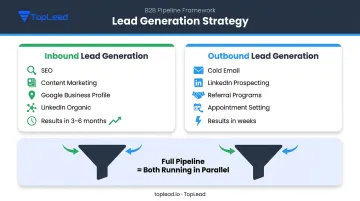
- Inbound strategies (SEO, content marketing, Google My Business) attract prospects already searching for accounting help
- Outbound strategies (cold email, LinkedIn, appointment setting) put your firm in front of decision-makers who aren't searching yet
- Qualifying leads matters as much as generating them: bad-fit clients drain more resources than an empty pipeline slot
- Sustainable growth requires treating lead generation as a system, not a campaign
What Makes Lead Generation Unique for Accounting Firms
The Trust Barrier Is Real
Accounting clients don't just hire a vendor — they hand over financial records, tax filings, and sometimes years of business history. That level of access requires trust that takes time to build.
Research from Demand Gen Report's 2024 B2B buyer study found that 72% of buyers say final vendor selection comes down to the provider's knowledge of their specific company and deep understanding of the business landscape. Price tipped the final decision only 8% of the time in Hinge's professional services buyer research.
Meanwhile, 6sense's research reported by Demand Gen found that 80% of B2B buyers reach out to a vendor only after they're already 70% through the buying journey — meaning prospects have typically done substantial research before your firm ever hears from them.
The "Everyone Needs Accounting" Trap
That trust dynamic makes positioning critical. Having a large addressable market doesn't automatically generate leads — firms that try to serve everyone end up differentiating on nothing, which usually means competing on price.
The firms that grow consistently compete on a defined niche and a visible track record instead. A CPA firm that publicly specializes in real estate investors or e-commerce businesses attracts higher-quality inquiries, charges higher fees, and closes more of the prospects it talks to.
Inbound vs. Outbound: Use Both
- Inbound (SEO, content, Google Business Profile) builds visibility over time and attracts prospects who are actively researching
- Outbound (cold email, LinkedIn, appointment setting) puts your firm in front of the right decision-makers, even when they aren't searching yet
Inbound takes months to produce results; outbound can generate meetings in weeks but requires ongoing execution. Running both in parallel is what separates firms with a full pipeline from those waiting on referrals.
Inbound Lead Generation Strategies for Accountants
SEO and Google My Business
Most accounting searches start online. BrightLocal's 2026 Local Consumer Review Survey found 97% of consumers read online reviews when evaluating local businesses — and that behavior extends directly to professional services like accounting.
For accounting firms, local SEO is the highest-leverage inbound channel. Key priorities:
- Target local, niche-specific keywords — phrases like "CPA for real estate investors in Austin" or "bookkeeping for e-commerce businesses in Chicago" attract qualified prospects with specific needs
- Optimize your Google Business Profile fully — complete service descriptions, photos, and consistent contact information. Firms with optimized profiles generate local inquiries without any ad spend
- Address technical SEO basics — fast page speed, mobile-friendly design, clear site structure, and location pages for each market you serve
One important expectation: Ahrefs' poll of 3,680 respondents found SEO typically takes 3–6 months to produce meaningful results, and new websites can take up to a year. Build SEO alongside faster-acting outbound tactics, not instead of them.
Content Marketing and Lead Magnets
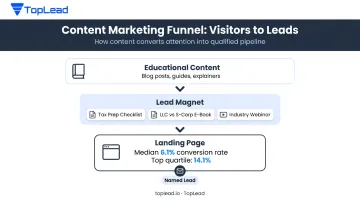
Publishing educational content — tax planning guides, industry-specific accounting explainers, financial checklists — positions your firm as an authority and attracts prospects who are actively researching before they're ready to call anyone.
The 2024 Edelman-LinkedIn B2B Thought Leadership study found 73% of B2B decision-makers consider thought leadership more trustworthy than standard marketing materials when evaluating a firm's capabilities.
The content has to target problems your ideal clients are actually searching for. A generic post about "the importance of good bookkeeping" attracts no one. A post like "How real estate LLCs should handle depreciation" attracts exactly the right audience.
Lead magnets turn anonymous readers into named prospects. Effective formats for accounting firms:
- A tax-season preparation checklist for small business owners
- An e-book on entity selection (LLC vs. S-Corp) with tax implications
- A webinar registration on year-end tax planning for a specific industry
Unbounce's 2024 Conversion Benchmark Report found commercial and professional services landing pages convert at a median rate of 6.1%, with the top quartile starting at 14.1%. Pair your lead magnet with a dedicated landing page — even a median-performing page turns roughly 1 in 16 visitors into a named lead.
Social Media and LinkedIn
LinkedIn is the primary social channel for B2B accounting lead generation. CMI's 2025 B2B Content Marketing report found 85% of B2B marketers identified LinkedIn as the social platform delivering the best organizational value — and LinkedIn's share of B2B buyer research jumped from 36% to 55% in a single year.
LinkedIn priorities for accounting firms:
- Optimize both the firm page and individual partner/owner profiles with clear specializations
- Publish short-form thought leadership posts on tax changes, financial planning, or industry-specific accounting issues
- Use LinkedIn Ads to reach decision-makers filtered by industry, company size, or job title
- Engage in relevant LinkedIn groups where your target clients are active
Facebook can support local brand awareness and community engagement, but for reaching business owners actively looking for accounting services, LinkedIn consistently outperforms other platforms.
Outbound Lead Generation Strategies for Accountants
Cold Email and Multi-Channel Outreach
Cold email works when it's targeted and personalized. A generic blast to a purchased list produces nothing. A sequence personalized to a prospect's industry, company size, and likely pain points can generate real responses.
Woodpecker's 2026 analysis of 20 million+ cold emails found that sequences of 4–7 emails generate reply rates around 27%, compared to roughly 9% for 1–3 email sequences — a strong argument for persistence over single-touch outreach.
What effective cold email requires:
- A clean, segmented contact list (industry, company size, geography)
- Subject lines that address a specific pain point, not your firm's credentials
- Short message bodies — 3 to 5 sentences with one clear call to action
- Follow-up sequences, not single sends
LinkedIn Prospecting and Referral Programs
LinkedIn prospecting works best when treated as relationship-building, not cold pitching. Using Sales Navigator or manual search, identify decision-makers in your target niche — CFOs at US mid-market companies, owners of businesses in your specialty industries — and send personalized connection requests that reference something specific. Warm the relationship with a few interactions before any mention of services.
Referral programs deserve more structure than most firms give them. Hinge Marketing's professional services buyer research found 71% of professional services buyers find a new firm by asking someone for a recommendation — and nearly 75% of the time, satisfied clients don't refer because they were never asked.
A structured referral program includes:
- Clearly defined criteria for who makes an ideal referral
- A direct ask, made at the right moment (after project completion, after a positive review)
- Incentives or at minimum a formal acknowledgment process
- Complementary partnerships with law firms, financial advisors, and business coaches whose clients overlap with yours
Networking, Events, and Appointment Setting
In-person and virtual networking generates warm leads that close faster than cold outreach. Speaking at industry events — both accounting conferences and niche events for your target clients — builds credibility quickly. Hosting a webinar on a specific tax or financial topic builds your email list while demonstrating expertise to an already-interested audience.
Appointment setting as an outsourced growth lever deserves specific attention for accounting firms trying to grow past referral-only pipelines. Most CPA firms don't have dedicated sales development resources, and consistent outbound prospecting is difficult to maintain alongside billable client work.
Specialized B2B appointment setting agencies solve this directly. TopLead, for example, runs multi-channel outreach (email, LinkedIn, and phone) on behalf of accounting firms under the client's brand, with messaging crafted around accounting-specific services — tax preparation, audits, bookkeeping. Their U.S.-based SDR teams verify decision-maker roles (business owners, CFOs, controllers) before any appointment is confirmed, so firms only spend time with prospects who have actual purchasing authority.
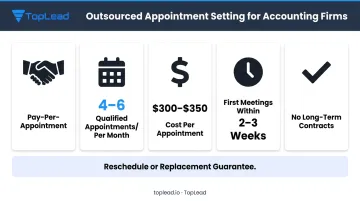
Key campaign details:
- Pay-per-appointment model — firms pay only for confirmed meetings
- Reschedule or replacement guarantee if a prospect cancels or no-shows
- 4–6 qualified appointments per month as a standard campaign baseline
- $300–$350 average cost per appointment
- First appointments typically arrive within two to three weeks of launch, with no long-term contracts required
For firms that want pipeline growth without building an in-house sales team, this kind of partnership provides a predictable, scalable alternative.
How to Qualify and Nurture Accounting Leads
What Makes a Good Accounting Lead
Not every inquiry is worth pursuing. A qualified accounting lead has four characteristics:
- A genuine, unmet need — they're not happy with their current provider, they've outgrown DIY accounting, or they need a specialty the current firm doesn't offer
- Budget to pay for professional services at your rate
- A business profile that fits your niche and capacity
- Decision-making authority — or direct access to the decision-maker
Skipping qualification leads to lengthy discovery calls with prospects who can't afford your rates, don't fit your service model, or were never serious buyers.
A Simple Qualification Framework
Ask these questions early — in a discovery call intake form or in the first conversation:
- What accounting challenges are you currently facing?
- What's your company's annual revenue and how many employees do you have?
- Are you currently working with an accountant or CPA?
- What's your timeline for making a change?
- Who else is involved in this decision?
Answers sort leads into three buckets: ready to engage, worth nurturing, or not a fit. Leads in the third category should be disqualified quickly rather than pursued.
Nurturing Longer-Cycle Prospects
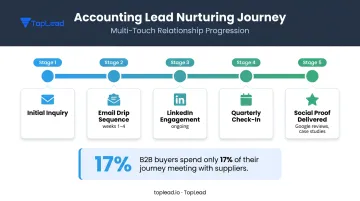
The leads sorted into "worth nurturing" aren't lost — they just need time. Most accounting prospects require multiple touchpoints before committing. Gartner's research shows B2B buyers spend only 17% of their buying journey actually meeting with suppliers; the rest of the time they're reading, comparing, and deciding independently.
Effective nurturing tactics:
- Automated email drip sequences that share relevant content over weeks or months
- Regular LinkedIn engagement (commenting on their posts, sharing relevant articles)
- A quarterly check-in email for warm-but-not-ready prospects
- Invitations to webinars or firm events
Social proof accelerates decisions. Google reviews, LinkedIn recommendations, and written case studies reduce perceived risk for hesitant prospects — especially when they're choosing between two firms that seem otherwise comparable.
Building a Consistent Lead Generation Pipeline
Sustainable pipeline growth comes from treating lead generation as an ongoing operational function — with defined targets, consistent tracking, and clear ownership — not something you revisit when the client roster thins out.
Set Targets and Track Metrics
Define clear monthly targets:
- Website visitors and organic search traffic
- Form submissions and inbound inquiries
- Appointments booked (inbound and outbound)
- Lead-to-client conversion rate
- Cost per acquired client (not just cost per lead)
Review performance monthly. When a channel underperforms for two consecutive months, investigate before cutting it — poor results often trace back to targeting or messaging, not the channel itself.
Use a CRM
A CRM gives the firm visibility into every lead's status, prevents follow-up from falling through the cracks, and reveals which channels produce the best-fit clients over time. Tools commonly used by accounting firms include:
- TaxDome — built specifically for tax and accounting workflows
- HubSpot — strong for inbound tracking and email sequences
- Salesforce and Pipedrive — flexible options for firms with more complex sales processes
TopLead integrates directly with all four, plus Close.io, so appointment data flows into your existing stack without manual entry and campaign reporting stays transparent throughout.
Scaling Without an In-House Team
For American firms that want predictable pipeline growth without diverting time from billable work, partnering with a specialized agency is often the most efficient option. The key is finding one with actual experience in financial and professional services — not a generalist that treats accounting the same as e-commerce or SaaS. Look for demonstrated results with CPA firms, bookkeepers, or tax practices specifically, and ask for examples before signing anything.
Frequently Asked Questions
How can accountants generate leads?
The most reliable approach combines inbound methods (SEO, content marketing, Google My Business) with outbound tactics (LinkedIn outreach, cold email, referrals, and appointment setting). Consistent execution of two or three strategies outperforms sporadic attempts across many channels.
What is the most effective lead generation strategy for accounting firms?
Referrals, local SEO, and targeted outbound outreach consistently produce high-quality leads for accounting firms of all sizes. The right mix depends on the firm's stage, niche, and available time — Referrals, local SEO, and targeted outbound outreach consistently produce high-quality leads for accounting firms of all sizes. The right mix depends on the firm's stage, niche, and capacity. Niche positioning amplifies all three approaches.
Should accounting firms use inbound or outbound lead generation?
Both serve different purposes. Inbound builds long-term visibility and trust; outbound generates faster results by directly reaching decision-makers. The highest-growth firms run both: outbound fills the near-term pipeline while inbound compounds results over time.
What qualifies as a good lead for an accounting firm?
A qualified lead has a genuine accounting need, budget for professional services, a business profile that fits the firm's niche, and actual purchasing authority. Chasing unqualified leads burns more time than having no leads — rigorous qualification is what separates high-growth firms from ones that stay perpetually busy but never scale.
How long does lead generation take to show results?
SEO typically takes 3–6 months to generate consistent traffic. Outbound tactics like cold email or appointment setting can produce meetings within weeks. Most firms treat these as complementary tracks, not competing choices.
How much should an accounting firm budget for lead generation?
Budgets vary based on whether the firm uses DIY methods, paid advertising, or outsourced services. The more useful metric is cost per acquired client, not cost per lead. A $350 appointment that closes into a $10,000 annual engagement is a fundamentally different investment than a $5 lead that never converts.