This feast-or-famine cycle isn't a discipline problem. It's a system problem. Solving it requires the right foundation, the right channels, and — most importantly — consistency even when you're slammed with client work.
This guide covers exactly that: how to build the foundation that makes lead generation work, which inbound and outbound strategies actually move the needle for consulting firms, how to build a routine that holds, and when to bring in outside help.
Key Takeaways
- Without a defined ICP, clear positioning, and a packaged offer, lead generation stalls before it starts
- Inbound builds long-term credibility; outbound fills the pipeline faster — use both
- Consistency beats intensity every time; a simple weekly routine outperforms sporadic bursts
- Quality of leads matters far more than raw volume
- Outsourcing prospecting to a specialized partner can accelerate pipeline without long-term contracts or hiring overhead
Build the Foundation Before You Generate a Single Consulting Lead
Most consultants who say "lead generation doesn't work" skipped this part. They went straight to tactics — cold emails, LinkedIn posts, networking events — without first defining who they're targeting, what they're offering, or why anyone should care. The result is activity that produces nothing.
Driving more traffic to a leaky funnel doesn't fix the funnel. The foundation has to come first.
Define Your Ideal Client Profile (ICP)
Your ICP is the starting point for every marketing and outreach decision. Without it, your messaging tries to speak to everyone and resonates with no one.
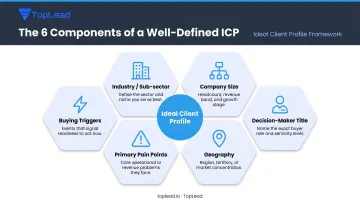
A well-defined ICP for the US market should specify:
- Industry and sub-sector — for example, mid-market manufacturing or regional healthcare groups
- Company size by headcount or revenue
- Decision-maker title — the person who can actually sign a contract
- Geography, if relevant to your practice
- Primary pain points your services address
- Buying triggers: events that make them likely to hire now (restructuring, compliance deadlines, rapid growth)
Avoid vague definitions like "any business that needs consulting help." The narrower your ICP, the sharper your outreach and the higher your conversion rates.
Craft a Clear Positioning Message
Once your ICP is locked, you need a single, outcome-focused sentence that answers: who do you help, with what problem, and to what result?
Use this framework:
"I help [IDEAL CLIENT] to [SOLVE PROBLEM] so that [OUTCOME]."
For example: "I help mid-sized logistics companies reduce supply chain costs so that they can protect margins without headcount cuts."
This message needs to be consistent across your LinkedIn headline, website homepage, and every outreach you send. Inconsistency creates confusion — and confused prospects don't convert.
Package Your Consulting Offer Strategically
Vague service descriptions create hesitation. "Strategic advisory and implementation support" tells a prospect almost nothing about what they're buying.
A productized consulting offer defines:
- Scope — exactly what's included and what falls outside the engagement
- Timeline — a fixed or phased schedule the client can plan around
- Deliverables — the specific outputs they receive when the work is done
A defined offer makes it easier for prospects to say yes and dramatically reduces the risk of scope creep once the project starts.
Set Up Tracking Before You Start Outreach
A basic CRM — or even a well-maintained spreadsheet — is non-negotiable before any outreach begins. Without it, you can't measure what's working.
Track these core metrics from day one:
- Leads needed per month to hit revenue goals
- Conversion rate from lead to proposal to close
- Number of conversations required to generate one opportunity
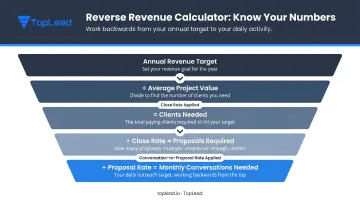
Work backwards from your annual revenue target. If your average project is worth $20,000 and you close 1 in 4 proposals, you need 4 proposals per client. Knowing these numbers turns lead generation from guesswork into a manageable math problem.
Inbound Lead Generation Strategies for Consulting Firms
Inbound strategies attract potential clients to you rather than requiring you to chase them. They take longer to produce results — typically 3–6 months to build real momentum — but they compound over time and build credibility that outbound alone can't replicate.
Thought Leadership and Content Marketing
According to Hinge's 2026 research on professional services firms, high-growth firms are 2.6x more likely to show high levels of visible expert activity than no-growth peers. Among those high-growth firms, 53% report their subject-matter experts are at least fairly active in producing and promoting thought leadership content.
For consultants, that gap in visible expertise is often the difference between a steady pipeline and a dry one.
Effective thought leadership content:
- Addresses specific pain points your ICP faces (not what you find interesting)
- Demonstrates your methodology, not just your credentials
- Takes a clear position rather than hedging every point
- Appears consistently — monthly at minimum, weekly if possible
Webinars and speaking engagements extend this further. They let prospects evaluate your thinking in real time, ask questions, and build trust before a sales conversation ever happens. Record every session and repurpose it across LinkedIn, your website, and email.
LinkedIn Organic Strategy
84% of B2B marketers identify LinkedIn as the organic social platform delivering the best value — and for consulting specifically, the concentration of decision-makers makes it the one platform worth prioritizing.
Three areas to optimize immediately:
- Headline — State your specialty and the outcome you deliver, not your job title
- About section — Write it for your ICP, not for recruiters
- Featured section — Pin a case study, lead magnet, or client result
For content, post 2–3 times per week. Mix formats: a brief insight one day, a short case study snippet another, a lesson learned from a recent engagement. And spend time engaging with your ICP's content — comments on their posts drive more profile visits than broadcasting alone.
Referral Programs and Client Advocacy
Referrals convert at a higher rate than any other lead source because trust is already built in. Academic research published in the Journal of Marketing found that referred customers deliver 16% higher lifetime value than non-referred customers — and that's in a traditional service business context.
That premium disappears if you're waiting passively for referrals to show up. Build a system instead:
- Ask satisfied clients directly for introductions (most are happy to help if you make it easy)
- Identify adjacent service providers who serve your same ICP — IT firms, accounting firms, legal practices — and build formal referral relationships with American firms in your network
- Consider modest incentives for successful introductions if your professional context allows it
Website and SEO Optimization
Your website should be built for your ICP, not for your own ego. Most consulting firm websites bury the value proposition under bios and awards. Flip that.
Key elements every consulting website needs:
- A clear, one-sentence value proposition above the fold on the homepage
- Dedicated landing pages for each core service
- Lead magnets (a diagnostic checklist, a short guide, an assessment) that capture contact information
- Basic on-page SEO targeting terms your ICP actually searches
SEO timelines are worth understanding: Ahrefs reports it typically takes 3–6 months to see measurable results from organic search. It requires patience upfront, but rankings compound — pages that rank today continue delivering traffic months later without additional spend.
Outbound Lead Generation Strategies for Consulting Firms
Inbound marketing builds pipeline gradually — but if you need clients in the next 60–90 days, outbound gets you there faster. For consultants in niche markets or those who need to close clients in the next 60–90 days, outbound is the faster path.
Targeted Email Outreach
The foundation of effective cold email is a well-built prospect list. A list of 200 precisely matched ICP targets will outperform a list of 2,000 generic contacts every time.
A high-converting consulting cold email follows this structure:
- Subject line — specific, not clever; references something relevant to their business
- Opening line — personalized to them, not a generic opener
- Pain point — one sentence about a problem they're likely experiencing
- Value statement — what you do and who you've helped
- CTA — low-friction: a 15-minute call, not a full proposal request
Broad B2B benchmarks show average cold email reply rates around 2.8%, rising to the 1–8.5% range depending on targeting quality. A/B test subject lines and CTAs from the start. Small improvements in open rates compound into meaningful pipeline differences over a quarter.
LinkedIn Prospecting and Direct Outreach
LinkedIn's native search and Sales Navigator both allow precise filtering by title, industry, company size, and geography — making it practical to build a targeted prospect list in under an hour.
For outreach messages that actually get responses:
- Reference something specific about their company or role in your opening line
- Don't pitch immediately — open a conversation, not a sales deck
- Keep it short: 3–4 sentences maximum
- Follow up once if no response, then move on
Personalized connection requests consistently outperform generic ones. The extra 90 seconds per message pays off in acceptance rates and reply quality.
Multi-Channel Outreach Sequences
Single-channel outreach leaves results on the table. Salesloft's analysis found email-only cadences produced 77% lower response rates, and phone-only cadences 91% lower, compared to coordinated multi-channel sequences.
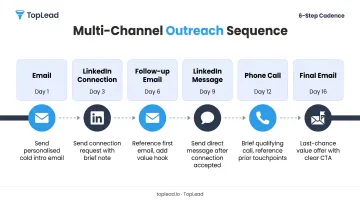
A practical 5–7 touch sequence over 2–3 weeks might look like:
- Email (Day 1)
- LinkedIn connection request (Day 3)
- Follow-up email (Day 6)
- LinkedIn message — reference the email (Day 9)
- Phone call (Day 12)
- Final email with a direct ask (Day 16)
Each follow-up should offer something useful: a relevant article, a specific pain point observation, or a brief insight. "Just checking in" messages get ignored.
Networking and Strategic Partnerships
Warm introductions close at a dramatically higher rate than cold outreach. Every referral partner relationship you build is a multiplier on your existing efforts.
To build a referral network that actually produces leads:
- Identify complementary providers who serve your exact ICP but don't compete with you (for example, a management consultant partnering with an HR tech firm or CFO advisory practice)
- Show up consistently at industry events and professional associations — not just once
- Follow up after every meaningful conversation with something specific, not a generic "great to meet you"
- Track referral sources so you know which relationships drive revenue
These relationships take 3–6 months to mature. The consultants who invest in them early rarely struggle with pipeline later.
How to Build a Consistent Lead Generation Routine
The difference between consultants with full pipelines and those scrambling for work almost always comes down to one thing: consistency. Not skill, not network size, not even offer quality — consistency is the deciding factor.
The most common failure mode: business development stops the moment client work picks up. Then the pipeline dries up 60–90 days later, and the scramble starts over.
Design Your Routine From Your Revenue Goal
Work backwards from what you actually need:
- Set an annual revenue target
- Divide by your average project value to find the number of new clients needed
- Apply your close rate to find the number of proposals required
- Apply your conversation-to-proposal rate to find the number of conversations needed per month
Then translate that number into a weekly minimum. For many small consulting firms, this looks like: 5 personalized LinkedIn or email outreach messages per day, 2 content posts per week, 1 networking call or coffee per week.
Protect the Time
Time-block business development on your calendar like a client meeting — it doesn't move or get pushed aside. Even during your busiest delivery periods, maintain a minimum baseline, even if that means cutting volume in half.
Run a monthly pipeline review to assess:
- Which channels are producing the highest-quality conversations?
- What's your current close rate, and is it improving?
- Where are leads dropping out of the funnel?
Adjust your channel mix based on data, not instinct.
Lead Generation Mistakes Consulting Firms Must Avoid
Three mistakes account for the majority of lead generation failures in consulting practices.
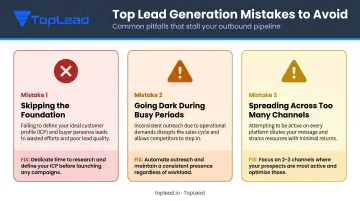
- Skipping the foundation. Jumping into outreach before defining your ICP, positioning, and offer is the most common reason consultants conclude that "lead gen doesn't work." It works — but only with the foundation in place first.
- Going dark during busy periods. Pausing business development during heavy delivery stretches creates the pipeline gaps consultants dread. The 60–90 day lag between stopping outreach and feeling the revenue drop is predictable — maintain a minimum activity baseline no matter how full your plate is.
- Spreading across too many channels. Running cold email, LinkedIn, a blog, a podcast, and paid ads simultaneously means doing none of them well. Pick 2–3 channels where your ICP actually spends time and master those before adding more.
When to Scale Your Consulting Lead Generation With Outside Help
Some signs it's time to consider outsourcing:
- You're spending more time prospecting than delivering client work
- Your pipeline is inconsistent despite genuine effort
- You want to enter a new market or vertical faster than DIY outreach allows
- You've mastered the fundamentals but need more volume
When evaluating a B2B lead generation partner, look for these five criteria:
- Verified decision-maker targeting (not just contact lists)
- Multi-channel outreach capability across email, phone, and LinkedIn
- Rigorous qualification before any meeting is booked
- Transparent performance reporting with clear metrics
- Flexible engagement terms with no long-term commitment required
TopLead's pay-per-appointment model, run by U.S.-based SDR teams, is built specifically for this scenario. Consulting firm clients receive qualified appointments with verified decision-makers — with no long-term contracts required to get started. Key program details:
- 4–6 qualified appointments per month, on average
- $300–$350 cost per appointment
- Reschedule or replacement guarantee on every no-show
- 3–6 month campaign lifecycles with CRM integration (Salesforce, HubSpot, Pipedrive)
For consulting firms with specialized needs — niche verticals, complex buying committees, or longer sales cycles — TopLead's embedded SDR Outreach model places trained SDRs who act as an extension of your team, handling the full prospecting process from first touch to confirmed calendar booking.
Frequently Asked Questions
How do you generate leads as a consultant?
Start by defining your ICP and positioning, then execute a combination of inbound strategies (thought leadership, LinkedIn, referrals) and outbound strategies (targeted email, LinkedIn prospecting, multi-channel sequences). Consistency across both, sustained over time, builds a reliable pipeline. Consultants who want faster results often outsource outbound prospecting to a specialist team so they can stay focused on delivery.
Can ChatGPT generate leads?
AI tools like ChatGPT can support lead generation by drafting outreach emails, building messaging frameworks, researching prospects, and creating content. They can't replace the strategy, targeting decisions, and relationship-building that effective consulting lead generation requires.
How long does it take to see results from consulting lead generation?
Inbound strategies — SEO, content marketing, LinkedIn — typically take 3–6 months to build meaningful momentum. Outbound strategies like email and LinkedIn DMs can produce initial conversations within weeks. Running both simultaneously is the fastest path to a full pipeline.
What is the most effective lead generation channel for consulting firms?
LinkedIn consistently performs best for B2B consulting due to its concentration of decision-makers. Referrals typically produce the highest close rates. The most effective approach combines both — LinkedIn for reach and early-stage awareness, referrals for the highest-converting opportunities.
How many leads does a consulting firm need per month?
It depends on your close rate and average project value. Work backwards from your revenue goal to calculate the number of conversations needed. For most small to mid-sized consulting firms, 4–8 qualified conversations per month is a realistic starting target.