For US companies, SDR outsourcing has become a practical solution for businesses that need qualified meetings without the overhead of building that function from scratch. This article breaks down exactly what SDR outsourcing is, how it works, who benefits most from it, and what separates programs that generate real pipeline from those that fill calendars with noise.
Key Takeaways
- SDR outsourcing means hiring a third-party firm to handle prospecting, lead qualification, and appointment setting on your behalf
- Your internal sales team focuses exclusively on closing while the outsourced team fills the calendar
- Key advantages: faster pipeline, lower overhead, and the ability to scale without headcount decisions
- Works best when you have a defined ICP and closers ready to convert qualified meetings
- Choose a provider with decision-maker verification, multi-channel execution, transparent reporting, and outcome-based pricing
What Is SDR Outsourcing and How Does It Work?
SDR outsourcing is the practice of engaging a third-party sales development firm to handle top-of-funnel activities on behalf of your internal sales team. That includes prospecting, outbound outreach, lead qualification, and appointment setting — everything that happens before a deal enters your pipeline.
Roles and Responsibilities of an SDR
SDRs are the first point of contact between your company and a potential buyer. They don't close deals. Their job is to identify target accounts, reach out across multiple channels, qualify prospects against defined criteria, and hand off sales-ready meetings to account executives.
What SDRs deliver is a qualified, confirmed appointment — not a contract. That handoff moment is where outsourced programs either succeed or fall apart, which is why the best providers are as focused on handoff quality as they are on booking volume.
The SDR Outsourcing Process, Step by Step
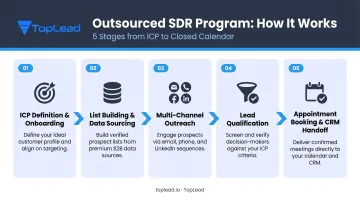
A well-run outsourced SDR program follows a consistent workflow:
- ICP definition and onboarding: The provider learns your target market, buyer personas, key pain points, and qualification criteria — covering attributes like industry, company size, geography, and buying triggers such as new leadership or growth stage.
- List building and data sourcing: Verified contact lists are built around your ICP using multiple enrichment sources. Quality providers layer data vendors and validate contacts before any outreach begins.
- Multi-channel outreach sequences: Personalized outreach is executed across email, phone, and LinkedIn in coordinated sequences timed to build familiarity without overwhelming prospects.
- Lead qualification: Responses are screened. Only prospects who meet your defined criteria — decision-making authority, company fit, relevant pain point — advance toward a meeting.
- Appointment booking and CRM handoff: Qualified meetings land directly on your AE's calendar, complete with conversation history, confirmed qualifying criteria, and any pain points surfaced during outreach.
Three Delivery Models to Know
| Model | What It Means | Best For |
|---|---|---|
| Fully managed | Provider owns the entire SDR function | Companies with no existing outbound infrastructure |
| Co-managed / augmented | External team embeds in your workflows and CRM | Companies with some process infrastructure who want to scale it |
| Fractional / shared SDR | Part-time or shared capacity | Lower-volume needs or early-stage validation |
The right model depends on your pipeline volume, product complexity, and how much control you want to keep over the process. Once you've identified the model that fits, the next question is whether the benefits justify the shift — which is where most companies find the clearest answer.
Key Benefits of Outsourcing Your SDR Function
Cost Efficiency
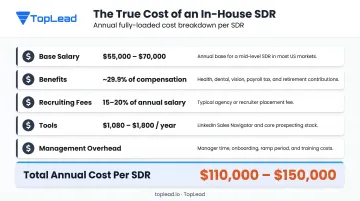
The true cost of an in-house SDR is consistently underestimated. According to Betts Recruiting's 2025 compensation data, entry-level SDR base salaries in tech run $55,000–$70,000, with on-target earnings adding another 20–60% on top.
Once you layer in the additional overhead, fully loaded costs climb fast:
- Benefits: The Bureau of Labor Statistics pegs these at roughly 29.9% of private-industry compensation costs
- Recruiting fees: Typically 15–20% of first-year salary for external hires
- Tools: LinkedIn Sales Navigator alone runs $1,080–$1,800 per license annually
- Management bandwidth: Supervision, coaching, and ramp oversight add hidden labor costs
The total? Most companies land between $110,000–$150,000 per SDR annually — before accounting for turnover.
Outsourced programs bundle data, tooling, SDR management, and reporting into a single engagement fee. TopLead's pay-per-appointment model, for instance, includes ICP list development, multi-channel outreach, quality control, CRM access, and reporting — with no separate billing for individual components and no long-term contract required.
Speed to Pipeline
In-house SDR hires typically take 3–4 months to ramp before they're producing consistently. Recruiting, onboarding, and training add weeks before day one even begins. Outsourced programs, by contrast, arrive with established outreach infrastructure, pre-built sequences, and proven playbooks.
TopLead clients across the United States generally receive their first qualified meetings within 2–4 weeks of campaign launch. Full cadence — consistent monthly volume with refined targeting — typically arrives around the 60–90 day mark as messaging is optimized and response patterns become clearer.
Scalability and Reduced Turnover Risk
SDR turnover is a persistent problem. Historical Bridge Group data puts average SDR tenure at roughly 1.4 years, and attrition rates have historically hovered around 30–34% annually. Replacing an SDR disrupts pipeline momentum and carries significant hidden costs — one industry estimate puts the total replacement cost, including training and missed quota, near $100,000 per departure.
Outsourced models absorb that risk entirely — the provider handles recruitment, replacement, and continuity, so a single resignation doesn't stall your pipeline.
The same flexibility applies to scaling. Need to test a new vertical or run a seasonal push? Outsourced teams can increase volume or shift targeting without headcount approvals or lengthy hiring cycles.
Access to Multi-Channel Expertise
Running coordinated outreach across email, phone, and LinkedIn simultaneously requires different tools, different skills, and consistent execution — all of which take time to build in-house. Quality outsourced providers bring proven outreach playbooks and the infrastructure to execute all three channels in a single integrated sequence.
Providers like TopLead take qualification further with decision-maker verification on every appointment, confirming that prospects hold actual purchasing authority — not just a relevant job title — before any meeting is booked.
Outsourced vs. In-House SDR: Making the Right Call
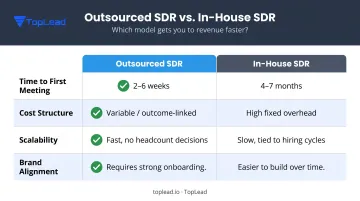
Side-by-Side Comparison
| Dimension | Outsourced SDR | In-House SDR |
|---|---|---|
| Time to first meeting | 2–6 weeks | 4–7 months (recruiting + ramp) |
| Cost structure | Variable, outcome-linked | High fixed overhead |
| Scalability | Fast — no headcount decisions | Slow — tied to hiring cycles |
| Brand/product alignment | Requires strong onboarding | Easier to build over time |
When to Outsource vs. Build In-House
Outsource when:
- You need pipeline quickly and can't wait for a 4–7 month ramp
- You're entering a new market or testing outbound ROI before committing to headcount
- You lack the recruiting infrastructure or management bandwidth to run an SDR team effectively
- You want predictable cost tied to outcomes, not activity
Neither option is right for every stage. Build in-house when:
- You have a proven outbound playbook and the volume to justify dedicated headcount
- Your product requires deep, long-term institutional knowledge that's hard to transfer
- You have a clear SDR-to-AE career path that supports retention
The Hybrid Approach
The outsource-or-build framing is also a false binary. Many high-growth companies run both simultaneously: an outsourced provider handles top-of-funnel prospecting and appointment setting while the internal team manages strategic accounts, inbound qualification, and product feedback loops. This isn't a fallback — it's a deliberate structure where outsourced SDRs drive new pipeline volume and internal reps deepen relationships that require institutional knowledge.
Who Should Consider SDR Outsourcing?
Profile 1: Established Companies With a Pipeline Volume Problem
These are companies with product-market fit, a functioning sales team, and a clear picture of what a qualified lead looks like — but no consistent mechanism to generate top-of-funnel volume at scale. They know how to close. They need a reliable source of meetings to close.
Profile 2: Growth-Stage Companies Testing Outbound
Startups and growth-stage firms often want to validate their outbound motion before hiring full-time SDRs. Outsourcing lets them test ICP targeting, messaging, and channel mix with a professional team — without locking into long-term overhead.
If the program produces qualified meetings that convert, the case for in-house investment is proven. If it doesn't, they've learned what doesn't work before committing to headcount.
One honest caveat: companies without a defined ICP or a sales team capable of closing won't get value from outsourced SDR. A provider can fill the calendar — but deals don't close if the foundation isn't there.
Industries That See the Strongest ROI
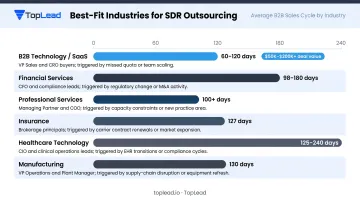
The best-fit verticals share common characteristics: consultative sales cycles, high deal values, and clearly defined buyer personas that reward precision targeting over volume.
- B2B technology and SaaS — sales cycles of 60–120 days, average deal values of $50K–$200K+ that reward precise qualification over raw volume
- Financial services — 98–180 day cycles with complex stakeholder structures
- Professional services (consulting, accounting, legal) — 100+ day cycles with specific trigger events like audits, growth, or leadership changes
- Insurance — 127-day average cycles with distinct decision-maker profiles
- Healthcare technology — 125–240 day cycles with regulatory gates that reward careful qualification
- Manufacturing — 130-day average cycles with procurement and operations decision-makers who require early qualification
TopLead has served American clients across all of these verticals — including Edward Jones, Aflac, Insperity, Wells Fargo Advisors, and Hub International — arranging more than 25,000 appointments for companies where a single closed deal justifies the cost of several qualified meetings.
Best Practices for SDR Outsourcing Success
Define Your ICP Before Engagement Begins
A poorly defined ideal customer profile is the single most common reason outsourced SDR programs underperform. Before onboarding a provider, document:
- Target industries and company size range
- Decision-maker titles and seniority
- Revenue range and buying triggers
- The specific criteria that make a prospect "sales-ready" for your team
Research from Foundry citing Forrester data found that organizations with a strong ICP achieve 68% higher account win rates. That advantage applies directly to how well an outsourced program can target and qualify on your behalf.
Stay Actively Involved in Messaging
Outsourced SDR teams are experts in outbound execution, not product evangelists. Plan for a structured onboarding that transfers:
- Deep product knowledge and key differentiators
- Competitive positioning and common objections
- The specific language your best prospects respond to
Treat the outsourced team as a true extension of your sales org. Providers that invest in this knowledge transfer consistently outperform those running generic scripts. TopLead's onboarding, for example, includes demo sessions and ICP-specific briefings built around the client's vertical before outreach begins.
Establish KPIs and Reporting Expectations Upfront
Agree on success metrics before the engagement starts. At minimum, track:
- Outreach activities by channel per week
- Contact-to-response rate
- Meetings booked vs. meetings completed
- Meeting-to-opportunity conversion rate
Providers reluctant to share activity-level data are a red flag. Quality partners provide real-time visibility — TopLead's reporting surfaces weekly metrics on contacted versus replied prospects, booked meetings, show rates, and channel attribution, integrated directly into Salesforce, HubSpot, Pipedrive, or Close.io.
Build a Strong SDR-to-AE Handoff Protocol
A qualified meeting is only valuable if the AE is prepared to run it. A strong handoff includes:
- The prospect's company background and relevant context
- Full conversation history from outreach
- Qualifying criteria confirmed during the SDR interaction
- Specific pain points surfaced and any objections raised
Context-rich handoffs measurably increase meeting-to-opportunity conversion. A booked meeting without context rarely becomes pipeline — the handoff is where that gap either closes or widens.
Set Realistic Ramp Expectations
Most outsourced SDR programs take 60–90 days to reach full cadence. The first 30–45 days involve messaging refinement, contact list optimization, and sequence testing. Treat that early data as intelligence to improve the program — not just a scoreboard.
Schedule regular performance reviews with the provider and use campaign data to iterate. Programs that treat the ramp period as a learning phase consistently outperform those that expect full results from week one.
Frequently Asked Questions
What are the roles and responsibilities of an SDR?
SDRs identify target accounts, execute multi-channel outreach (phone, email, LinkedIn), qualify prospects against defined criteria, and book meetings for account executives. They focus entirely on pipeline creation — not deal closing. Their output is a sales-ready appointment handed off to a closer.
How much does it cost to outsource SDR services?
Pricing models vary: retainer-based programs typically run $3,000–$12,000/month depending on scope and whether SDRs are US-based or offshore. Pay-per-meeting models range from $300–$500+ per appointment, with complex enterprise cycles running higher. Cost-per-qualified-meeting is a more meaningful metric than the monthly headline fee.
How long does it take to see results from outsourced SDRs?
Most programs deliver first meetings within 4–6 weeks of launch. Full cadence — consistent volume with refined targeting and conversion data — typically arrives between 60–90 days as messaging and list quality are optimized through early campaign feedback.
When should a company outsource SDRs instead of hiring in-house?
Outsource when speed to pipeline matters, when you need to validate outbound ROI before committing to headcount, when entering new markets, or when you lack the recruiting and management infrastructure to build an SDR team effectively. Build in-house when you have a proven playbook and volume to justify dedicated headcount.
What industries benefit most from SDR outsourcing?
B2B technology/SaaS, financial services, professional services, insurance, healthcare technology, and manufacturing see the strongest returns. Long sales cycles, high deal values, and defined buyer personas make the investment in qualified meeting generation economically sound.
What should I look for when choosing an SDR outsourcing company?
Key criteria to evaluate:
- Multi-channel outreach capability (email, phone, LinkedIn)
- Verified decision-maker contact data
- Documented experience in your specific industry
- Transparent real-time reporting
- Clear onboarding process with a realistic ramp timeline
Outcome-based pricing (paying for completed meetings, not activity) is a strong signal of provider accountability — providers like TopLead operate on a pay-per-appointment model with a reschedule or replacement guarantee, which keeps incentives aligned with your results.