Introduction
Picture a typical SDR's morning: dial a number, wait through four rings, hit voicemail, log the outcome, move to the next contact. Repeat. By noon, they've worked through 30 numbers and had maybe five actual conversations. Manual dialing is slow, and that ratio doesn't improve with effort alone.
Salesforce research shows sales reps spend 60% of their time on non-selling tasks. For outbound teams specifically, a significant portion of that lost time goes directly to the mechanical act of dialing. When pipelines depend on conversation volume, that's a structural problem.
Automated outbound calling solves it by handling the dialing entirely — agents spend their time talking rather than waiting. This article covers:
- What automated outbound calling actually is
- The five main dialer types
- Key business benefits
- Highest-impact B2B use cases
- What compliance looks like in practice
Key Takeaways
- Automated outbound calling software dials contact lists automatically — routing answered calls to live agents or delivering pre-recorded messages — eliminating manual dialing
- Five dialer types — predictive, power, progressive, preview, and IVR — each suited to different campaign goals
- Core benefits include higher call volume, lower cost per contact, better lead quality, and continuous optimization through call data
- Top B2B use cases: lead generation, appointment setting, payment reminders, customer surveys, and upsell campaigns
- TCPA and Do Not Call compliance is non-negotiable: willful violations cost up to $1,500 per call, with FTC civil penalties reaching $53,088 per violation
What Is Automated Outbound Calling?
Automated outbound calling is technology that places outgoing calls from a preloaded contact list without requiring agents to dial numbers manually. When a call is answered, the system either routes it to an available agent or delivers a pre-recorded message. Unanswered calls can receive a voicemail drop or get queued for follow-up automatically.
How the Workflow Operates
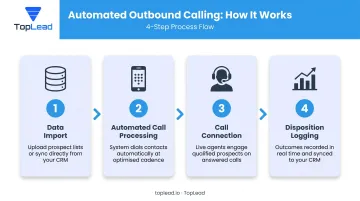
Every automated outbound system follows four core steps:
- Data import — Contact records are pulled from a CRM or database, often with segmentation applied before calling begins
- Automated call processing — The system dials based on the selected mode (predictive, power, progressive, etc.)
- Call connection — Answered calls route to available agents; unanswered calls trigger voicemail drop or callback queuing
- Disposition logging — Every call outcome is recorded automatically, feeding reporting dashboards for analysis
Automated Calling vs. Robocalling
That four-step workflow is also what separates legitimate automated calling from robocalling — a distinction that matters legally. Legitimate automated outbound calling connects answered calls to live agents, operates with proper consent, and complies with federal regulations. Robocalling delivers unsolicited pre-recorded messages with no human handoff. That's precisely what TCPA enforcement targets. Systems that route to real agents and honor consent requirements operate under an entirely different legal and ethical standard.
Types of Automated Outbound Calling Systems
Choosing the wrong dialer type is one of the most common mistakes B2B teams make. Each system is built for specific campaign conditions.
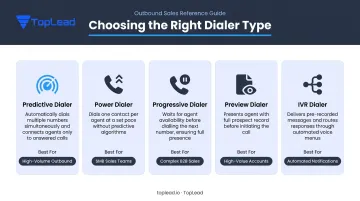
Predictive Dialers
Predictive dialers use algorithms to call multiple numbers simultaneously, predicting when agents will become available and connecting only live-answered calls in real time. The result is maximum talk time for large agent pools.
The trade-off is real: if the algorithm misjudges agent availability, calls get answered with no one ready, which drives abandonment. FCC rules cap abandonment at no more than 3% of live-answered telemarketing calls, measured over 30 days per campaign. Best suited for high-volume US operations like large-scale market research or debt collections.
Power Dialers
Power dialers automatically dial one number per available agent the moment a call ends with no idle time and no abandonment risk. As soon as an agent wraps up, the next number dials.
This balance of speed and compliance makes power dialers a strong fit for small-to-mid-size American B2B sales teams running targeted outreach where call quality matters alongside volume.
Progressive Dialers
Progressive dialers wait until an agent fully completes a call and signals readiness before dialing the next contact. The brief pause gives agents time to review notes or prepare for the next conversation.
For B2B campaigns involving complex discussions with decision-makers — benefits advisory, PEO sales, financial services — that preparation window meaningfully improves call quality. Pacing matters more than raw throughput here.
Preview Dialers
Preview dialers display full prospect context — CRM history, company details, previous interaction notes — before initiating each call. The agent reviews the record first, then the call goes out.
This is the right tool for high-value account conversations, renewal discussions, or any situation where personalization directly affects whether a decision-maker stays on the line. The extra pre-call context is worth the slower pace.
IVR-Based Auto Dialers
IVR (Interactive Voice Response) dialers deliver automated voice menus or pre-recorded messages and collect simple responses without a live agent. They're purpose-built for high-volume communications that don't require real-time conversation:
- Appointment reminders and confirmations
- Payment notifications
- Post-service satisfaction surveys
- Opt-in or opt-out processing
AI-Powered Dialers
The latest generation of dialers combines traditional dialing modes with real-time conversation intelligence, sentiment analysis, and automated call summaries. Gartner projects that 95% of seller research workflows will begin with AI by 2027, up from less than 20% in 2024. AI-assisted dialing tools are increasingly central to that shift, particularly for script optimization and live agent coaching.
Key Benefits of Automated Outbound Calling for B2B Businesses
Agent Productivity and Call Volume
The most immediate impact is time recovery. Manual dialing burns agent time on ring cycles, busy signals, and voicemail navigation. Automated systems handle all of that mechanically, leaving agents to do one thing: talk to prospects.
More conversations per shift means faster pipeline progression. For SDR teams measured on booked meetings, the cumulative gain is substantial across a full campaign.
Improved Lead Quality Through CRM Integration
When agents receive prospect context before every call — industry, company size, previous touchpoints, CRM notes — conversations become more targeted. An agent who knows a prospect attended a recent webinar or is approaching a contract renewal date can open with something relevant rather than a generic pitch.
Automated follow-up scheduling reinforces this. No interested prospect falls through the cracks because an agent forgot to call back after a busy afternoon.
Scalable Cost Structure
Building an in-house SDR function carries substantial fixed costs. A single rep runs $45,000–$60,000 annually in salary alone, before adding CRM licenses, sequencing tools, data procurement, and training. New SDRs typically need 90 days to reach baseline productivity.
Automated outbound calling shifts the repetitive dialing work to software. Teams can increase campaign intensity during peak periods — new market entry, seasonal pushes, product launches — without proportional headcount increases.
Real-Time Data and Continuous Optimization
Every call generates structured data: outcome, duration, disposition, agent. That data feeds reporting dashboards that managers can act on immediately.
Common optimization moves driven by call data:
- Adjusting calling windows based on connection rate patterns
- Identifying which script variants produce longer conversations
- Cleaning contact lists to remove consistently unreachable numbers
- Flagging individual agents for targeted coaching
Each campaign iteration builds on the last, so performance improves progressively rather than plateauing.
Top Use Cases for Automated Outbound Calling
B2B Lead Generation and Appointment Setting
This is the highest-impact use case for most B2B organizations. SDR teams use automated outbound calling to systematically work through segmented prospect lists, qualify decision-makers, and book introductory meetings at a scale manual dialing can't match.
The quality of those appointments depends heavily on two things: how well the contact list is segmented before calling begins, and how rigorously agents qualify on the call itself. Volume without qualification produces meetings that don't convert — which is why qualification rigor matters as much as dialing capacity.
Organizations that outsource this function (rather than building it in-house) typically partner with managed SDR services like TopLead, which combines outbound calling with trained SDR teams to handle qualification and delivery while internal sales teams focus on closing.
Appointment Reminders and Confirmations
Service-based businesses in healthcare, financial advisory, professional services, and insurance use automated outbound calls to confirm upcoming appointments, send pre-appointment reminders, and facilitate rescheduling when needed. IVR-based systems handle this efficiently at scale — no agent time required for routine confirmations.
The business case is straightforward: fewer no-shows, lower administrative burden on office staff, and better utilization of expensive professional time (advisors, clinicians, consultants).
Payment Reminders and Collections
Finance teams deploy IVR or progressive dialers to contact customers with overdue balances, deliver payment notifications, or initiate payment plan discussions. This use case carries strict regulatory requirements under the Fair Debt Collection Practices Act (FDCPA) and must be paired with proper compliance configurations in the dialing software — including time-zone restrictions, DNC scrubbing, and documented opt-out procedures.
Customer Surveys and Post-Interaction Feedback
Companies use automated outbound calls to gather NPS scores, satisfaction ratings, or market research input after purchases, support interactions, or service completions. Voice outreach tends to capture more nuanced responses than email surveys — respondents can elaborate in ways that checkbox formats don't allow.
Cross-Selling and Upselling to Existing Customers
Account management teams trigger calling campaigns based on CRM signals. Common triggers include:
- Contract renewal dates approaching
- Product usage hitting defined thresholds
- Feature adoption milestones
- Lapsed engagement after onboarding
The goal is identifying expansion opportunities within the existing customer base before competitors do. Preview or progressive dialers work best here — the agent reviews full account context before the call begins, making the conversation feel consultative rather than opportunistic.
Compliance Considerations and When to Outsource Outbound Calling
The U.S. Regulatory Landscape
Automated outbound calling operates under several overlapping federal frameworks:
| Regulation | Key Requirement |
|---|---|
| TCPA | Requires prior express consent before automated calls to protected lines; AI-generated voices covered as of Feb. 2024 |
| FTC Telemarketing Sales Rule | Calls must connect to an agent within 2 seconds of greeting; abandonment rate capped at 3% over 30 days |
| National DNC Registry | Must use a registry version no more than 31 days old before calling |
| Calling Hours | No calls before 8 a.m. or after 9 p.m. local time at the called party's location |
| Entity-Specific DNC | Company-specific do-not-call requests must be honored for 5 years |
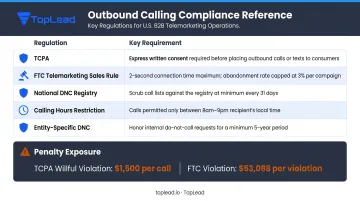
Penalties are substantial. TCPA violations carry $500 per violation, trebled to $1,500 for willful or knowing violations. FTC civil penalties reach $53,088 per violation as of January 2025. State laws add further requirements — Florida's FTSA, for example, creates its own $500 per-violation exposure with specific notice requirements.
B2B note: FTC guidance exempts most B2B calls from the Telemarketing Sales Rule, but TCPA consent requirements and state-level regulations still apply. Consult legal counsel for your specific state and industry before launching campaigns.
Building a Compliance-Ready Setup
Practical compliance checklist for in-house programs:
- Use dialing software with built-in DNC list integration and automatic scrubbing
- Configure time-zone-based calling restrictions in the dialer
- Maintain documented records of consent for every contact
- Establish a clear opt-out procedure that removes contacts immediately
- Update DNC lists at least every 31 days
- Disclose caller identity, sales purpose, and goods/services promptly at the start of each call
When Outsourcing Makes More Sense
Managing automated outbound calling effectively requires more than software. It demands qualified SDR teams, ongoing compliance monitoring, list hygiene, script testing, and performance tracking. For many B2B businesses, that operational infrastructure costs more to build and maintain than it returns.
TopLead operates as a virtual SDR team: handling list building, script optimization, TCPA compliance (including opt-out processing and permission-based contact sourcing), and performance reporting across CRM platforms like Salesforce, HubSpot, and Pipedrive. Clients receive contacted vs. replied rates, booked meetings, call show rates, and lead qualification data directly in their CRM. Appointments arrive with full contact history and call notes, so internal teams are prepared for every conversation.
Frequently Asked Questions
What are the benefits of outbound dialing software?
Outbound dialing software eliminates manual dialing, reduces agent idle time between calls, and automatically logs call outcomes, producing higher daily call volumes without adding headcount. CRM integration improves lead quality and surfaces the reporting data needed to optimize campaigns over time.
Is AI outbound calling legal?
Yes, provided it complies with TCPA regulations, honors Do Not Call lists, obtains proper consent, and discloses the automated nature of the call. The FCC confirmed in February 2024 that AI-generated voices fall under TCPA's "artificial voice" rules — and state-level requirements vary, so consult legal counsel before deployment.
What is the difference between automated outbound calling and robocalling?
Legitimate automated outbound calling connects answered calls to live agents, requires prior consent, and complies with federal and state regulations. Robocalling typically refers to unsolicited pre-recorded message calls with no human component, which is the primary target of TCPA enforcement.
Which types of businesses benefit most from automated outbound calling?
Any business with high outbound contact volume benefits, particularly B2B sales organizations, financial services firms, insurance agencies, healthcare providers, SaaS companies, and professional services firms running appointment-driven pipelines.
What is the best auto dialer type for a small B2B sales team?
Power or progressive dialers. They provide meaningful automation without the compliance risk of predictive dialing, and they give agents enough pacing to engage in personalized, meaningful conversations with decision-makers, which is what actually converts in B2B selling.
How does automated outbound calling improve B2B lead generation?
Automation allows SDR teams to contact significantly more qualified prospects per day, ensures consistent multi-touch follow-up, and delivers CRM-backed context that makes each conversation more relevant. Together, these factors shorten the path from first contact to booked meeting.