That complexity has only increased. According to Forrester's State of Business Buying 2024, an average of 13 people are now involved in a B2B purchase decision, and 86% of B2B purchases stall during the buying process. More stakeholders, longer cycles, and higher buyer friction mean your sales development function carries more weight than ever.
Pick the wrong model and you waste budget on slow ramps, high turnover, or the wrong outsourced partner. Pick the right one and you have a consistent pipeline engine that lets your closers close.
This article breaks down both models across cost, speed, scalability, and KPIs—so you can make a decision grounded in your actual situation, not generic advice.
Key Takeaways
- In-house SDR teams offer control and deep product knowledge, but carry high total costs, slow ramp times, and significant turnover risk
- Outsourced teams deploy faster and cost less per appointment, though partner vetting determines whether you get focus discipline or wasted budget
- The KPIs that actually matter: cost per qualified appointment, SQL conversion rate, and pipeline contribution rate
- 53% of B2B technology firms now use a hybrid model, combining in-house and outsourced SDRs
- Your best choice depends on company stage, product complexity, and whether you need pipeline speed or long-term knowledge depth
In-House vs. Outsourced Sales Development: Quick Comparison
Here's how the two models stack up across five key dimensions:
| Dimension | In-House SDR Team | Outsourced SDR Team |
|---|---|---|
| Cost | High — fully loaded SDR can exceed $100K/year (salary, benefits, tools, hiring) | Predictable — retainer-based ($4K–$10K/month) or pay-per-appointment ($300–$350/meeting) |
| Speed to Deploy | Slow — 3–6 months to hire, onboard, and ramp | Fast — active outreach typically begins within weeks |
| Scalability | Limited by hiring cycles and headcount | Flexible — capacity adjusts without new hires |
| Product Knowledge | Deep — embedded in product, culture, and positioning | Moderate — strong on ICP and value prop, limited on technical depth |
| Focus/Discipline | Variable — internal SDRs get pulled into non-SDR tasks | High — prospecting and booking is the only job |
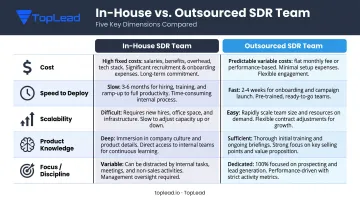
The right choice depends on your company's stage, sales cycle length, and internal capacity — the sections below work through each scenario.
In-House Sales Development: Pros, Cons & Best Use Cases
An in-house SDR team means hiring, training, and managing sales development representatives internally. These reps prospect, qualify leads, and book meetings for your account executives—fully embedded in your organization, operating within your culture and reporting structure.
Companies typically choose this model for control, brand alignment, and the expectation that internal SDRs will develop institutional knowledge over time.
Where In-House Teams Excel
Internal SDRs can engage in nuanced conversations about technical features, pricing, and competitive positioning—not just qualify. For enterprise SaaS, healthcare technology, or financial services, where prospects ask detailed questions before agreeing to a first meeting, deep product knowledge is a real differentiator.
Cultural alignment compounds that advantage. Internal SDRs attend QBRs, sit in on product launches, and absorb messaging shifts as they happen. An outsourced team receives a briefing doc; an internal SDR lives the changes.
The Real Costs (and Hidden Ones)
The cost picture is less flattering than most hiring plans acknowledge.
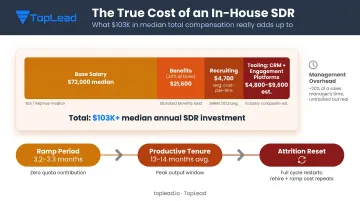
Glassdoor's 2025 data puts median total compensation for a U.S.-based SDR at $103,000 per year. Stack in the hidden costs and the number climbs fast:
- Benefits — roughly 30% of base compensation (BLS data)
- Recruiting — SHRM estimates average cost-per-hire near $4,700
- Tooling — CRM licenses, sales engagement platforms, and data subscriptions
- Management overhead — coaching time, pipeline reviews, and performance management
That investment resets constantly. Bridge Group's data places average SDR tenure at roughly 1.4–1.5 years, and ramp time at 3.2–3.3 months. After ramp, you have about 13–14 months of full productivity before the attrition cycle begins again.
Beyond cost, focus dilution is a chronic problem. Internal SDRs get pulled into team meetings, pricing discussions, and ad hoc projects. Without rigorous enforcement, outbound activity volume drops and qualification consistency suffers.
When In-House Makes Sense
Choose in-house when:
- Your product requires consultative, technically detailed SDR conversations
- Your sales cycle is 12+ months and requires deep relationship continuity
- You have internal management bandwidth dedicated to SDR coaching and process enforcement
- Brand control and messaging consistency are non-negotiable strategic priorities
Outsourced Sales Development: Pros, Cons & Best Use Cases
Outsourced sales development means delegating prospecting, qualification, and appointment-setting to a specialized third-party team. This model has expanded as SDR work has grown more specialized, requiring dedicated focus, multi-channel execution, and purpose-built tooling that most companies can't sustain internally.
The Case for Outsourcing
The advantages compound quickly once you understand the structural differences:
- Speed to pipeline: Outsourced teams typically begin active outreach within two to four weeks of onboarding — versus three to six months to hire and ramp an in-house rep. For companies that need pipeline now, that gap matters.
- Specialized focus: Outsourced SDRs do one thing — prospect, qualify, and book. They're not pulled into internal meetings or pricing calls, which produces higher daily activity volume and more consistent cadence execution.
- Scalability without headcount: When pipeline needs increase, you adjust your program, not your org chart. No hiring lag, no severance risk.
- Proven playbooks: Experienced partners bring frameworks already tested at scale — not a starting-from-scratch build.
TopLead, for example, operates as a virtual SDR team with U.S.-based SDR teams: multi-channel outreach (email, LinkedIn, and phone), rigorous decision-maker verification, ICP-specific list-building, and CRM integration with Salesforce, HubSpot, Pipedrive, and Close.io. Clients receive weekly reporting on contacted/replied rates, booked meetings, show rates, and channel attribution. Over 15 years and 25,000+ appointments, those frameworks have been refined in ways that take in-house teams years to replicate independently.
The Limitations to Know
Product depth has a ceiling. Outsourced SDRs can carry high-level conversations about your value proposition and ICP, but they can't provide technical recommendations or detailed product guidance. For highly customized or deeply technical solutions, this is a real constraint.
Partner quality varies significantly. A poorly matched outsourced provider can damage your reputation with prospects. When evaluating partners, prioritize:
- Demonstrated experience in your vertical
- Transparent qualification criteria
- Real-time CRM reporting access
- A replacement or reschedule guarantee (providers who resist reporting transparency are a red flag)
When Outsourced Makes Sense
Choose outsourced when:
- You need pipeline fast without the overhead of building an internal team
- You're entering a new market and need immediate prospecting execution
- Your ICP is well-defined and your offer is clear
- You want your internal sales team focused entirely on closing, not sourcing
KPIs to Track: In-House vs. Outsourced Sales Development
KPIs are the only objective way to evaluate whether either model is working. Without clear metrics, it's impossible to hold anyone accountable—internal or external—or make an informed decision about when to adjust course.
Core KPIs for Both Models
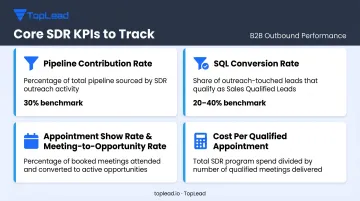
Track these four metrics regardless of which structure you're running:
- Pipeline contribution rate — What percentage of closed-won revenue traces back to SDR-sourced opportunities. This is the ultimate accountability metric for any sales development function.
- SQL conversion rate — What percentage of SDR-touched leads become Sales Qualified Leads. Typical rates run 20–40% depending on vertical and ICP tightness; tracking your own trend line reveals whether your qualification criteria are calibrated correctly.
- Appointment show rate and meeting-to-opportunity rate — Whether booked meetings are actually happening and progressing. Low show rates almost always signal a qualification problem: prospects who weren't ready to begin with.
- Cost per qualified appointment (CPQA) — The clearest apples-to-apples comparison between models. Divide total SDR investment by qualified appointments booked.
For in-house teams, CPQA should include salary, benefits, tools, and management time — not just base compensation. TopLead's pay-per-appointment model averages $300–$350 per appointment, which serves as a useful baseline when calculating your fully loaded in-house cost.
KPIs Specific to Outsourced Partnerships
With an outsourced team, two additional metrics matter:
- Activity volume and cadence compliance — Daily call volume, email send rate, and follow-up adherence should be visible in your CRM. Any partner who resists this level of transparency is a red flag.
- Ramp time to first qualified appointment — How many days from contract signing to the first meeting on your calendar? A well-run outsourced program should deliver first appointments within 30–60 days; most in-house SDRs take 3+ months to reach the same output.
Which Model Is Right for Your Business?
Neither model is universally superior. The right answer depends on where your company is right now.
Choose in-house if:
- Your product requires consultative SDR engagement and deep technical knowledge
- Your sales cycle exceeds 12 months and depends on relationship continuity
- You have dedicated management bandwidth and budget for sustained SDR investment
Choose outsourced if:
- You need qualified pipeline quickly without building internal infrastructure
- You're scaling or entering a new market with a well-defined ICP
- You want your closers focused on closing, not sourcing
Consider a hybrid model if:
- Your internal team handles inbound leads and existing account development while an outsourced partner drives new outbound prospecting
This split is already common. Foundry's research shows 53% of B2B technology organizations now blend in-house and outsourced sales development — the highest share recorded across their three-year study.
For American B2B companies that want qualified decision-maker appointments without building an internal SDR team, TopLead's pay-per-appointment model is worth a look. There's no long-term contract, every appointment comes with a reschedule/replacement guarantee, and CRM reporting is included.
Conclusion
In-house sales development makes sense when deep product alignment matters and you have the budget and management bandwidth to build it properly. Outsourcing fits when you need pipeline moving faster than a hiring cycle allows — without the fixed overhead of a full SDR team.
Whichever model you choose, track cost per qualified appointment, SQL conversion rate, and pipeline contribution rate from day one. These metrics will tell you objectively whether the model is working—and when it's time to adjust.
If the outsourced path is the direction you're leaning, TopLead's pay-per-appointment model — with no long-term contracts and a reschedule/replacement guarantee — is built specifically for B2B service businesses that need qualified meetings on the calendar without the guesswork.
Frequently Asked Questions
What is the difference between in-house and outsourced sales development?
In-house sales development means hiring and managing SDRs internally—they're on your payroll, embedded in your culture, and fully under your direction. Outsourced sales development means a third-party team handles prospecting, qualification, and appointment-setting on your behalf. The core trade-off is control and product depth versus speed and cost efficiency.
When should you outsource sales development vs. keep it in-house?
Outsource when you need pipeline fast, are entering a new market, or want your internal team focused entirely on closing. Keep it in-house when your product requires technically deep SDR conversations, your sales cycle is long and relationship-dependent, and you have dedicated management bandwidth to run the function properly.
What KPIs should I track for an outsourced sales development team?
Focus on four: cost per qualified appointment, SQL conversion rate, appointment show rate, and ramp time to first qualified meeting. These metrics hold any outsourced partner accountable to outcomes—not just activity—and make it straightforward to compare performance against in-house alternatives.
How much does outsourced sales development cost compared to in-house?
A fully loaded in-house SDR typically costs over $100,000 per year when you account for salary (Glassdoor median: $103K total comp), benefits, tools, and hiring costs. Outsourced models range from roughly $4,000–$10,000/month on retainer, or pay-per-appointment structures around $300–$350 per qualified meeting—a lower cost entry point for most early- to mid-stage B2B companies.
Can in-house and outsourced sales development work together?
Yes—a hybrid model is common and often effective. The typical split: an outsourced team drives new outbound prospecting and new market penetration, while the in-house team manages inbound leads and existing account development. More than half of B2B technology firms already operate this way, according to Foundry's research.
How long does it take for an outsourced SDR team to deliver results?
A well-run outsourced program typically begins active outreach within two to four weeks of onboarding, with first qualified appointments booked within 30–60 days. By contrast, a newly hired in-house SDR typically takes three to six months to reach consistent output after ramp.