Introduction
Most B2B revenue teams eventually face the same fork in the road: invest in inbound content that builds pipeline slowly over months, or run outbound campaigns that generate meetings faster but require more upfront discipline and budget. Neither is inherently wrong — but the trade-offs are real.
According to a 2025 Gartner survey of 632 B2B buyers, 61% prefer a rep-free buying experience, which seems to favor inbound. Yet those same buyers are 1.8x more likely to complete a high-quality deal when digital touchpoints are paired with a sales rep. That tension is exactly what this guide unpacks.
You'll get clear definitions of both strategies, a side-by-side comparison, and a decision framework built for B2B service businesses weighing pipeline speed against long-term brand authority.
Key Takeaways
- Inbound attracts prospects through content, SEO, and organic channels — trust-building by nature, but takes 3–6+ months to generate consistent pipeline
- Outbound reaches decision-makers directly via cold email, calls, and LinkedIn — faster pipeline, but only works with precise targeting and consistent execution
- Key differences: speed, cost profile, lead warmth, and targeting control
- Most high-performing B2B companies run both simultaneously
- Your choice should depend on pipeline urgency, buyer research behavior, budget, and internal capabilities
Inbound vs. Outbound Lead Generation: Quick Comparison
| Dimension | Inbound | Outbound |
|---|---|---|
| Approach | Pull (attract) | Push (reach out) |
| Who Initiates Contact | The prospect | Your team |
| Lead Warmth | Higher — prospect self-selects | Lower — cold to warm, depending on targeting |
| Time to First Results | 3–6+ months | Weeks to a few months (in-house ramp included) |
| Cost Profile | Lower long-term CPL; higher upfront content investment | Higher short-term CPL; costs scale with SDR capacity |
| Scalability | Scales with content production and SEO authority | Scales with headcount, tooling, and data quality |
| Best Suited For | Long buying cycles, self-researching buyers, brand building | Narrow ICPs, new market entry, near-term pipeline needs |
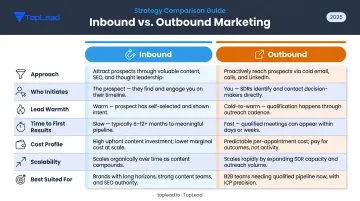
These are tendencies, not hard rules. Paid search (PPC) can compress inbound timelines significantly. Account-Based Marketing (ABM) executed with precision can produce warm outbound leads that convert at rates comparable to inbound. What drives results is how closely the channel matches how your specific buyers research, evaluate, and decide — not which column they fall into on a comparison chart.
What Is Inbound Lead Generation?
Inbound lead generation attracts potential buyers to your brand by creating content they're already searching for: blog posts, eBooks, webinars, SEO-optimized pages. Prospects come to you when they're ready to learn, rather than being contacted cold.
Core Inbound Tactics
- Content marketing (blogs, whitepapers, case studies) — builds authority and captures early-funnel research traffic
- SEO — drives compounding organic traffic over time as content ranks
- Social media engagement — builds brand awareness and community around your expertise
- Paid search (PPC) — accelerates visibility for high-intent keywords, often before organic rankings take hold
- Lead nurturing via email — moves self-selected prospects through the funnel after they've engaged with content
Each tactic targets a different stage of the buyer journey. The payoff is compounding — once these layers work together, inbound can generate pipeline continuously without incremental spend on every lead.
Why Inbound Works for B2B
The business case for inbound is strong — CMI's 2025 B2B Content Marketing research found that 74% of B2B marketers reported content marketing generated demand or leads in the prior 12 months. The same study found case studies effective for 53% of respondents, and webinars for 51%.
Key advantages:
- Compounding returns — a well-ranked article or resource keeps generating leads for years without additional spend
- Higher initial intent — prospects who find you through search or content are already problem-aware
- Brand authority — consistent content builds credibility in crowded markets before a prospect ever talks to your team
Where Inbound Falls Short
- SEO typically takes 3–6 months before showing measurable results, and pipeline volume often lags even further
- Content production requires consistent investment — CMI found 45% of B2B marketers still lack a scalable content creation model
- You have limited control over which accounts engage — your content attracts whoever searches for it, not necessarily your ICP
These limitations don't disqualify inbound — they define where it thrives. Inbound fits best in companies with longer sales cycles (SaaS, professional services, financial advisory) where buyers spend significant time researching before making contact.
Demand Gen Report data shows 80% of B2B buyers initiate first contact only once they're about 70% through their buying journey. That means inbound content needs to be present long before your sales team enters the picture.
What Is Outbound Lead Generation?
Outbound lead generation is a proactive strategy where your team identifies target prospects and initiates contact directly, rather than waiting for them to find you. Done well, it puts your message in front of the right decision-maker at the right time, regardless of whether they're actively researching your category.
Core Outbound Tactics
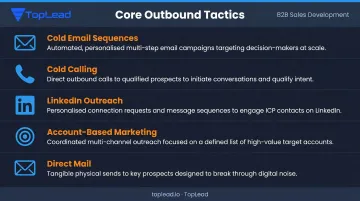
- Cold email sequences: personalized, multi-touch campaigns to targeted prospect lists
- Cold calling: direct phone outreach, most effective when paired with prior email touches
- LinkedIn outreach: connection requests, direct messages, and content engagement
- Account-Based Marketing (ABM): coordinated multi-channel outreach focused on specific named accounts
- Direct mail: high-impact physical outreach used selectively for high-value accounts
Modern outbound is not mass-blast messaging. RAIN Group's prospecting research — covering 489 sellers, 488 B2B buyers, and $4.2B in purchases across 25 industries — found that top performers generated 2.7x more conversions and 1.8x more quality outcomes than average reps. The differentiator was targeted, value-led prospecting, not volume.
Why Outbound Works for B2B
- Generates qualified meetings within weeks, compared to months for inbound
- Gives you direct control over which industries, job titles, company sizes, and geographies you reach
- Lets you dial outreach volume up or down based on current pipeline needs
Where Outbound Gets Complicated
Outbound carries real execution risk. Building an internal SDR function isn't fast or cheap:
- Bridge Group's 2024 data on U.S.-based SDR teams shows SDR ramp time averages 3 months (±2 weeks), plus ~25–30 days to fill an open seat
- Historical SDR attrition runs 40–50% — meaning a 10-person team at 50% attrition can miss annual production by 11%
- Fully loaded SDR costs go well beyond base salary ($45,000–$60,000/year) — add benefits, tooling, data, management time, and training
Generic outreach compounds these problems. Gartner found 73% of B2B buyers actively avoid suppliers that send irrelevant outreach. Precision matters.
Outbound fits best when you're entering a new market, launching a product, targeting a narrow ICP (RIAs, insurance brokers, CFOs at mid-market manufacturers), or carrying near-term revenue targets that inbound's timeline can't support.
For US teams without the infrastructure to build and retain an internal SDR function, outsourcing removes ramp time and eliminates the overhead of recruiting, training, and backfilling reps. TopLead's pay-per-appointment model, for instance, delivers sales-ready meetings directly to client calendars — with a reschedule or replacement guarantee and no long-term contract — giving B2B teams predictable appointment flow without the internal build.
Inbound vs. Outbound: Which Should You Choose?
There's no universal answer here. The right choice depends on four factors most B2B leaders don't assess honestly enough.
Decision Factors to Evaluate
- Pipeline urgency — do you need meetings in 30 days or 9 months?
- Buyer research behavior — do your buyers self-research extensively online, or do they rely on referrals and direct outreach?
- ICP specificity — is your target audience broad and searchable, or narrow and hard to reach organically?
- Internal capabilities — do you have content resources and SEO infrastructure, or SDR talent and outreach tooling?
Choose Inbound If:
- Your buyers are active online researchers who evaluate vendors long before making contact
- You're building long-term brand equity and can commit to a 6–12 month content ramp
- You have the team and tools to produce consistent content and manage lead nurturing at scale
- Quarterly pipeline targets are less urgent than 12-month growth goals
Choose Outbound If:
- You need pipeline within weeks, not months
- You're targeting a narrow, definable ICP where organic reach is limited
- You're entering a new vertical or launching a new product without an established content presence
- You want direct control over which accounts you're pursuing and at what volume
A Note on ROI Expectations
Inbound has a lower long-term cost per lead, but the returns take time to materialize — and that lag has real opportunity cost. Outbound typically carries a higher short-term CPL but can deliver faster ROI for companies with defined ICPs and shorter sales cycles.
Avoid precise CPL benchmarks from generic sources — they vary widely by vertical, campaign quality, and execution. Research current industry norms for your specific market before committing budget to either channel.
The Hybrid Approach: Why Most High-Performing B2B Companies Use Both
Inbound and outbound work best together, not in isolation.
Inbound builds awareness and captures self-qualified prospects already in research mode. Outbound targets specific accounts that may never find you through content, no matter how strong your SEO is. Together, they cover both the passive and active segments of your addressable market.
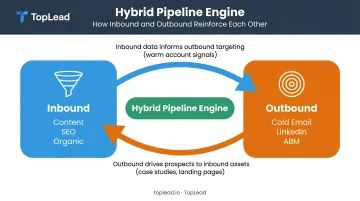
In practice, the two reinforce each other:
- Outbound can drive prospects to inbound assets — sending a case study or landing page as part of an outreach sequence adds credibility before the meeting
- Inbound data can inform outbound targeting — content engagement and website visits signal which accounts are already warm, making them higher-priority outbound targets
McKinsey's B2B Pulse 2024 found that market leaders continue to invest in omnichannel sales — not because it's fashionable, but because buyers move across channels unpredictably.
A prospect might discover you through a blog post, go cold for three months, then respond to a direct LinkedIn message. Covering both motions means you're present at more of those touchpoints — which is where deals actually close.
Conclusion
Neither inbound nor outbound is the right default. Inbound wins on long-term CPL and buyer trust. Outbound wins on speed, precision, and control. What matters is making a deliberate choice based on your growth stage, ICP behavior, pipeline urgency, and available resources.
If your priority is faster, more predictable B2B pipeline — especially with a narrow ICP or a near-term revenue target — an outbound-first or hybrid model is worth a serious look. And if building an internal SDR function isn't realistic right now, partnering with a specialized agency can cut your ramp time from months to weeks while removing the execution and retention risk that comes with in-house teams. TopLead's pay-per-appointment model — no long-term contracts, decision-maker-verified meetings, and a reschedule/replacement guarantee — is built specifically for that scenario.
Frequently Asked Questions
What is inbound lead generation?
Inbound lead generation attracts potential buyers through valuable content, SEO, and organic channels — so prospects come to you when they're ready, rather than being contacted cold. It works best for buyers who self-research extensively before engaging a vendor.
What is outbound lead generation?
Outbound lead generation is a proactive strategy where your team identifies and contacts target prospects directly (cold email, phone, LinkedIn, or ABM) rather than waiting for them to find you. It prioritizes speed and ICP precision over passive reach.
Which is better: inbound or outbound?
Neither is inherently better. Inbound builds long-term trust and typically yields a lower cost per lead over time. Outbound generates pipeline faster and allows precise account targeting. Most high-performing B2B companies run both in some combination.
What are the main differences between inbound and outbound?
Inbound is slower to ramp but produces self-selected, higher-intent leads. Outbound moves faster but requires quality data, skilled execution, and tolerance for a higher short-term cost per lead.
Can you run inbound and outbound at the same time?
Yes — and it's widely accepted as best practice. They reinforce each other most effectively when both teams work from a shared ICP and consistent messaging — inbound nurturing the audience outbound is actively targeting.
How do I know which strategy is right for my business?
Evaluate your pipeline urgency, buyer research habits, team capacity, and budget. Companies with a narrow ICP and near-term revenue goals tend to see faster returns from a focused outbound program or an outsourced appointment-setting partner.