Outbound cold calling keeps re-emerging as one of the most reliable answers to this problem, and yet it's one of the most dismissed tactics in the B2B playbook. The skepticism is understandable. Most people have experienced bad cold calls — generic pitches, wrong timing, zero relevance. But that's an execution problem, not a channel problem.
This article breaks down what outbound cold calling actually is, why it still works for B2B growth, and the specific advantages that make it worth building into your sales strategy as a permanent fixture rather than a last resort.
Key Takeaways
- Outbound cold calling is proactive, seller-initiated outreach to prospects who haven't engaged yet — the goal is to qualify and open a sales conversation
- Unlike inbound, it gives businesses direct control over pipeline volume and who enters the funnel
- Key advantages: direct decision-maker access, real-time market feedback, and scalable pipeline growth
- Ignoring outbound creates a reactive pipeline — competitors who do call will reach your prospects first
- Cold calling delivers results when treated as a system, not a one-time effort
What Is Outbound Cold Calling?
Outbound cold calling is when a sales representative phones a prospect who has had no prior contact with the company. No form fill, no ad click, no prior inquiry. The rep initiates the conversation, with the immediate goal of sparking interest, qualifying fit, and advancing the prospect toward a sales meeting.
Salesforce defines outbound sales as the process in which a seller initiates contact with a potential customer, typically through cold calling or emailing — and that seller-initiated distinction is what matters most.
Outbound vs. Inbound: Why the Distinction Matters
In inbound sales, the prospect raises their hand first. They fill out a form, click an ad, download a resource. The lead arrives warmed. In outbound cold calling, the sales team decides who to contact and when — which fundamentally changes how pipeline is built.
Inbound pipeline is determined by traffic, algorithms, and content performance. Outbound pipeline is determined by decisions your team makes: who to target, how many calls to make, which industries to prioritize.
That distinction shapes everything — inbound pipeline is something you attract; outbound pipeline is something you construct.
Cold Calling Within a Broader Outbound Strategy
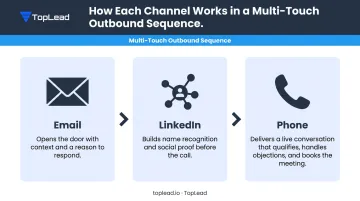
Cold calling rarely works in isolation. Most effective outbound programs combine phone, email, and LinkedIn across a structured sequence of touchpoints — typically six to eight before a prospect converts. Within that sequence, the phone call plays a role no other channel fills: a direct, real-time human conversation that can qualify interest, address objections, and book meetings in a single exchange.
Each channel in that sequence serves a distinct purpose:
- Email opens the door with context and a clear reason to respond
- LinkedIn builds name recognition and social proof before the call
- Phone delivers what the other two can't — a live conversation that qualifies, handles objections, and books the meeting on the spot
Key Advantages of Outbound Cold Calling
Each advantage here maps directly to outcomes B2B sales leaders track: pipeline volume, lead quality, sales cycle length, and conversion rate.
Direct Access to Decision-Makers
Cold calling is one of the few channels that lets a sales rep bypass marketing noise and speak directly with the person who holds buying authority — and do it quickly.
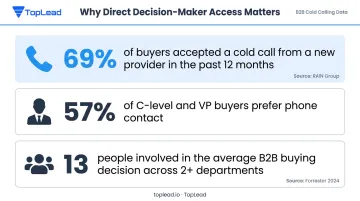
According to RAIN Group's sales prospecting research, 69% of buyers accepted phone calls from new providers in the prior 12 months, and 57% of C-level and VP buyers prefer phone contact. That's not a small opening — it's a substantial one.
Why does this matter operationally?
- Speed to meaningful conversation: Getting to the right decision-maker from the first touchpoint compresses the sales cycle. Fewer rounds of gatekeeping means faster qualification and faster close.
- Real-time rapport: Tone, empathy, and immediate responses allow reps to adjust their pitch in the moment — something email can't replicate.
- Buying committee complexity: Forrester's 2024 State of Business Buying reports that an average of 13 people are involved in a B2B buying decision, with 89% of purchases spanning two or more departments. Getting to the right person early — before a competitor does — is decisive.
This advantage is particularly acute in financial services, insurance, SaaS, and healthcare, where buying committees are large and time-to-first-meaningful-conversation directly impacts deal outcomes. TopLead's campaigns in these sectors specifically target roles with verified purchasing authority — HR directors, CFOs, controllers, agency principals — rather than booking meetings with whoever happens to answer.
KPIs impacted: Decision-maker connection rate, appointment booking rate, lead quality score, average sales cycle duration.
Real-Time Feedback That Sharpens Messaging and Strategy
Every call generates intelligence that no web analytics dashboard can match. Objections raised, questions asked, language used by prospects — this is live market data, available in real time, at no additional cost.
Sales teams that capture and act on call feedback can refine messaging within days. Teams that rely only on email open rates and digital behavioral data wait weeks or quarters to see patterns.
The cumulative benefit matters here. Call feedback doesn't just improve future calls — it sharpens email sequences, LinkedIn messaging, and targeting criteria across the entire outbound program. One well-run call campaign can elevate the performance of every other channel running alongside it.
This advantage is most critical during three specific moments:
- Entering a new market — call feedback reveals what resonates before significant budget is committed
- Launching a new product — live objections surface positioning gaps faster than any survey
- Competitive repositioning — real-time objection intelligence shows exactly where competitors are winning and why
TopLead's campaigns include structured feedback loops where call outcomes, objection patterns, and disqualification reasons inform ongoing campaign optimization. The first month focuses on launch and learning; subsequent months build on what's working.
KPIs impacted: Lead conversion rate, message-to-meeting rate, objection frequency trends, time-to-pipeline-improvement after messaging changes.
Scalable, Predictable Pipeline Growth
Outbound cold calling is one of the few lead generation methods that scales in direct proportion to business need. When built on a consistent, process-driven foundation, it creates a predictable output: a known number of calls produces a known number of conversations, which produces a known number of appointments.
Referrals and SEO don't offer that kind of linearity. Paid ads come close, but their costs rise with competition and their results depend on algorithms your team doesn't control.
What predictable pipeline actually means:
- Sales leadership can forecast revenue and set growth targets with real data
- Capacity planning becomes possible — headcount, onboarding, and infrastructure decisions follow pipeline clarity
- The program scales to fit the business: a boutique firm targeting four qualified appointments per month runs the same structured process as an enterprise targeting fifty
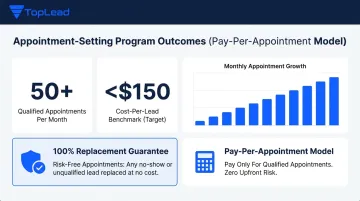
TopLead's standard programs guarantee a minimum of 4–6 qualified appointments per month at an average cost per lead of $300–$350, with a replacement guarantee covering any no-shows or cancellations. That cost-per-outcome structure ties investment directly to results rather than activity volume.
When scalability matters most: During geographic expansion, vertical entry, or any moment when inbound pipeline slows and the team needs a proactive mechanism to maintain deal flow.
KPIs impacted: Monthly qualified leads, pipeline coverage ratio, cost per qualified lead, appointment booking rate, revenue forecast accuracy.
What Happens When Outbound Cold Calling Is Missing
B2B businesses that rely exclusively on inbound or passive outreach face a set of structural consequences that compound over time:
- Pipeline volume is controlled by website traffic and ad performance, not intentional prospecting. Revenue forecasting becomes guesswork.
- Decision-makers get reached by competitors first. Forrester research shows the majority of B2B buyers have a shortlist of preferred vendors before they even start a formal purchase process. Passive sellers rarely make that list.
- Without live call feedback, teams can't identify objections or messaging gaps until patterns surface in passive data — often weeks or months later, at higher cost.
- Content, paid media, and referrals each have their own timelines and ceilings. None of them put your team in direct control of who enters the funnel or how quickly.
The practical result: your pipeline reflects what the market chooses to show you, not what your team actively pursues. Competitors running outbound programs fill that gap.
How to Get the Most Value from Outbound Cold Calling
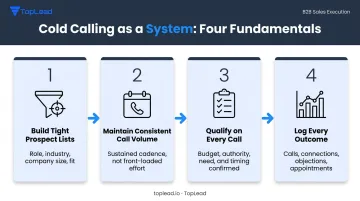
Cold calling produces results when treated as a system, not a task. That means:
- Build prospect lists tight enough to guide every call — defined by role, industry, company size, and fit
- Maintain call volume and frequency consistently across the campaign, not just in the first two weeks
- Confirm budget, authority, need, and timing on every call before booking any appointment
- Log every outcome: calls made, connections reached, objections raised, appointments booked
Weekly or biweekly reviews of call data separate programs that compound over time from those that plateau after the first month. Without structured review, effort accumulates but insight doesn't.
For American B2B companies that lack in-house SDR capacity, building a cold calling program from scratch carries real overhead: hiring, training, tooling, and ramp time. TopLead operates as a virtual SDR team, handling prospecting, multi-channel outreach, and appointment setting with verified decision-makers under a pay-per-appointment model. In over 15 years, the company has set more than 25,000 appointments — built on the same fundamentals covered here: ICP precision, consistent cadence, and qualification that protects close rates.
Conclusion
Outbound cold calling works because it puts businesses in direct control of their pipeline. The proactive nature of the channel, direct access to decision-makers, and a real-time feedback loop are structural advantages passive channels simply cannot replicate. Applied consistently, those advantages compound.
Each campaign cycle produces better targeting, more refined messaging, and higher-quality appointments. The program gets sharper over time, not stale.
For B2B companies serious about predictable growth, cold calling is a foundational sales channel — one that builds a pipeline you own, not one you're renting from an algorithm. Companies like TopLead have arranged over 25,000 qualified appointments across industries by applying exactly this approach: structured outreach, decision-maker verification, and campaigns that improve with every cycle.
Frequently Asked Questions
What is the role of outbound cold calling?
Outbound cold calling lets businesses initiate conversations with decision-makers, qualify prospects, and build pipeline without waiting for inbound leads. It gives sales teams direct control over how fast and consistently the funnel grows.
What are outbound cold calls?
Outbound cold calls are calls initiated by a salesperson to prospects who have not previously expressed interest in the product or service. The purpose is to introduce the company, assess fit, and advance the prospect toward a scheduled sales conversation.
Is cold calling illegal in the USA?
B2B cold calling is generally legal in the U.S. under FTC and Telemarketing Sales Rule provisions, which exempt most business-to-business solicitation calls from Do Not Call requirements. However, businesses must still comply with TCPA restrictions on autodialer use, state-level regulations, and internal DNC procedures — the exemption is not blanket.
What are the three C's of cold calling?
The three C's are: Clarity (communicate your purpose and value concisely), Confidence (speak with assurance to build trust), and Consistency (maintain persistence and follow-through across every call and touchpoint).
How does outbound cold calling differ from inbound sales?
In inbound sales, the prospect initiates contact. In outbound cold calling, the sales team initiates outreach, giving businesses direct control over pipeline volume and targeting. That control requires structured execution — but it means growth stops depending on whether a prospect happens to find you first.
What industries benefit most from outbound cold calling?
Outbound cold calling works best in B2B industries with high-value contracts and longer sales cycles — financial services, insurance, SaaS, professional services, healthcare, and manufacturing. These sectors rely on direct decision-maker access that cold calling is built to deliver.