The pricing landscape doesn't help. Lead generation services range from a few hundred dollars per lead to thousands per month in retainers, and two services priced identically can deliver wildly different results depending on what "lead" actually means to the provider.
This guide breaks down the real cost ranges, the pricing models behind them, what drives prices up or down, and how to build a budget that makes sense for your deal size and growth targets.
Key Takeaways
- Cost range: Lead generation services run $50–$150/lead at the entry level, $150–$300 for managed outreach, and $300–$500+ for verified, sales-ready appointments
- Monthly retainers: Typically $2,000–$10,000+/month for managed outbound programs
- What raises prices: Target complexity, qualification depth, multi-channel outreach, and decision-maker verification
- At $20,000+ average deal size, paying $300–$350 per confirmed appointment beats cheap, unqualified contacts that stall your pipeline
How Much Do Lead Generation Services Cost?
Lead generation services don't have a single price — costs depend on the pricing model, service scope, and what "lead" actually means in the contract. Misunderstanding this upfront leads to underbudgeting, buying the wrong tier, or getting blindsided by hidden setup fees.
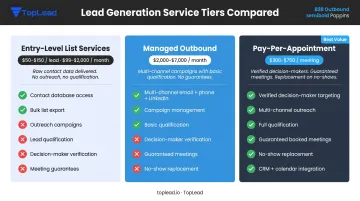
Entry-Level: List-Based Services ($50–$150/lead or $99–$2,000/month)
These services deliver raw contact data — names, emails, job titles, company size — filtered by firmographic criteria you specify. Tools like UpLead start at $99/month for 170 credits.
The deliverable is a contact list — no outreach, no qualification, no appointment setting, and no verification that these contacts are decision-makers open to a conversation.
This tier makes sense if you have an in-house SDR team ready to activate the data. If you don't, the list rarely converts on its own. Teams that need outreach execution should look at the next tier.
Mid-Range: Managed Outbound ($2,000–$7,000/month)
At this level, an agency or SDR team runs outbound campaigns on your behalf — typically cold email plus one additional channel — and hands off leads that meet basic criteria. Appointment-setting retainers in 2026 typically run $2,000–$10,000+/month, depending on volume and service depth.
What's typically included vs. excluded at this tier:
- Included: Multi-channel outreach (email + one additional channel), lead hand-off at basic qualification criteria
- Excluded: Appointment guarantees, decision-maker verification, no-show protection, or any assurance that delivered leads will attend scheduled meetings
High-End: Pay-Per-Appointment ($300–$750/qualified meeting)
Performance-based appointment-setting services charge $300–$750 per qualified meeting, with the client paying only when a confirmed meeting with a verified decision-maker lands on their calendar.
TopLead's U.S.-based SDR teams deliver a pay-per-appointment model that sits at the lower end of this range — $300–$350 per appointment — with a guaranteed minimum of 4–6 qualified appointments per month, decision-maker verification, CRM integration, and a reschedule/replacement guarantee for no-shows. No setup fees, no long-term contracts.
What These Prices Never Include
Regardless of tier, nearly all lead gen service pricing excludes:
- Ad spend (if paid channels are involved)
- CRM platform licenses
- Content creation or copywriting beyond initial messaging
- Internal sales team time for follow-up
- Email sequencing or LinkedIn outreach tool subscriptions (LinkedIn Sales Navigator Core runs $119.99/month per license)
Lead Generation Pricing Models: Which One Are You Buying?
One of the most common reasons businesses overbuy or underspend on lead gen is comparing prices without realizing they're comparing fundamentally different service models. A "$200 lead" from a retainer model and a "$200 lead" from a pay-per-appointment model are not the same thing.
Here's how each model actually works — and what you're really paying for.
Retainer / Monthly Fee Model
You pay a flat monthly fee for an agency or SDR team to run campaigns on your behalf. Quality B2B lead generation agencies typically charge $3,000–$25,000/month, with many single-SDR-equivalent programs around $5,000/month.
You pay regardless of results. If the campaigns underperform, you still write the check — which makes provider quality the single most important variable in this model.
Pay-Per-Lead (PPL) Model
You pay a fixed fee for each lead that meets pre-defined criteria — industry, company size, title, and revenue band. Predictable cost per lead is the main draw. The problem is that "lead" definitions vary widely across providers — a contact that checks firmographic boxes isn't the same as someone ready for a sales conversation.
Pay-Per-Appointment (PPA) Model
You only pay when a qualified meeting with a verified decision-maker is booked and confirmed. This is the highest-accountability model because the provider earns nothing until they deliver a real conversation.
TopLead operates exclusively on this model for American B2B companies — no retainers, no setup fees, no hidden charges. At $300–$350 per appointment with a replacement guarantee on no-shows, the financial risk sits with the provider, not the client. Payment options include per-appointment or structured monthly, quarterly, or annual plans depending on volume.
Hybrid / Performance + Retainer Model
A smaller base retainer covers baseline campaign costs, with per-appointment fees layered on top. Larger campaigns can justify this structure, but it reintroduces the "paying for activity rather than outcomes" risk that makes pure retainer models frustrating.
Key Factors That Affect Lead Generation Service Costs
Beyond the pricing model, several variables shift costs up or down. Understanding them helps you budget realistically rather than reacting to price differences that look arbitrary from the outside.
Industry and Target Audience Complexity
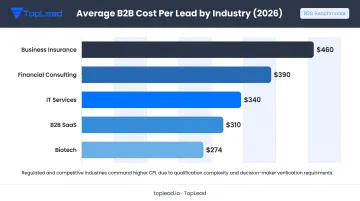
Targeting regulated or highly competitive industries — financial services, healthcare, enterprise SaaS — requires more research, more outreach touches, and more rigorous qualification before any meeting is booked.
Industry-specific CPL benchmarks reflect this: B2B SaaS averages around $310/lead, Business Insurance around $460, and Biotech around $274, according to 2026 data from First Page Sage. Targeting broad SMB audiences costs less per contact — though lower costs typically come with lower close rates.
Lead Qualification Standards and Verification Depth
Surface-level qualification — industry match, company size, job title filter — costs less but delivers contacts with no verified buying intent, authority, or timeline.
Deep qualification costs more per lead but produces a materially better conversation. Before any appointment reaches the client's calendar, TopLead's US-based process confirms:
- Decision-maker authority (business owners, CFOs, HR directors, or department heads)
- Buying readiness and active pain point
- Budget awareness and role fit
Channel Mix and Outreach Scope
Single-channel outreach (cold email only) costs less than true multi-channel campaigns. Multi-channel outreach across email, LinkedIn, and phone improves reach and response rates but requires more coordination, more tooling, and more skilled SDRs — all of which show up in the price.
TopLead includes all three channels in the base service. Email, LinkedIn, and phone outreach are standard — no à la carte fees for adding channels mid-campaign.
Campaign Duration and Volume Commitments
Short one-month campaigns cost more per lead than sustained 3–6 month programs because the ramp-up work — ICP development, list building, messaging refinement, A/B testing — gets amortized across more appointments over time. TopLead's typical campaign lifecycle runs 3–6 months, with campaigns growing more effective as response patterns emerge and outreach sequences are refined.
Cheap vs. Premium Lead Gen Services — What's the Real Difference?
The gap between a $500/month service and a $5,000/month service isn't just price. It's qualification depth, delivery accountability, and what happens when a lead doesn't show up or isn't a fit.
Quality and Conversion Rates
Lower-cost services typically deliver higher volumes of unverified contacts that require heavy internal filtering before your sales team can act on them. Premium services deliver fewer leads but at much higher intent, so your sales team spends time on conversations rather than triage.
Belkins describes $2,000/month as "light automation with minimal strategy and possibly no appointment setting," while $3,000–$4,000/month begins to include more experienced SDR support. That quality gap doesn't stay contained to a single lead. It compounds across every opportunity in the pipeline.
Accountability and Guarantees
Budget services rarely offer any recourse when a lead is wrong, unresponsive, or a clear mismatch. The lead was delivered per spec, technically. What happens next isn't their problem.
Premium services build accountability into the structure. TopLead, for example, structures accountability into every engagement:
- Replacement guarantee covers no-shows and cancellations at no extra cost
- CRM integration lets clients track each appointment from delivery to close
- Weekly reporting covers outreach activity, qualification criteria, and campaign performance
- Decision-maker verification is confirmed before any appointment lands on the calendar
The Real Math on "Cheap" Leads
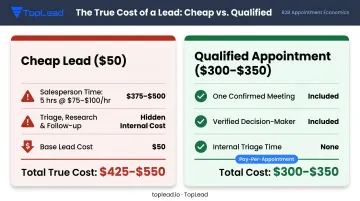
If a salesperson's fully loaded cost runs $75–$100/hour and they spend five hours chasing an unqualified contact — emails, calls, prep, a meeting that goes nowhere — that "free" or $50 lead just cost $375–$500 in internal time alone.
At that point, paying $300–$350 for a pre-qualified appointment with a verified decision-maker isn't a premium. It's a better allocation of the same budget.
How to Set the Right Lead Gen Budget for Your Business
Your lead generation budget should be driven by deal size, sales cycle length, and growth targets — not gut feel. Work backwards from revenue goals to find a number that's defensible.
Step 1: Anchor on deal value and close rate
If your average deal value is $50,000 and your close rate on qualified appointments is 20%, each appointment carries $10,000 in expected revenue. Paying $300–$500 per appointment is a strong return on that math.
Run the same calculation for your numbers: average deal value × close rate = expected revenue per appointment. Divide your customer acquisition cost target by expected revenue per appointment to find the max you should pay per appointment.
Step 2: Set a realistic monthly appointment target
Determine how many qualified conversations your sales team needs monthly to hit pipeline goals. Multiply by your cost per appointment to arrive at a monthly budget range.
Factor in that campaigns typically need 3–6 months to ramp. Month-one results won't reflect steady-state performance.
TopLead's guaranteed minimum of 4–6 appointments/month at $300–$350 each means a baseline monthly investment of roughly $1,200–$2,100 for qualified, verified meetings. For businesses with $20,000+ average deal values, that math works at almost any reasonable close rate.
Step 3: Avoid the most common budgeting mistakes
- Don't budget only for the lead gen service and forget CRM licenses, internal follow-up capacity, and ramp-up months
- Don't judge month-one performance against steady-state expectations
- Don't choose a provider based on lowest price without evaluating qualification standards and guarantee structure
Gartner's 2025 CMO Spend Survey found overall marketing budgets flat at 7.7% of company revenue. If you're calibrating total marketing spend, that benchmark gives you a reasonable upper boundary before carving out your lead gen allocation.
Frequently Asked Questions
What is the 5-minute rule for leads?
Research from InsideSales found that conversion rates jump by more than 8x when follow-up happens within the first five minutes of a lead showing interest. Pre-qualified appointments sidestep this problem entirely — the prospect has already confirmed the meeting and is expecting the conversation.
What are the 4 laws of lead generation?
The four core principles are targeting (right audience), messaging (relevant to their pain), channel (where they actually engage), and follow-up (consistent touches over time). Campaigns that shortcut any of these waste budget, no matter how much is spent on the service.
What are the three types of leads?
Cold leads have no prior awareness of your offer. Warm leads have shown some interest — an email open, a content download. Hot leads (sales-ready appointments) are qualified, engaged, and actively ready for a buying conversation. Pricing reflects this hierarchy — sales-ready appointments cost the most but convert at significantly higher rates than cold contacts.
How much should a B2B company budget for lead generation services in 2026?
Most B2B companies allocate lead generation within an overall marketing budget of roughly 7–10% of target revenue, per Gartner benchmarks. For appointment-setting services specifically, a realistic starting budget is $1,200–$5,000/month depending on industry, volume needs, and deal size.
What is a good cost per lead for B2B in 2026?
A "good" CPL depends heavily on deal value. For high-value B2B sales with $20,000+ deals, a CPL of $300–$500 for a qualified appointment represents strong ROI. For lower deal values, the math requires cheaper lead acquisition costs — typically through managed outbound retainers or in-house SDR teams.
Is pay-per-appointment lead generation worth the cost compared to retainer models?
For most B2B companies with longer sales cycles and high deal values, yes. Pay-per-appointment models eliminate the risk of paying for activity that produces no results — you only invest when a qualified meeting is confirmed, which is well-suited for businesses where conversation quality matters more than raw contact volume.