This article lays out 8 specific diagnostic signs that your current approach to outbound prospecting is costing you pipeline and revenue. If several of these resonate, outsourcing your prospecting function may be the most practical path forward.
This is written for B2B sales leaders, founders, and revenue-focused executives at companies where outbound is either stalling or underdelivering relative to growth goals.
Key Takeaways
- Thin or unpredictable pipeline signals inconsistent prospecting activity at the top of funnel
- AEs doing prospecting work is a costly misallocation of your highest-value sales resources
- Declining response and meeting rates point to messaging and sequencing that a specialized team would rebuild
- SDR turnover and ramp costs often make in-house attempts more expensive than outsourcing
- When your team gets busy, prospecting stops — and pipeline dries up 60–90 days later
What Is Outbound Prospecting Outsourcing (And What It Isn't)
Outsourcing outbound prospecting means delegating top-of-funnel activities — target list building, multi-channel outreach, prospect qualification, and appointment setting — to a specialized external team, while your internal salespeople focus on closing.
This is not handing over your entire sales function. The distinction matters:
- What it is: A virtual SDR team that owns prospecting from contact identification through booked meeting, with its own tooling, outreach infrastructure, and qualification process
- What it isn't: A list vendor, a call center, or a general "sales outsourcing" arrangement that blurs responsibility for closing
A true outsourced partner integrates with your CRM, reports on pipeline metrics transparently, and delivers confirmed meetings with verified U.S. decision-makers already on your calendar.
Signs 1–4: Your Pipeline and Performance Are Warning You
Sign 1: Your Pipeline Is Chronically Thin or Wildly Unpredictable
The clearest symptom: pipeline reviews reveal either too few opportunities in early stages, or sharp month-to-month fluctuations with no reliable pattern. Both trace back to inconsistent outbound activity.
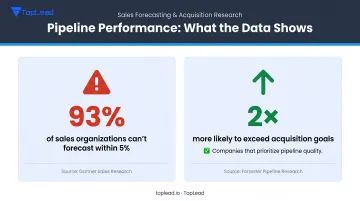
According to Clari, 93% of sales organizations cannot forecast revenue within 5% — even in the final two weeks of a quarter. While forecasting has many inputs, the root cause is typically pipeline visibility problems that start at the top of funnel.
Gartner reinforces the point: organizations that prioritize sales pipeline quality are 2x more likely to exceed customer acquisition expectations. Consistent prospecting isn't a nice-to-have; it's the engine behind predictable revenue.
If your pipeline feels more like weather than a managed system, the missing ingredient is usually a dedicated, consistent outbound function.
Sign 2: Your Account Executives Are Spending Time Prospecting Instead of Closing
When there's no dedicated outbound function, AEs fill the gap. The problem: you're paying closer-level compensation for SDR-level work.
Salesforce's 2024 State of Sales report, based on 5,500 sales professionals across 27 countries, found that sales reps spend 70% of their time on non-selling activities. The same report found that 84% of reps missed quota last year.
Those two numbers aren't unrelated. Every hour an AE spends sourcing contacts, writing cold emails, or chasing unresponsive prospects is an hour not spent moving qualified deals forward.
The fix isn't asking AEs to manage their time better. It's removing prospecting from their job description entirely and giving it to people whose only job is to fill the calendar with qualified meetings.
Sign 3: Your Outbound Response Rates and Meeting Conversion Rates Are Dropping
Declining metrics are a direct signal. If cold email reply rates, call-to-connect ratios, or discovery-call conversions have deteriorated over consecutive quarters, the cause is usually one of three things:
Declining metrics are a direct signal. If cold email reply rates, call-to-connect ratios, or discovery-call conversions have deteriorated over consecutive quarters, the cause is usually one of three things:
- Outdated tactics — outreach approaches that no longer match how buyers respond
- Weak messaging — copy that isn't tailored to ICP pain points or decision-maker context
- Single-channel dependency — relying on email or calls alone instead of coordinated sequences
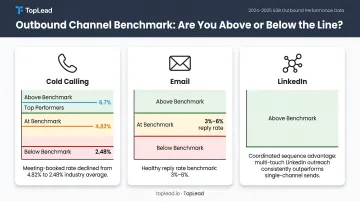
The data backs this up. Cognism's 2025 cold calling report, based on 41,936 connected calls, found that cold-call meeting-booked success fell from 4.82% in 2024 to 2.48% in 2025. The same report notes that high-performing, data-driven teams still reach 6.7% — roughly 3x the average — suggesting the gap is execution, not market conditions.
Meanwhile, Salesloft's 2024 cadence benchmarks put healthy email reply rates at 3%–6% and call connection rates at 12%–15%. If your team is meaningfully below these, the issue is almost certainly fixable with better outreach strategy.
A specialized outbound partner brings tested, multi-channel frameworks with ICP-specific messaging. A specialized outbound partner brings tested, multi-channel frameworks with ICP-specific messaging — coordinated email, phone, and LinkedIn sequences designed to reach buyers where they actually respond. That's a different discipline than the high-volume, untargeted outreach most internal teams default to when prospecting isn't their primary focus.
Sign 4: You're Missing Revenue Targets and Can't Trace It Back to a Clear Cause
This is the pipeline attribution gap. Leadership sees a revenue shortfall but doesn't have clean data linking the miss to specific failures in outbound volume, lead quality, or conversion rates — usually because prospecting is tracked informally or not at all.
The consequence: you can't fix what you can't measure. Without structured reporting, every pipeline conversation becomes a guessing game about whether the problem is messaging, targeting, volume, or timing.
An outsourced outbound partner solves this by design. TopLead, for example, integrates directly with CRM platforms (Salesforce, HubSpot, Pipedrive) and delivers weekly reporting that covers:
- Contacted vs. replied metrics by channel
- Booked meetings, show rates, and no-show patterns
- Lead qualification status and decision-maker verification
- Channel-level attribution across email, phone, and LinkedIn
When leadership can see exactly what's being touched and what's converting at each stage, the root cause of a revenue shortfall becomes clear — and addressable.
Signs 5–8: Your Team and Resources Are Being Stretched Too Thin
Sign 5: Every Attempt to Build an In-House SDR Function Has Underperformed
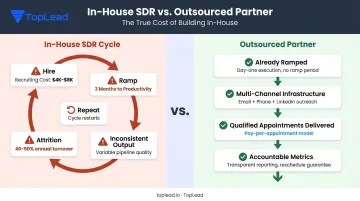
The pattern is familiar: you hire an SDR, ramp time runs 3–6 months, performance is inconsistent, and the rep leaves before the investment pays off.
Bridge Group's 2024 attrition research puts normal SDR attrition planning at 40%–50%, with clients at 25%–35% attrition considered "outstanding." Average ramp time has held at 3 months ± 2 weeks since 2007. That means a new SDR hire typically takes 3 months to become productive — and nearly half leave within the year.
Each failed hire represents sunk cost across salary, benefits, recruiting, onboarding, and tooling, with minimal pipeline to show for it. The cycle then repeats.
Outsourcing eliminates this treadmill. You get a US-based SDR team that's already ramped, running a multi-channel outreach infrastructure, and accountable for delivering qualified appointments — not raw potential that takes quarters to develop.
Sign 6: Your Outreach Is Reactive and Single-Channel, Not Systematic
Most internal teams default to one channel — usually sporadic email blasts or occasional calls — with no defined sequence and no consistent follow-up. Outreach happens when someone has bandwidth, not on a tested cadence.
Effective B2B outbound today requires:
- Email, phone, and LinkedIn working in coordinated sequence — not independently
- Messaging tailored to specific ICP pain points, not generic value propositions
- Defined cadences with set follow-up intervals and escalation logic
- Adaptive triggers that shift the sequence based on how prospects engage
This requires dedicated time, purpose-built tooling, and people whose only job is outreach. Most internal teams — especially those where prospecting is one responsibility among many — don't have any of these in place consistently.
Sign 7: Prospecting Activity Stops the Moment Your Team Gets Busy
This is the feast-and-famine cycle. When a big deal enters late stage, inbound picks up, or quarter-end pressure builds, prospecting gets deprioritized. Your team is busy — legitimately — and outbound is the activity that can wait. Except it can't.
Pipeline gaps appear weeks later, precisely when the earlier prospecting activity would have converted. By then, the urgency has passed and the cycle starts over.
The root cause is structural. If prospecting isn't someone's dedicated, exclusive responsibility, it will always lose to more immediate priorities. An outsourced function is protected from that competition by design — the team shows up every day to do one thing, regardless of what's happening inside your sales org.
Sign 8: You're Entering a New Market, Vertical, or ICP Segment
When a company targets a new industry, geography, or buyer persona it hasn't previously served, the internal team typically lacks the right contact databases, market-specific messaging, and established credibility signals for that audience. Building those from scratch takes time — and the first several months of internal prospecting into a new market are often expensive trial and error.
An outsourced partner with cross-vertical experience compresses that curve significantly. TopLead has run appointment-setting campaigns across financial services, insurance, SaaS, manufacturing, healthcare, professional services, and PEO — with clients including Edward Jones, Insperity, Aflac, and Wells Fargo Advisors.
When a consulting firm used TopLead to target regional banks, they generated 6+ qualified leads per month within a 3-month campaign lifecycle. The targeting and messaging frameworks already existed — there was no trial-and-error phase to absorb.
What to Look for When Outsourcing Outbound Prospecting
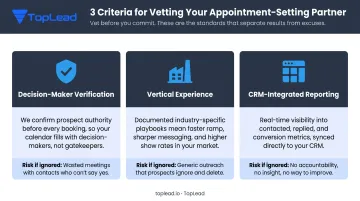
Not all outsourced outbound partners operate the same way. Before selecting one, evaluate them on three criteria:
Decision-maker verification — Confirm the partner validates prospect authority before booking, not just interest. You want meetings with HR directors, CFOs, and business owners who can close a deal — not gatekeepers or exploratory contacts who can't.
Vertical experience — Generic firms apply the same playbook to every client. Look for a partner with documented experience in your industry, where messaging frameworks, contact databases, and qualification criteria already exist.
CRM-integrated reporting — You should see contacted vs. replied metrics, conversion rates by channel, and appointment outcomes in real time, not in a monthly summary email. If reporting isn't in your CRM, accountability suffers.
Beyond these three criteria, pay attention to contract structure. Avoid partners that lock you into long-term agreements without performance accountability. A pay-per-qualified-appointment model aligns incentives correctly — the partner only succeeds when you receive confirmed meetings with real decision-makers.
TopLead is built around this structure. Clients pay per appointment, with a reschedule or replacement guarantee for no-shows and no long-term contract required. Outreach runs across email, LinkedIn, and phone, with CRM integration and weekly reporting. Cost per appointment averages $300–$350, with a guaranteed minimum of 4–6 qualified leads per month.
Frequently Asked Questions
When should a company consider outsourcing outbound prospecting?
The clearest triggers are unpredictable pipeline, internal teams too stretched to prospect consistently, or repeated failures to build a cost-effective in-house SDR function. If any of the 8 signs above describe your current situation, outsourcing is worth evaluating now rather than after another quarter of missed targets.
What is the difference between outsourced lead generation and outsourced outbound prospecting?
Lead generation often means delivering contact lists or inbound traffic. Outsourced outbound prospecting means an external team actively reaches out, qualifies prospects on your behalf, and books confirmed meetings with verified decision-makers onto your calendar — a fundamentally different scope of work.
How much does outsourced outbound prospecting typically cost?
Pricing models vary between monthly retainers and pay-per-appointment structures. For context, TopLead's model averages $300–$350 per qualified appointment. Compare this against the fully-loaded cost of hiring and ramping an in-house SDR — including salary, benefits, recruiting, tools, and management time across a 3–6 month ramp period before they're consistently productive.
Can outsourced outbound prospecting work for small or early-stage B2B companies?
Yes, provided three things are in place: a clearly defined ICP, a differentiated value proposition that SDRs can communicate credibly, and a closing process ready to handle the meetings being booked. Outsourcing fills the top of funnel — the internal team still needs to convert the appointments generated.
How long does it take to see results from outsourced outbound prospecting?
Most campaigns require an initial period for messaging refinement, list building, and cadence testing before appointment volume becomes consistent. Plan for a 3–6 month campaign lifecycle to evaluate true performance — the first 30 days rarely reflect what the program can deliver at full stride.
What should a company prepare before outsourcing outbound prospecting?
Start with a clearly defined ICP (firmographics, decision-maker roles, and qualifying criteria), a specific and differentiated value proposition, and a sales process ready to act on booked appointments. The sharper these inputs are upfront, the faster the outsourced team can build targeting and messaging that converts.