Introduction
Here's the trap most B2B sales teams fall into: you need an ICP to target the right companies, but you need real prospect data to build a solid ICP. Neither can exist without the other — so where do you start?
Most teams respond by either waiting too long to begin outreach (paralysis) or blasting every company that vaguely fits (chaos). According to Salesforce, 73% of B2B buyers actively avoid sellers who send irrelevant outreach — meaning the chaos approach fails and damages your brand in the process.
The better answer is to treat early outreach as structured research, not premature selling. This guide walks through a five-step approach to identify and engage target companies before your ICP is formally defined. You'll use problem hypotheses, proxy data, trigger events, and segmented experiments — the same signals that eventually become your ICP.
TL;DR
- Your solution's problem statement points to initial target segments — start there, not a blank slate
- Use firmographic filters and trigger events to narrow your list even without historical customer data
- Run 2–3 micro-segment outreach batches simultaneously as parallel experiments
- Measure response rate, conversation quality, and pain alignment per segment, not just conversion
- When consistent patterns appear across multiple independent conversations, that's your signal to formalize
How to Find Target Companies Without a Clear ICP
Step 1: Start with a Problem Hypothesis, Not a Customer Profile
When you have no ICP, your solution's core problem statement is your starting point. Ask one question: what kind of company feels this pain most acutely and most frequently?
Work through that question systematically:
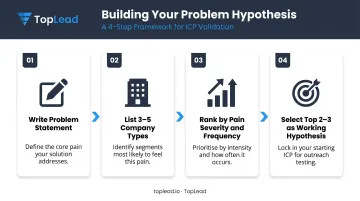
- Write your problem statement in one or two sentences — specific, not generic
- List 3–5 company types that would experience this problem regularly
- Rank them by severity of pain and frequency of occurrence
- Pick the top 2–3 as your working hypothesis
From there, translate your hypothesis into initial firmographic filters: industry vertical, company size (headcount range), revenue band, and geography. These aren't your final ICP — they're a working proxy to test against.
TopLead's onboarding process for clients without a defined ICP starts exactly here. Rather than accepting vague targets like "any SaaS company," their ICP development process pushes toward specificity: "software companies between 20 and 150 employees experiencing rapid growth and using a specific tool stack." That precision determines whether your early outreach generates useful signal.
Step 2: Use Proxy Data Sources to Generate Your First Target List
With your firmographic hypothesis in hand, you can pull an initial list — even without having closed a single deal.
Primary database sources to use:
- LinkedIn Sales Navigator — best for filtering by role, seniority, geography, and industry; particularly effective for building targeted lists
- Apollo — offers 65+ search filters combining firmographic, technographic, and intent signals across 230M+ contacts
- ZoomInfo — covers technographic data across 30,000+ technologies, useful for tech-stack-based targeting
- Crunchbase — surfaces funding events, hiring signals, and company updates that flag buying activity
Key filters to prioritize: industry, employee count, geography, target role seniority, and — where available — technology stack.
Supplement database searches with secondary signals: job board postings that reveal relevant buying activity, niche event attendee lists in your vertical, and industry association directories. A company hiring a Head of RevOps tells you something about its growth stage. A company listing five open benefits coordinator roles signals an HR initiative in motion.
TopLead's own list-building combines multiple data sources — LinkedIn Sales Navigator, ZoomInfo, Apollo, and Lusha — with intent-based platforms like Bombora and 6sense, layering sources and validating data to address accuracy gaps that come with any single database.
Step 3: Apply Trigger Event Filters to Prioritize the List
A list of 500 companies is too large to treat equally. Trigger events help you decide who to contact first by identifying companies in a state of change — and therefore more likely to be evaluating new solutions.
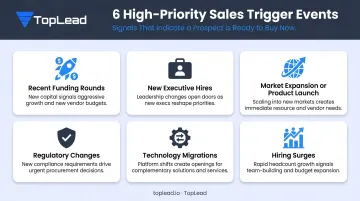
High-priority trigger events to monitor:
- Recent funding rounds (budget exists, growth mandate is active)
- New executive hires, especially in relevant functions (new leaders change vendors)
- Expansion into new markets or product launches (operational pressure increases)
- Regulatory changes or compliance deadlines (urgency is externally imposed)
- Technology migrations or system sunsets (replacement cycles create openings)
- Hiring surges in roles related to your solution's use case
Crunchbase tracks funding events, M&A, product launches, and employment signals — all useful for flagging companies showing active buying signals. Platforms like Bombora identify statistically significant spikes in research activity at the account level, surfacing companies actively investigating solutions like yours.
TopLead monitors funding rounds, mergers, hiring surges, and tech stack changes as part of its standard list prioritization process — and uses intent-based platforms to surface prospects when they're actively in research mode rather than dormant.
Step 4: Run Small, Segmented Outreach Batches as ICP Experiments
Don't blast your entire list at once. Break it into 2–3 micro-segments based on distinct company profiles — industry vertical A vs. vertical B, or company size tier 1 vs. tier 2. Run separate outreach sequences to each.
This functions as a parallel A/B test. Each segment gets different messaging tailored to its assumed pain profile, and you track results independently.
Metrics to track per segment:
- Response rate (are they replying at all?)
- Conversation quality (are responses substantive or dismissive?)
- Stated pain alignment (do they describe the problem you solve without prompting?)
- Speed of engagement (how quickly did they respond?)
- Self-qualification behavior (are they asking deeper questions about your solution?)
The last two are particularly telling. A prospect who responds within hours and immediately asks about integration or implementation is sending a different signal than one who replies "thanks, not now" three days later. Same outcome on paper, very different implications for prioritization.
Step 5: Capture and Analyze Patterns from Early Conversations
Early outreach generates qualitative data — but it evaporates fast if you don't capture it. Most teams skip this step entirely and wonder why their ICP never sharpens.
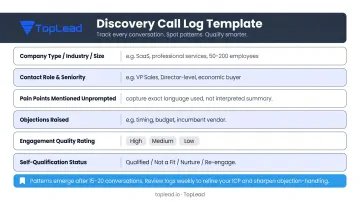
Build a simple tracking system — a CRM custom field or spreadsheet column — and log the following after each conversation:
- Company type, industry, size
- Role and seniority of the contact
- Pain points mentioned unprompted
- Objections raised
- Engagement quality rating (high / medium / low)
- Whether they self-qualified
After 15–20 substantive conversations across your segments, patterns will begin to emerge: a particular vertical responding consistently, a specific role asking sharp questions, a company size range where the pain is most acute. These patterns are the raw material of your future ICP.
TopLead's post-meeting reporting captures pain points, decision-maker roles, stakeholder involvement, and stated buying motivation — feeding this data back into campaign refinement throughout the engagement cycle. Early conversations are treated as structured research, not just conversion attempts.
Key Signals That Tell You a Company Could Be a Fit
When you lack a defined ICP, stack multiple observable signals to build confidence in a prospect rather than relying on any single data point.
Firmographic alignment creates the baseline filter. Even a hypothesis-based ICP should specify at least 2–3 firm constraints — industry, size, geography — to avoid targeting everyone and learning nothing.
Behavioral signals during outreach routinely outweigh static firmographic data:
- Substantive replies that describe their situation unprompted
- Follow-up questions about implementation, pricing, or timelines
- Fast response speed (within 24–48 hours of cold outreach)
- Willingness to book a call without extensive convincing
Trigger events as intent proxies include funding rounds, leadership changes, and rapid hiring — plus compliance deadlines, competitor product launches, and technology sunsets that create urgency without your involvement.
Tech stack indicators reveal buying readiness. Tools like ZoomInfo and Apollo provide technographic filters that identify companies using specific tools — which can signal relevant pain points or indicate readiness to evaluate adjacent solutions. Job postings work similarly: a company hiring a data engineer while using legacy reporting tools is probably in pain.
Prospect enthusiasm is qualitative but easy to read once you know what to look for. Genuine interest shows up as specific questions, unprompted context-sharing, and a prospect who moves the conversation forward on their own. Polite deflection tends to be vague and non-committal. The difference is usually obvious within the first exchange.
What You Need Before You Start Prospecting Without an ICP
Three things are non-negotiable before you begin:
Write a one- or two-sentence problem statement that articulates exactly what your solution fixes. Every targeting decision flows through this — without it, outreach is aimless no matter how long the list.
Get access to at least one prospecting platform that filters by industry, headcount, and geography — LinkedIn Sales Navigator, Apollo, or ZoomInfo all work. The only requirement is a filtered, testable list, not a perfect one.
Set up a lightweight tracking system — even a single CRM field or spreadsheet column recording which company type, role, and message resonated. Without it, patterns from early conversations disappear and that early signal is lost for good.
Common Mistakes When Targeting Without an ICP
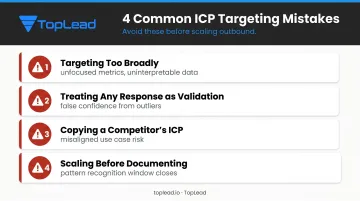
Four patterns consistently derail early targeting efforts — and each one is more avoidable than it looks.
Targeting too broadly, too long. "Any B2B company with 50+ employees" is the most common failure mode. When the list is too wide, metrics become uninterpretable — you can't tell whether a low response rate means your message is wrong or your target is wrong. Either could be true, and you have no way to separate them.
Treating any positive response as validation. One enthusiastic prospect or a fast-closed deal can create false confidence in a company type. You need a pattern across multiple independent data points. Early outliers — especially referrals or warm introductions — can seriously distort the picture. Stage 2 Capital's research notes that early-stage companies often have very small customer counts, which means evidence quality matters more than sample size.
Copying a competitor's stated ICP. Competitors may be targeting suboptimally, serving a different use case, or have resources to serve a broader market that you don't. Reverse-engineering their targeting is a shortcut that usually backfires.
Scaling before documenting what's working. This is the costliest mistake. TopLead has seen clients come in after being burned by previous vendors who spammed 1,000+ leads per week with no segmentation — causing domain reputation damage and zero booked meetings. Once you move from 20 conversations to 200, your ability to spot what's actually working drops and the window for clean pattern recognition closes. Scale only after you've captured what's driving results.
When to Formalize Your ICP Based on What You're Learning
You're ready to formalize when you see a consistent pattern across multiple independent data points — not one. Specific signals include:
- A particular company type responding at notably higher response rates than others
- Multiple deals progressed or closed with companies that share the same 3–4 attributes
- Recurring objections from a specific account type that consistently signal poor fit
- A clear "type" emerging in your conversation notes without you forcing it
Formalization means you have enough directional evidence to stop testing everything equally and start concentrating effort where patterns are already emerging.
That said, reaching pattern-clarity faster requires volume — more conversations across more segments than most teams can generate on their own. TopLead's multi-channel campaigns run email, LinkedIn, and phone outreach simultaneously across targeted segments, compressing what typically takes 6+ months of solo prospecting into a structured 3–6 month cycle built specifically to surface ICP signals.
The results from that compression are measurable. One HR software client tripled their appointment rates within 60 days after tightening their ICP and launching coordinated multi-channel cadences. A fintech client saw SQL quality rise 45% within three months after a similar targeting refinement.
A formalized ICP document should include:
- 3–5 firmographic attributes (industry, size, revenue, geography, growth stage)
- 1–2 behavioral or trigger-based qualifiers (hiring signals, funding stage, tech stack)
- A clear decision-maker role
- An Anti-ICP note identifying company types that showed consistent signs of poor fit during testing
Frequently Asked Questions
What is the difference between a target customer and an ICP?
A target customer refers to any company or person you're trying to sell to. An ICP is a data-informed, specific profile of the type of company most likely to buy, retain, and derive high value from your solution. The ICP is the refined, high-conversion subset of your broader target market.
How do you figure out your ICP?
Analyze your best existing customers for shared firmographic and behavioral traits. With no customers yet, build a hypothesis around your solution's core problem, run structured outreach to 2–3 micro-segments, and track which company types respond and advance fastest.
How do you target your ICP once it's defined?
Use firmographic filters in prospecting tools to build a list, layer trigger event monitoring to prioritize companies in an active buying moment, and run personalized multi-channel outreach — email, LinkedIn, and phone — to decision-makers at those companies.
What if I have no existing customers to analyze?
Build a short filtered list in Apollo or LinkedIn Sales Navigator around the company type most likely to feel your solution's core pain. Run a small outbound test — 20 to 30 companies — and treat every response (or non-response) as data that sharpens your targeting.
How many companies should I target when I don't have a defined ICP?
Test 2–3 distinct micro-segments simultaneously, with roughly 20–50 companies per segment. That volume generates enough signal to spot real differences in response rates. Go broader and the data gets noisy; go narrower and you can't draw reliable conclusions.