Introduction
Most marketing agencies are genuinely good at growing their clients' businesses. Growing their own? That's where things get uncomfortable.
Referrals dry up. Inbound content takes months to gain traction. And the agency that was fully booked six months ago is suddenly scrambling to replace two clients who churned. This feast-or-famine cycle is common — and it's preventable.
Outbound calling is one of the most direct ways to break it. When done with a defined target list, a clear ICP, and a consistent cadence, phone outreach gives agencies proactive control over who enters their pipeline — and when.
According to RAIN Group's sales prospecting research, 82% of buyers accept meetings with sellers who reach out proactively. Most agencies already know outbound works — they just haven't built the system to do it consistently.
This article covers five concrete, operational benefits of outbound calling for marketing agencies — along with what agencies typically lose by ignoring it.
TL;DR
- Outbound calling shifts agency growth from reactive to proactive, targeting specific prospects on your schedule
- Phone calls surface budget, authority, and timeline faster than email threads ever will
- Every call produces market intelligence that sharpens positioning and messaging
- Early phone touchpoints build client trust faster, improving retention before the contract is even signed
- Structured calling generates trackable data that enables real optimization, not just gut-feel adjustments
What Is Outbound Calling for Marketing Agencies
Outbound calling, in this context, means proactive phone outreach to prospective clients, lapsed relationships, or warm contacts who haven't responded to other touchpoints. It's distinct from answering inbound inquiries — the agency initiates.
For most marketing agencies, outbound calling serves one primary purpose: business development. That means booking discovery calls, qualifying leads, and reaching decision-makers (CMOs, marketing directors, business owners) before a competitor does.
Outbound calling works alongside email and LinkedIn — not instead of them. Each channel plays a different role:
- Email and LinkedIn build awareness and credibility over time
- Phone calls deliver real-time conversation, immediate qualification, and the kind of rapport that takes weeks to build through written exchanges alone
5 Outbound Calling Benefits for Marketing Agencies
Most marketing agencies are skilled at generating demand for their clients. Generating demand for themselves is a different problem. Between client delivery, reactive inbound inquiries, and referral-dependent pipelines, outbound prospecting is often the first thing that gets cut when the team gets busy — and the first thing missed when revenue stalls.
Outbound calling is one of the few channels that puts agencies back in control. A single well-run calling program can shorten the gap between prospect identification and booked meeting from weeks to days.
The five benefits below each connect to a specific outcome agency owners and business development leads track every quarter: pipeline consistency, deal velocity, market insight, client retention, and campaign optimization.
Benefit 1: Predictable Control Over New Client Acquisition
Most agencies don't have a business development problem. They have a consistency problem. Referrals arrive on someone else's schedule. Inbound content is subject to algorithm shifts. Neither gives the agency meaningful control over when qualified prospects enter the pipeline.
Outbound calling gives agencies that control back. With a defined ICP and a contact list built around specific industries, company sizes, or decision-maker roles, agencies can generate qualified first conversations on their own timeline — regardless of what's happening with inbound.
What Structured Outreach Actually Produces
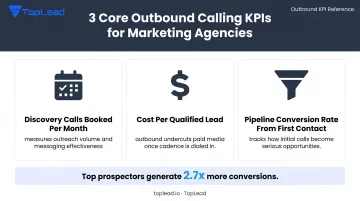
RAIN Group's research found that top-performing prospectors generate 2.7x more conversions and 1.8x more quality outcomes — including meetings and demos — compared to average prospectors. The differentiator isn't the channel. It's the structure.
Key KPIs this affects:
- Discovery calls booked per month — a direct measure of outreach volume and messaging effectiveness
- Cost per qualified lead — outbound typically undercuts paid media once a cadence is dialed in
- Pipeline conversion rate from first contact — tracks how well initial calls translate to serious opportunities
This benefit is especially relevant when an agency is entering a new vertical (like e-commerce or hospitality) or recovering from a slow referral stretch. Outbound calling is the only acquisition lever with a direct relationship between input and output.
Those KPI gains are amplified when phone is part of a multichannel cadence. Industry data shows email-only response rates run 77% lower than sequences that include phone calls — which is why outbound programs that combine both channels consistently outperform single-channel efforts.
Benefit 2: Faster Lead Qualification and Shorter Sales Cycles
A well-run five-minute phone call surfaces what ten email exchanges cannot.
In a single conversation, a skilled caller can determine:
- Whether the prospect has an active need right now
- Who else is involved in the decision
- What the approximate budget expectation is
- Whether a competitor is already in consideration
The Cost of Skipping This Step
Salesforce data shows sales reps spend only 28% of their week actually selling — and HubSpot reports that 50% of sales time is wasted on unproductive prospecting. For marketing agencies, unqualified leads are expensive: they consume proposal time, creative resources, and meeting hours before the mismatch becomes obvious.
Phone qualification solves this by moving disqualification earlier. A prospect who doesn't have the budget or the authority gets removed from the pipeline in week one, not week six.
For agencies offering high-ticket retainers or complex engagements, the stakes are higher. Misaligned expectations at the pitch stage cause scope disputes, underpriced work, and early churn — problems a ten-minute qualification call catches before they cost you a client.
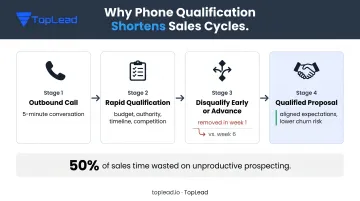
The KPIs that shift most noticeably: average sales cycle length, proposal-to-close rate, and time spent per unqualified lead.
Benefit 3: Real-Time Market Intelligence
Most agencies overlook this benefit. It also happens to be the one that builds compounding value with every call made.
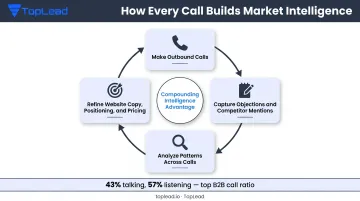
Every outbound call, whether it converts or not, generates usable data:
- Which objections come up most frequently
- What competitors prospects are already evaluating
- How prospects describe their problems in their own language
- Where your current positioning lands flat
Turning Call Conversations Into Strategy
Gong's analysis of over 25,000 B2B sales conversations found a consistent pattern: successful calls involve 43% talking and 57% listening. Top reps ask more, assume less, and walk away with intelligence that shapes how they position on the next call.
For marketing agencies, this has direct downstream value. The objections you hear repeatedly on calls should influence your website copy, your case study selection, and your pricing structure. In crowded verticals where every competitor claims the same outcomes, the agency that knows how buyers actually talk about their problems holds a real positioning edge.
As Forrester noted in 2023, direct engagement between sellers and buyers has dropped 12% since 2019. Agencies that still make direct calls are gathering competitive intelligence their counterparts simply aren't collecting.
That intelligence feeds back into measurable outcomes — specifically messaging conversion rate over time, ICP accuracy, and competitive displacement rate.
Benefit 4: Stronger Early Client Relationships and Higher Retention
A phone call early in a relationship establishes something email cannot: tone. How someone speaks, how they handle an unexpected question, whether they actually listen — those signals communicate professionalism and build trust faster than any polished proposal deck.
Salesforce's research backs this up directly: 88% of buyers say they only purchase from salespeople they regard as trusted advisors. That status gets built through real conversations, not proposal documents.
Why Pre-Sale Conversations Reduce Churn
Agencies that use outbound calling during the pre-sale and early onboarding phases tend to see fewer "this isn't what we expected" conversations two months in. When a client has spoken with someone at the agency before signing — actually spoken, not just exchanged emails — they come into the engagement with clearer expectations and a warmer baseline of trust.
For agencies where one unhappy client can ripple through a referral network, early trust-building has an outsized effect on long-term retention.
KPIs impacted by this approach:
- Client retention rate
- Average client lifetime value
- Time-to-signed-contract from first meeting
Benefit 5: Measurable Outreach with Built-In Optimization Loops
Referrals are great until they aren't — and when they slow down, there's no data to diagnose the problem. Outbound calling operates differently. Every call produces a data point.
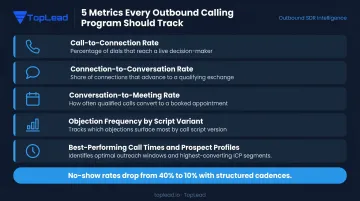
A structured calling program tracks:
- Call-to-connection rate
- Connection-to-conversation rate
- Conversation-to-meeting rate
- Objection frequency by script variant
- Best-performing call times and prospect profiles
The Compounding Advantage of Tracked Data
Salesloft's cadence research shows structured meeting-confirmation cadences alone can reduce no-show rates from 40% to just 10%. That's a measurable pipeline gain driven entirely by a process change, not headcount.
The same principle applies to opener testing, call timing, and targeting criteria. Agencies that log call outcomes consistently can identify, within a few months, which prospect types convert and which burn time — then cut the latter from future lists entirely.
Referral pipelines offer no equivalent feedback loop. There's nothing to test, no timing to optimize, and no prospect profile to refine. Outbound calling gives agencies a system that improves with each campaign cycle — compounding returns without adding headcount.
KPIs impacted: call-to-meeting conversion rate, contact list quality, cost per booked call.
What Happens When Outbound Calling Is Ignored
Agencies that rely exclusively on inbound and referrals face three compounding problems:
- When inbound dips — algorithm change, slow content period, a competitor's new campaign — there's no lever to pull. Revenue becomes hostage to factors outside the agency's control.
- Without qualification calls, leads arrive shaped by their own assumptions — and scope disputes, underpriced engagements, and early churn follow.
- Agencies can't sharpen their positioning if they don't know what's not landing — and email non-responses don't explain anything.
How to Get the Most Value from Outbound Calling
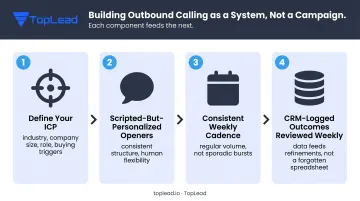
Outbound calling works when it operates as a system, not a campaign. That means:
- A defined ICP — specific industry, company size, decision-maker role, buying triggers
- Scripted-but-personalized openers — enough structure to be consistent, enough flexibility to be human
- A consistent cadence — not sporadic bursts, but regular weekly call volume
- CRM-logged outcomes reviewed weekly — so data feeds back into refinements, not into a spreadsheet nobody reads
For agencies that want to scale outbound without overloading internal teams, working with a specialized B2B lead generation partner is often the faster path. TopLead's pay-per-appointment model is built for agencies that need qualified meetings without the overhead: clients only pay for calls that reach verified decision-makers, with 4–6 qualified leads per month guaranteed and a reschedule or replacement guarantee on no-shows.
With over 25,000 appointments arranged and average CPLs of $300–$350, the model ties every dollar spent to a specific, measurable result.
Optimization is ongoing. Call data should feed back into ICP refinement, messaging, and targeting every month — not just at campaign launch.
Conclusion
Outbound calling gives marketing agencies something most digital-first growth strategies don't: direct, controllable access to the specific prospects they actually want to work with.
The five benefits compound. Better call data sharpens targeting, which generates higher-quality conversations that close faster and retain longer. Each campaign cycle builds on the last — and that compounding effect is exactly what separates agencies running outbound consistently from those who treat it as a reactive fix. TopLead's clients see this play out firsthand: across more than 25,000 appointments arranged, the programs that deliver the strongest pipeline returns are the ones treated as a core growth function, not a short-term sprint.
Frequently Asked Questions
What are the benefits of outbound calling for marketing agencies?
Outbound calling helps agencies build a predictable pipeline, qualify leads faster, and gather real-time market intelligence — the five core benefits covered above. It also supports stronger early client relationships and provides measurable data for continuous outreach improvement.
Is outbound calling illegal?
Outbound calling is legal when it complies with applicable regulations. The FTC exempts most B2B calls from the Telemarketing Sales Rule, while B2B calls to business landlines carry fewer restrictions than B2C calls. That said, automated dialing to wireless numbers without prior consent triggers TCPA obligations — so compliance depends on your dialing technology, number type, and applicable state law.
Should marketing agencies outsource outbound calling or handle it in-house?
In-house calling offers more brand control but requires dedicated training, management, and ramp-up time, often 60–90 days before meaningful pipeline appears. Outsourcing to a specialist like TopLead provides immediate SDR expertise, scalable capacity, and typically a lower cost per qualified lead, with no long-term contract required.
How many outbound calls does it take to fill an agency's pipeline?
The Bridge Group's 2023 benchmark data from 365 B2B companies shows SDRs average 52 calls per day, with Salesloft benchmarking phone connection rates at 5–10% for high-volume outbound. From there, working backward from a target of 4–6 new client meetings per month gives you a realistic daily call volume to aim for.
How do you measure the success of an outbound calling campaign?
Track four core metrics: call-to-connection rate, connection-to-meeting rate, cost per qualified appointment, and downstream close rate from outbound-sourced leads. Reviewing these weekly — not monthly — is what separates optimizing campaigns from merely running them.
What's the difference between cold calling and warm calling for marketing agencies?
Cold calls target prospects with no prior relationship; warm calls follow up on prospects who've had a prior touchpoint, such as an email opened, content downloaded, or a LinkedIn interaction. Salesloft benchmarks warm "Hot Lead" conversion at 11.5–12.3%, compared to 5–10% for cold outbound. That gap makes multi-channel sequencing (email first, call second) the smarter approach.