Introduction
Running outbound without a dedicated SDR is a real capacity problem — not a strategy problem. Account executives, founders, and sales managers are expected to prospect, sequence, follow up, and close simultaneously. Something always slips, and it's usually pipeline.
According to Salesforce, sales reps spend just 28% of their week actually selling. The rest goes to research, data entry, sequencing, and admin — exactly the work a dedicated SDR would own. For lean teams, that math is brutal.
AI outreach tools have changed that calculus. The best platforms now handle list building, signal monitoring, personalized sequencing, and follow-up at a scale that previously required a full SDR function.
The problem is that most tools aren't built for lean teams. Many assume a RevOps resource to configure them, an annual contract budget, and a separate data subscription to feed them leads.
This guide is for teams who need pipeline results without that overhead. It covers the top AI outreach tools built for lean setups, the criteria that actually matter when evaluating them, and how to decide whether software or a managed service fits your situation.
TL;DR
- AI outreach tools automate top-of-funnel work, freeing AEs and founders to focus on closing
- The strongest tools consolidate data, personalization, and engagement in one workflow — not three separate subscriptions
- Signal-based outreach (job changes, intent data, funding events) consistently outperforms static email blasts
- Avoid annual lock-ins when piloting; quarterly commitments let you validate ROI before scaling
- If you'd rather skip the tools entirely, a managed outreach partner delivers the SDR function without the software overhead
Why Teams Without a Dedicated SDR Struggle with Outbound
The Capacity Conflict
Outbound prospecting and deal-closing compete for the same hours. When one person owns both, neither gets done well. Forrester reports that the average sales rep burns nearly two full days per week on admin work instead of selling — and that's with some support infrastructure. Without an SDR, the time drain is worse.
The result is a familiar pattern: AEs focus on closing the deals already in pipeline, prospecting stops, and four weeks later the pipeline looks empty. Then the cycle reverses. Feast-or-famine revenue becomes the default operating mode.
The Tool Sprawl Trap
Teams often try to solve this by stacking point tools — one platform for contact data, another for email sequences, a third for LinkedIn outreach. The goal is coverage, but the result is coordination overhead. Data falls out of sync between systems, contacts get sequenced twice, and the time spent managing integrations offsets the efficiency those tools were meant to provide.
This pattern shows up repeatedly among teams that have already experimented with disconnected stacks — volume doesn't translate into qualified pipeline.
The Personalization Paradox
Without an SDR to research each prospect, teams face an uncomfortable tradeoff:
- Send generic outreach → low reply rates, damaged sender reputation
- Research each prospect manually → unsustainable at any meaningful volume
This is the exact problem AI outreach tools are designed to solve. The best platforms automate the research layer — pulling in job change signals, company news, and intent data — so messaging can be specific without requiring manual hours per contact.
What to Look for in an AI Outreach Tool
Workflow Consolidation First
The right tool must cover the full prospecting-to-engagement cycle without requiring separate subscriptions. Look for these capabilities in a single platform:
- AI-powered prospect list building (no separate data provider required)
- Signal-based triggering (job changes, intent events, funding rounds)
- Multi-channel sequencing across email, LinkedIn, and phone
- AI-personalized messaging beyond basic merge fields
- Native CRM sync (not just a Zapier workaround)
- Built-in deliverability infrastructure (domain warmup, sending reputation management)
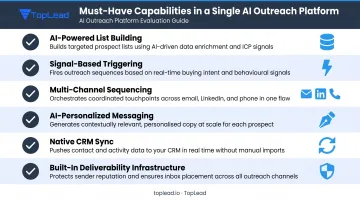
If onboarding the tool requires standing up three other subscriptions first, the consolidation benefit disappears before the first sequence runs.
Governance and Control Matter More Than You Think
Scaling AI output without human oversight creates deliverability problems that take weeks to undo. For teams without a RevOps resource, the controls below aren't optional — they're what keep outbound from becoming a liability:
- Approval flows that hold contacts for human review before they enter any sequence
- Daily or weekly volume caps that prevent send spikes from triggering spam filters
- Message review queues so AI-written copy stays accurate and on-brand
This is especially important for niche B2B products where a single poorly-worded email to the wrong contact can close a door permanently.
Pricing Model Considerations
| Model | Best For | Watch Out For |
|---|---|---|
| Per-user/month | Predictable small teams | Add-on costs for data, calling, deliverability |
| Per-message/credit | Variable send volume | Hard to forecast monthly costs |
| Flat platform fee | High-volume teams | Can be expensive for light users |
| Quarterly billing | First-time adopters testing AI outbound | Less discount than annual |
For a first pilot, start quarterly. If the tool isn't generating qualified pipeline within 90 days, no annual contract traps you into a second quarter of the same result.
Best AI Outreach Tools for Teams Without a Dedicated SDR
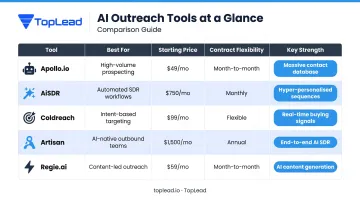
Each tool below was evaluated on workflow consolidation, pricing transparency, onboarding speed, personalization depth, and fit for small teams or founders running their own outbound.
Apollo.io
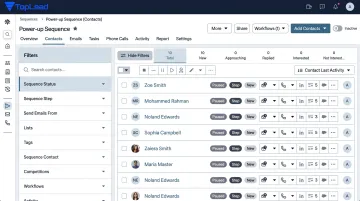
Apollo is an end-to-end GTM platform combining 230M+ contacts, AI research, multi-channel sequencing, and dialing in a single workspace. For SDR-less teams, the value is replacing multiple point tools with one login.
Two features drive most of the value for lean teams:
- Outbound Copilot automates prospect identification and adds contacts to sequences on a recurring cadence, with human-in-the-loop approval before anyone goes live
- AI Context Center auto-populates messaging based on your value proposition and ICP pain points, producing specific output rather than generic templates
| Criteria | Details |
|---|---|
| Best For | AEs and founders who want a unified platform for data, sequencing, and AI personalization without managing a multi-tool stack |
| Pricing | Free tier available; paid plans start at $49/user/month billed annually |
| Key Strength | All-in-one: contact database, AI research, multi-channel sequences, calling, and conversation intelligence in one workspace |
AiSDR
AiSDR is built specifically for SMBs that want to run outbound without annual enterprise contracts. Its AI SDR agent (Enigma) handles prospecting, outreach, follow-ups, and reply handling across email, LinkedIn, and phone.
The quarterly billing cycle is a genuine differentiator: lean teams can validate results before committing long-term. Setup completes in one day (assuming the email domain is ready and ICP details are provided), with a dedicated GTM engineer handling onboarding. The native two-way HubSpot integration makes it a strong fit for HubSpot-first teams.
| Criteria | Details |
|---|---|
| Best For | SMBs and startups testing AI outbound for the first time who need transparent pricing and can't commit to a 12-month contract |
| Pricing | Starts at $900/month for 1,200 AI messages/month, billed quarterly. Annual billing available at a 20% discount |
| Key Strength | Quarterly commitments, true autopilot reply handling, and one-day onboarding with a dedicated GTM engineer |
Coldreach
Coldreach monitors 97M+ accounts in real time across job postings, company news, LinkedIn activity, and SEC filings and only triggers outreach when a verified buying signal matches a custom intent definition you set.
The key differentiator for niche B2B teams: intent signals are defined in plain English. Instead of choosing from a generic library of triggers, you describe what "in-market" looks like for your specific product. Built-in deliverability infrastructure covers domain warmup, send pacing, and reputation monitoring — included rather than sold as an add-on.
Note: Coldreach pricing appears in conflict across official sources, ranging from $749/month to $899/month. Confirm current rates directly before committing.
| Criteria | Details |
|---|---|
| Best For | Founders and lean teams with a clearly defined ICP who want to reach prospects at the right moment rather than blasting static lists |
| Pricing | Self-serve plans start at approximately $749–$899/month; higher tiers are quote-based. Confirm current pricing before purchasing |
| Key Strength | Custom intent signals defined in plain English; research-first personalization before any message is sent |
Artisan (Ava)
Artisan's AI BDR agent Ava bundles a 300M+ verified B2B contact database directly into the platform. For teams that don't already pay for ZoomInfo, Apollo, or a separate data provider, that changes the cost math significantly.
Ava covers the full outbound cycle, with several capabilities worth noting for lean teams:
- Personalized email and LinkedIn sequences from lead sourcing through close
- Built-in deliverability suite covering warmup, placement testing, and spam avoidance
- Website visitor identification (person-level in the US, company-level globally)
Note: Official Artisan sources show self-serve pricing starting at $250/month and indicate Ava handles replies and books meetings autonomously — earlier claims of human handoff after first touch are not supported by current documentation.
| Criteria | Details |
|---|---|
| Best For | Teams without an existing data provider who need high-volume outbound across a broad ICP without paying for data separately |
| Pricing | Self-serve plans available from $250/month; higher tiers on annual billing. Confirm current pricing before purchasing |
| Key Strength | 300M+ contact database bundled in-platform, strong deliverability suite, and website visitor identification for retargeting |
Regie.ai
Regie.ai (RegieOne) takes a human-augmentation approach rather than full replacement, combining AI Auto-Pilot Agents that handle long-tail prospecting volume alongside human reps who manage warm conversations, all within a single workflow interface.
The platform includes a 220M+ contact database with mobile numbers, 100+ built-in intent signals, and an integrated AI Dialer with parallel dialing and real-time talking points. For teams transitioning from zero SDR function to a small hybrid model, Regie's architecture scales without requiring a platform change.
| Criteria | Details |
|---|---|
| Best For | Teams building their first sales function who want AI to handle prospecting volume while keeping humans in the loop for warm conversations |
| Pricing | AI SEP at $180/user/month; Force Multiplier Rep at $499/user/month; both on annual contracts |
| Key Strength | Single workflow for AI agents and human reps; 220M+ contacts with mobile numbers and 100+ intent signals included |
How We Chose These Tools
Evaluation Criteria
Every tool on this list was assessed against criteria specific to SDR-less teams:
- Workflow consolidation: Does it replace multiple point tools, or does it require a stack to function?
- Pricing transparency: Are costs published, or is everything quote-based?
- Contract flexibility: Is quarterly or month-to-month available, or only annual?
- Onboarding speed: Can a small team get live without a RevOps resource?
- Personalization quality: Does AI output go beyond first-name merge fields?
Common Mistakes When Choosing
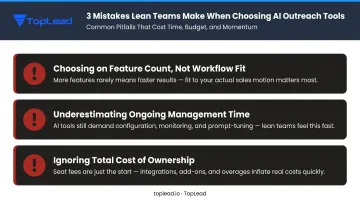
Three selection errors appear repeatedly among lean teams evaluating outreach tools:
- Choosing on feature count, not workflow fit — A platform with 40 features you'll use 4 of is not a good fit
- Underestimating ongoing management time — ICP definition, signal tuning, message quality review, and deliverability monitoring require real hours every week
- Ignoring total cost of ownership — The headline price often excludes required add-ons: data enrichment, dialer access, extra mailboxes, or onboarding fees
When a Managed Service Makes More Sense
Software tools deliver results when someone owns the strategy, signal configuration, message quality, and ongoing optimization. For teams without that bandwidth, a managed outreach partner typically delivers better ROI than self-serve software.
TopLead's pay-per-appointment model offers a direct alternative: rather than paying monthly for platform access and managing the tooling yourself, you pay only when a qualified, decision-maker-verified appointment lands on your calendar. With 25,000+ appointments delivered across financial services, SaaS, insurance, and professional services, and no long-term contracts required, run the total cost comparison against any self-serve platform before committing.
Conclusion
Choosing the right AI outreach tool comes down to three things: how much of the SDR workflow it covers, whether your team can configure it without RevOps support, and whether the pricing holds up once you factor in ramp time.
Prioritize:
- Consolidation over features — fewer tools, more coverage
- Signal quality over send volume — targeted beats blasted
- Proof of performance over marketing claims — G2 reviews and published case studies beat vendor demos
Even the best tools stall without a defined ICP and someone accountable for ongoing optimization. If your team lacks that bandwidth, self-serve software often produces inconsistent results — and the time cost of managing it erodes whatever efficiency the tool was supposed to create.
That's where a managed partner like TopLead becomes a stronger option. Their pay-per-appointment model delivers decision-maker-verified meetings directly to your calendar, with no long-term contract and campaigns typically live within 2–4 weeks of launch.
Frequently Asked Questions
What does SDR stand for in jobs?
SDR stands for Sales Development Representative — a role focused on outbound prospecting, lead qualification, and booking meetings for account executives. SDRs handle top-of-funnel activity; they don't close deals. That work falls to AEs or founders once a meeting is set.
How much does AI SDR cost?
Self-serve AI SDR platforms start around $750–$900/month at the entry level. Mid-market platforms with annual contracts typically run $2,000–$5,000/month when add-ons (data, dialer, extra mailboxes) are factored in. Always calculate total cost of ownership, not just the headline rate.
Can an AI outreach tool fully replace a dedicated SDR?
AI tools handle prospecting, list building, sequencing, and basic reply management well. They fall short on nuanced qualification judgment, discovery conversations, complex objection handling, and relationship-building with enterprise accounts. Most teams use AI for top-of-funnel volume and humans for warm conversations.
What is the biggest challenge of running outbound without an SDR?
The time-split problem. AEs and founders doing their own outbound must compete for attention between prospecting and closing, and one consistently suffers. AI tools reduce the research and sequencing burden significantly, though someone still needs to own ICP definition, signal configuration, and ongoing optimization.
How long does it take to see results from an AI outreach tool?
Most platforms need 2–4 weeks for domain warmup and sequence calibration before meaningful data is available. Realistic pipeline results typically show up within 6–12 weeks, depending on ICP clarity, message quality, and send volume. Expect a ramp period before drawing conclusions.
What is the difference between an AI outreach tool and a managed lead generation service?
AI outreach tools are software platforms requiring in-house setup, configuration, and ongoing management. A managed service like TopLead provides a done-for-you SDR function — handling strategy, multi-channel outreach, prospect qualification, and appointment setting — so the sales team only engages when a confirmed meeting is on the calendar.